
Financial Algebra: The Part Most Textbooks Skip
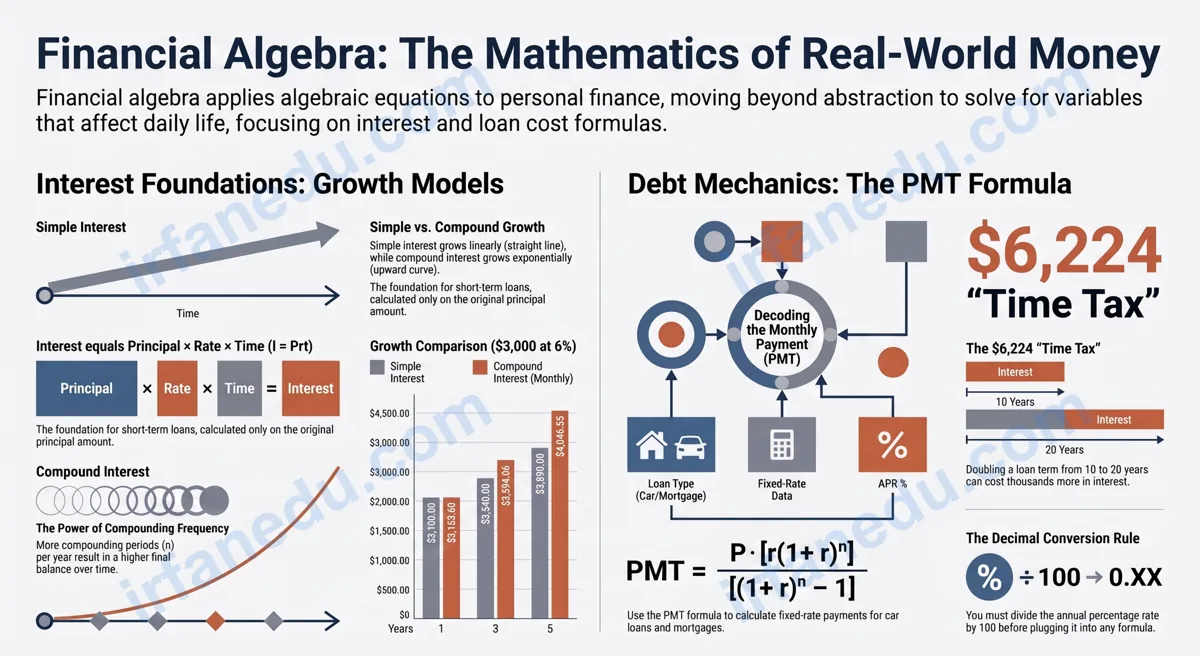
Here is the part most people miss about financial algebra: it is not a harder version of regular algebra. It is the same algebra you already know, applied to questions that actually affect your life — your student loan, your first credit card, your savings account. Once you see that connection, the formulas stop feeling abstract and start feeling urgent.
Financial algebra is taught in high school as a bridge course between Algebra 2 and real-world decision-making. But the concepts inside it — interest, amortization, exponential growth — show up on standardized tests, in college economics, and in every major financial decision you will ever make.
Financial algebra applies algebraic formulas and equations to personal finance problems. It covers simple interest (I = Prt), compound interest (A = P(1 + r/n)^nt), loan payment calculations, budgeting equations, and investment growth models. Students learn to solve for any variable in these formulas, interpret financial graphs, and make data-driven money decisions.
By the end of this guide, you will be able to:
- Calculate simple and compound interest from scratch
- Understand why compounding frequency changes your final balance
- Use the loan payment formula to decode any monthly payment
- Set up and solve a personal budget using linear equations
- Avoid the three formula errors that cost students the most points
Financial algebra is not a separate subject from algebra — it is algebra with a real-world price tag. Every formula here solves a problem you will face with actual money.
Financial algebra is the branch of math that applies algebraic formulas to real-world money situations — calculating simple and compound interest, loan payments, savings growth, and budgets. It uses variables like principal (P), rate (r), and time (t) to solve problems that directly affect your financial life, making abstract algebra immediately practical and testable.
- Simple interest: I = Prt — calculated on the original principal only.
- Compound interest: A = P(1 + r/n)^nt — grows faster because interest earns interest.
- More compounding periods per year = more money in a savings account, more cost in a loan.
- The loan payment formula (PMT) tells you exactly what you owe each month.
- Budget algebra uses linear equations to balance income and expenses.
- The most common student error: forgetting to convert the annual rate to a decimal before plugging into any formula.
Simple Interest: The Foundation Formula
Simple interest is calculated only on the original principal — it does not grow on itself. The formula is I = Prt, where I is interest earned, P is the principal, r is the annual rate as a decimal, and t is time in years.
This formula appears in short-term loans, savings bonds, and many standardized test problems. It is the starting point for everything else in financial algebra.
Problem: You deposit $2,000 in a savings account that pays 4% simple interest per year. How much interest do you earn in 3 years? What is your total balance?
Step 1 — Convert the rate: 4% = 0.04
Step 2 — Apply I = Prt: I = 2000 × 0.04 × 3 = $240
Step 3 — Total balance: A = P + I = 2000 + 240 = $2,240
You can also rearrange the formula to solve for any unknown. If you know the interest earned and want to find the rate, use r = I / (Pt). If you want to find time, use t = I / (Pr). This algebraic flexibility is exactly what financial algebra tests.
Always convert your percentage to a decimal before plugging in. Writing 4 instead of 0.04 gives you an answer 100 times too large. This single error accounts for the majority of wrong answers I see on financial algebra assessments.
In my experience teaching financial math, students who struggle with simple interest almost always have the same problem: they treat the formula as a thing to memorize rather than a sentence to read. I = Prt literally says “interest equals principal times rate times time.” Read it that way once, and you will never forget it.
Compound Interest: Where the Real Math Lives
Compound interest is calculated on both the principal and the accumulated interest — so your balance grows on itself. The formula is A = P(1 + r/n)nt, where A is the final amount, P is the principal, r is the annual rate as a decimal, n is the number of compounding periods per year, and t is time in years.
This is the formula that makes savings accounts powerful and credit card debt dangerous. The math is the same either way — only the context changes.
Problem: You invest $3,000 at 6% annual interest, compounded monthly, for 5 years. What is the final balance?
Given: P = 3000, r = 0.06, n = 12, t = 5
Step 1: r/n = 0.06/12 = 0.005
Step 2: nt = 12 × 5 = 60
Step 3: A = 3000 × (1.005)60
Step 4: (1.005)60 ≈ 1.3489
Step 5: A = 3000 × 1.3489 = $4,046.55
Interest earned = $4,046.55 − $3,000 = $1,046.55
Compare that to simple interest on the same deposit: I = 3000 × 0.06 × 5 = $900. Compounding earned you an extra $146.55 over five years — and that gap widens dramatically over longer periods.
  Compound Interest Growth: $3,000 at 6% Monthly Compounding

  Year 0  |====|  $3,000.00
  Year 1  |=======|  $3,183.60
  Year 2  |=========|  $3,381.35
  Year 3  |===========|  $3,594.06
  Year 4  |=============|  $3,822.90
  Year 5  |===============|  $4,046.55
           ^                ^
        Principal         +$1,046.55 earned

  Simple Interest (same terms):
  Year 5  |=============|  $3,900.00  (+$900.00)

  Gap at Year 5: $146.55 — grows larger every year
How Compounding Frequency Changes Your Balance
The value of n in the formula matters more than most students realize. More compounding periods per year means more frequent interest additions, which means a slightly higher final balance.
| Compounding | n (per year) | Final Balance | Interest Earned |
|---|---|---|---|
| Annually | 1 | $4,014.68 | $1,014.68 |
| Semi-annually | 2 | $4,030.56 | $1,030.56 |
| Quarterly | 4 | $4,038.71 | $1,038.71 |
| Monthly | 12 | $4,046.55 | $1,046.55 |
| Daily | 365 | $4,049.38 | $1,049.38 |
The difference between annual and daily compounding here is about $35 — small on $3,000, but significant on a $300,000 mortgage or a $50,000 student loan.
I always tell students: the compound interest formula is the most important equation you will ever learn that is not taught in a dedicated math class. It governs your retirement account, your mortgage, and your credit card balance. Understanding it is not optional — it is financial self-defense.
Simple vs. Compound Interest: Side-by-Side
Simple and compound interest both start with the same principal and rate, but they diverge quickly over time. The key difference is what the interest is calculated on each period.
| Feature | Simple Interest | Compound Interest |
|---|---|---|
| Formula | I = Prt | A = P(1 + r/n)nt |
| Calculated on | Original principal only | Principal + accumulated interest |
| Growth shape | Linear (straight line) | Exponential (curve) |
| Best for borrowers? | Yes — cheaper over time | No — costs more over time |
| Best for savers? | No — earns less | Yes — earns more over time |
| Common uses | Short-term loans, bonds | Savings accounts, mortgages, credit cards |
| Effect of time | Proportional increase | Accelerating increase |
A quick memory trick: simple interest grows in a straight line; compound interest curves upward. On a graph, the compound line always overtakes the simple line — and the gap never stops widening.
How Loan Payments Are Calculated
The monthly loan payment formula — called the PMT formula — tells you exactly how much you owe each month on any fixed-rate loan. It is the formula behind every car loan, mortgage, and student loan payment schedule.
The formula is: PMT = P × [r(1+r)n] / [(1+r)n − 1]
Where P = loan principal, r = monthly interest rate (annual rate ÷ 12), and n = total number of monthly payments.
-
Identify your values. Write down the loan amount (P), the annual interest rate, and the loan term in years.
-
Convert the annual rate to a monthly rate. Divide the annual rate (as a decimal) by 12. A 6% annual rate becomes r = 0.06/12 = 0.005.
-
Calculate total payments. Multiply years by 12. A 5-year loan has n = 60 payments.
-
Compute (1+r)n. This is the growth factor. For r = 0.005 and n = 60: (1.005)60 ≈ 1.3489.
-
Plug into the PMT formula. PMT = P × [0.005 × 1.3489] / [1.3489 − 1] = P × 0.006745 / 0.3489.
-
Multiply by the principal. For a $10,000 loan: PMT = 10,000 × 0.01933 = $193.33/month.
Problem: A student takes a $10,000 loan at 6% annual interest for 5 years. What is the monthly payment? What is the total amount repaid?
P = 10,000 | r = 0.005 | n = 60
PMT = 10,000 × [0.005 × (1.005)60] / [(1.005)60 − 1]
PMT = 10,000 × [0.005 × 1.3489] / [0.3489]
PMT = 10,000 × 0.01933 = $193.33/month
Total repaid = 193.33 × 60 = $11,599.80
Total interest paid = $11,599.80 − $10,000 = $1,599.80
That $1,599.80 in interest is the real cost of borrowing $10,000. Financial algebra makes that cost visible — which is exactly why this course exists.
Budgeting With Algebra
Budget algebra uses linear equations to model income, expenses, and savings. The core equation is simple: Income − Expenses = Savings. But financial algebra courses push this further — you solve for unknown expenses, find break-even points, and model multi-variable budgets.
Problem: A student earns $1,800/month. Fixed expenses total $1,100. The student wants to save 15% of income. How much is available for variable expenses?
Savings goal = 0.15 × 1800 = $270
Available = 1800 − 1100 − 270 = $430 for variable expenses
This type of problem also appears in a system-of-equations format. For example, if you have two income sources and three expense categories, you set up and solve a system — the same skill tested in Algebra 2, now with a paycheck attached.
The budgeting section is where financial algebra earns its place in the curriculum. I have seen students who could not engage with abstract systems of equations suddenly nail them the moment the variables were labeled “rent,” “groceries,” and “savings.” Context is not a crutch — it is a cognitive tool.
Most guides teach you the compound interest formula. Almost none explain why the exponent is nt and not just t.
Students often memorize A = P(1 + r/n)nt without understanding what nt actually counts. It is not years — it is the total number of compounding events. If you compound monthly for 5 years, interest is applied 60 separate times. Each application uses the new, slightly larger balance as its base. The exponent nt is the count of those applications.
This matters practically: a loan advertised as “6% annual” compounded monthly is not the same as one compounded annually. The effective annual rate (EAR) for monthly compounding at 6% nominal is actually 6.168%, calculated as (1 + 0.06/12)12 − 1. Banks are legally required to disclose the APR, but many students — and adults — do not know to look for it or what it means. Financial algebra is the subject that teaches you to decode it.
In my experience, this is the single concept that, once understood, changes how students read every financial product they encounter for the rest of their lives.
Common Mistakes (and How to Fix Them)
These three errors appear on almost every financial algebra assessment. Fixing them before your test is worth more than any extra studying.
| Mistake | Wrong Approach | Correct Approach |
|---|---|---|
| Rate not converted to decimal | r = 5 (used as-is) | r = 0.05 (divide by 100) |
| Using annual rate in monthly formula | r = 0.06 in PMT formula | r = 0.06/12 = 0.005 per month |
| Confusing A (total) with I (interest only) | Reports A = $4,046 as “interest earned” | Interest = A − P = $4,046 − $3,000 = $1,046 |
When a problem gives you a rate as a percentage (like 7.5%), always write it as a decimal (0.075) before touching any formula. Make this a non-negotiable habit — it eliminates one of the most common error types in financial algebra entirely.
Real-World Applications of Financial Algebra
Financial algebra is not a course you take and forget. Every major financial decision in adult life uses at least one of its formulas. Here is where each concept shows up in the real world.
- Student loans: The PMT formula calculates your monthly repayment. Changing the loan term from 10 to 20 years lowers your monthly payment but dramatically increases total interest paid.
- Credit cards: Most cards compound daily (n = 365). A $2,000 balance at 20% APR compounded daily grows to $2,442 in one year if you make no payments.
- Retirement savings: The compound interest formula shows why starting at 22 instead of 32 can double your retirement balance, even with identical contributions.
- Car loans: The PMT formula is used by every dealership finance department. Knowing it lets you verify any payment quote before you sign.
- Savings goals: Rearranging the compound interest formula to solve for P tells you exactly how much to deposit today to reach a target amount in the future.
The $100/month difference: Two students each borrow $20,000 for college. Student A chooses a 10-year repayment plan; Student B chooses 20 years. Both pay 5% annual interest.
Student A: PMT ≈ $212/month | Total paid ≈ $25,456 | Interest ≈ $5,456
Student B: PMT ≈ $132/month | Total paid ≈ $31,680 | Interest ≈ $11,680
Student B pays $80 less per month but $6,224 more in total. Financial algebra makes that trade-off visible before you sign the loan documents.
1. You deposit $5,000 at 3% simple interest for 4 years. How much interest do you earn?
Sources & References
Written and fact-checked by Dr Irfan Mansuri. External links open in a new tab and are provided for further reading and verification.