
The Discriminant (b²-4ac): What It Really Tells You About a Quadratic
The Myth That Trips Students Up
Here is the truth: every quadratic equation does have an answer. The discriminant is the tool that tells you exactly what kind of answer to expect — before you do any heavy algebra. Ignore it, and you are solving blind.
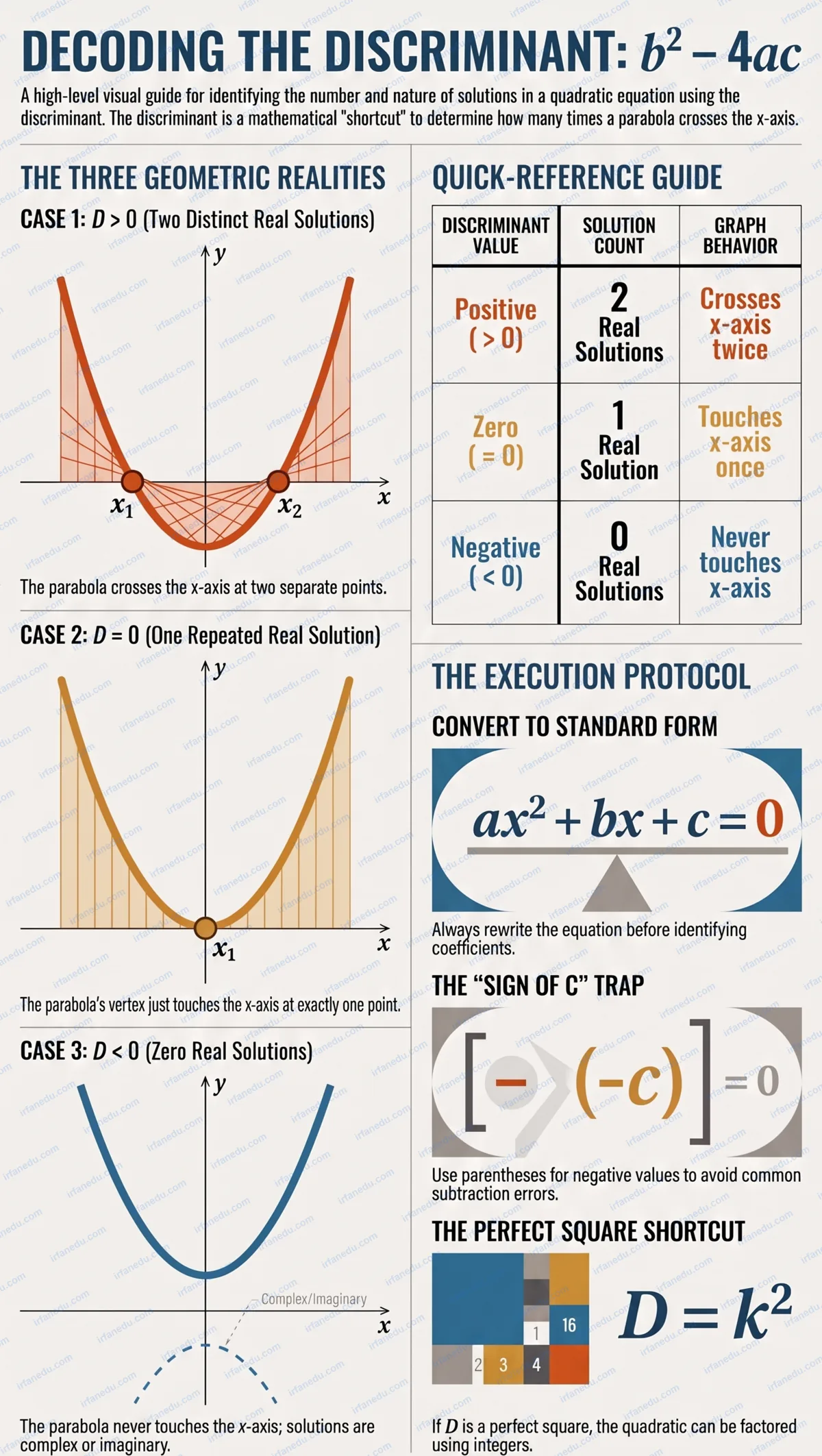
The discriminant is the expression b²-4ac found under the square root sign in the quadratic formula. For any equation in the form ax²+bx+c=0, it tells you whether the equation has two real solutions (D > 0), one real solution (D = 0), or no real solutions (D < 0) — in seconds, without fully solving the equation.
What You Will Learn in This Article
- What the discriminant is and where it comes from
- How to calculate b²-4ac correctly every time
- How to interpret all three cases (positive, zero, negative)
- The most common mistakes students make — and how to avoid them
- Worked examples with step-by-step solutions
- Real-world situations where the discriminant is genuinely useful
⚡ TL;DR – Quick Summary
- The discriminant is D = b²-4ac from the quadratic formula
- D > 0: two distinct real solutions (parabola crosses x-axis twice)
- D = 0: exactly one real solution (parabola touches x-axis once)
- D < 0: no real solutions (parabola never touches x-axis)
- Always write the equation in ax²+bx+c=0 form before calculating
- The discriminant saves time — use it before attempting the full formula
| Discriminant Value | Number of Real Solutions | Graph Behavior | Solution Type |
|---|---|---|---|
| D > 0 | Two distinct solutions | Parabola crosses x-axis at two points | Two real, unequal roots |
| D = 0 | One solution (repeated) | Parabola touches x-axis at vertex | One real, equal root |
| D < 0 | No real solutions | Parabola does not touch x-axis | Two complex (imaginary) roots |
What the Discriminant Actually Is
The myth says the discriminant is just a “check step” you can skip. The truth is it is the single most efficient piece of information a quadratic equation can give you.
The full quadratic formula is:
x = (-b ± √(b²-4ac)) / (2a)
The part under the square root — b²-4ac — is the discriminant. Mathematicians label it D (or sometimes the Greek letter delta).
Think of it this way: before you can take a square root, you need to know whether the number inside is positive, zero, or negative. That single fact decides everything about the solutions. The discriminant hands you that fact instantly.
The word “discriminant” comes from the Latin discriminare, meaning “to distinguish” or “to separate.” It literally distinguishes between the three types of solution behavior. Once you understand that, the formula stops feeling like a random rule and starts making sense.
In my experience teaching algebra, the discriminant is the most underused shortcut in a student’s toolkit. I have watched students spend five minutes grinding through the full quadratic formula only to get a square root of a negative number and panic. A ten-second discriminant check at the start would have told them exactly what to expect. Make it a habit: calculate D first, always.
The Three Cases: Positive, Zero, Negative
The three cases of the discriminant are not arbitrary — each one has a clear geometric meaning tied to the parabola’s graph.
Case 1: D > 0 (Two Real Solutions)
When b²-4ac is positive, the square root in the quadratic formula produces a real number. The ± sign then gives two different values for x. The parabola crosses the x-axis at two separate points.
For x²-5x+6=0: D = (-5)²-4(1)(6) = 25-24 = 1 (positive). Two solutions: x=2 and x=3.
Case 2: D = 0 (One Repeated Solution)
When b²-4ac equals zero, the square root term disappears. The formula reduces to x = -b/(2a). There is only one solution, and the parabola just grazes the x-axis at its vertex.
For x²-6x+9=0: D = (-6)²-4(1)(9) = 36-36 = 0. One solution: x=3 (the vertex touches the x-axis).
Case 3: D < 0 (No Real Solutions)
When b²-4ac is negative, you would need to take the square root of a negative number. That is not possible in the real number system. The parabola sits entirely above or entirely below the x-axis and never intersects it.
For x²+x+1=0: D = (1)²-4(1)(1) = 1-4 = -3 (negative). No real solutions.
How to Calculate the Discriminant Step by Step
The calculation itself is straightforward. The errors almost always come from one source: not writing the equation in standard form first.
- Step 1 — Standard form: Rewrite the equation as ax²+bx+c=0. Move every term to one side.
- Step 2 — Identify a, b, c: Read off the coefficients. Be careful with signs — a negative b is still just b.
- Step 3 — Square b: Calculate b². Remember: squaring always gives a non-negative result.
- Step 4 — Calculate 4ac: Multiply 4 × a × c. Watch sign carefully if c is negative.
- Step 5 — Subtract: D = b² – 4ac. This is your discriminant.
- Step 6 — Interpret: D > 0 means two solutions; D = 0 means one; D < 0 means none.
Worked Examples
Theory only sticks when you see it applied. Here are three fully worked examples covering each case.
Example 1: Two Solutions (D > 0)
Equation: 2x²+7x-4=0
a=2, b=7, c=-4
D = 7²-4(2)(-4) = 49+32 = 81
D = 81 > 0, so there are two real solutions. Since 81 is a perfect square (9²), the equation factors cleanly.
Solutions: x = (-7±9)/4, giving x=0.5 and x=-4.
Example 2: One Solution (D = 0)
Equation: 4x²-12x+9=0
a=4, b=-12, c=9
D = (-12)²-4(4)(9) = 144-144 = 0
D = 0, so there is exactly one repeated solution.
Solution: x = -(-12)/(2×4) = 12/8 = 1.5
Example 3: No Real Solutions (D < 0)
Equation: 3x²+2x+5=0
a=3, b=2, c=5
D = 2²-4(3)(5) = 4-60 = -56
D = -56 < 0, so there are no real solutions. The parabola sits entirely above the x-axis.
Wrong vs. Right: Common Mistakes
These are the exact errors I see most often. Each one changes your discriminant — and therefore your answer — completely.
| WRONG (Common Mistake) | RIGHT (Correct Approach) |
|---|---|
| Reading a, b, c before moving all terms to one side | Always rewrite as ax²+bx+c=0 first, then read the coefficients |
| Calculating (-b)² instead of b² — treating b as already negative | b is the coefficient as written; b² is always positive regardless of sign |
| Forgetting the sign of c when computing 4ac (e.g., treating -5 as +5) | Keep the sign: if c=-5, then 4ac = 4(a)(-5) — this flips the result |
| Saying “no solution” and stopping when D < 0 | State “no real solutions” — complex solutions exist; the problem may ask for them |
| Confusing D=0 (one solution) with D<0 (no real solutions) | D=0 means the parabola touches the axis; D<0 means it never reaches it |
| Assuming a perfect square discriminant always means integer solutions | Check: x = (-b ± √D) / (2a). The 2a denominator may still give a fraction |
The sign-of-c mistake is the one I see most on test papers. A student writes 4ac = 4(2)(5) when c is actually -5, getting a completely different discriminant. My fix: circle the sign of c before you do anything else. That one habit eliminates the error almost entirely. It takes two seconds and saves you from a wrong answer on a question you actually understood.
Visual Solution: Parabola and the X-Axis
The discriminant’s three cases map directly to three parabola shapes. This ASCII diagram shows all three side by side.
   D > 0                D = 0                D < 0
Two real roots       One real root        No real roots

      |                    |                    |
   *  |  *              *  |  *              *  |  *
  *   |   *            *   |   *            *   |   *
 *    |    *          *    |    *          *    |    *
*-----+--x1-x2-*    *------x1------*    *------+------*
      |                    |                    |
      |                    |                    |

Parabola crosses    Parabola touches     Parabola stays
x-axis at 2 pts     x-axis at 1 pt      above x-axis

  b²-4ac > 0          b²-4ac = 0          b²-4ac < 0
The parabola's position relative to the x-axis is determined entirely by the sign of b²-4ac. This is why the discriminant is so powerful: it tells you the geometry of the solution without drawing a single graph.
Why the Discriminant Matters Beyond the Classroom
The discriminant is not just a test-taking tool. It shows up in real problems where knowing whether a solution exists is the entire point.
Physics: Projectile Motion
When you model a thrown ball's height with a quadratic equation, the discriminant tells you whether the ball reaches a target height at all. A negative discriminant means the ball never gets that high — no need to solve further.
Engineering: Structural Design
Engineers use quadratic equations to model stress, load, and vibration. A negative discriminant in a resonance equation signals that a system will not oscillate at a given frequency — critical safety information.
Economics: Break-Even Analysis
Profit and cost functions are often quadratic. The discriminant tells a business analyst whether a product can ever break even (D ≥ 0) or whether it will always run at a loss (D < 0) at the given price and cost structure.
[IMAGE: A parabola graph showing three cases of discriminant with x-axis intersections labeled | ALT: Parabola graph showing discriminant positive zero negative cases with x-axis intersections for quadratic equations]
Quick Quiz: Test Your Understanding
Select an answer to reveal whether it is correct.
1. For the equation x²+4x+4=0, what is the discriminant?
2. The discriminant of 2x²-3x+5=0 is negative. What does this tell you?
3. Which equation has a positive discriminant that is also a perfect square?
Practice Problems
Try each problem yourself, then click to reveal the full solution.
Problem 1: Find the discriminant of 3x²-6x+3=0 and state the number of solutions.
Solution:
a=3, b=-6, c=3
D = (-6)²-4(3)(3) = 36-36 = 0
D = 0, so the equation has exactly one real solution (a repeated root).
Solution: x = -(-6)/(2×3) = 6/6 = 1
Problem 2: Does x²+3x+10=0 have real solutions? Show your work.
Solution:
a=1, b=3, c=10
D = 3²-4(1)(10) = 9-40 = -31
D < 0, so no real solutions exist. The parabola sits entirely above the x-axis.
Problem 3: A quadratic ax²+bx+c=0 has D=49. How many solutions does it have, and are they rational?
Solution:
D = 49 > 0, so there are two distinct real solutions.
Since 49 is a perfect square (7²), the square root in the quadratic formula is a whole number. This means the solutions are rational numbers (assuming a, b, c are integers).
Problem 4: Rewrite 5x²=2x-1 in standard form, then find the discriminant.
Solution:
Standard form: 5x²-2x+1=0
a=5, b=-2, c=1
D = (-2)²-4(5)(1) = 4-20 = -16
D < 0: no real solutions. Note: if you forgot to move terms first and used c=−1, you would get D=4+20=24 — completely wrong answer.
Frequently Asked Questions
What is the discriminant in a quadratic equation?
The discriminant is the expression b²-4ac found under the square root sign in the quadratic formula. It tells you how many real solutions the equation ax²+bx+c=0 has: two solutions if positive, one solution if zero, and no real solutions if negative. It is the fastest way to classify a quadratic without fully solving it.
What does a negative discriminant mean?
A negative discriminant means the quadratic equation has no real solutions. The square root of a negative number is not defined in the real number system, so the parabola never crosses the x-axis. The equation still has two solutions — they are complex (imaginary) numbers — but for most high school problems, you simply state "no real solutions."
What does a discriminant of zero mean?
When the discriminant equals zero, the quadratic has exactly one real solution, called a repeated or double root. The parabola just touches the x-axis at its vertex without crossing it. The solution is x = -b/(2a). This case is also called a "perfect square trinomial" when the coefficients are integers.
How do you calculate the discriminant step by step?
First, write the equation in standard form ax²+bx+c=0. Then identify a, b, and c with their correct signs. Square b to get b². Multiply 4 times a times c. Subtract: D = b²-4ac. For example, for 2x²+3x-5=0: D = 3²-4(2)(-5) = 9+40 = 49. The result is your discriminant.
Can the discriminant be used for equations other than quadratics?
The b²-4ac discriminant applies specifically to quadratic (degree 2) equations. Higher-degree polynomials have their own discriminant formulas, but those are significantly more complex and not covered in standard high school algebra. For any equation of the form ax²+bx+c=0, b²-4ac is all you need.
What is the difference between the discriminant and the quadratic formula?
The quadratic formula is the full expression x = (-b ± √(b²-4ac)) / (2a) used to find the actual numerical solutions. The discriminant is just the b²-4ac part under the square root. You use the discriminant to quickly preview how many solutions exist without computing the full formula — a useful time-saver on timed exams.
If the discriminant is a perfect square, what does that mean?
When the discriminant is a positive perfect square (like 1, 4, 9, 25, 49), its square root is a whole number. This means the quadratic formula will produce rational solutions, and the quadratic can almost certainly be factored using integers. It is a useful signal on multiple-choice tests: try factoring before reaching for the full formula.
Key Takeaways
- The discriminant D = b²-4ac is the expression under the square root in the quadratic formula.
- D > 0 gives two distinct real solutions; D = 0 gives one repeated solution; D < 0 gives no real solutions.
- Always rewrite the equation in ax²+bx+c=0 form before identifying a, b, and c.
- The most common error is a sign mistake with c — circle the sign of c before computing 4ac.
- A perfect square discriminant signals rational solutions and a factorable quadratic.
- The discriminant saves time on tests: calculate it first to know what kind of answer to expect.
- The geometric meaning: D tells you how many times the parabola intersects the x-axis.
Sources & References
Reviewed by Dr. Irfan Mansuri. External links open in a new tab and are provided for further reading and verification.