
When Do Sophomores Take the PSAT? Complete 10th Grade Guide
Fact vs. Fiction: Common PSAT Myths for Sophomores
Before anything else, I want to clear the air. Most of the confusion students and parents have about the sophomore PSAT comes from a handful of myths that spread fast online. The table below addresses the most common ones directly.
| What People Believe (Fiction) | What Is Actually True (Fact) |
|---|---|
| Sophomores must take the PSAT in October. | Sophomores have two options: the PSAT 10 (spring, Feb-Apr) or the PSAT/NMSQT (October). Neither is mandatory. |
| A sophomore’s PSAT score counts for National Merit Scholarships. | Only 11th-grade PSAT/NMSQT scores qualify for National Merit. Sophomore scores do not count, regardless of how high they are. |
| The PSAT and SAT use the same score scale. | The PSAT scores range from 320-1520. The SAT scores range from 400-1600. They are similar but not identical. |
| There is no point taking the PSAT as a sophomore. | Taking the PSAT in 10th grade gives you a diagnostic baseline and 12-18 months to improve before the scores that actually matter. |
| The PSAT 10 is easier than the PSAT/NMSQT. | Both tests cover the same content and use the same 320-1520 scale. The PSAT 10 is simply administered at a different time of year. |
| Colleges see your PSAT scores. | Colleges do not receive PSAT scores. Only SAT scores are sent to colleges. PSAT scores are for your use only. |
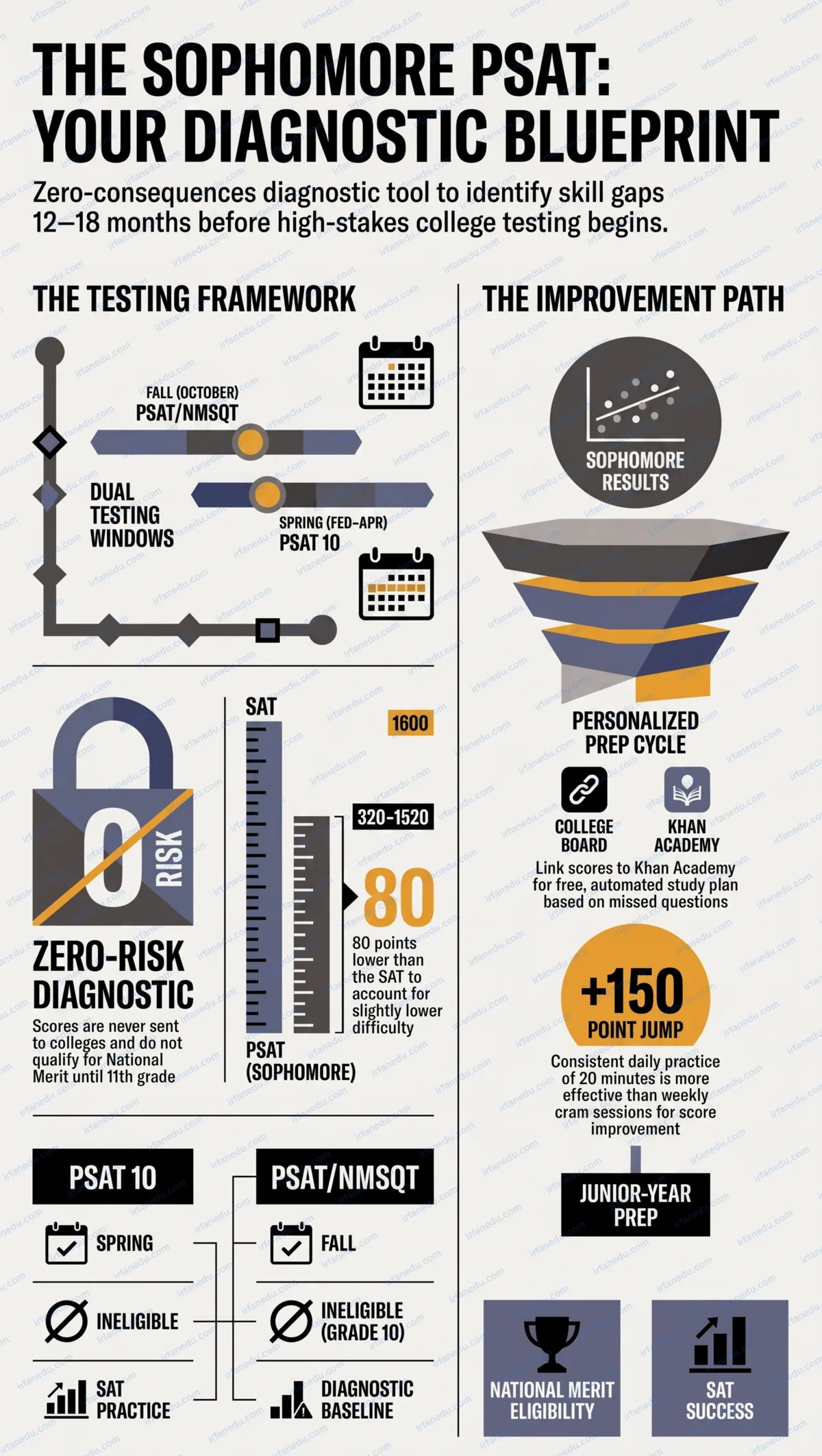
Sophomores (10th graders) typically take the PSAT in one of two windows: the PSAT 10, offered by schools in the spring between February and April, or the PSAT/NMSQT, offered in October. Neither test is mandatory for 10th graders, but taking one gives students a critical diagnostic baseline more than a year before the SAT.
If you are a sophomore wondering whether to bother with the PSAT, or a parent trying to figure out what your child’s school should be offering, you are in the right place. I have spent years helping students navigate standardized testing timelines, and the sophomore PSAT is one of the most underused opportunities in the college prep process.
In this guide, I will walk you through the exact timing, the two test versions available to 10th graders, what the scores mean, and how to turn your results into a concrete study plan. By the end, you will know exactly what to do and when.
- Understand the two PSAT options available to 10th graders
- Know the exact testing windows and how registration works
- Read a PSAT score report and identify your weak areas
- Build a study plan that bridges your sophomore PSAT to your junior SAT
⚡ TL;DR – Quick Summary
- Sophomores take the PSAT 10 (spring, Feb-Apr) or PSAT/NMSQT (October).
- Neither test is required; most schools offer at least one option.
- Sophomore PSAT scores do NOT count for National Merit Scholarships.
- Scores range from 320-1520; colleges never see PSAT results.
- Use your score report + Khan Academy to build a personalized SAT prep plan.
- Taking it sophomore year gives you 12-18 months to improve before junior year.
| Test Name (10th grade) | PSAT 10 or PSAT/NMSQT |
| PSAT 10 Testing Window | February – April (spring) |
| PSAT/NMSQT Testing Window | October (fall) |
| Total Score Range | 320 – 1520 |
| Section Score Range | 160 – 760 per section |
| Test Duration | Approximately 2 hours 45 minutes |
| Sections | Evidence-Based Reading & Writing; Math |
| National Merit Eligibility | No (11th grade only) |
| Colleges Receive Scores? | No |
| Cost | Set by school; often free or low-cost |
What Is the PSAT and Why Does It Exist?
The PSAT stands for Preliminary SAT. It is a standardized test created and administered by the College Board, the same organization that runs the SAT. The PSAT exists for two main reasons: to give students a realistic preview of the SAT, and to identify high-scoring juniors for the National Merit Scholarship Program.
There are actually three versions of the PSAT family of tests. The PSAT 8/9 targets 8th and 9th graders. The PSAT 10 targets 10th graders specifically. The PSAT/NMSQT (National Merit Scholarship Qualifying Test) is the version that matters for scholarship eligibility and is taken primarily in 11th grade.
As a sophomore, you sit in the middle of this ladder. You are past the introductory PSAT 8/9 level, but you are not yet at the high-stakes junior-year test. That makes sophomore year the ideal time to take a full-length, realistic practice run with no consequences attached to the result.
When Exactly Do Sophomores Take the PSAT?
Sophomores have two distinct testing windows, and the one you use depends on which version of the PSAT your school offers. Here is a clear breakdown of both options.
Option 1: PSAT 10 (Spring Window)
The PSAT 10 is designed exclusively for 10th graders. Schools administer it during a spring testing window that typically runs from late February through April. The exact date is chosen by your school, so two schools in the same city might test on different days within that window.
Because it happens in spring, you have the benefit of having completed most of your sophomore-year coursework before you sit down to test. This generally means your math skills are more developed than they would be in October.
Option 2: PSAT/NMSQT (October)
The PSAT/NMSQT is offered every October, usually on a Wednesday and a Saturday. Sophomores are allowed to take this version, and many schools administer it to their entire 10th and 11th grade classes at the same time.
Taking the October PSAT/NMSQT as a sophomore is a perfectly valid choice. Just remember: your score will not count for National Merit, no matter how high it is. That eligibility is reserved strictly for 11th graders.
In my experience, students who take the PSAT 10 in spring tend to score slightly higher than they would in October of the same year, simply because they have covered more curriculum. If your school offers both options, I recommend the spring PSAT 10 for your first attempt. You will get a more accurate read on where you actually stand.
PSAT 10 vs. PSAT/NMSQT: What Is the Difference?
This is the question I get most often from 10th graders and their parents. The short answer: the content and scoring are nearly identical. The differences are in timing, purpose, and who can qualify for scholarships.
| Feature | PSAT 10 | PSAT/NMSQT |
|---|---|---|
| Who Takes It | 10th graders only | 10th and 11th graders |
| When Offered | February – April (spring) | October (fall) |
| Score Range | 320 – 1520 | 320 – 1520 |
| Sections | Reading/Writing + Math | Reading/Writing + Math |
| National Merit Eligibility | No | Yes (11th grade only) |
| Colleges See Scores? | No | No |
| Primary Purpose | Diagnostic / SAT practice | Diagnostic + National Merit qualifier |
| Administered By | Your school | Your school |
The key takeaway from this table: for a sophomore, both tests serve the same practical purpose. They give you a detailed score report that shows exactly which skills need work. The National Merit angle simply does not apply until 11th grade.
PSAT Score Range and What a Good Score Looks Like
The PSAT uses a total score range of 320 to 1520. This is intentionally set 80 points below the SAT’s 400-1600 range to reflect the fact that the PSAT is slightly less difficult than the full SAT.
Your total score is made up of two section scores, each ranging from 160 to 760:
- Evidence-Based Reading and Writing (EBRW): 160-760
- Math: 160-760
You also receive subscores and cross-test scores that break down your performance into specific skill areas like “Heart of Algebra,” “Problem Solving and Data Analysis,” “Command of Evidence,” and “Words in Context.” These subscores are where the real diagnostic value lives.
What Is a Good PSAT Score for a Sophomore?
| Performance Level | Approximate Total Score | What It Means |
|---|---|---|
| Below Average | 320 – 880 | Significant skill gaps; start prep immediately |
| Average (50th percentile) | 880 – 1010 | On track; consistent practice will push you higher |
| Above Average | 1010 – 1200 | Strong foundation; focus on closing specific gaps |
| Competitive | 1200 – 1350 | Excellent for a sophomore; aim for 1400+ on SAT |
| Exceptional | 1350 – 1520 | National Merit range as a junior; maintain and refine |
PSAT TOTAL SCORE: 320 - 1520
|
+-- Evidence-Based Reading & Writing (EBRW): 160 - 760
|     |
|     +-- Reading Test Score (8-38)
|     +-- Writing & Language Test Score (8-38)
|     +-- Subscores: Command of Evidence, Words in Context,
|                    Expression of Ideas, Standard English
|
+-- Math: 160 - 760
      |
      +-- Math Test Score (8-38)
      +-- Subscores: Heart of Algebra, Problem Solving &
                     Data Analysis, Passport to Advanced Math

EBRW Score + Math Score = Total Score (320-1520)
How to Register for the PSAT as a Sophomore
Unlike the SAT, you cannot register for the PSAT directly through the College Board website as an individual student. The PSAT is administered through schools, which means your school must sign up to offer the test.
Here is the process, step by step:
- Talk to your school counselor. Ask whether your school offers the PSAT 10 (spring) or the PSAT/NMSQT (October), or both. Do this at the start of your sophomore year.
- Confirm the registration deadline. Schools have their own internal sign-up deadlines, which are often weeks before the actual test date.
- Ask about the fee. The College Board charges schools a per-student fee, but many schools absorb this cost or charge a small amount. Some districts offer it free to all students.
- Create a College Board account. Go to collegeboard.org and create a free student account. You will use this to access your score report after the test.
- Show up prepared. Bring a valid photo ID, two No. 2 pencils, and an approved calculator on test day. Check the College Board’s current calculator policy before the test.
How to Use Your Sophomore PSAT Results Effectively
Getting your score report is just the beginning. The real value of the sophomore PSAT comes from what you do with that report over the next 12-18 months. Here is a structured approach I recommend to every student I work with.
Step 1: Access Your Full Score Report
Log in to your College Board student account. Your score report includes your total score, section scores, subscores, cross-test scores, and a question-level breakdown showing which specific questions you missed and why.
Step 2: Identify Your Two Weakest Skill Areas
Do not try to fix everything at once. Look at your subscores and pick the two areas with the lowest scores. For most students, this is either “Heart of Algebra” in math or “Command of Evidence” in reading. Start there.
Step 3: Connect to Khan Academy’s Free SAT Prep
The College Board has a free partnership with Khan Academy’s Official SAT Practice. When you link your College Board account to Khan Academy, it automatically generates a personalized study plan based on your actual PSAT results. This is one of the most powerful free tools in test prep, and almost no sophomore uses it.
Step 4: Practice 20-30 Minutes Per Day
Consistency beats intensity. Twenty focused minutes every day produces far better results than a three-hour cram session once a week. Set a daily calendar reminder and treat it like homework.
Step 5: Take a Full Practice SAT After 8-10 Weeks
After two months of focused practice, download a free official SAT practice test from the College Board website. Take it under timed conditions. Compare your results to your original PSAT score to measure real improvement.
I have seen students raise their SAT scores by 150-200 points simply by following this five-step process after their sophomore PSAT. The students who improve the most are not the ones who buy expensive prep courses. They are the ones who consistently use their score report as a roadmap and work on their specific weak areas every single day. The data is there in your report. You just have to use it.
Practical PSAT Prep Tips for 10th Graders
You do not need to spend months in intense preparation before your sophomore PSAT. The test is low-stakes for you right now. But a few targeted actions in the weeks before the test will help you get a more accurate and useful baseline score.
Before the Test
- Take one official free practice test from the College Board website under timed conditions. This alone will familiarize you with the format and reduce test-day anxiety.
- Review the basic math formulas provided at the start of the math section so you know what is given and what you need to memorize.
- Practice active reading on longer passages. The reading section rewards students who can identify the main argument and evidence quickly.
- Get a full night of sleep before the test. Cognitive performance drops measurably with less than 7 hours of sleep.
On Test Day
- Read each question completely before looking at the answer choices.
- Use the process of elimination. Crossing out two obviously wrong answers doubles your odds on a guess.
- Do not leave any question blank. There is no penalty for wrong answers on the PSAT.
- Manage your time. If a question takes more than 90 seconds, mark it and move on. Return to it if time allows.
PSAT to SAT: The Full Sophomore-to-Senior Timeline
Understanding where the sophomore PSAT fits in the bigger picture helps you treat it with the right level of seriousness. Here is the full testing timeline from 10th grade through 12th grade.
GRADE 10 (Sophomore Year)
  Feb-Apr  -->  PSAT 10 (spring) OR
  October  -->  PSAT/NMSQT (fall)
                [Diagnostic only. No National Merit. No college reporting.]

GRADE 11 (Junior Year)
  October  -->  PSAT/NMSQT  <-- THIS is the National Merit qualifying test
  Mar/May  -->  SAT (first attempt recommended)
  Apr/Jun  -->  SAT Subject Tests (if applicable)

GRADE 12 (Senior Year)
  Aug/Oct  -->  SAT retake (if needed)
  Nov      -->  Early Decision / Early Action applications due
  Dec-Jan  -->  Regular Decision applications due
  May      -->  AP Exams

KEY: Sophomore PSAT feeds into Junior SAT prep.
     Junior PSAT/NMSQT score determines National Merit eligibility.
The sophomore PSAT is the foundation of this entire sequence. A student who takes it seriously in 10th grade enters junior year with a clear study plan, a realistic score baseline, and 12 months of targeted practice already completed.
Quick Knowledge Check: PSAT for Sophomores
1. Which PSAT version is designed specifically for 10th graders and offered in the spring?
2. What is the total score range for the PSAT?
3. A sophomore scores 1380 on the October PSAT/NMSQT. Does this score qualify them for National Merit?
Practice Problems: PSAT-Style Questions
Try these sample questions, then click to reveal the solution and explanation.
Problem 1 (Math – Heart of Algebra): If 3x + 7 = 22, what is the value of 6x?
Step 1: Solve for x.
3x + 7 = 22
3x = 15
x = 5
Step 2: Find 6x.
6x = 6(5) = 30
PSAT Tip: The question asks for 6x, not x. A common mistake is to stop at x = 5. Always re-read what the question is actually asking for.
Problem 2 (Math – Data Analysis): A student scored 680, 720, 650, and 710 on four practice tests. What is the mean score?
Mean = (680 + 720 + 650 + 710) / 4
Mean = 2760 / 4
Mean = 690
PSAT Tip: Data analysis questions often ask for mean, median, or range. Practice identifying which measure is being requested before calculating.
Problem 3 (Reading – Command of Evidence): A passage states: “Studies show students who sleep 8+ hours before a test score an average of 12% higher than those who sleep fewer than 6 hours.” Which claim does this evidence best support?
PSAT Tip: Command of Evidence questions ask you to match a piece of evidence to the claim it supports. The evidence must directly and specifically support the claim – not just be related to the same topic.