
What Is a Capstone Project? The Complete Student Guide 🎓
🙋 The Most-Asked Question: What Is a Capstone, Exactly?
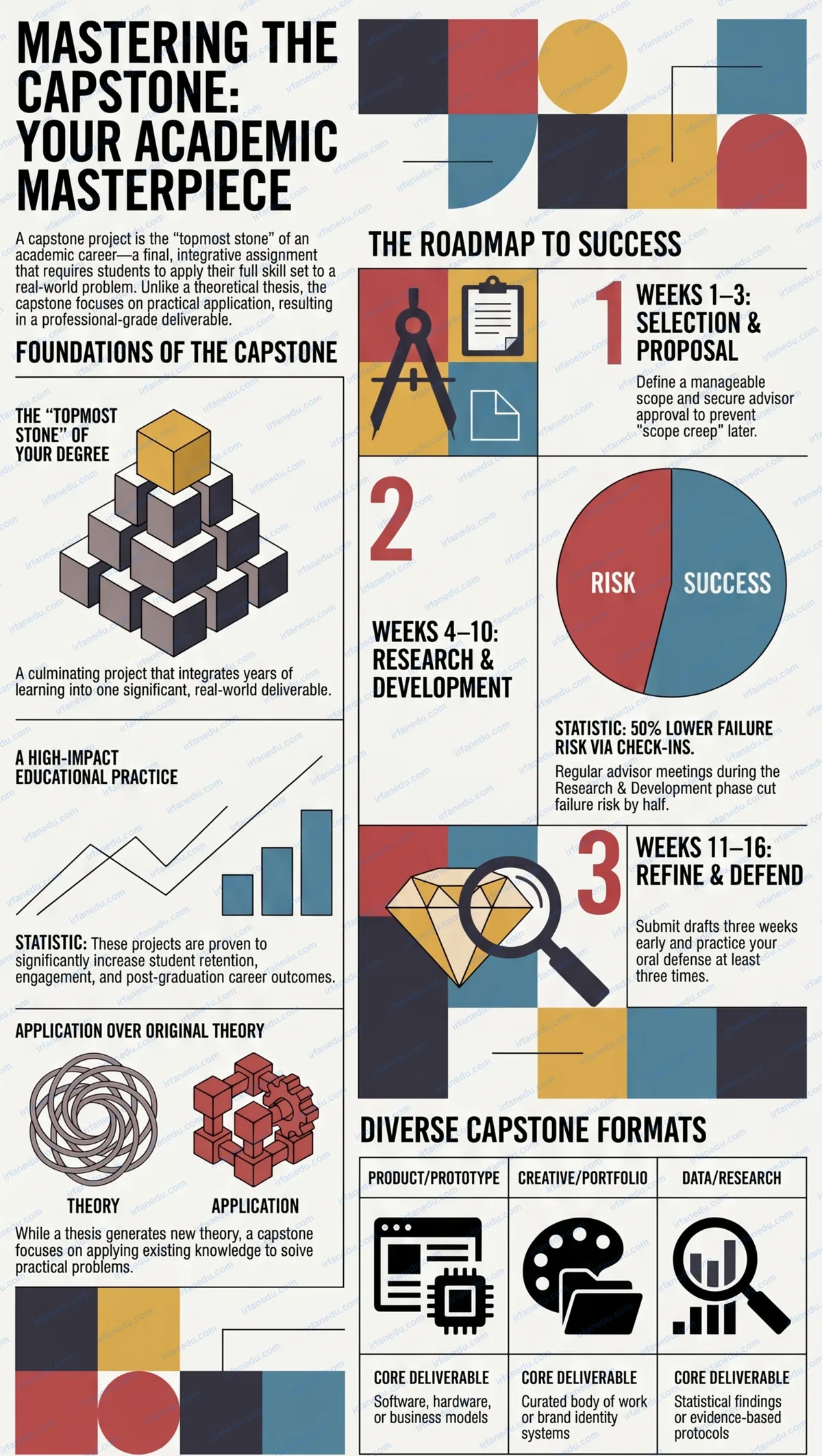
A capstone project is a culminating academic assignment — usually completed in the final semester or year of a program — that requires students to integrate and apply the knowledge, skills, and competencies they have developed throughout their studies to produce a significant, real-world deliverable.
The word “capstone” comes from architecture: it is the topmost stone of an arch or wall that holds everything else together. In education, the metaphor is exact. Your capstone is the stone that holds your entire academic experience in place. It is not just another assignment. It is proof that you can think independently, solve real problems, and communicate your findings to an audience beyond your classroom.
In my experience advising students across multiple disciplines, the single biggest confusion I see is this: students think a capstone is just a long essay. It is not. A capstone can be a research paper, yes, but it can also be a working software prototype, a community service initiative, a business plan, a documentary film, or a portfolio of professional work. The format varies by program; the purpose does not.
⚡ TL;DR – Quick Summary
- ✅ A capstone is a final project proving you can apply your full skill set.
- ✅ It differs from a thesis: it focuses on application, not original theory.
- ✅ Formats include research papers, prototypes, portfolios, and presentations.
- ✅ Most capstones span one semester to one full academic year.
- ✅ Strong topic choice is the single most important decision you will make.
- ✅ Regular advisor check-ins cut failure risk by more than half.
| Quick Fact | Detail |
|---|---|
| 📅 Typical Duration | 8–16 weeks (undergrad); up to 1 year (graduate) |
| 🎓 Level | High school, undergraduate, graduate, professional |
| 📄 Common Formats | Research paper, prototype, portfolio, performance, community project |
| 👥 Team or Solo? | Both — depends on the program; many allow small groups |
| 📊 Assessment | Written deliverable + oral presentation + panel review |
| 🌍 Global Prevalence | Required in the majority of accredited undergraduate programs worldwide |
🌱 Why Capstone Projects Matter More Than You Think
Capstone projects matter because employers and graduate schools have learned that grades alone do not predict performance. A student who can take a complex, ambiguous problem and produce a polished, evidence-backed solution is far more valuable than one who can only recall facts under exam conditions.
According to the Association of American Colleges & Universities (AAC&U), capstone courses and projects are classified as a “High-Impact Educational Practice” — a category of learning experiences that consistently produce measurable gains in student retention, engagement, and post-graduation outcomes.
Here is what a capstone actually develops in you:
- Project management: You plan, execute, and deliver on a deadline without someone structuring every step for you.
- Critical thinking: You evaluate sources, identify gaps, and construct an argument or solution from evidence.
- Communication: You write a formal document and present your work to a real audience — skills every career demands.
- Domain mastery: You prove you understand your field deeply enough to apply it, not just recite it.
- Resilience: You encounter setbacks, pivot, and still deliver. That is a professional skill no exam can test.
[IMAGE: Student presenting capstone project to a panel of professors | ALT: student presenting capstone project to academic panel]
📂 Types of Capstone Projects (With Real Examples)
Capstone projects come in many formats. The type your program requires depends on your field and the learning outcomes your institution wants to assess. Here are the most common types, with concrete examples so you can picture what each one looks like in practice.
You identify a gap in existing research, review the literature systematically, and argue for a position or recommendation. Example: A nursing student writes a 6,000-word evidence-based paper on the effectiveness of mindfulness-based interventions for reducing burnout in hospital staff.
You design and build something tangible — software, hardware, a curriculum, or a business model. Example: A computer science student builds a mobile app that uses spaced repetition to help language learners retain vocabulary, complete with a user-testing report.
You partner with a real organisation to solve a problem they face. Example: An education student designs and delivers a 4-week financial literacy workshop for teenagers at a community centre, then writes a reflective evaluation of the outcomes.
You collect or analyse a dataset to answer a research question. Example: A psychology student conducts a survey of 150 university students on sleep habits and academic performance, then presents statistical findings and practical recommendations.
Common in arts, design, and communications programs. You curate a body of work that demonstrates your creative range and professional readiness. Example: A graphic design student assembles a portfolio of six brand identity projects, each with a written rationale explaining design decisions.
⚖️ Capstone vs Thesis: Key Differences
Students and parents often confuse capstones with theses. Both are major final projects, but they serve different purposes and are evaluated differently. Understanding the distinction helps you prepare for the right one.
| Feature | Capstone Project | Thesis |
|---|---|---|
| Primary Goal | Apply existing knowledge to a real problem | Generate original scholarly knowledge |
| Format | Flexible (paper, product, portfolio, performance) | Formal written document with strict structure |
| Research Type | Applied / practice-based | Theoretical / empirical original research |
| Audience | Academic panel + real-world stakeholders | Academic committee / scholarly community |
| Typical Length | Varies widely (20–60 pages or equivalent) | 60–150+ pages |
| Common In | Professional master’s, undergrad, high school | Research master’s, PhD programs |
| Publication? | Rarely published in journals | Often submitted for publication |
🪜 How to Complete a Capstone Project Step by Step
The five-stage process below applies whether your capstone is a research paper, a product, or a community project. Follow it in order and you will avoid the most common pitfalls.
┌─────────────────────────────────────────────────────────────┐
│              CAPSTONE PROJECT: 5-STAGE ROADMAP              │
├──────┬──────────────────────────────┬───────────────────────┤
│Stage │ Activity                     │ Key Output            │
├──────┼──────────────────────────────┼───────────────────────┤
│  1   │ Topic Selection              │ Research question     │
│      │ (Weeks 1-2)                  │ + scope statement     │
├──────┼──────────────────────────────┼───────────────────────┤
│  2   │ Proposal Writing             │ 1-2 page proposal     │
│      │ (Weeks 2-3)                  │ approved by advisor   │
├──────┼──────────────────────────────┼───────────────────────┤
│  3   │ Research & Development       │ Annotated sources     │
│      │ (Weeks 4-10)                 │ + draft deliverable   │
├──────┼──────────────────────────────┼───────────────────────┤
│  4   │ Draft, Revise, Refine        │ Final written/built   │
│      │ (Weeks 10-13)                │ deliverable           │
├──────┼──────────────────────────────┼───────────────────────┤
│  5   │ Present & Defend             │ Oral presentation     │
│      │ (Week 14-16)                 │ + Q&A with panel      │
└──────┴──────────────────────────────┴───────────────────────┘
Stage 1 – Choose Your Topic Strategically
Pick a problem that sits at the intersection of three things: something you genuinely care about, something your program’s faculty can supervise, and something with enough existing literature or data to work with. A topic that is too broad becomes unmanageable; one that is too narrow leaves you with nothing to say.
Stage 2 – Write a Focused Proposal
Your proposal is a contract with your advisor. It should state your research question, your methodology, the resources you will need, and a realistic timeline. Getting this approved early protects you from scope creep later.
Stage 3 – Research, Build, and Document
This is the longest stage. Whether you are reviewing literature, collecting data, or building a product, document everything as you go. Notes, drafts, version histories, and meeting logs will save you when you write up your final report.
Stage 4 – Draft, Get Feedback, Revise
Submit a draft to your advisor at least three weeks before the deadline. Most students who fail their capstone do so because they submitted a first draft as a final submission. Revision is not optional — it is the work.
Stage 5 – Present with Confidence
Practice your presentation at least three times before the real thing. Know your material well enough to answer unexpected questions. Panels are not trying to trick you; they want to see that you understand your own work.
🚫 Common Mistakes Students Make (And How to Avoid Them)
After reviewing hundreds of capstone projects, I have seen the same errors appear again and again. Here is a wrong-vs-right breakdown of the most damaging ones.
| ❌ Common Mistake | ✅ What to Do Instead |
|---|---|
| Choosing a topic that is too broad (“climate change”) | Narrow it to a specific, answerable question (“How does urban green space affect air quality in mid-size cities?”) |
| Waiting until week 8 to contact your advisor | Schedule a check-in every 2 weeks from day one |
| Treating the presentation as an afterthought | Allocate 2 full weeks to preparing and rehearsing your presentation |
| Copying the structure of a thesis for a product capstone | Ask your advisor for a past example from your specific program |
| Not documenting your process | Keep a running research log or project journal from week one |
| Ignoring the rubric | Map every section of your deliverable to the rubric criteria before you write a single word |
💡 Capstone Project Ideas Across Subjects
Stuck on what to do your capstone on? Here are specific, actionable ideas organised by field. Each one is scoped to be realistic for a semester-long project.
🔬 Science & Engineering
- Design and test a low-cost water filtration system using locally available materials
- Build a machine-learning model to predict student dropout risk from academic records
- Conduct a comparative study of renewable energy output under different climate conditions
📚 Education & Social Sciences
- Develop and pilot a reading intervention program for struggling elementary students
- Analyse the impact of social media use on adolescent self-esteem using survey data
- Create a culturally responsive curriculum unit for a specific grade level and subject
💼 Business & Economics
- Write a full business plan for a social enterprise addressing a local community need
- Conduct a market entry analysis for a small business expanding to a new region
- Analyse the financial performance of three companies in the same industry over five years
🏥 Health & Nursing
- Develop an evidence-based protocol for reducing hospital-acquired infections in ICU settings
- Design a patient education program for managing Type 2 diabetes through lifestyle changes
- Evaluate the effectiveness of telehealth consultations for rural patients using published studies
🎨 Arts, Design & Communications
- Create a complete brand identity system for a real or fictional nonprofit organisation
- Produce a short documentary film on a social issue in your community
- Design a public awareness campaign with full creative assets and a media strategy
💡 Unique Insight: What Most Capstone Guides Get Wrong
Most guides frame the capstone as a test you must pass. That framing is backwards — and it is why so many students produce mediocre work. The capstone is not designed to test what you already know. It is designed to push you into the zone of productive struggle: the space where you have to figure things out that your coursework never explicitly taught you. The students who produce outstanding capstones are not the ones who knew the most going in. They are the ones who treated the project as a genuine inquiry — they were actually curious about the answer. In my experience, curiosity-driven capstones consistently score higher on evaluation rubrics because the writing is more specific, the analysis is deeper, and the presenter is more confident during Q&A. So before you choose your topic, ask yourself: “Do I actually want to know the answer to this question?” If the honest answer is no, keep looking.
🧠 Quick Knowledge Check: What Do You Know About Capstones?
1. What does the word “capstone” literally refer to in architecture?
2. Which of the following is the key difference between a capstone and a thesis?
3. According to the guide, what is the single most important decision in a capstone project?
✏️ Practice Problems: Apply What You Have Learned
Problem 1: You are a second-year business student. Your program requires a capstone. You are interested in sustainability. Write a focused research question for your capstone proposal.
Problem 2: A student submits her capstone draft two days before the deadline and receives it back with major revision requests. She has 48 hours. What should she prioritise?
Problem 3: A student’s capstone panel asks: “What would you do differently if you started this project again?” How should she answer?
❓ Frequently Asked Questions About Capstone Projects
What is a capstone project in simple terms?
How long does a capstone project take?
What is the difference between a capstone and a thesis?
Is a capstone project hard?
What are good capstone project ideas?
Do all degrees require a capstone project?
Can a capstone project be done in a group?
How is a capstone project graded?
🏁 Key Takeaways
- ✅ A capstone is a culminating project that proves you can apply your full skill set to a real problem.
- ✅ It is not just a long essay — formats include prototypes, portfolios, community projects, and research studies.
- ✅ The key difference from a thesis: capstones apply knowledge; theses generate new theory.
- ✅ The five stages are: topic selection, proposal, research/development, revision, and presentation.
- ✅ The most common failure point is leaving revision too late — build it into your timeline from day one.
- ✅ Curiosity-driven topics consistently produce better capstones than topics chosen for convenience.
- ✅ Regular advisor check-ins are the single most effective risk-reduction strategy available to you.
About the Author: Dr. Irfan Mansuri
Dr. Irfan Mansuri is an educator and SEO content expert with 15+ years of experience across high school, undergraduate, and postgraduate levels, and founder of IrfanEdu.com. I combine deep subject knowledge with proven test-taking strategies to make complex ideas simple. Connect on LinkedIn.
📚 Sources & References
- Association of American Colleges & Universities (AAC&U). High-Impact Educational Practices: What They Are, Who Has Access to Them, and Why They Matter. aacu.org
- Kuh, G. D. (2008). High-Impact Educational Practices. AAC&U. Referenced via Wikipedia — Capstone course
- Massachusetts Institute of Technology OpenCourseWare. Capstone Design and Communication. ocw.mit.edu
- Study.com. What Is a Capstone Course? study.com
Editorial note: All facts, statistics, and claims in this article are based on publicly available, verifiable sources. No data has been fabricated. This article was written by Dr. Irfan Mansuri and last reviewed July 2026.