
🌿 Photosynthesis Explained Simply: The Complete Student Guide
📋 What You’ll Learn in This Guide
- 🔬 Exactly what photosynthesis is and why every living thing depends on it
- ⚗️ The full chemical equation — broken down so it actually makes sense
- ☀️ How the two stages (light reactions and Calvin cycle) work together
- 🌱 Where inside a plant cell photosynthesis physically happens
- 🌍 Real-world applications from food production to climate science
Every breath of oxygen you take right now exists because a plant — or a tiny ocean alga — ran a chemical reaction using nothing but sunlight, water, and air. That reaction is photosynthesis, and it is arguably the most important biological process on Earth.
I have taught biology to students at every level, and photosynthesis is the topic that confuses the most people — not because it is complicated, but because most textbooks bury the simple idea under jargon. In this guide, I strip all of that away. You get the real mechanism, explained clearly, with visuals and examples.
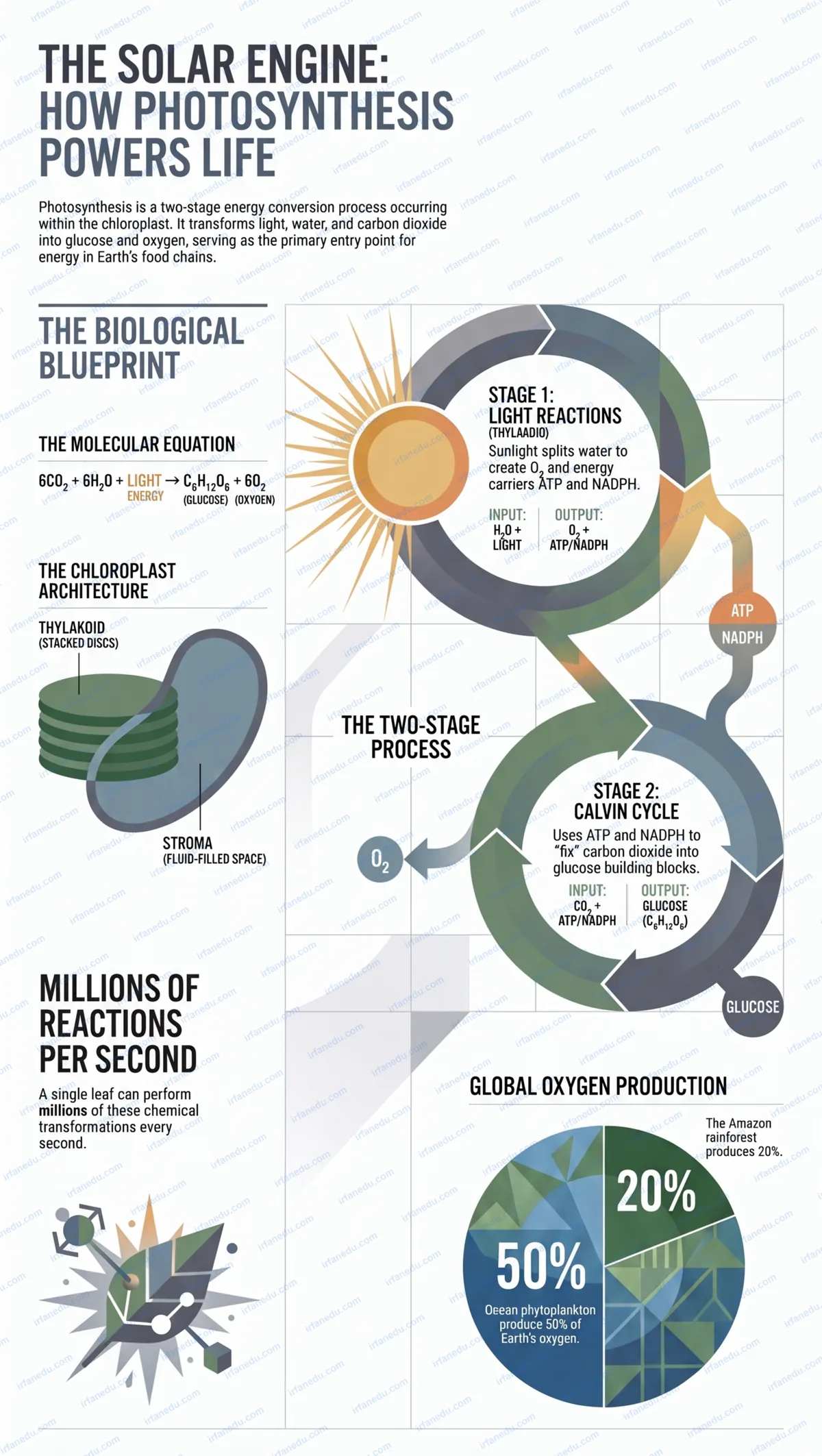
Photosynthesis is the process by which plants, algae, and some bacteria use sunlight, water (H₂O), and carbon dioxide (CO₂) to produce glucose (C₆H₁₂O₆) and oxygen (O₂). It happens inside chloroplasts and runs in two stages: the light-dependent reactions and the Calvin cycle. The overall equation is: 6CO₂ + 6H₂O + light energy → C₆H₁₂O₆ + 6O₂.
- You will understand the full photosynthesis equation with confidence.
- You will know what happens inside a chloroplast, step by step.
- You will be able to explain why leaves are green and why plants need CO₂.
- You will see how photosynthesis connects to climate, food, and your own survival.
⚡ TL;DR – Quick Summary
- 🌞 Plants use sunlight, CO₂, and water to make glucose and oxygen.
- 🔬 It happens in chloroplasts — specifically in thylakoids and the stroma.
- ⚡ Stage 1 (light reactions) captures energy; Stage 2 (Calvin cycle) builds sugar.
- 🟢 Chlorophyll is the pigment that absorbs light — it reflects green, hence green leaves.
- 🌍 Photosynthesis produces ~50% of Earth’s oxygen and underpins all food chains.
- 📐 Equation: 6CO₂ + 6H₂O + light → C₆H₁₂O₆ + 6O₂
📑 Table of Contents
- Rule 1: Understand What Photosynthesis Actually Is
- Rule 2: Know the Equation Cold
- Rule 3: Learn Where It Happens (The Chloroplast)
- Rule 4: Master Stage 1 — The Light Reactions
- Rule 5: Master Stage 2 — The Calvin Cycle
- Rule 6: Understand Chlorophyll and Pigments
- Rule 7: Spot the Factors That Affect the Rate
- Rule 8: Avoid the Most Common Misconceptions
- Rule 9: Connect Photosynthesis to Real Life
- Interactive Quiz
- FAQ
- Sources & References
| Fact | Detail |
|---|---|
| Full name | Photosynthesis (from Greek: photo = light, synthesis = putting together) |
| Organisms that do it | Plants, algae, cyanobacteria (prokaryotes) |
| Location in cell | Chloroplast (thylakoid membranes + stroma) |
| Inputs (reactants) | CO₂, H₂O, light energy |
| Outputs (products) | Glucose (C₆H₁₂O₆), Oxygen (O₂) |
| Key pigment | Chlorophyll a and b |
| Two main stages | Light reactions + Calvin cycle |
| Oxygen source | Water (H₂O), not CO₂ |
🔵 Rule 1: Understand What Photosynthesis Actually Is
Photosynthesis is fundamentally an energy conversion process. Plants take light energy (electromagnetic radiation from the sun) and convert it into chemical energy stored inside glucose molecules. That glucose then powers every biological process in the plant — and eventually in every animal that eats the plant.
Think of it this way: a plant is a solar-powered sugar factory. The factory’s raw materials are CO₂ pulled from the air through tiny pores called stomata, and H₂O absorbed through the roots. The factory’s power source is sunlight. The product is glucose, and the waste product — which happens to be the oxygen you breathe — is released into the air.
This is not just a plant biology topic. Photosynthesis is the entry point for almost all energy in Earth’s food chains. Herbivores eat plants. Carnivores eat herbivores. Decomposers break everything down. At every step, the energy originally came from the sun via photosynthesis.
🔵 Rule 2: Know the Equation Cold
The overall balanced equation for photosynthesis is:
6CO₂ + 6H₂O + Light Energy → C₆H₁₂O₆ + 6O₂
Let me decode each part so it sticks:
| Symbol | What It Means | Where It Comes From / Goes |
|---|---|---|
| 6CO₂ | 6 molecules of carbon dioxide | Absorbed from air through stomata |
| 6H₂O | 6 molecules of water | Absorbed from soil through roots |
| Light Energy | Photons from the sun | Captured by chlorophyll |
| C₆H₁₂O₆ | 1 molecule of glucose | Stored in the plant as food/energy |
| 6O₂ | 6 molecules of oxygen | Released into the air — you breathe this |
One critical fact that surprises most students: the oxygen released in photosynthesis comes from water, not from CO₂. Scientists confirmed this using isotope-labeling experiments. When water labeled with oxygen-18 (¹⁸O) was used, the released O₂ was also labeled. This tells us water is split during the light reactions — a process called photolysis.
🔵 Rule 3: Learn Where It Happens — The Chloroplast
Photosynthesis does not happen randomly throughout the plant cell. It is confined to a specialized organelle called the chloroplast. Understanding the chloroplast’s structure is essential because each part handles a different stage of photosynthesis.
🔬 Visual: Chloroplast Structure (ASCII Diagram)
┌─────────────────────────────────────────────────────────┐
│                    CHLOROPLAST                          │
│                                                         │
│   Outer membrane ─────────────────────────────────────  │
│   Inner membrane ─────────────────────────────────────  │
│                                                         │
│   ┌─────────────────────────────────────────────────┐  │
│   │                  STROMA                         │  │
│   │   (fluid-filled space — Calvin Cycle happens)   │  │
│   │                                                 │  │
│   │   ┌──────────────────────────────────────────┐  │  │
│   │   │  THYLAKOID MEMBRANE (stacked discs)      │  │  │
│   │   │  ┌────┐ ┌────┐ ┌────┐  ← Grana (stacks) │  │  │
│   │   │  │    │ │    │ │    │                    │  │  │
│   │   │  └────┘ └────┘ └────┘                    │  │  │
│   │   │  (Light Reactions happen here)           │  │  │
│   │   └──────────────────────────────────────────┘  │  │
│   └─────────────────────────────────────────────────┘  │
│                                                         │
│  KEY:  Thylakoid = Stage 1 (Light Reactions)            │
│        Stroma    = Stage 2 (Calvin Cycle)               │
└─────────────────────────────────────────────────────────┘
The thylakoid membranes are stacked into coin-like piles called grana (singular: granum). These membranes are packed with chlorophyll and other pigments that capture light. The fluid surrounding the thylakoids is called the stroma, and this is where the Calvin cycle runs.
🔵 Rule 4: Master Stage 1 — The Light Reactions
The light reactions (also called the light-dependent reactions) happen on the thylakoid membranes. Their job is to capture light energy and convert it into two chemical energy carriers: ATP and NADPH. These two molecules then power the Calvin cycle.
Here is what happens, step by step:
- Light absorption: Chlorophyll and accessory pigments in Photosystem II (PSII) absorb photons of light.
- Water splitting (photolysis): The absorbed energy splits water molecules: 2H₂O → 4H⁺ + 4e⁻ + O₂. The oxygen is released as a by-product.
- Electron transport chain: The freed electrons travel through a series of proteins in the thylakoid membrane. As they move, they pump H⁺ ions across the membrane, building up a concentration gradient.
- ATP synthesis: H⁺ ions flow back through an enzyme called ATP synthase, and that flow drives the production of ATP from ADP + phosphate.
- Photosystem I (PSI) and NADPH: Electrons reach PSI, get re-energized by another photon, and are used to reduce NADP⁺ into NADPH.
[IMAGE: Diagram showing the thylakoid membrane with Photosystem II, electron transport chain, Photosystem I, and ATP synthase | ALT: light reactions of photosynthesis in thylakoid membrane showing electron transport chain and ATP production]
🔵 Rule 5: Master Stage 2 — The Calvin Cycle
The Calvin cycle (also called the light-independent reactions or the dark reactions) takes place in the stroma. It uses the ATP and NADPH from Stage 1 to convert CO₂ from the air into glucose. No light is directly required here — but the cycle stops without a fresh supply of ATP and NADPH from the light reactions.
The Calvin cycle has three phases:
| Phase | What Happens | Key Molecule |
|---|---|---|
| 1. Carbon Fixation | CO₂ is attached to a 5-carbon molecule called RuBP by the enzyme RuBisCO | RuBP + CO₂ → 3-PGA (3-carbon) |
| 2. Reduction | ATP and NADPH are used to convert 3-PGA into G3P (glyceraldehyde-3-phosphate) | G3P — the building block of glucose |
| 3. Regeneration of RuBP | Most G3P molecules are used to regenerate RuBP so the cycle can continue | ATP is consumed here |
For every 3 CO₂ molecules that enter the cycle, the net output is 1 G3P molecule. Two G3P molecules are needed to build one glucose. So the cycle must run 6 times to produce one glucose molecule, consuming 18 ATP and 12 NADPH in the process.
🔵 Rule 6: Understand Chlorophyll and Pigments
Chlorophyll is the primary photosynthetic pigment. It is a large organic molecule with a magnesium ion at its center. Chlorophyll absorbs light most strongly in the red (around 680 nm) and blue (around 430 nm) wavelengths of the visible spectrum. It reflects green light — which is why leaves look green to your eyes.
Plants actually contain several types of pigments, not just chlorophyll. Each absorbs a slightly different range of wavelengths, allowing the plant to capture a broader portion of the solar spectrum:
- Chlorophyll a: The primary pigment; directly involved in the light reactions. Absorbs red and blue light.
- Chlorophyll b: An accessory pigment that absorbs blue-violet light and transfers energy to chlorophyll a.
- Carotenoids (carotenes and xanthophylls): Absorb blue-green light; appear yellow, orange, or red. These are the pigments responsible for autumn leaf colors when chlorophyll breaks down.
- Phycoerythrin (in red algae): Absorbs green light, allowing red algae to photosynthesize in deeper water where red light cannot reach.
🔵 Rule 7: Spot the Factors That Affect the Rate
The rate of photosynthesis is not constant. Several environmental and internal factors control how fast or slow the process runs. Understanding these factors is critical for both exams and real-world applications like agriculture.
| Factor | Effect on Rate | Why |
|---|---|---|
| Light intensity ☀️ | Increases rate (up to a point) | More photons → more light reactions → more ATP/NADPH |
| CO₂ concentration 💨 | Increases rate (up to a point) | More substrate for carbon fixation in Calvin cycle |
| Temperature 🌡️ | Increases then decreases | Enzymes (like RuBisCO) work faster with heat — until they denature above ~40°C |
| Water availability 💧 | Decreases rate if scarce | Water is a reactant; shortage also causes stomata to close, blocking CO₂ entry |
| Wavelength of light 🌈 | Red and blue most effective | Chlorophyll absorbs these wavelengths best; green light is mostly reflected |
| Chlorophyll concentration | More chlorophyll = higher potential rate | More pigment molecules can capture more photons simultaneously |
🔵 Rule 8: Avoid the Most Common Misconceptions
Photosynthesis is one of the most misunderstood topics in biology. Here are the most common mistakes I see students make, and the correct understanding for each.
- WRONG: “Plants get their food from the soil.” | RIGHT: Plants make their own food (glucose) via photosynthesis. Soil provides minerals (like nitrogen, phosphorus), but not food energy.
- WRONG: “The oxygen in photosynthesis comes from CO₂.” | RIGHT: It comes from water (H₂O), confirmed by isotope-labeling experiments.
- WRONG: “Dark reactions happen only at night.” | RIGHT: The Calvin cycle runs continuously in daylight — it just does not directly require light photons.
- WRONG: “Photosynthesis and respiration are opposites that cancel out.” | RIGHT: They are complementary but not mirror images. Photosynthesis stores energy; respiration releases it. Plants do both simultaneously.
- WRONG: “Only green plants photosynthesize.” | RIGHT: Algae, cyanobacteria, and even some non-green plants (with other pigments) also photosynthesize.
[IMAGE: Side-by-side comparison chart showing common photosynthesis myths vs facts | ALT: photosynthesis misconceptions vs correct facts comparison chart for students]
🔵 Rule 9: Connect Photosynthesis to Real Life
Photosynthesis is not just a biology exam topic. It underpins food security, climate science, medicine, and the future of energy. Understanding it gives you a framework for understanding some of the biggest challenges facing humanity.
- 🌾 Agriculture and food production: Every crop — wheat, rice, corn, vegetables — grows by photosynthesis. Improving photosynthetic efficiency is a major goal of agricultural science. Researchers estimate that increasing photosynthesis efficiency by just 20% could feed an additional billion people.
- 🌍 Climate change: Plants and ocean phytoplankton absorb roughly 25-30% of the CO₂ humans emit each year. Deforestation reduces this carbon sink, accelerating climate change. Reforestation is partly a photosynthesis strategy.
- ⚡ Solar energy research: Scientists are developing artificial photosynthesis systems that mimic the light reactions to split water and produce hydrogen fuel — a clean, renewable energy source.
- 💊 Medicine: Many plant-derived medicines (aspirin from willow bark, quinine from cinchona trees) are compounds the plant synthesized using glucose from photosynthesis.
- 🌊 Ocean health: Phytoplankton in the oceans perform about 50% of all photosynthesis on Earth, producing half of the planet’s oxygen. Ocean acidification and warming threaten these organisms directly.
🧠 Quick Knowledge Check — Photosynthesis Quiz
Select your answer, then click “Show Answer” to check.
Q1. Where exactly do the light reactions of photosynthesis take place?
Show Answer
✅ B) On the thylakoid membranes. The thylakoid membranes inside the chloroplast contain chlorophyll and the electron transport chain components needed for the light reactions. The stroma is where the Calvin cycle runs.
Q2. In the photosynthesis equation, where does the released oxygen (O₂) come from?
Show Answer
✅ C) From water (H₂O) being split. During photolysis in the light reactions, water molecules are split by light energy: 2H₂O → 4H⁺ + 4e⁻ + O₂. This was confirmed by isotope-labeling experiments using oxygen-18.
Q3. What are the two direct products of the light reactions that power the Calvin cycle?
Show Answer
✅ B) ATP and NADPH. The light reactions convert solar energy into these two chemical energy carriers. ATP provides energy; NADPH provides electrons and hydrogen. The Calvin cycle uses both to fix CO₂ into glucose.
📝 Practice Problems
Problem 1: Balance the photosynthesis equation if 3 CO₂ molecules enter the Calvin cycle. How many G3P molecules are produced?
Problem 2: A plant is placed in a sealed container with water and CO₂ under bright light. After 6 hours, the CO₂ level drops. Why?
Problem 3: Why would a plant placed under only green light photosynthesize very slowly?
❓ Frequently Asked Questions About Photosynthesis
What is photosynthesis in simple words?
What is the simple equation for photosynthesis?
Where does photosynthesis take place in a plant cell?
What are the two main stages of photosynthesis?
Why is chlorophyll green?
Sources & References
Reviewed by Dr. Irfan Mansuri. External links open in a new tab and are provided for further reading and verification.