
Mitosis vs Meiosis Differences: What Most Guides Get Wrong
|
Last Updated: July 2026
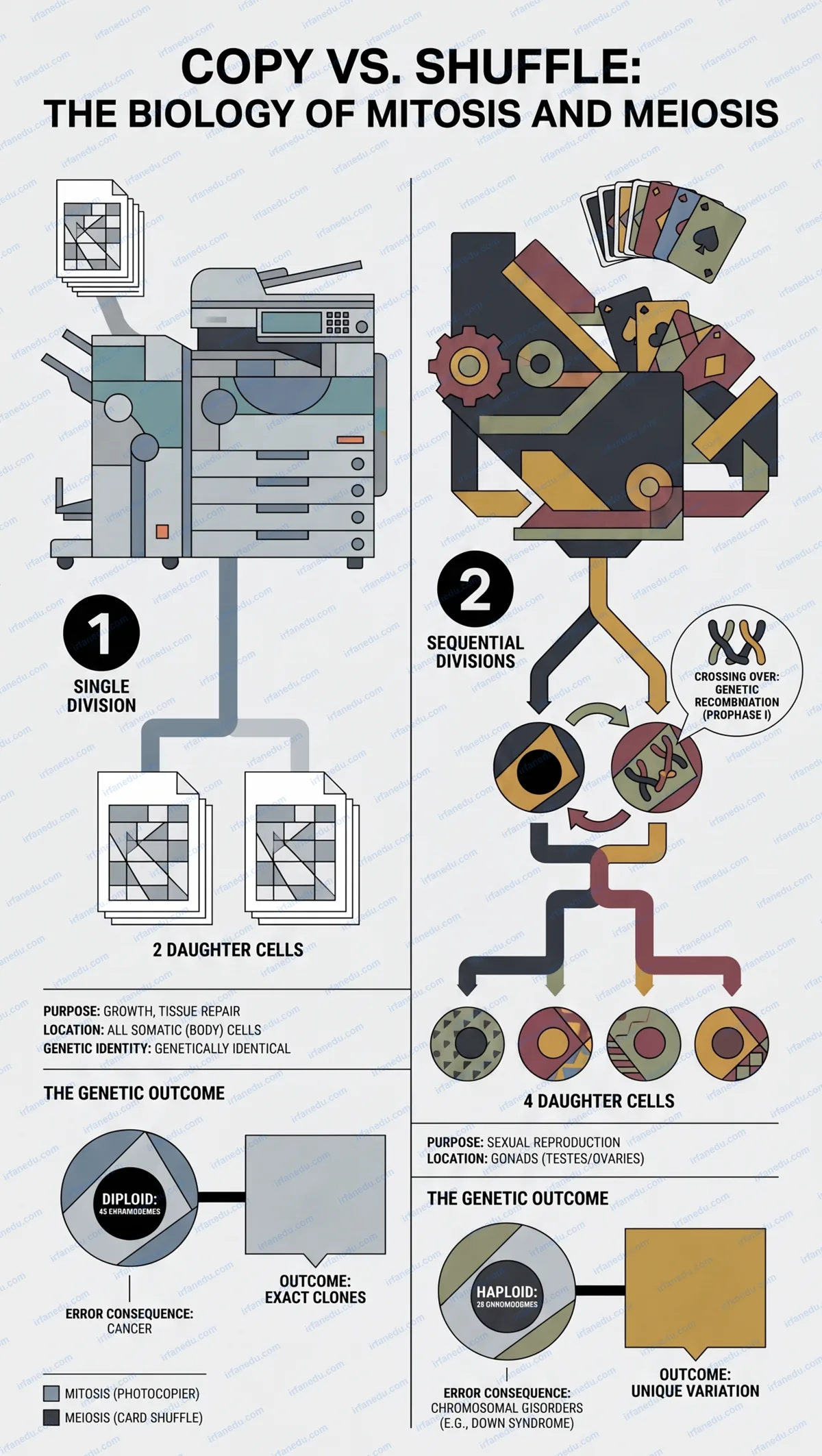
Most Guides Get This Wrong. Here Is What Actually Matters.
Every biology textbook lists the stages of mitosis and meiosis. Most students memorize PMAT, pass the test, and forget everything by the following week. That is not understanding — that is pattern matching.
The real question is not “what are the stages?” The real question is why do two different division processes exist at all? Once you understand the purpose behind each process, every detail — the chromosome counts, the number of divisions, the presence or absence of crossing over — falls into place without brute memorization.
- The biological purpose behind each type of cell division
- Every stage of mitosis and meiosis, clearly explained
- A 5-step method to distinguish them on any exam
- The most common student mistakes and how to avoid them
- Real-world consequences when these processes go wrong
In my experience teaching biology for over 15 years, the single biggest reason students confuse mitosis and meiosis is that they study them as two separate lists rather than as two solutions to two different biological problems. When I reframe it as “your body needs to copy itself” vs. “your species needs to mix genes,” students connect the dots in minutes. I will use that framing throughout this guide.
⚡ TL;DR – Quick Summary
- Mitosis: 1 division, 2 diploid daughter cells, genetically identical, for growth/repair.
- Meiosis: 2 divisions, 4 haploid daughter cells, genetically unique, for reproduction.
- Crossing over happens only in meiosis (Prophase I), creating genetic diversity.
- Humans: diploid cells have 46 chromosomes; haploid gametes have 23.
- Mitosis errors can cause cancer; meiosis errors can cause chromosomal disorders.
- The purpose of the division determines every other difference between them.
| Feature | Quick Answer |
|---|---|
| Number of divisions in mitosis | 1 |
| Number of divisions in meiosis | 2 (Meiosis I + Meiosis II) |
| Daughter cells in mitosis | 2 diploid (2n) |
| Daughter cells in meiosis | 4 haploid (n) |
| Genetic outcome of mitosis | Identical to parent cell |
| Genetic outcome of meiosis | Unique (crossing over + independent assortment) |
| Where mitosis occurs | All somatic (body) cells |
| Where meiosis occurs | Gonads (testes and ovaries) |
| Human chromosome count (diploid) | 46 (23 pairs) |
| Human chromosome count (haploid) | 23 |
What Are Mitosis and Meiosis?
Both processes start with one parent cell that has already duplicated its DNA during a phase called S phase (part of interphase). That is where the similarity ends.
Mitosis is the process your body uses to replace old or damaged cells and to grow. When a skin cell wears out, a stem cell undergoes mitosis to produce two identical replacement cells. The chromosome number stays exactly the same as the parent cell.
Meiosis is the process used exclusively in the reproductive organs to create gametes — sperm in males, eggs in females. The chromosome number is cut in half. When a sperm (23 chromosomes) fuses with an egg (23 chromosomes) during fertilization, the resulting zygote has the correct full count of 46.
Think of mitosis as a photocopier — it makes exact copies. Think of meiosis as a card shuffle — it cuts the deck in half and mixes the cards before dealing, so every hand is different.
Stages of Mitosis Explained
Mitosis is one continuous division. Scientists divide it into four main stages for convenience. The acronym PMAT helps: Prophase, Metaphase, Anaphase, Telophase.
Prophase
Chromosomes condense and become visible under a microscope. The nuclear envelope breaks down. Spindle fibers begin to form from structures called centrosomes at opposite poles of the cell.
Metaphase
Spindle fibers attach to chromosomes at a region called the centromere. All chromosomes line up along the cell’s equator (the metaphase plate). This alignment ensures each daughter cell gets one copy of every chromosome.
Anaphase
Sister chromatids are pulled apart to opposite poles of the cell. At this point, the cell temporarily has double the chromosome number — but only briefly, because the cell is about to divide.
Telophase and Cytokinesis
Nuclear envelopes reform around each set of chromosomes. The chromosomes decondense. Cytokinesis (the physical splitting of the cytoplasm) follows, producing two genetically identical daughter cells.
PARENT CELL (2n = 46 chromosomes)
         |
         | DNA replication (S phase)
         |
    [PROPHASE]
    Chromosomes condense
    Spindle forms
         |
    [METAPHASE]
    Chromosomes align at center
    --------[==|==][==|==]--------
         |
    [ANAPHASE]
    Sister chromatids pulled apart
    <-- [=] [=] [=]   [=] [=] [=] -->
         |
    [TELOPHASE + CYTOKINESIS]
         |              |
  DAUGHTER CELL 1   DAUGHTER CELL 2
    (2n = 46)          (2n = 46)
    IDENTICAL          IDENTICAL
Stages of Meiosis Explained
Meiosis has two rounds of division. Meiosis I is the reduction division — it halves the chromosome number. Meiosis II resembles mitosis but starts with haploid cells.
Meiosis I
Prophase I is the most complex and most important stage in all of cell division. Homologous chromosomes (the matching pairs, one from each parent) pair up in a process called synapsis. During this pairing, crossing over occurs: segments of DNA are exchanged between non-sister chromatids. This is the engine of genetic diversity.
Metaphase I: Homologous pairs (bivalents) line up at the metaphase plate. The orientation of each pair is random — this is independent assortment, the second source of genetic diversity.
Anaphase I: Homologous chromosomes (not sister chromatids) are pulled to opposite poles. Each pole now has one chromosome from each homologous pair.
Telophase I and Cytokinesis I: Two haploid cells form. Each cell has half the original chromosome number, but each chromosome still consists of two sister chromatids joined at the centromere.
Meiosis II
No DNA replication occurs between Meiosis I and Meiosis II. Meiosis II separates the sister chromatids in each of the two haploid cells, producing four haploid daughter cells total. Each of the four cells is genetically unique.
PARENT CELL (2n = 46 chromosomes)
         |
         | DNA replication (S phase)
         |
    [PROPHASE I]  <-- CROSSING OVER happens here
    Homologs pair up, exchange segments
         |
    [METAPHASE I] <-- Independent assortment
    Homolog pairs align at center
         |
    [ANAPHASE I]
    Homologs pulled apart (NOT sister chromatids)
         |
    [TELOPHASE I + CYTOKINESIS I]
         |                   |
   Cell A (n=23)         Cell B (n=23)
         |                   |
   [MEIOSIS II]         [MEIOSIS II]
   (like mitosis)       (like mitosis)
     |       |             |       |
  Cell 1  Cell 2        Cell 3  Cell 4
  (n=23) (n=23)         (n=23) (n=23)
  ALL FOUR ARE GENETICALLY UNIQUE
Want to master more biology concepts with clear, expert-reviewed explanations?
How to Tell Mitosis and Meiosis Apart in 5 Steps
On an exam, you will often see a diagram or a description and be asked to identify which type of division is shown. Here is the exact method I teach my students.
- Check the purpose. Growth or repair = mitosis. Reproduction (gamete formation) = meiosis.
- Count the divisions. One division = mitosis. Two sequential divisions = meiosis.
- Count the daughter cells. Two cells = mitosis. Four cells = meiosis.
- Check the chromosome number. Daughter cells diploid (same as parent) = mitosis. Daughter cells haploid (half the parent) = meiosis.
- Look for crossing over or synapsis. Homologous chromosomes pairing up = meiosis. No pairing = mitosis.
Mitosis = 2 daughter cells. Meiosis = 4 daughter cells. If you forget everything else, this one number tells you which process you are looking at in 90% of exam questions.
Common Mistakes Students Make
After reviewing thousands of student answers, I see the same errors appear again and again. Here are the most damaging ones and how to fix them.
| Wrong Thinking | Correct Understanding |
|---|---|
| "Meiosis II is just a repeat of Meiosis I." | Meiosis I separates homologs; Meiosis II separates sister chromatids. They are fundamentally different events. |
| "Crossing over happens in both mitosis and meiosis." | Crossing over is exclusive to Prophase I of meiosis. It does not occur in mitosis. |
| "Mitosis produces haploid cells." | Mitosis always produces diploid cells. Only meiosis produces haploid cells. |
| "DNA replication happens between Meiosis I and II." | No DNA replication occurs between the two meiotic divisions. This is why the chromosome number stays halved. |
| "All four meiosis products are identical." | All four are genetically unique because of crossing over and independent assortment. |
| "Meiosis happens in all body cells." | Meiosis is restricted to the gonads (testes and ovaries). All other cell divisions use mitosis. |
Some questions show a cell in Metaphase II of meiosis and ask students to identify it. Because Metaphase II looks like Metaphase of mitosis (chromosomes lined up at the plate), students often say "mitosis." The giveaway is the chromosome number — in Metaphase II, the cell is already haploid. Always check the chromosome count in the diagram.
Real-World Applications: Why This Actually Matters
Cell division is not an abstract concept. It has direct consequences for health, medicine, and evolution.
Cancer: Mitosis Out of Control
Cancer is fundamentally a disease of uncontrolled mitosis. Normal cells have checkpoints that halt division if something goes wrong. When mutations disable these checkpoints, cells divide without stopping, forming tumors. Understanding mitosis is the foundation of understanding cancer biology and why chemotherapy drugs target rapidly dividing cells.
Chromosomal Disorders: Meiosis Errors
When chromosomes fail to separate properly during meiosis — a process called nondisjunction — the resulting gametes have the wrong chromosome number. If a gamete with an extra chromosome 21 is fertilized, the resulting individual has three copies of chromosome 21 instead of two. This condition is known as Down syndrome (trisomy 21). Similar errors on other chromosomes cause other conditions.
Evolution: Meiosis as the Engine of Diversity
Sexual reproduction exists because meiosis generates genetic variation. Crossing over and independent assortment mean that no two gametes are genetically identical. This variation gives populations the raw material for natural selection to act on — which is why sexually reproducing species tend to adapt faster to changing environments than asexually reproducing ones.
[IMAGE: Diagram showing nondisjunction during meiosis leading to trisomy | ALT: Nondisjunction in meiosis causing chromosomal disorder trisomy 21 Down syndrome diagram]
I think the real-world angle is criminally underused in biology education. When I tell students that the reason they are genetically different from their siblings — despite having the same parents — is directly because of crossing over in meiosis, the concept clicks immediately. Abstract biology becomes personal. If you are a teacher or a parent helping a student, lead with the real-world story first, then introduce the vocabulary. The retention rate is dramatically higher in my experience.
Full Comparison Table: Mitosis vs Meiosis
This table is the most complete side-by-side comparison you will find. Use it as a revision reference before any exam.
| Feature | Mitosis | Meiosis |
|---|---|---|
| Purpose | Growth, repair, asexual reproduction | Sexual reproduction (gamete formation) |
| Where it occurs | All somatic (body) cells | Gonads (testes, ovaries) |
| Number of divisions | 1 | 2 (Meiosis I + Meiosis II) |
| Number of daughter cells | 2 | 4 |
| Chromosome number in daughters | Diploid (2n) — same as parent | Haploid (n) — half of parent |
| Genetic identity of daughters | Identical to parent cell | Genetically unique |
| Crossing over | Does not occur | Occurs in Prophase I |
| Synapsis (homolog pairing) | Does not occur | Occurs in Prophase I |
| Independent assortment | Does not occur | Occurs in Metaphase I |
| DNA replication before division | Yes (once, before mitosis) | Yes (once, before Meiosis I only) |
| Stages | Prophase, Metaphase, Anaphase, Telophase | Prophase I, Metaphase I, Anaphase I, Telophase I, Prophase II, Metaphase II, Anaphase II, Telophase II |
| Homologous chromosome behavior | Do not pair up | Pair up (synapsis) in Prophase I |
| Sister chromatid separation | In Anaphase | In Anaphase II |
| Homolog separation | Does not occur | In Anaphase I |
| Products (in humans) | 2 cells with 46 chromosomes | 4 cells with 23 chromosomes |
| Error consequences | Cancer, cell death | Chromosomal disorders (e.g., trisomy 21) |
Quick Quiz: Test Your Knowledge
Question 1: How many daughter cells does meiosis produce?
Question 2: During which stage of meiosis does crossing over occur?
Question 3: A cell has 12 chromosomes. After undergoing mitosis, how many chromosomes will each daughter cell have?
Practice Problems: Reveal the Answer
Problem 1: A cell with 2n = 8 undergoes meiosis. How many chromosomes are in each final daughter cell?
Meiosis halves the chromosome number. If the parent cell is diploid with 8 chromosomes (2n = 8), then n = 4. Each of the four haploid daughter cells will contain 4 chromosomes. Remember: no DNA replication occurs between Meiosis I and Meiosis II, so the halving is not reversed.
Problem 2: A student says "crossing over increases genetic variation in mitosis." Identify the error and correct it.
Crossing over is exclusive to Prophase I of meiosis. Mitosis produces genetically identical daughter cells. The correct statement is: "Crossing over during Prophase I of meiosis increases genetic variation in the gametes produced."
Problem 3: Why must meiosis produce haploid cells rather than diploid cells?
During sexual reproduction, two gametes fuse. If each gamete were diploid (2n), the resulting zygote would be tetraploid (4n), and each generation would double the chromosome number. By producing haploid gametes (n), meiosis ensures that fertilization restores the correct diploid number (2n) in the offspring.
Problem 4: In a diagram, you see a cell with chromosomes lined up at the metaphase plate and the cell appears haploid. Is this Metaphase of mitosis or Metaphase II of meiosis?
In Metaphase of mitosis, the cell is diploid. In Metaphase II of meiosis, the cell is already haploid (Meiosis I already separated the homologs). The arrangement of chromosomes at the plate looks similar in both cases, so the chromosome count is the critical clue. A haploid cell at the metaphase plate = Metaphase II.
Frequently Asked Questions
What is the main difference between mitosis and meiosis?
How many divisions occur in mitosis vs meiosis?
Does crossing over happen in mitosis?
Where does mitosis occur in the body?
What does haploid and diploid mean?
Why is meiosis important for genetic diversity?
Sources & References
Reviewed by Dr. Irfan Mansuri. External links open in a new tab and are provided for further reading and verification.