
Lord of the Flies Symbolism: Every Major Symbol Explained 🐚🔥
✓ Expert Reviewed by Dr. Irfan Mansuri
[Last Updated: July 2026]
🎬 The Case Study: One Classroom, One Confusion
Picture this: a student named Maya sits down to write her English essay on Lord of the Flies. She knows the plot perfectly. She can name every character. But when her teacher asks, “What does the conch really mean?” — Maya goes blank. She writes, “The conch is a shell they use to talk.” She gets a C.
Her classmate Leo writes one extra sentence: “The conch represents democratic order, and its destruction signals the death of civilization.” Leo gets an A.
The difference between Maya and Leo is not intelligence. It is knowing how to read symbols. By the end of this guide, you will read every major symbol in this novel exactly the way Leo did.
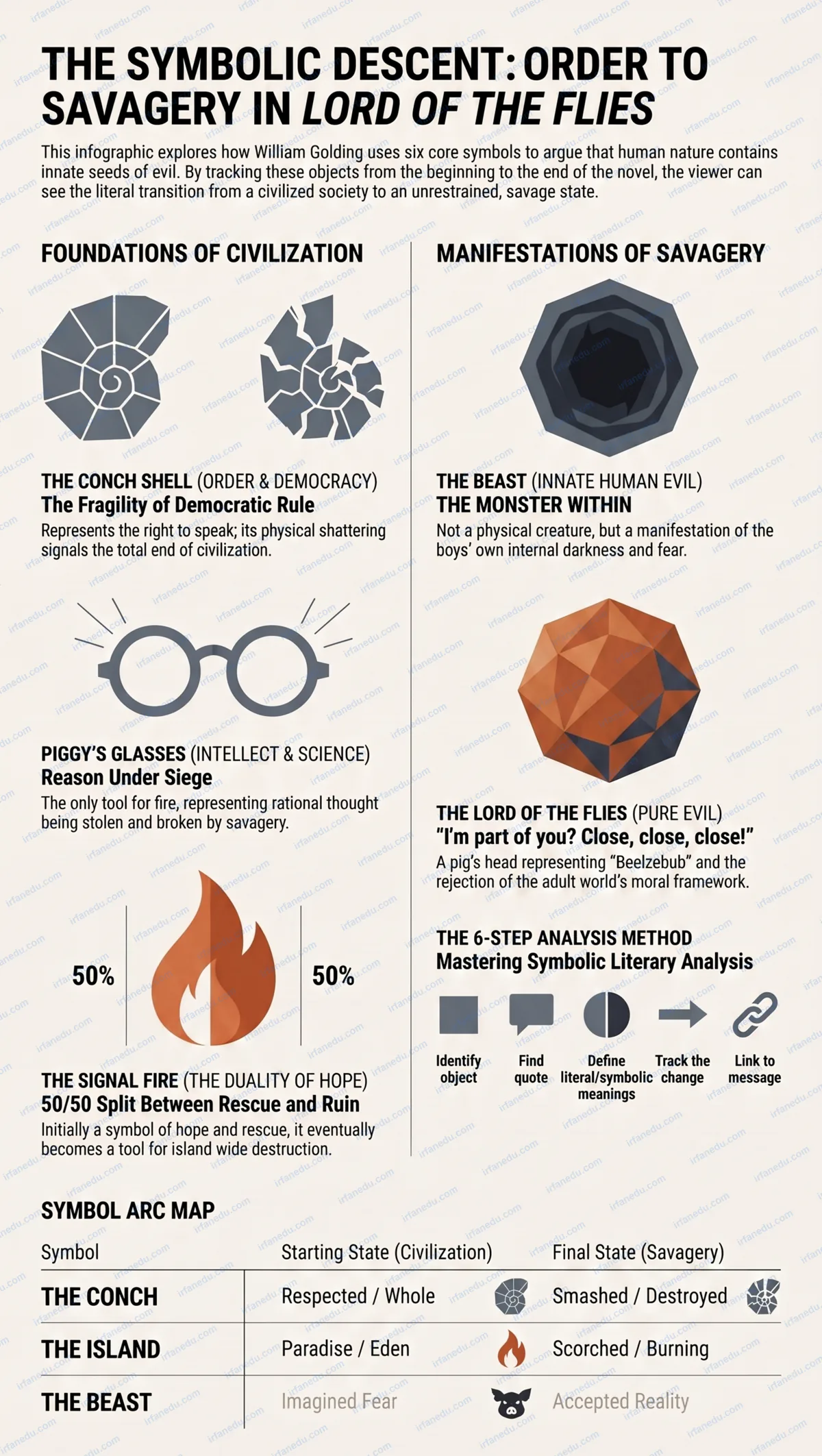
Lord of the Flies symbolism refers to the deeper meanings behind physical objects and characters in William Golding’s 1954 novel. The six core symbols — the conch shell, the beast, fire, Piggy’s glasses, the pig’s head (Lord of the Flies), and the island — each represent abstract ideas such as civilization, inner evil, reason, and the loss of innocence.
William Golding did not write a simple adventure story about boys on an island. He wrote a philosophical argument about human nature — and he made that argument almost entirely through symbols. Every object that matters in this novel carries a second meaning. Once you see those meanings, the whole book snaps into focus.
By the end of this guide, you will be able to identify every major symbol, explain what it represents, quote the text to support your point, and track how each symbol changes across the novel. That is exactly what top-grade essay answers require.
- Identify and explain all 6 major symbols in Lord of the Flies
- Use direct quotes to support symbolic analysis
- Understand how symbols change meaning as the novel progresses
- Apply a step-by-step method to write a strong symbolism essay
- Avoid the most common mistakes students make in literary analysis
⚡ TL;DR – Quick Summary
- 🐚 Conch = democratic order and civilized authority; its destruction = civilization’s end
- 👹 The Beast = the boys’ own inner evil, not an external monster
- 🔥 Fire = rescue and hope (signal fire) vs. destruction (hunters’ fire)
- 👓 Piggy’s glasses = intellect and reason, gradually destroyed by savagery
- 🐷 Lord of the Flies (pig’s head) = pure evil, the devil, Beelzebub
- 🏝️ The island = the Garden of Eden corrupted by human nature
| Symbol | Literal Object | Symbolic Meaning | Destroyed / Lost? |
|---|---|---|---|
| 🐚 Conch Shell | A large shell used as a horn | Order, democracy, civilization | Yes — smashed with Piggy’s death |
| 👹 The Beast | Imagined monster on the island | Innate human evil / fear | Never — it lives inside the boys |
| 🔥 Fire | Signal fire and hunters’ fire | Rescue (hope) vs. destruction | Signal fire abandoned; island burned |
| 👓 Piggy’s Glasses | Thick-lensed spectacles | Intellect, science, rational thought | Yes — stolen and smashed |
| 🐷 Lord of the Flies | Pig’s head on a stick | Pure evil, Beelzebub, the devil | Decays — but its message endures |
| 🏝️ The Island | Tropical island | Paradise / Garden of Eden | Yes — set on fire and destroyed |
📚 What Is Symbolism in Lord of the Flies?
Symbolism is when an author uses a concrete object, person, or event to represent an abstract idea. In Lord of the Flies, Golding does this deliberately and consistently. He was writing in response to the horrors of World War II, and he wanted to argue that human beings carry the seeds of evil within themselves — not just in dictators or soldiers, but in all of us.
To make that argument, he placed a group of ordinary British schoolboys on a deserted island, stripped away all adult authority, and watched what happened. Every symbol in the novel is a tool Golding uses to track the boys’ moral decline — from civilized children to savage killers.
Golding himself confirmed this in interviews. He said the novel is “an attempt to trace the defects of society back to the defects of human nature.” Every symbol is a piece of that argument.
🐚 The Conch Shell — Order, Democracy, and Civilization
The conch shell is the novel’s most important symbol of civilization. From the moment Ralph and Piggy discover it on the beach, it becomes the tool that holds the group together — whoever holds the conch has the right to speak at assemblies.
“We’ll have rules! Lots of rules! Then when anyone breaks ’em —” — Jack, Chapter 2
“The conch exploded into a thousand white fragments and ceased to exist.” — Chapter 11
The conch represents the democratic process — the idea that every voice deserves to be heard. Ralph’s decision to use it as a speaking token is a direct parallel to parliamentary or democratic debate. As long as the boys respect the conch, they maintain the basic structures of a civilized society.
But notice how the conch’s power erodes gradually. In the early chapters, all the boys fall silent when it is raised. By the middle of the novel, Jack openly defies it. By Chapter 11, when Roger pushes the boulder that kills Piggy, the conch is shattered at the same moment. This is not coincidence — Golding destroys the symbol of civilization at the exact moment civilization itself dies among the boys.
In my experience teaching this novel, the conch is the symbol students understand most easily — but they often miss its most powerful moment. It is not the destruction of the conch that matters most. It is the moment Jack first says “the conch doesn’t count on this side of the island.” That line is where civilization actually dies. The physical smashing is just Golding making it official. I always tell students: track the conch’s authority, not just its existence.
👹 The Beast — The Evil Within Every Human Being
The beast is the novel’s most psychologically complex symbol. The younger boys believe there is a literal monster on the island — a creature in the jungle, a thing in the water. The older boys mostly dismiss this fear. But Golding’s point is far more disturbing: the beast is real, and it lives inside the boys themselves.
Simon is the character who grasps this truth. In Chapter 5, during the assembly about the beast, he tries to say it: “Maybe there is a beast… maybe it’s only us.” The other boys laugh at him. They are not ready to accept that the evil they fear is their own.
“Fancy thinking the Beast was something you could hunt and kill! You knew, didn’t you? I’m part of you? Close, close, close! I’m the reason why it’s no go? Why things are what they are?” — The Lord of the Flies speaking to Simon, Chapter 8
The beast takes several forms across the novel: the “beastie” the littluns fear, the dead parachutist mistaken for a monster, and ultimately the Lord of the Flies itself. Each form represents a different aspect of human fear and evil. The parachutist is particularly significant — it is a literal product of adult warfare, suggesting that the boys’ savagery is not unique to children but is inherited from the adult world.
🔥 Fire — The Dual Symbol of Hope and Destruction
Fire is the novel’s most versatile symbol because it carries two completely opposite meanings at the same time. This duality is central to Golding’s argument about human nature: the same force that can save us can also destroy us.
The signal fire represents the boys’ connection to civilization and their hope of rescue. Ralph’s obsession with keeping it burning is his obsession with remaining civilized and being found. Every time the fire goes out, it signals that the boys are losing their grip on the values of their old world.
| Type of Fire | What It Represents | Key Moment |
|---|---|---|
| 🔦 Signal Fire | Hope, rescue, civilization | Goes out while boys hunt; ship passes |
| 🔥 Hunters’ Fire | Savagery, destruction, power | Used to roast pigs; later burns the island |
| 🏝️ Final Fire (island) | Total destruction, loss of paradise | Jack’s tribe burns the island to flush Ralph out |
The irony of the novel’s ending is devastating: the fire that finally brings rescue is the fire Jack’s tribe sets to kill Ralph. The boys are saved by an act of destruction. Golding is pointing out that civilization’s rescue of the boys comes not because of their virtue, but despite their savagery.
  LORD OF THE FLIES — SYMBOL ARC MAP
  ====================================

  BEGINNING OF NOVEL          >>>          END OF NOVEL
  (Civilization)                           (Savagery)

  🐚 Conch      [RESPECTED]  ─────────────►  [SMASHED]
  🔥 Signal Fire [BURNING]   ─────────────►  [ABANDONED]
  👓 Piggy's Glasses [INTACT] ────────────►  [STOLEN + BROKEN]
  🏝️ Island     [PARADISE]   ─────────────►  [BURNING]
  👹 Beast      [IMAGINED]   ─────────────►  [ACCEPTED AS REAL]
  🐷 Pig's Head [NOT YET]    ─────────────►  [WORSHIPPED]

  EACH SYMBOL TRACKS THE SAME ARC:
  ORDER ──────────────────────► CHAOS
  REASON ─────────────────────► SAVAGERY
  HOPE ───────────────────────► DESTRUCTION
👓 Piggy’s Glasses — Reason, Science, and Intellectual Power
Piggy’s glasses are one of the most carefully constructed symbols in the novel. On a literal level, they are the only tool the boys have to start a fire — they focus sunlight onto kindling. On a symbolic level, they represent the power of intellect, science, and rational thought.
Piggy himself is the symbol of reason and democracy. He is consistently the most logical thinker on the island. He understands the importance of the signal fire, he grasps the social value of the conch, and he sees through Jack’s manipulation. But he is physically weak, asthmatic, and socially mocked — Golding’s way of showing how society often marginalizes its most rational voices.
“Piggy’s arms and legs twitched a bit, like a pig’s after it has been killed.” — Chapter 11
“Which is better — to have rules and agree, or to hunt and kill?” — Piggy, Chapter 11
The theft of the glasses by Jack’s tribe in Chapter 10 is a direct act of aggression against reason. Jack does not steal them to see better — he steals them to make fire, to take the power of intellect and redirect it toward savagery. When the glasses are finally smashed, reason is literally broken.
I think Piggy’s glasses are the most underrated symbol in the novel, and students who write about them in depth tend to produce the most original essays. The key insight is this: Piggy’s glasses do not just represent intelligence in the abstract. They represent the usefulness of intelligence to civilization. Without them, the boys cannot even make fire. Golding is saying that without reason, civilization cannot survive — it literally cannot keep its lights on.
🐷 The Lord of the Flies (Pig’s Head) — Pure Evil and the Devil
The pig’s head on a stick is the novel’s most visceral and disturbing symbol. Jack’s hunters place it on a sharpened stick as an offering to the beast. But Golding gives it a name — “Lord of the Flies” — which is a direct translation of “Beelzebub,” a Hebrew name for the devil.
This is not subtle. Golding is explicitly connecting the boys’ descent into savagery with the concept of evil itself. The pig’s head is the physical manifestation of everything the boys have become — it is their idol, their god, the thing they worship when they abandon civilization.
“This head is for the beast. It’s a gift.” — Jack, Chapter 8
“You knew, didn’t you? I’m part of you? Close, close, close!” — The Lord of the Flies to Simon, Chapter 8
Simon’s hallucination in Chapter 8 is the novel’s most important symbolic scene. The pig’s head appears to speak to him, telling him that the beast is inside the boys — that evil is not external but internal. Simon is the only character who fully understands this, which is why Golding makes him the character who is killed. The truth-teller is destroyed by the very evil he tried to name.
The Lord of the Flies also represents the boys’ rejection of the adult world’s moral framework. By creating their own idol, they create their own religion — one built on fear, power, and violence rather than reason and compassion.
🏝️ The Island — The Garden of Eden and Paradise Lost
The island is described in almost paradise-like terms at the beginning of the novel. It has fruit, fresh water, beauty, and warmth. Golding deliberately sets up this paradise to echo the Garden of Eden — a place of innocence and potential that is corrupted by the flaws of its inhabitants.
The boys arrive on the island as a result of a war — they are evacuees from a nuclear conflict in the adult world. The island is their chance to build something better. Instead, they replicate the very violence they fled. This is Golding’s darkest point: human beings cannot escape their own nature, even in paradise.
“This is our island. It’s a good island. Until the grownups come to fetch us we’ll have fun.” — Ralph, Chapter 1
“The island was scorched up like dead wood.” — Chapter 12
By the final chapter, the island is on fire. The paradise is literally burning. The naval officer who rescues Ralph looks at the smoke and ash with confusion — he cannot understand how children could do this. But Golding’s readers understand perfectly. The island’s destruction is the logical end point of every symbolic arc in the novel.
✍️ How to Analyze Symbolism in a Lord of the Flies Essay (Step-by-Step)
Now let me bring Maya’s story full circle. Here is the exact method that turns a C answer into an A answer. I use this six-step framework with every student I teach.
- Step 1 — Identify the object. Name the physical symbol clearly (e.g., “the conch shell”).
- Step 2 — Find the key quote. Select one or two direct quotes where the symbol appears most powerfully. Quotes are non-negotiable in literary analysis.
- Step 3 — State the literal meaning. Describe what the object is in the story’s world (a shell used to call assemblies).
- Step 4 — State the symbolic meaning. Explain the deeper idea it represents (democratic order, the right to speak, civilization).
- Step 5 — Track the change. Show how the symbol’s meaning or power shifts across the novel. This is the step most students skip, and it is the step that earns top marks.
- Step 6 — Link to Golding’s message. Connect the symbol to Golding’s central argument about human nature, civilization, and evil.
Remember Maya? Using this six-step method, she rewrote her essay. Instead of “the conch is a shell they use to talk,” she wrote: “The conch shell symbolizes democratic order and the right to free speech. Golding tracks its authority across the novel — from the moment all boys fall silent when it is raised in Chapter 1, to Jack’s defiant dismissal of it in Chapter 8, to its final destruction alongside Piggy in Chapter 11. The conch’s arc mirrors civilization’s arc: both are fragile, both are respected only as long as the group chooses to respect them, and both are destroyed by the same force — unchecked savagery.” She got an A.
⚠️ Common Mistakes Students Make When Writing About Symbolism
After reviewing hundreds of student essays on this novel, I see the same errors again and again. Here are the most damaging ones — and how to fix them.
| ❌ Wrong Approach | ✅ Correct Approach |
|---|---|
| “The conch is a symbol of talking.” | “The conch symbolizes democratic order and the right to free speech.” |
| “The beast is scary.” | “The beast represents the innate capacity for evil within every human being.” |
| “Fire is used for cooking and signals.” | “Fire carries dual symbolism: the signal fire represents hope and civilization; the hunters’ fire represents destruction and savagery.” |
| “Piggy’s glasses help him see.” | “Piggy’s glasses symbolize intellect and rational thought; their theft and destruction mirrors the defeat of reason by savagery.” |
| Describing the symbol without quoting the text | Always include a direct quote to anchor your symbolic analysis |
| Treating symbols as static (same meaning throughout) | Track how the symbol’s meaning or power changes across the novel |
🧠 Quick Quiz: Lord of the Flies Symbolism
Select your answer — instant feedback below each question.
1. What does the conch shell primarily symbolize in Lord of the Flies?
See Answer
✅ B — Democratic order and civilized authority. The conch gives the holder the right to speak, representing the rule of law and democratic process.
2. Simon’s hallucination with the pig’s head reveals that the beast is really:
See Answer
✅ C — The innate evil inside the boys themselves. The Lord of the Flies tells Simon: “I’m part of you.” This is the novel’s central symbolic revelation.
3. The theft of Piggy’s glasses by Jack’s tribe symbolizes:
See Answer
✅ B — The defeat of reason and intellect by savagery. Piggy’s glasses represent rational thought; their theft is a direct assault on the power of the intellect.
📝 Practice Problems — Reveal on Click
Practice 1: Write a symbolic analysis sentence for the signal fire.
Practice 2: How does the island’s symbolism shift from Chapter 1 to Chapter 12?
Practice 3: Why is it significant that the Lord of the Flies means “Beelzebub”?
❓ Frequently Asked Questions
What does the conch shell symbolize in Lord of the Flies?
What does the beast represent in Lord of the Flies?
What do Piggy’s glasses symbolize?
What does fire symbolize in Lord of the Flies?
What does the Lord of the Flies (pig head) symbolize?
What does the island symbolize in Lord of the Flies?
What is the overall theme of symbolism in Lord of the Flies?
🔑 Key Takeaways
- 🐚 The conch = democratic order; its destruction = civilization’s death
- 👹 The beast = innate human evil, not an external monster
- 🔥 Fire = hope and rescue (signal fire) vs. destruction (hunters’ fire)
- 👓 Piggy’s glasses = intellect and reason, defeated by savagery
- 🐷 The Lord of the Flies = Beelzebub, the devil, pure evil worshipped by the boys
- 🏝️ The island = the Garden of Eden, corrupted and destroyed by human nature
- ✍️ In essays, always quote the text, state the symbolic meaning, and track how the symbol changes
- 🎯 Every symbol in the novel traces the same arc: order to chaos, reason to savagery, hope to destruction
📚 Related
Sources & References
Reviewed by Dr. Irfan Mansuri. External links open in a new tab and are provided for further reading and verification.