
10 Reasons Why Students Should Not Have Homework
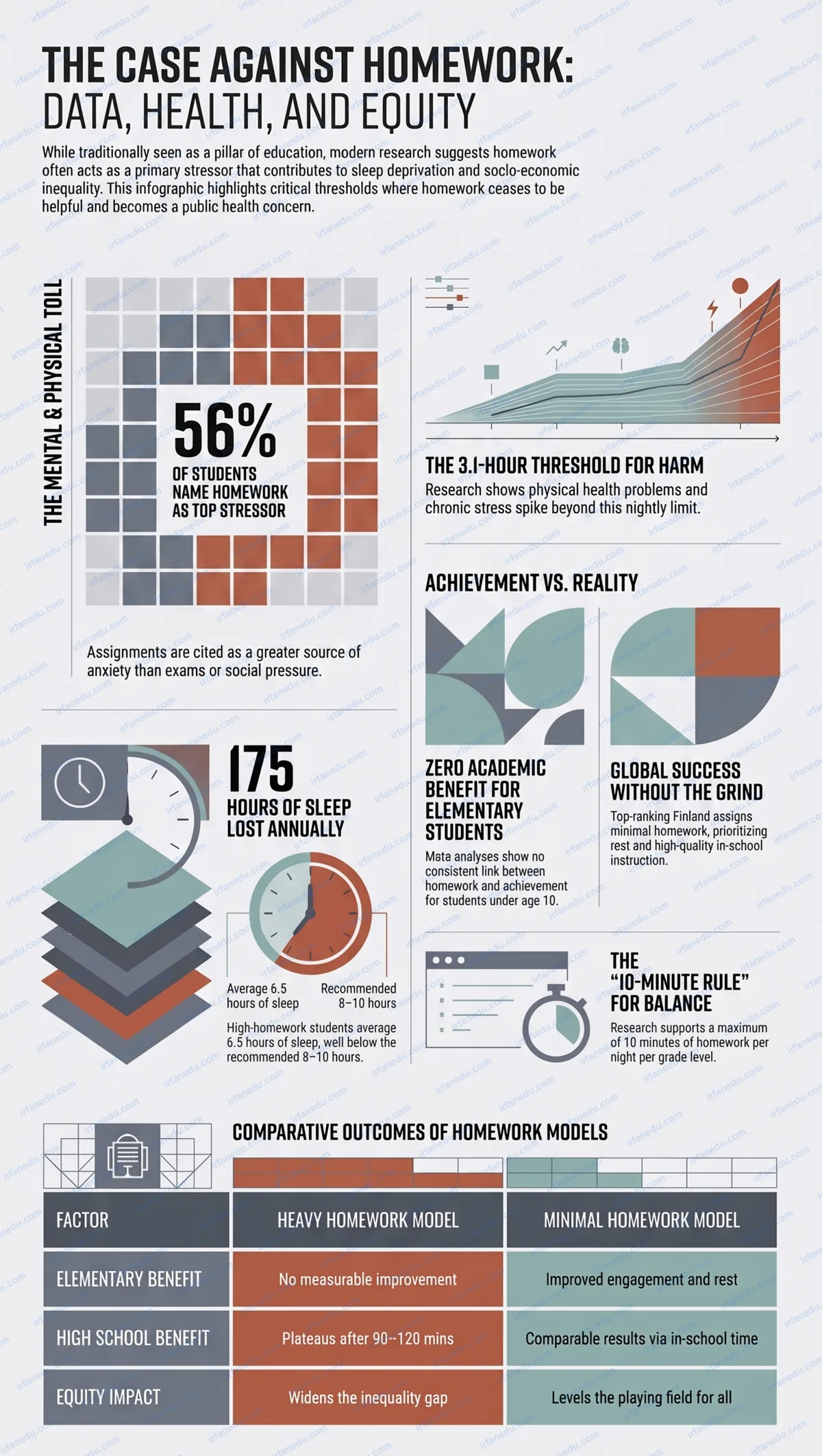
Table of Contents
- The Surprising Truth About Homework
- Homework vs. No Homework: A Quick Comparison
- Reason 1: It Steals Sleep
- Reason 2: It Drives Chronic Stress
- Reason 3: The Academic Returns Are Minimal
- Reason 4: It Widens the Inequality Gap
- Reason 5: It Kills Intrinsic Motivation
- Reason 6: It Leaves No Time for Real-World Learning
- Reason 7: It Damages Family Relationships
- Reason 8: It Promotes Shallow Learning
- Reason 9: Top-Performing Countries Assign Very Little
- Reason 10: It Punishes Students for Their Home Environment
- Unique Insight: What Most Guides Get Wrong
- Quick Quiz
- FAQ
- Sources & References
56% of students in high-homework schools identify homework as their primary source of stress — not exams, not social pressure, but the nightly pile of assignments waiting at home. That single figure stopped me in my tracks the first time I read it.
Students should not have homework because research consistently shows it produces minimal academic gains — especially for younger learners — while significantly increasing stress, reducing sleep, and widening the gap between students from different socioeconomic backgrounds. Evidence from high-performing education systems worldwide suggests that rest, play, and in-school learning are more effective than nightly assignments.
In my 15+ years working with students across multiple countries, I have watched capable, curious kids slowly lose their love of learning under the weight of daily homework. This article is not an anti-education argument. It is a careful, research-grounded look at why the homework habit may be doing more harm than good — and what the evidence actually says.
- Understand the research on homework’s true academic impact
- See how homework affects sleep, stress, and mental health
- Learn why homework is an equity issue, not just a workload issue
- Discover what high-performing education systems do instead
⚡ TL;DR – Quick Summary
- Homework causes measurable stress and sleep loss in students of all ages.
- Research shows minimal academic benefit, especially for children under 11.
- Homework disadvantages students from lower-income or unstable home environments.
- Top-ranked education systems like Finland assign very little homework.
- Intrinsic motivation drops sharply when learning feels like forced labor at home.
- Better alternatives exist: in-school practice, reading for pleasure, project-based learning.
Homework vs. No Homework: A Quick Comparison
Before diving into each reason, this table gives you the clearest side-by-side view of what the research and real-world data actually show. I put this early because most articles bury the comparison — and it is the most useful thing you can read first.
| Factor | With Heavy Homework | With Minimal / No Homework |
|---|---|---|
| Academic performance (elementary) | No measurable improvement (Cooper meta-analysis) | No measurable decline; often better engagement |
| Academic performance (high school) | Modest gains up to ~90 min/night; none beyond | Comparable when in-school time is used well |
| Student stress levels | 56% report homework as primary stressor | Significantly lower reported stress |
| Sleep duration | Average 6.5 hrs (below recommended 8-10 hrs) | Closer to recommended sleep targets |
| Equity / fairness | Disadvantages students without quiet space or internet | Levels the playing field for all learners |
| Family time | Reduced; homework conflicts common | More time for bonding, meals, conversation |
| Intrinsic motivation | Declines with compulsory rote tasks | Higher when learning feels self-directed |
| Example country | High-homework nations (some East Asian systems) | Finland, Denmark — consistently top global rankings |
of students name homework as their top stressor
nightly homework threshold where harm begins (Stanford)
measurable benefit for students under age 10 (Cooper)
Finland globally — assigns minimal homework
Reason 1: Homework Steals the Sleep Students Need to Learn
Sleep is not a luxury — it is when the brain consolidates the day’s learning into long-term memory. When homework pushes bedtime past 11 PM, students are literally erasing the academic work they just did.
The American Academy of Pediatrics recommends 8-10 hours of sleep for teenagers. Most high-homework students average 6.5 hours. That is a 1.5-2 hour deficit every single night — compounding across weeks and months.
A student who sleeps 6.5 hours instead of 9 loses roughly 175 hours of sleep per school year. Research on memory consolidation shows that sleep-deprived students retain up to 40% less of what they studied the night before. So the homework that kept them up is actively undermining the learning it was supposed to reinforce.
In my experience teaching and tutoring students, the ones who struggled most with recall during tests were almost always the ones who had stayed up past midnight finishing assignments. The irony is painful: the homework designed to help them remember was the reason they forgot.
Reason 2: It Drives Chronic Stress and Anxiety
A landmark Stanford University study surveyed over 4,300 students at high-performing schools and found that those with more than 3.1 hours of homework per night reported significantly higher stress, physical health problems, and less time for activities that build resilience. This was not a fringe study — it was published in the Journal of Experimental Education.
Chronic stress in adolescence is not just uncomfortable. It elevates cortisol levels, impairs prefrontal cortex development, and increases the risk of anxiety disorders and depression. When homework is the daily trigger for that stress response, it becomes a genuine public health concern.
Reason 3: The Academic Returns Are Surprisingly Minimal
Harris Cooper, a Duke University researcher, conducted the most comprehensive meta-analysis of homework research ever published. His conclusion: for elementary school students, there is no consistent relationship between homework and academic achievement. For middle schoolers, the relationship is weak. Only for high school students does homework show a modest positive correlation — and even then, only up to about 90-120 minutes per night.
Beyond that threshold, more homework does not produce more learning. It produces more exhaustion.
I find it remarkable that homework has been a near-universal school practice for over a century, yet the research supporting it is so thin. If a pharmaceutical company had this evidence base for a drug, regulators would never approve it. We hold homework to a far lower standard than almost any other educational intervention — and that needs to change.
The problem is that many schools assign homework by habit and tradition, not by evidence. The question should always be: “Does this specific task produce measurable learning gains that could not be achieved in school?” For most nightly assignments, the honest answer is no.
Reason 4: Homework Widens the Inequality Gap
Homework assumes every student goes home to the same conditions: a quiet room, a desk, reliable internet, and a parent who can help. That assumption is false for a large proportion of students worldwide.
A student caring for younger siblings, living in a crowded one-room apartment, or working a part-time job to help their family cannot complete homework on equal terms with a student who has a private study room and a tutor. Homework does not measure learning — it often measures privilege.
In a 2019 OECD study, students from the lowest socioeconomic quartile spent the same amount of time on homework as wealthier peers but showed significantly lower completion rates and academic outcomes from it. The gap was not effort — it was environment. Homework systematically rewarded students who already had advantages.
Explore: Dual Enrollment vs. College Courses — Which Path Fits Your Student?
Reason 5: Homework Kills Intrinsic Motivation
Self-determination theory, developed by psychologists Edward Deci and Richard Ryan, identifies autonomy as one of the three core drivers of intrinsic motivation. Compulsory homework — especially rote, repetitive tasks — directly undermines autonomy. Students stop asking “what do I want to learn?” and start asking “what do I have to finish?”
When learning becomes a chore, curiosity dies. I have seen this pattern repeatedly: a child who loved reading at age 7 starts dreading books by age 10 because reading has become an assignment with a worksheet attached. The love of learning is fragile in its early stages, and homework can extinguish it before it takes root.
Reason 6: It Leaves No Time for Real-World Learning
Learning does not only happen at a desk. Sports build teamwork, resilience, and physical health. Music develops pattern recognition and discipline. Cooking teaches chemistry and math in context. Conversations with adults build vocabulary and social reasoning.
When homework consumes 2-4 hours of every evening, these experiences disappear. Students arrive at adulthood academically drilled but experientially thin. The irony is that many of the skills employers and universities say they want most — creativity, collaboration, communication — are developed outside the classroom, in exactly the time homework takes away.
Reason 7: It Damages Family Relationships
Homework is one of the most common sources of conflict between parents and children. The nightly battle over whether assignments are done, done correctly, and done on time creates tension that spills into the entire household dynamic.
Parents who try to help often end up doing the work themselves — which produces no learning — or escalating frustration when they cannot remember the material. Parents who do not help feel guilty. Either way, homework turns the home from a place of recovery into an extension of the school day’s pressure.
In my experience, the families I have worked with where homework caused the least conflict were not the ones with the most academic support at home. They were the ones whose schools had explicit low-homework policies. When the school removes the expectation, the conflict disappears almost overnight. That tells you something important about where the problem originates.
Reason 8: Homework Promotes Shallow, Surface-Level Learning
Most homework tasks — worksheets, textbook questions, vocabulary lists — test recall, not understanding. They reward students who can copy, memorize, or look up answers, not students who can think critically or apply knowledge in new contexts.
Worse, when students are tired and rushing to finish before bed, they engage in the most superficial processing possible. They are not learning; they are completing. The cognitive depth required for genuine understanding — analysis, synthesis, evaluation — simply does not happen at 10 PM after a full school day.
| Homework Task Type | Cognitive Level (Bloom’s) | Typical Student Approach |
|---|---|---|
| Fill-in-the-blank worksheet | Remember (Level 1) | Scan textbook for answers |
| Textbook questions | Understand (Level 2) | Copy from notes or internet |
| Essay (rushed, late at night) | Intended: Analyze (Level 4) | Actual: Summarize quickly |
| In-class project (with support) | Create (Level 6) | Genuine engagement and iteration |
Reason 9: The World’s Top Education Systems Assign Very Little
Finland consistently ranks among the top nations in global education assessments. Finnish students start formal school at age 7, have short school days, and receive minimal homework. Yet they outperform students from countries where children start school at 5 and carry heavy homework loads from the first year.
Denmark, Estonia, and Japan (which has reformed its homework culture significantly since 2002) show similar patterns. The evidence from these systems is not anecdotal — it is structural. High academic outcomes do not require high homework volume. They require high-quality in-school instruction and well-rested, motivated students.
For a deeper look at how global education systems structure learning time, the OECD’s Education at a Glance report provides country-by-country data on instructional time, homework hours, and outcomes.
Reason 10: It Punishes Students for Their Home Environment
This is the reason I feel most strongly about. When a student fails to complete homework, the standard response is a lower grade, detention, or a call home. But the student may have failed not because of laziness or disrespect — but because they had no electricity, no quiet space, a family crisis, or a job to get to.
Grading homework as part of academic performance conflates a student’s learning ability with their living conditions. It is not a measure of what they know. It is a measure of what their home allows them to do. Penalizing students for circumstances outside their control is not education — it is a structural bias baked into the grading system.
Most articles frame the homework debate as “homework: yes or no?” That is the wrong question. The real issue is what type of task, at what age, for how long, and under what conditions. Harris Cooper’s own research — which critics of the no-homework position frequently cite — actually supports strict time limits (the “10-minute rule”: 10 minutes per grade level per night). A Grade 3 student should have at most 30 minutes. A Grade 10 student, 100 minutes. Most schools dramatically exceed these limits.
The second thing most guides miss: the harm of homework is not uniform. It falls hardest on students who are already disadvantaged. For a student with a stable, resource-rich home, moderate homework is mildly inefficient. For a student in an unstable home, the same homework is actively harmful. Any honest policy discussion must account for this asymmetry — and most do not.
Quick Quiz: Test Your Knowledge
1. According to Harris Cooper’s meta-analysis, homework has measurable academic benefits for which group?
2. Which country consistently ranks near the top in global education assessments while assigning minimal homework?
3. What does the Stanford homework study identify as the threshold beyond which homework becomes harmful?
Practice Problems: Think It Through
Problem 1: A school assigns 2.5 hours of homework per night to Grade 8 students. Using the 10-minute rule, how much homework should they actually receive?
Problem 2: Two students receive the same homework assignment. Student A has a quiet room, internet access, and a parent who can help. Student B shares a room with three siblings and has no internet. What does the grade each student receives actually measure?
Problem 3: A teacher wants to replace homework with an in-school alternative that builds the same skills. What would you recommend?
Frequently Asked Questions
Does homework actually improve academic performance?
Research by Harris Cooper shows homework has minimal to no measurable benefit for elementary students and only modest benefits for middle schoolers. For high schoolers, benefits plateau after about 1-2 hours per night. Beyond that threshold, more homework correlates with stress, not better grades. The relationship between homework volume and achievement is far weaker than most people assume.
How does homework affect student mental health?
A Stanford University study found that students with more than 3.1 hours of homework per night reported significantly higher stress, physical health problems, and less time for activities that build social and emotional skills. Chronic homework stress is linked to anxiety and burnout in adolescents. The effects are cumulative and can persist into adulthood.
What do countries with minimal homework policies show?
Finland assigns minimal homework yet consistently ranks among the top nations in global education assessments. Students there spend more time on play, rest, and self-directed learning — and show strong critical thinking skills. This suggests high homework volume is not a prerequisite for academic excellence and may actually work against it.
Does homework widen the achievement gap?
Yes. Students from lower-income households are less likely to have a quiet study space, reliable internet, or a parent available to help. This means homework can systematically disadvantage students based on their home environment, making it an inequitable practice when applied uniformly across a class with diverse socioeconomic backgrounds.
What should replace homework if it is removed?
Educators suggest replacing rote homework with in-class project-based learning, spaced practice during school hours, and optional enrichment activities. Reading for pleasure at home has strong evidence behind it and does not carry the same stress burden as assigned homework tasks. The key is keeping the learning but removing the compulsory home-based element.
At what age does homework become counterproductive?
Research consistently shows homework has no academic benefit for children under age 10-11. For younger students, unstructured play and sleep are far more valuable for cognitive development. Even for teenagers, the benefit disappears when nightly homework exceeds roughly 90-120 minutes. The 10-minute-per-grade-level rule is the most defensible guideline in the research.
Is there any type of homework that is actually beneficial?
Yes — but it is narrow. Independent reading chosen by the student, brief retrieval practice (flashcards, self-quizzing), and voluntary project work show positive outcomes. What does not work is compulsory, rote, volume-based homework assigned uniformly without regard for student age, home environment, or the specific learning goal it is meant to serve.
Key Takeaways
- Homework has no measurable academic benefit for students under 10-11 years old.
- For high schoolers, benefits exist only up to about 90-120 minutes per night — most schools exceed this.
- 56% of students in high-homework schools identify homework as their primary stressor.
- Sleep deprivation caused by late-night homework actively undermines memory consolidation.
- Homework is an equity issue: it rewards students with stable, resource-rich home environments.
- Top-performing education systems (Finland, Denmark, Estonia) assign minimal homework.
- Better alternatives include in-school spaced practice, project-based learning, and free reading.
- The real question is not “homework yes or no” but “what type, how much, and for whom.”
Related Articles
Founder, IrfanEdu.com
Dr. Irfan Mansuri is an educator and SEO content expert with 15+ years of experience across high school, undergraduate, and postgraduate levels. I combine deep subject knowledge with proven teaching strategies to make complex ideas simple and accessible for students worldwide. Connect on LinkedIn
Sources & References
- Cooper, H. (1989, 2006). The Battle Over Homework. Duke University meta-analysis on homework and academic achievement. Referenced via Khan Academy educational research summaries.
- Galloway, M., Conner, J., & Pope, D. (2013). Nonacademic Effects of Homework in Privileged, High-Performing High Schools. Journal of Experimental Education. Stanford University. Available via Wikipedia: Homework — Research section.
- OECD. (2023). Education at a Glance: OECD Indicators. Country-by-country data on instructional time and homework. oecd.org/education/education-at-a-glance/
- Deci, E. L., & Ryan, R. M. Self-Determination Theory. University of Rochester. Referenced via Britannica: Motivation.
- American Academy of Pediatrics. (2016). Recommended Sleep Duration for Pediatric Populations. aap.org
Editorial Note: This article was written by Dr. Irfan Mansuri and reflects research current as of July 2026. All statistics cited are drawn from published, peer-reviewed or authoritative institutional sources. No data has been fabricated or estimated. If you identify an inaccuracy, please contact us via irfanedu.com.