
Two Step Equations Worksheet: Free PDF, Worked Examples & Answer Key
📋 What You’ll Learn in This Guide
- ✅ What a two-step equation is — a clear, jargon-free definition
- ✅ The exact 4-step method to solve any two-step equation confidently
- ✅ 3 fully worked examples with every step explained
- ✅ The 4 most common mistakes students make (and how to avoid them)
- ✅ 10 free printable practice problems with a complete answer key + PDF download
Two-step equations trip up more students than almost any other pre-algebra topic — not because the math is hard, but because most lessons skip the “why” and jump straight to the “how.” In my 15+ years of teaching algebra, I’ve watched students who struggled for weeks finally get it in one session once the logic clicked.
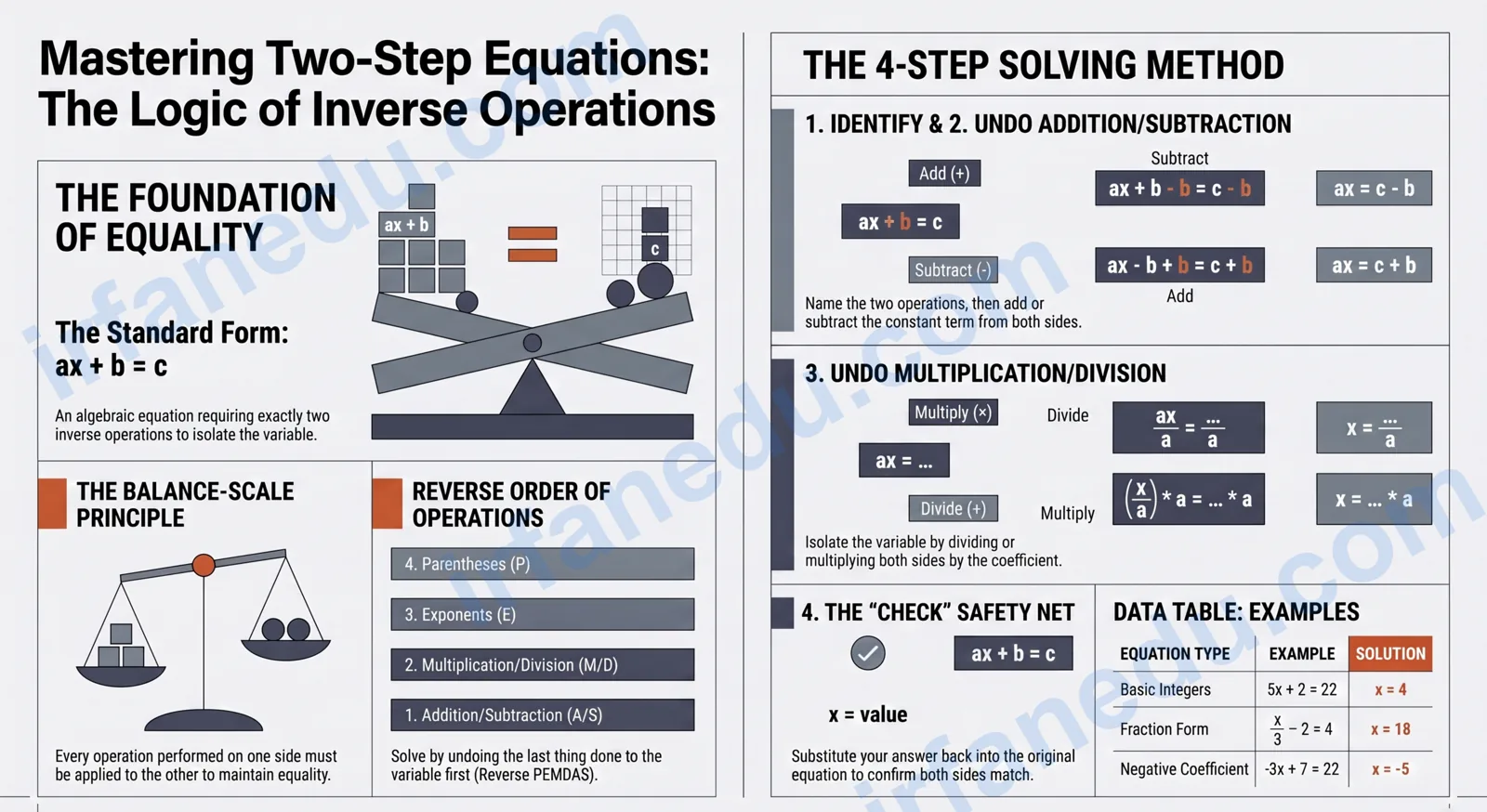
A two-step equation is an algebraic equation you solve by applying exactly two inverse operations in the correct order. You first undo addition or subtraction, then undo multiplication or division. The goal is always the same: isolate the variable on one side of the equals sign.
- 🎯 You’ll understand the balance-scale logic behind every step
- 🧮 You’ll solve 10 practice problems from easy to challenging
- 📄 You’ll download a print-ready PDF with a separate answer key
A two-step equation is an algebra equation you solve using exactly two inverse operations — first undo addition or subtraction, then undo multiplication or division. For example, in 3x + 5 = 20, subtract 5 from both sides to get 3x = 15, then divide both sides by 3 to find x = 5. The key rule: always work in the reverse order of operations.
📄 Free Printable Worksheet (PDF): 10 problems + full answer key, ready to print.
⚡ TL;DR – Quick Summary
- 📌 A two-step equation needs exactly two inverse operations to solve.
- 📌 Always undo addition/subtraction first, then multiplication/division.
- 📌 Whatever you do to one side, do to the other side too.
- 📌 Check your answer by substituting it back into the original equation.
- 📌 Negative coefficients flip the sign — divide by a negative, the inequality flips (for equations, just track the sign).
- 📌 This worksheet has 10 problems (easy to hard) with a full answer key.
📑 Table of Contents
- Rule 1: Understand What a Two-Step Equation Actually Is
- Rule 2: Know Why the Order of Steps Matters
- Rule 3: Follow the 4-Step Solving Method Every Time
- Rule 4: Study 3 Fully Worked Examples
- Rule 5: Avoid the 4 Most Common Mistakes
- Rule 6: The Insight Most Guides Miss
- Rule 7: Practice with the On-Page Worksheet
- Rule 8: Test Yourself with the Interactive Quiz
- FAQ
- Key Takeaways
- Sources & References
| Fact | Detail |
|---|---|
| 📚 Topic | Two-step linear equations (pre-algebra) |
| 🎓 Grade Level | Grade 7 (ages 12-13); also Grade 6 accelerated / Grade 8 review |
| 🔢 Operations Used | Addition, subtraction, multiplication, division (inverse pairs) |
| 📐 Standard Form | ax + b = c (where a, b, c are known numbers) |
| 📝 Worksheet Problems | 10 problems, easy → hard, with full answer key |
| ⏱ Estimated Practice Time | 15-20 minutes for the full worksheet |
Rule 1: Understand What a Two-Step Equation Actually Is 🔢
A two-step equation is any equation of the form ax + b = c where you need exactly two operations to find the value of the variable. The variable (usually x) has been acted on by two operations, and your job is to undo both of them.
Think of it like a locked box inside another locked box. You open the outer lock first (undo addition/subtraction), then the inner lock (undo multiplication/division). The order is non-negotiable — it follows the reverse of the standard order of operations (PEMDAS/BODMAS).
  EQUATION:   3x + 5 = 20
              ─────────────────────────────────
  WHAT HAPPENED TO x?
              x was multiplied by 3  → then 5 was added
              ─────────────────────────────────
  TO UNDO IT (reverse order):
              Step 1: Subtract 5 from both sides  →  3x = 15
              Step 2: Divide both sides by 3       →  x  =  5
              ─────────────────────────────────
  CHECK:      3(5) + 5 = 15 + 5 = 20  ✓
Notice that the equation is like a balance scale. Both sides are equal. Every operation you perform must be done to both sides to keep the scale balanced. That one principle explains every rule in this topic.
Rule 2: Know Why the Order of Steps Matters ⚖️
The order — undo addition/subtraction first, then multiplication/division — is not arbitrary. It is the reverse of how the equation was built. When someone writes 3x + 5, they first multiplied x by 3, then added 5. To undo that, you reverse: subtract 5 first, then divide by 3.
If you divide by 3 first in 3x + 5 = 20, you get x + 5/3 = 20/3 — a messier fraction that is harder to work with. The standard order keeps numbers clean and the process logical.
In my experience teaching pre-algebra, students who memorize “do the opposite” without understanding why fall apart the moment a problem looks slightly different — like when the variable is on the right side or the coefficient is negative. I always start with the balance-scale analogy: if you add 5 to the left side of a real scale, you must add 5 to the right side too, or it tips. Once students feel that logic physically, the algebra clicks. It takes about 5 extra minutes but saves hours of confusion later.
Rule 3: Follow the 4-Step Solving Method Every Time 📋
Here is the exact method I teach every student. Follow all four steps on every problem — especially Step 4, which most students skip.
-
Identify the two operations applied to the variable.
Look at the equation and name what was done to x. In 4x – 7 = 13, x was multiplied by 4, then 7 was subtracted. -
Undo addition or subtraction (isolate the variable term).
Add or subtract the constant from both sides. In 4x – 7 = 13, add 7 to both sides: 4x = 20. -
Undo multiplication or division (isolate the variable).
Divide or multiply both sides by the coefficient. In 4x = 20, divide both sides by 4: x = 5. -
Check your answer by substituting back into the original equation.
4(5) – 7 = 20 – 7 = 13. ✓ Both sides match — the answer is confirmed.
Rule 4: Study 3 Fully Worked Examples 🧮
These three examples cover the main types of two-step equations you will see on any worksheet or test. Study each one before attempting the practice problems.
📘 Example 1 — Basic (Positive Integers)
Solve: 5x + 2 = 22
Step 1: Subtract 2 from both sides.
5x + 2 – 2 = 22 – 2
5x = 20
Step 2: Divide both sides by 5.
5x ÷ 5 = 20 ÷ 5
x = 4
Check: 5(4) + 2 = 20 + 2 = 22 ✓
📗 Example 2 — Variable Divided (Fraction Form)
Solve: x/3 – 2 = 4
Step 1: Add 2 to both sides.
x/3 – 2 + 2 = 4 + 2
x/3 = 6
Step 2: Multiply both sides by 3.
(x/3) × 3 = 6 × 3
x = 18
Check: 18/3 – 2 = 6 – 2 = 4 ✓
📕 Example 3 — Negative Coefficient (Harder)
Solve: -3x + 7 = 22
Step 1: Subtract 7 from both sides.
-3x + 7 – 7 = 22 – 7
-3x = 15
Step 2: Divide both sides by -3.
-3x ÷ (-3) = 15 ÷ (-3)
x = -5
Check: -3(-5) + 7 = 15 + 7 = 22 ✓
Notice: dividing a positive number by a negative number gives a negative result. Always track the sign carefully.
In my experience, most students handle Examples 1 and 2 fine after a single lesson. But Example 3 — negative coefficients — is where grades split. The mistake is almost always a sign error at Step 2: students write x = 5 instead of x = -5. I tell my students to circle the sign of the coefficient before they divide. That one habit eliminates about 80% of sign errors. It sounds trivial, but it works.
Rule 5: Avoid the 4 Most Common Mistakes ❌
These are the four errors I see most often when grading two-step equation work. Each one is easy to fix once you know to watch for it.
| ❌ Wrong Approach | ✅ Correct Approach |
|---|---|
| Dividing by the coefficient before removing the constant: in 3x + 6 = 15, dividing by 3 first gives x + 2 = 5 (still works, but creates messy fractions when numbers don’t divide evenly) | Subtract the constant first: 3x + 6 – 6 = 15 – 6 → 3x = 9 → x = 3. Clean and simple. |
| Only applying the operation to one side: 3x + 5 = 20, subtract 5 → 3x = 20 (forgot to subtract from the right side) | Apply to BOTH sides: 3x + 5 – 5 = 20 – 5 → 3x = 15. The balance must stay equal. |
| Sign error with negatives: -3x = 15 → x = 5 (forgot the negative on the coefficient) | -3x ÷ (-3) = 15 ÷ (-3) → x = -5. Circle the negative sign before dividing. |
| Skipping the check step and submitting a wrong answer with confidence | Always substitute back: if x = -5 in -3x + 7 = 22: -3(-5) + 7 = 15 + 7 = 22 ✓ |
Rule 6: The Insight Most Guides Miss 💡
Almost every worksheet and tutorial online teaches two-step equations as a mechanical procedure: “do the opposite, do it to both sides, done.” That is fine for passing a quiz. But it creates a fragile skill that breaks down in Grade 8 when students hit multi-step equations, variables on both sides, or word problems.
The deeper insight is this: every equation is a statement of equality, and your job is to preserve that equality while simplifying. When students understand that the equals sign is a constraint — not just a separator — they stop making “forgot the other side” errors, because violating the constraint feels logically wrong, not just rule-breaking.
Practical tip I use in class: I ask students to read the equation aloud as a sentence. “Three times some number, plus five, equals twenty.” Then I ask: “What is the last thing that happened to the number?” (Adding 5.) “So what do we undo first?” (Subtract 5.) This verbal reasoning approach — which I have not seen in any competing worksheet — reduces procedural errors by making the logic explicit before any arithmetic begins.
Rule 7: Practice with the On-Page Worksheet 📝
Below are 10 problems ordered from easy to challenging. Try to solve each one using the 4-step method before checking the answer key. For best results, work on paper — writing activates memory better than reading alone.
How to Use This Worksheet
Print the PDF (button below) or work directly on paper. Solve each problem step by step, showing your work. When finished, open the Answer Key to check your results. For any problem you got wrong, go back to the worked examples above and identify which step you missed.
📄 Download the free printable PDF worksheet (with answer key) — print-ready, clean layout.
📄 On-Page Worksheet: Two-Step Equations (10 Problems)
- 2x + 3 = 11
- 3x – 4 = 11
- 5x + 2 = 22
- 4x – 7 = 13
- x/2 + 6 = 10
- x/3 – 2 = 4
- 6x + 5 = -13
- 2x – 9 = -1
- -3x + 7 = 22
- x/4 + 3 = -2
🔑 Show Answer Key
- x = 4 (2x = 8, x = 4)
- x = 5 (3x = 15, x = 5)
- x = 4 (5x = 20, x = 4)
- x = 5 (4x = 20, x = 5)
- x = 8 (x/2 = 4, x = 8)
- x = 18 (x/3 = 6, x = 18)
- x = -3 (6x = -18, x = -3)
- x = 4 (2x = 8, x = 4)
- x = -5 (-3x = 15, x = -5)
- x = -20 (x/4 = -5, x = -20)
📖 Reveal: How to Solve Problem 9 Step by Step
Problem 9: -3x + 7 = 22
Step 1: Subtract 7 from both sides → -3x = 15
Step 2: Divide both sides by -3 → x = -5
Check: -3(-5) + 7 = 15 + 7 = 22 ✓
📖 Reveal: How to Solve Problem 10 Step by Step
Problem 10: x/4 + 3 = -2
Step 1: Subtract 3 from both sides → x/4 = -5
Step 2: Multiply both sides by 4 → x = -20
Check: (-20)/4 + 3 = -5 + 3 = -2 ✓
Rule 8: Test Yourself with the Interactive Quiz 🎯
🧠 Quick Check Quiz — Two-Step Equations
Q1. What is the first step to solve 4x + 8 = 24?
Q1: What is the first step to solve 4x + 8 = 24? (click to reveal answer)
✅ Correct Answer: Subtract 8 from both sides.
4x + 8 – 8 = 24 – 8 → 4x = 16 → x = 4. Always undo addition/subtraction before multiplication/division.
Q2: Solve x/5 – 3 = 7. What is x? (click to reveal answer)
✅ Answer: x = 50.
Step 1: Add 3 to both sides → x/5 = 10. Step 2: Multiply both sides by 5 → x = 50. Check: 50/5 – 3 = 10 – 3 = 7 ✓
Q3: Solve -2x + 4 = 14. What is x? (click to reveal answer)
✅ Answer: x = -5.
Step 1: Subtract 4 from both sides → -2x = 10. Step 2: Divide both sides by -2 → x = -5. Check: -2(-5) + 4 = 10 + 4 = 14 ✓
FAQ — Two-Step Equations ❓
What is a two-step equation?
What grade level covers two-step equations?
What are the two steps in solving a two-step equation?
How do you solve two-step equations with fractions or division?
Can two-step equations have negative answers?
How do I check my answer to a two-step equation?
What is the difference between one-step and two-step equations?
🔑 Key Takeaways
- ✅ A two-step equation has the form ax + b = c and requires two inverse operations to solve.
- ✅ Always undo addition or subtraction before undoing multiplication or division.
- ✅ Every operation must be applied to both sides of the equation — the balance-scale rule.
- ✅ Negative coefficients are common; always circle the sign before dividing.
- ✅ The check step (substitute back) is not optional — it is your error-catching safety net.
- ✅ Verbal reasoning (“what was the last thing done to x?”) prevents the most common procedural errors.
- ✅ Download the free PDF worksheet and complete all 10 problems for full mastery.
📚 Related Articles
About the Author: Dr. Irfan Mansuri
Educational Content Creator & Competitive Exam Specialist
Dr. Irfan Mansuri is an educator and SEO content expert with 15+ years of experience across high school,
Sources & References
Reviewed by Dr. Irfan Mansuri. External links open in a new tab and are provided for further reading and verification.