
Fill in the Missing Values to Make Equations True
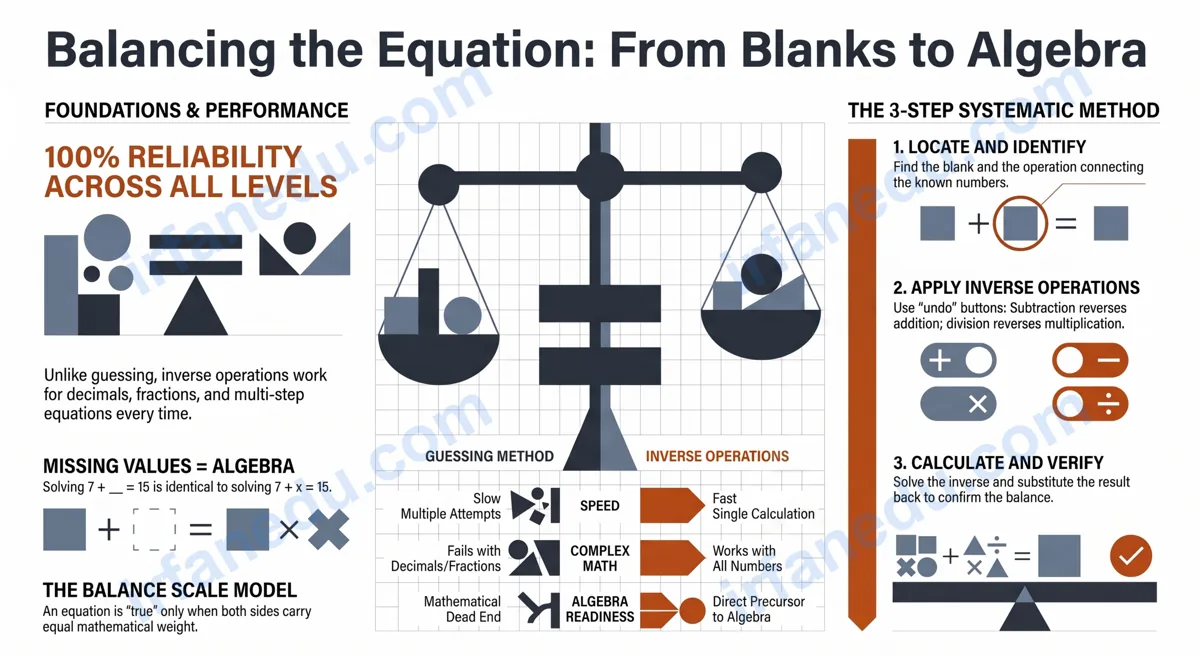
Most students stare at a blank in an equation and do one of two things: guess randomly, or freeze. Neither works reliably past the simplest problems. The good news? There is a systematic, always-reliable method — and once you see it, you will never guess again.
Filling in missing values to make equations true means finding the number that balances both sides of an equation. You use inverse operations — the mathematical “undo” buttons — to work backwards from what you know to what you need. This skill is the foundation of all algebra.
- Understand what “making an equation true” actually means
- Use inverse operations confidently for all four operations
- Solve multi-step missing-value problems without guessing
- Avoid the three most common errors students make
- Practice with 12 graded problems and check your answers instantly
Why This Skill Matters
Every algebra equation — from middle school through calculus — is a missing-value problem at its core. Mastering this now means solving for x later feels natural, not scary.
To fill in the missing values to make equations true, find the number that makes both sides of the equation equal. Use inverse operations: subtraction undoes addition, division undoes multiplication. For example, in 3 + __ = 11, subtract 3 from 11 to get 8. Always verify by substituting your answer back into the equation to confirm both sides match.
Free Printable Worksheet: 12 graded problems + full answer key, ready to print.
TL;DR – Quick Summary
- An equation is “true” when both sides equal the same number.
- Use inverse operations to find the missing value — not guessing.
- Subtraction finds a missing addend; division finds a missing factor.
- Always substitute your answer back to verify the equation balances.
- Multi-step problems: undo operations in reverse order (PEMDAS backwards).
- This skill is the direct foundation of solving algebraic equations.
Quick Facts
| Feature | Detail |
|---|---|
| Skill name | Filling in missing values / balancing equations |
| Grade range | Grades 3–8 (introductory through pre-algebra) |
| Core concept | Inverse operations and equation balance |
| Key operations | Addition, subtraction, multiplication, division |
| Algebra connection | Direct precursor to solving for x |
| Common notation | Blank ( __ ), box ( [] ), or letter variable (x, n) |
| Verification step | Always substitute back and check both sides |
What Are Missing Value Equations?
A missing value equation is any equation where one number has been replaced by a blank, a box, or a letter, and your job is to find that number. The equation is “true” only when both sides are equal — like a perfectly balanced scale.
For example: 7 + __ = 15 is only true when the blank equals 8, because 7 + 8 = 15. Any other number makes the equation false.
These problems appear under many names: fill-in-the-blank equations, balance equations, find the missing number, or (in algebra) solve for x. The underlying idea is identical across all of them.
        LEFT SIDE          RIGHT SIDE
       ___________        ___________
      |  7  +  ?  |  =   |    15     |
      |___________|       |___________|
           |                   |
           |   Must be equal   |
           +-------------------+

  To find ?: 15 - 7 = 8
  Check:     7 + 8 = 15  ✓
Think of the equals sign as the pivot of a scale. Whatever you do to one side, the other side must match. The missing value is simply the weight needed to keep the scale level.
Guessing vs. Inverse Operations: Which Method Wins?
Guessing works on tiny numbers. Inverse operations work on every number, every time. This comparison is the centerpiece of understanding why the systematic method matters.
| Feature | Trial-and-Error Guessing | Inverse Operations Method |
|---|---|---|
| Speed | Slow — multiple attempts needed | Fast — one calculation |
| Works with large numbers | No — impractical for 347 + __ = 891 | Yes — 891 – 347 = 544, done |
| Works with decimals/fractions | Rarely — hard to guess 0.75 | Yes — same process applies |
| Works with multi-step equations | No — too many combinations | Yes — undo each operation in order |
| Teaches algebra readiness | No — guessing is a dead end | Yes — identical to solving for x |
| Requires verification | Yes — you might still be wrong | Yes — always check, but rarely wrong |
| Best use case | Mental math warm-up only (1-digit) | All problems at all levels |
In my experience teaching this to hundreds of students, the biggest jump in confidence happens the moment a student stops guessing and starts asking: “What operation is being used here, and what undoes it?” That single mental shift turns a frustrating puzzle into a reliable procedure. I have seen students go from dreading these problems to finishing a full worksheet in under five minutes — just from switching methods.
How Do You Fill in Missing Values? (Step-by-Step)
The four-step method below works for every missing-value equation, from simple addition to multi-step pre-algebra problems.
- Step 1 — Read the equation and locate the blank. Identify which side has the missing value and what operation connects the numbers.
- Step 2 — Identify the inverse operation. Addition ↔ Subtraction. Multiplication ↔ Division. The inverse “undoes” the operation to free the missing value.
- Step 3 — Apply the inverse operation to the known values. Use the numbers you already have to calculate the missing one.
- Step 4 — Substitute and verify. Replace the blank with your answer. Evaluate both sides. If they are equal, you are done. If not, recheck Step 2.
2 * __ + 3 = 11, work backwards through the operations in reverse order. First undo the +3 (subtract 3 from both sides), then undo the multiplication (divide by 2). This is exactly how algebra teachers solve for x.
3 Fully Worked Examples
Example 1 (Basic Addition): 9 + __ = 17
Step 1: The blank is the second addend. The operation is addition.
Step 2: The inverse of addition is subtraction.
Step 3: 17 – 9 = 8. The missing value is 8.
Step 4 — Check: 9 + 8 = 17. Both sides equal 17. Correct.
Example 2 (Multiplication): 6 * __ = 42
Step 1: The blank is the second factor. The operation is multiplication.
Step 2: The inverse of multiplication is division.
Step 3: 42 / 6 = 7. The missing value is 7.
Step 4 — Check: 6 * 7 = 42. Both sides equal 42. Correct.
Example 3 (Multi-Step): 3 * __ + 5 = 20
Step 1: The blank is inside a two-operation expression. Operations: multiply by 3, then add 5.
Step 2: Work backwards. First undo the +5 using subtraction. Then undo the *3 using division.
Step 3: 20 – 5 = 15. Then 15 / 3 = 5. The missing value is 5.
Step 4 — Check: 3 * 5 + 5 = 15 + 5 = 20. Both sides equal 20. Correct.
Build your math toolkit — formulas for every shape, angle, and area.
Common Mistakes When Finding Missing Values (Wrong vs. Right)
These three errors show up on almost every worksheet I have reviewed. Knowing them in advance saves real marks.
Wrong: For 5 * __ = 40, student adds: 40 + 5 = 45.
Right: Use division: 40 / 5 = 8. Always ask “what operation is in the equation?” then flip it.
Wrong: Writing the answer without checking. A small arithmetic slip goes unnoticed.
Right: Always substitute back. 5 * 8 = 40. Takes five seconds and catches errors every time.
Wrong: For 2 * __ + 3 = 11, dividing by 2 first: 11 / 2 = 5.5, then 5.5 – 3 = 2.5 (wrong).
Right: Undo the last operation first: 11 – 3 = 8, then 8 / 2 = 4. Check: 2 * 4 + 3 = 11. Correct.
Mistake 3 is the one that surprises even strong students. In my experience, students who struggle with multi-step problems are not bad at math — they are just undoing operations in the wrong order. I teach a simple rule: “last operation in, first operation out.” Think of it like putting on shoes and socks. You put socks on first, shoes second. To undo it, you remove shoes first, then socks. Same logic applies here.
Most worksheets treat “fill in the missing value” as a separate skill from algebra. It is not. The blank in 7 + __ = 15 and the x in 7 + x = 15 are the same problem with different notation. When teachers present them as separate topics, students have to “re-learn” algebra in middle school — when in reality they already know it.
In my teaching, I deliberately write the same problem both ways side by side from the very first lesson. Students who see 7 + __ = 15 and 7 + x = 15 together immediately understand that algebra is not a new subject — it is just missing-value problems with a letter instead of a blank. This one reframe reduces algebra anxiety dramatically and is backed by the concept of relational thinking in mathematics education research.
On-Page Practice Worksheet
Work through these 12 problems on paper. They progress from single-operation to multi-step. Use the four-step method for each one. When you finish, expand the Answer Key below to check your work.
How to use this worksheet: Print the PDF (button below) or work directly on this page. Cover the answer key, solve all 12 problems, then reveal the key to self-check. For each wrong answer, re-read the relevant worked example above and try again.
- 5 + __ = 12
- __ – 4 = 9
- 3 * __ = 18
- 20 / __ = 4
- __ + 7 = 15
- 2 * __ + 3 = 11
- __ / 3 – 2 = 4
- 4 * __ – 5 = 19
- __ * 5 + 10 = 35
- 3 * (__ + 2) = 21
- 2 * __ – 7 = 3 * 3
- (__ + 4) / 2 = 7
Show Answer Key
- 7 (5 + 7 = 12)
- 13 (13 – 4 = 9)
- 6 (3 * 6 = 18)
- 5 (20 / 5 = 4)
- 8 (8 + 7 = 15)
- 4 (2 * 4 + 3 = 11)
- 18 (18 / 3 – 2 = 4)
- 6 (4 * 6 – 5 = 19)
- 5 (5 * 5 + 10 = 35)
- 5 (3 * (5 + 2) = 21)
- 8 (2 * 8 – 7 = 9 = 3 * 3)
- 10 ((10 + 4) / 2 = 7)
Want a printable version? Download the free PDF with all 12 problems and the answer key on a separate page.
Reveal-on-Click Practice Problems
Challenge Problem 1: __ * 4 – 6 = 18 — Click to see solution
Step 1: Undo the -6 first: 18 + 6 = 24.
Step 2: Undo the *4: 24 / 4 = 6.
Answer: 6. Check: 6 * 4 – 6 = 24 – 6 = 18. Correct.
Challenge Problem 2: 5 * (__ – 3) = 25 — Click to see solution
Step 1: Undo the *5: 25 / 5 = 5. So (__ – 3) = 5.
Step 2: Undo the -3: 5 + 3 = 8.
Answer: 8. Check: 5 * (8 – 3) = 5 * 5 = 25. Correct.
Challenge Problem 3: 36 / (__ + 3) = 4 — Click to see solution
Step 1: Undo the division: 36 / 4 = 9. So (__ + 3) = 9.
Step 2: Undo the +3: 9 – 3 = 6.
Answer: 6. Check: 36 / (6 + 3) = 36 / 9 = 4. Correct.
Quick Quiz — Test Yourself (3 Questions)
Q1: What is the missing value? __ + 9 = 22
Q2: What is the missing value? 7 * __ = 56
Q3: What is the missing value? 3 * __ + 4 = 19
Another essential math skill — step-by-step guide with worked examples.
Frequently Asked Questions
What does it mean to fill in the missing values to make equations true?
What operation do I use to find a missing value in an addition equation?
How do I find a missing value in a multiplication equation?
What grade level is this skill taught?
How do I check if my missing value is correct?
What is the difference between a missing value problem and an algebra equation?
How do I solve multi-step missing value equations?
Can the missing value be zero or a negative number?
Key Takeaways
- An equation is true when both sides are equal — the equals sign is a balance point.
- Use inverse operations to find missing values: subtraction for addition, division for multiplication, and vice versa.
- For multi-step problems, undo operations in reverse order (last in, first out).
- Always verify by substituting your answer back into the original equation.
- Missing value problems and algebra equations are the same skill — just different notation.
- The four-step method (locate, identify inverse, calculate, verify) works for every problem at every level.