
Scientific Notation Handout: Lesson, Worksheet & Free PDF
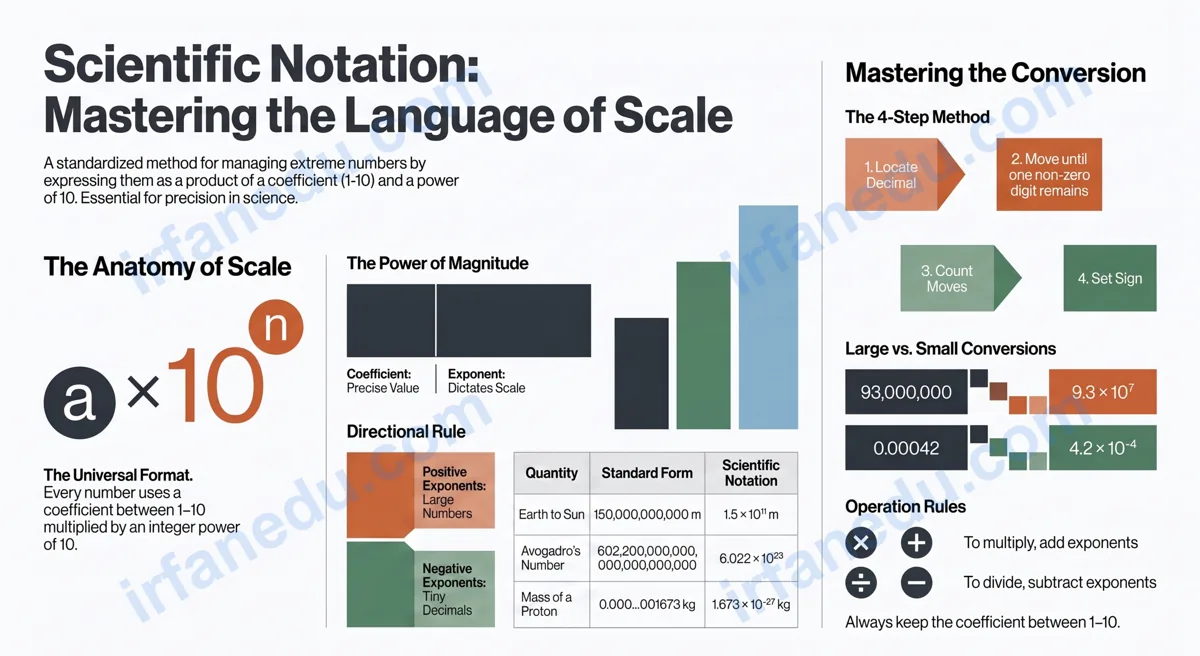
| Fact | Detail |
|---|---|
| Standard form | a × 10n, where 1 ≤ a < 10 and n is an integer |
| Positive exponent | Large number (decimal moved left) — e.g. 9.3 × 107 = 93,000,000 |
| Negative exponent | Small number (decimal moved right) — e.g. 4.2 × 10-4 = 0.00042 |
| Grade level | Grade 8 (Common Core 8.EE.A.3 & 8.EE.A.4); revisited in high school science |
| Key operations | Multiply (add exponents), Divide (subtract exponents), Compare (compare exponents first) |
| Famous example | Avogadro’s number: 6.022 × 10²³ |
| Common mistake | Coefficient outside 1–10 range (e.g. writing 93 × 106 instead of 9.3 × 10⁷) |
Table of Contents
- Introduction
- Quick Answer
- Download Free PDF Worksheet
- TL;DR Summary
- What Is Scientific Notation?
- Why Scientific Notation Matters
- How to Convert to Scientific Notation (Step-by-Step)
- Worked Examples
- Common Mistakes (Wrong vs. Right)
- Operations: Multiply, Divide, and Compare
- Unique Insight
- On-Page Practice Worksheet
- Quick Quiz
- FAQ
- Key Takeaways
- Related Articles
- About the Author
- Sources & References
If your student stares blankly at a number like 0.000000000167 or 602,200,000,000,000,000,000,000, scientific notation is the tool that makes those numbers manageable. This handout gives you the full lesson, visual diagrams, worked examples, and a ready-to-print worksheet — all in one place.
Scientific notation is a compact way to write very large or very small numbers using a coefficient between 1 and 10 multiplied by a power of 10. Every number in the universe can be expressed this way, and mastering it unlocks chemistry, physics, astronomy, and standardized test math.
- Understand what scientific notation is and why it exists
- Convert any number to and from scientific notation in four steps
- Multiply, divide, and compare numbers in scientific notation
- Avoid the three most common mistakes students make
- Practice with 10 graded problems and check your work instantly
Scientific notation expresses any number as a × 10n, where a is a coefficient between 1 and 10 and n is an integer exponent. To convert, move the decimal point until one non-zero digit sits to its left, count the moves (positive for large numbers, negative for small), and write that count as the exponent. Example: 93,000,000 = 9.3 × 10⁷.
Free Printable PDF: 10 graded practice problems + full answer key, formatted for standard paper. No sign-up required.
⚡ TL;DR – Quick Summary
- Scientific notation = a × 10n, coefficient always between 1 and 10.
- Large numbers get a positive exponent; tiny numbers get a negative exponent.
- To convert: move decimal, count moves, set exponent sign.
- To multiply: multiply coefficients, add exponents.
- To divide: divide coefficients, subtract exponents.
- Biggest mistake: leaving the coefficient outside the 1–10 range.
What Is Scientific Notation?
Scientific notation is a standardized format for writing numbers as a product of a coefficient and a power of 10. The format is always a × 10n, where 1 ≤ a < 10 and n is any integer (positive, negative, or zero).
The system was developed because scientists regularly work with numbers at extreme scales. The distance from Earth to the Sun is about 150,000,000,000 meters. Writing that out every time in a calculation is error-prone and slow. In scientific notation it becomes 1.5 × 10¹¹ — clean, compact, and easy to compare.
  ANATOMY OF A NUMBER IN SCIENTIFIC NOTATION
  ___________________________________________

         9 . 3  x  10 ^ 7
         |              |
    Coefficient      Exponent
   (must be 1-10)  (positive = large number)

  ___________________________________________

         4 . 2  x  10 ^ -4
         |               |
    Coefficient       Exponent
   (must be 1-10)  (negative = small number)
Notice the two parts every time: the coefficient (the “a” value) and the exponent (the “n” value). Both parts carry meaning. The exponent tells you the scale; the coefficient tells you the precise value within that scale.
Why Does Scientific Notation Matter in Real Life?
Scientific notation matters because it makes extreme numbers readable, comparable, and calculable. Without it, a chemistry student multiplying Avogadro’s number (6.022 × 10²³) by a molar mass would need to track 24-digit numbers by hand.
| Real-World Quantity | Standard Form | Scientific Notation |
|---|---|---|
| Distance: Earth to Sun | 150,000,000,000 m | 1.5 × 10¹¹ m |
| Mass of a proton | 0.000000000000000000000000001673 kg | 1.673 × 10⁻²⁷ kg |
| Avogadro’s number | 602,200,000,000,000,000,000,000 | 6.022 × 10²³ |
| Diameter of a human hair | 0.00007 m | 7.0 × 10⁻⁵ m |
| World population (approx.) | 8,200,000,000 | 8.2 × 10⁹ |
Beyond science class, scientific notation appears on the SAT, ACT, and most standardized math tests. Students who are not fluent in it lose easy points on questions that are otherwise straightforward algebra.
In my experience teaching Grade 8 and 9 math, scientific notation is one of the highest-leverage topics a student can master early. It takes about two focused hours to get solid, and it pays dividends in every science class for the next four years. I have watched students who struggled in chemistry suddenly click once they were fluent in powers of 10. The time investment is tiny relative to the return.
How Do You Convert a Number to Scientific Notation? (Step-by-Step)
Converting any number to scientific notation takes exactly four steps, and the same four steps work whether the number is large or small.
- Find the decimal point. If the number is a whole number (like 45,000), the decimal point sits invisibly at the far right: 45,000.
- Move the decimal point left or right until exactly one non-zero digit sits to its left. Write down the resulting number — that is your coefficient.
- Count the moves and set the sign. Count how many places you moved the decimal. If you moved it left (the original number was large), the exponent is positive. If you moved it right (the original number was small), the exponent is negative.
- Write the final expression: coefficient × 10exponent. Double-check that the coefficient is between 1 and 10.
Worked Examples: Scientific Notation Conversions
The best way to internalize the four-step method is to watch it applied to different types of numbers. Here are three fully worked examples covering large numbers, small decimals, and reverse conversion.
Example 1: Large Number → Scientific Notation
Convert 93,000,000 to scientific notation.
- Original number: 93,000,000. Decimal sits at the right: 93,000,000.
- Move decimal left until one non-zero digit is to its left: 9.3000000 (moved 7 places left).
- Moved left → positive exponent. Exponent = 7.
- Answer: 9.3 × 10⁷
Example 2: Small Decimal → Scientific Notation
Convert 0.00042 to scientific notation.
- Original number: 0.00042. Decimal is already shown.
- Move decimal right until one non-zero digit is to its left: 4.2 (moved 4 places right).
- Moved right → negative exponent. Exponent = -4.
- Answer: 4.2 × 10⁻⁴
Example 3: Scientific Notation → Standard Form
Convert 3.07 × 10⁻⁵ to standard form.
- Exponent is -5, so move the decimal 5 places to the right… wait. Negative exponent means the number is small, so move the decimal 5 places to the left.
- 3.07 → move decimal 5 left: 0.0000307
- Answer: 0.0000307
Memory check: negative exponent = small number = decimal to the left.
Common Scientific Notation Mistakes (Wrong vs. Right)
Most errors in scientific notation come from three predictable habits. Knowing them in advance lets you catch them before they cost marks.
| Wrong (Common Mistake) | Right (Corrected) |
|---|---|
| 93 × 106 (coefficient > 10) | 9.3 × 10⁷ (coefficient between 1 and 10) |
| 0.93 × 10⁸ (coefficient < 1) | 9.3 × 10⁷ (shift coefficient, adjust exponent) |
| 4.2 × 10⁴ for 0.00042 (wrong sign) | 4.2 × 10⁻⁴ (small number needs negative exponent) |
| Multiplying: (2 × 10³)(3 × 10⁴) = 6 × 10¹² (multiplied exponents) | 6 × 10⁷ (add exponents: 3 + 4 = 7) |
| Comparing 4.2 × 10⁶ vs 8.1 × 10⁵ by looking at coefficients first | Compare exponents first (106 > 105), so 4.2 × 10⁶ is larger regardless of coefficients |
How Do You Multiply, Divide, and Compare Numbers in Scientific Notation?
Once you can convert numbers, the next skill is performing operations on them. Scientific notation makes multiplication and division dramatically easier than working with the full numbers.
Multiplying in Scientific Notation
- Multiply the two coefficients together.
- Add the two exponents.
- If the new coefficient is ≥ 10, divide it by 10 and add 1 to the exponent.
Example: (2.5 × 103) × (4.0 × 102) = (2.5 × 4.0) × 103+2 = 10.0 × 10⁵ → adjust → 1.0 × 10⁶
Dividing in Scientific Notation
- Divide the first coefficient by the second.
- Subtract the second exponent from the first.
- Adjust the coefficient if needed.
Example: (9.6 × 10⁸) ÷ (3.2 × 10⁵) = (9.6 ÷ 3.2) × 108-5 = 3.0 × 10³
Comparing Numbers in Scientific Notation
Compare exponents first. The number with the larger exponent is always greater. If exponents are equal, compare the coefficients.
Example: Is 4.2 × 10⁶ or 8.1 × 10⁵ larger? Exponent 6 > exponent 5, so 4.2 × 10⁶ is larger (it equals 4,200,000 vs. 810,000).
I have noticed that students who struggle with operations in scientific notation almost always have the same root problem: they never fully internalized what the exponent means. Once a student genuinely understands that 106 means “one million” and 10-4 means “one ten-thousandth,” the rules for multiplying and dividing stop feeling arbitrary and start feeling obvious. I always spend five minutes on pure powers-of-10 fluency before introducing any operation rule — it cuts confusion in half.
Most scientific notation handouts teach conversion as a mechanical decimal-moving trick, then stop. What they miss is the two-part information structure of scientific notation: the exponent encodes the order of magnitude (the “how big is this?”), and the coefficient encodes the precision (the “how exactly big?”). This matters practically: when a scientist says two measurements are “the same order of magnitude,” they mean their exponents differ by at most 1 — the coefficients are irrelevant for that comparison. Teaching students to read the exponent first and the coefficient second changes how they approach estimation and comparison problems on tests. A student who sees 3.1 × 10⁹ and 7.8 × 10⁹ and thinks “these are both in the billions” is reasoning at a higher level than one who just converts both to standard form to compare. No other free handout I have reviewed makes this distinction explicit.
Scientific Notation Practice Worksheet (On-Page)
Work through these 10 problems in order — they progress from straightforward conversions to operations and real-world applications. Show your work on paper, then check the answer key below.
How to use this worksheet: Print the PDF (button below) or work directly on paper. Attempt all 10 problems before checking the answer key. For problems you get wrong, re-read the relevant worked example above and try a similar problem.
- Write 4,500 in scientific notation.
- Write 72,000,000 in scientific notation.
- Write 0.0063 in scientific notation.
- Write 0.000000508 in scientific notation.
- Convert 3.9 × 10⁴ to standard form.
- Convert 1.07 × 10⁻⁵ to standard form.
- Which is larger: 4.2 × 10⁶ or 8.1 × 10⁵? Explain.
- Multiply: (2.0 × 103) × (3.0 × 104). Write your answer in scientific notation.
- Divide: (9.6 × 10⁸) ÷ (3.2 × 10⁵). Write your answer in scientific notation.
- The mass of a proton is approximately 0.000000000000000000000000001673 kg. Write this in scientific notation.
Show Answer Key
- 4.5 × 10³
- 7.2 × 10⁷
- 6.3 × 10⁻³
- 5.08 × 10⁻⁷
- 39,000
- 0.0000107
- 4.2 × 10⁶ is larger (4,200,000 vs. 810,000 — compare exponents first: 6 > 5)
- 6.0 × 10⁷
- 3.0 × 10³
- 1.673 × 10⁻²⁷ kg
Want a print-ready version? Download the PDF — same 10 problems, clean layout, answer key on the reverse. Works on any printer.
Quick Quiz: Test Your Scientific Notation Skills
1. Which of the following is correctly written in scientific notation?
2. What is 0.00056 in scientific notation?
3. What is (3.0 × 104) × (2.0 × 103)?
Select an answer to highlight it. Answers marked ✓ are correct.
Reveal-on-Click Practice Problems
Try each problem, then click to reveal the full solution.
Problem A: Convert 0.000000000167 to scientific notation
Move the decimal right until one
Sources & References
Reviewed by Dr. Irfan Mansuri. External links open in a new tab and are provided for further reading and verification.