
Technical Math: Core Formulas, Concepts & Worked Examples
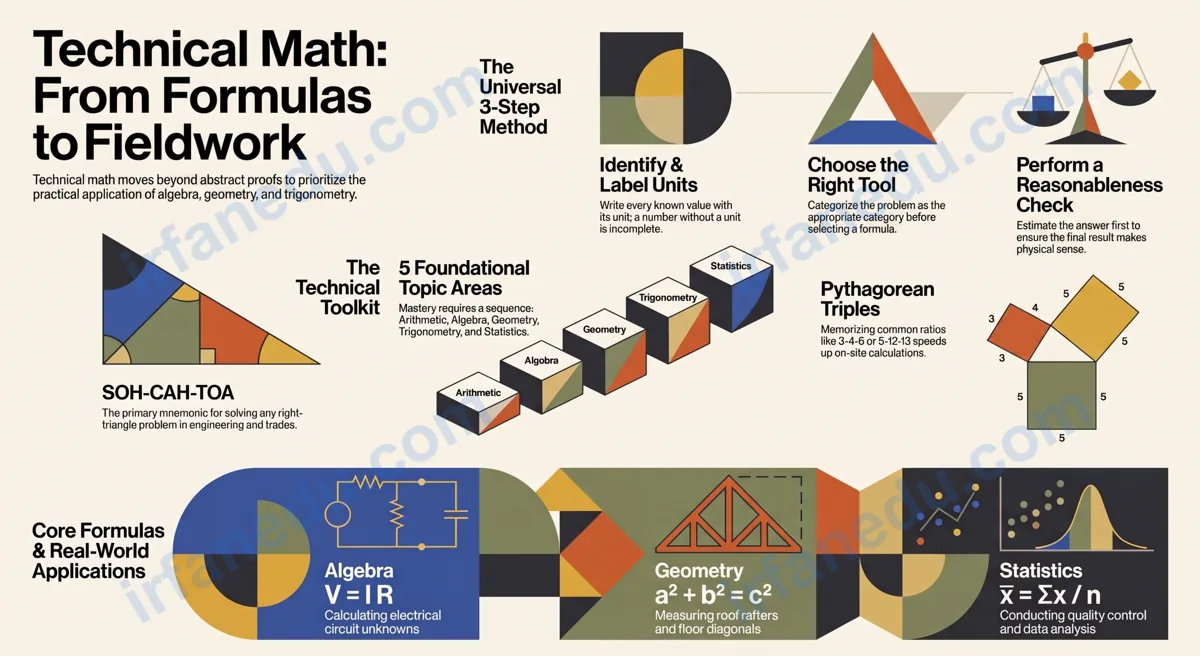
Algebra: ax + b = c → x = (c - b) / a
Pythagorean Theorem: a² + b² = c²
Area of a Circle: A = πr²
Ohm’s Law (applied): V = I × R
Slope of a Line: m = (y&sub2; - y&sub1;) / (x&sub2; - x&sub1;)
Trigonometry (SOH-CAH-TOA): sinθ = opp/hyp | cosθ = adj/hyp | tanθ = opp/adj
Mean: x̄ = ∑x / n
Technical math is the branch of mathematics that applies algebra, geometry, trigonometry, measurement, and basic statistics to solve real-world problems. Unlike pure math, it prioritises using formulas and step-by-step procedures over abstract proofs, making it the essential skill set for students entering technical, vocational, or STEM career pathways.
If you have ever stared at a formula and wondered why it matters, this guide is for you. I have taught technical math at multiple levels for over 15 years, and the single biggest obstacle I see is not intelligence — it is that students are handed formulas without seeing them in action first. This article flips that. Every concept here starts with the formula, then proves it with a worked example you can follow line by line.
- Understand what technical math covers and why it matters for your future
- Master the five core topic areas with clear formulas and examples
- Avoid the most common errors that cost students marks
- Use a repeatable 5-step method for any technical math problem
- Test yourself with an interactive quiz and practice problems
⚡ TL;DR – Quick Summary
- Technical math applies five core areas: algebra, geometry, trigonometry, measurement, and statistics.
- Every problem type has a specific formula — learn the formula first, then the example.
- Unit analysis (tracking units) eliminates the majority of calculation errors.
- SOH-CAH-TOA solves any right-triangle problem in technical trades and engineering.
- A 5-step problem-solving method works across all technical math topics.
- Technical math is used daily by electricians, nurses, engineers, and programmers.
| Topic | Core Formula | Real-World Use |
|---|---|---|
| Algebra | ax + b = c | Calculating material costs, circuit unknowns |
| Geometry | A = πr², V = lwh | Flooring, piping, blueprint reading |
| Trigonometry | sin/cos/tan | Roof angles, pipe offsets, surveying |
| Measurement | Unit conversion ratios | Scaling recipes, converting units on the job |
| Statistics | x̄ = ∑x / n | Quality control, test score analysis |
What Is Technical Math?
Technical math is mathematics applied directly to practical, real-world problems. It is the math used on a job site, in a lab, in a clinic, or in a workshop — not the math used to prove theorems on a blackboard.
The term covers a specific curriculum taught in US high schools and community colleges, typically as a standalone course (often called “Technical Mathematics” or “Applied Math”) that prepares students for trades, technology, and health-science programs. According to the Khan Academy Math curriculum, the foundational skills in algebra, geometry, and data handling are the building blocks every student needs before specialising.
What separates technical math from a standard algebra or pre-calculus course is its emphasis on context. You are not solving for x in a vacuum — you are finding the length of a pipe, the voltage in a circuit, or the area of a floor. That context makes the math stick.
In my experience teaching this subject, students who struggle with technical math almost always have one specific gap: they never learned to carry units through a calculation. A number without a unit is just a number. A number with a unit is an answer. I spend the first week of any technical math course drilling unit analysis, and it transforms student confidence faster than any other intervention I have tried.
What Are the Core Topics in Technical Math?
Technical math covers five main topic areas, each building on the previous one. Here is how they connect:
| Topic Area | What You Learn | Builds On | Difficulty |
|---|---|---|---|
| Arithmetic & Fractions | Operations, ratios, percentages | Nothing — entry point | Low |
| Algebra | Equations, formulas, variables | Arithmetic | Low-Medium |
| Geometry | Area, volume, angles, shapes | Arithmetic | Medium |
| Trigonometry | Right triangles, sine/cosine/tangent | Geometry + Algebra | Medium |
| Statistics | Mean, median, mode, graphs | Arithmetic | Low-Medium |
Most technical math courses run in this order. If you are studying independently, follow this sequence — skipping ahead to trigonometry without solid algebra will make the work much harder than it needs to be.
Algebra: How Do You Solve Equations in Technical Math?
In technical math, algebra means rearranging a formula to find an unknown value. You are not factoring polynomials — you are isolating one variable using inverse operations.
ax + b = c
Step 1: Subtract b from both sides: ax = c - b
Step 2: Divide both sides by a: x = (c - b) / a
Problem: An electrician uses Ohm’s Law: V = I × R. The voltage V = 120 V and the current I = 4 A. Find the resistance R.
Step 1: Write the formula: V = I × R
Step 2: Rearrange to isolate R: R = V / I
Step 3: Substitute: R = 120 V / 4 A
Answer: R = 30 ohms (Ω)
Notice how the units divide: V/A = Ω. Unit analysis confirms the answer is correct.
Problem: A carpenter buys lumber at $3.50 per linear foot. The total bill is $87.50. How many feet did she buy?
Formula: Total = Price × Quantity → Quantity = Total / Price
Substitute: Quantity = $87.50 / $3.50 per ft = 25 ft
Answer: 25 linear feet
Geometry: How Do You Calculate Area, Volume & Diagonal Distances?
Geometry in technical math focuses on three things: area (2D surfaces), volume (3D spaces), and the Pythagorean theorem (diagonal distances). These appear constantly in construction, manufacturing, and design.
Rectangle Area: A = l × w
Circle Area: A = πr²
Cylinder Volume: V = πr²h
Rectangular Prism Volume: V = l × w × h
Pythagorean Theorem: a² + b² = c²
         c (hypotenuse)
        /|
       / |
      /  |  b (vertical leg)
     /   |
    /____|
       a (horizontal leg)

  a² + b² = c²

  Example: a = 6 ft, b = 8 ft
  c² = 6² + 8² = 36 + 64 = 100
  c  = √100 = 10 ft
Problem: A roof has a horizontal run of 12 ft and a vertical rise of 5 ft. How long is the rafter (the diagonal)?
Formula: c = √(a² + b²)
Substitute: c = √(12² + 5²) = √(144 + 25) = √169 = 13 ft
Answer: The rafter is 13 ft long.
This is a classic 5-12-13 Pythagorean triple — memorising common triples (3-4-5, 5-12-13, 8-15-17) saves time on the job.
Want more geometry practice? My complete formula reference covers every shape you need.
Trigonometry: How Does SOH-CAH-TOA Work in Technical Math?
Trigonometry in technical math almost always means right-triangle trigonometry. The three ratios — sine, cosine, and tangent — let you find any side or angle in a right triangle when you know two other measurements.
sin(θ) = Opposite / Hypotenuse
cos(θ) = Adjacent / Hypotenuse
tan(θ) = Opposite / Adjacent
To find an angle: θ = sin⁻¹(opp/hyp) | θ = tan⁻¹(opp/adj)
Problem: A plumber needs to route a pipe around an obstacle. The pipe must travel 10 inches horizontally and rise 6 inches vertically. What angle does the pipe make with the horizontal?
Identify: Opposite = 6 in (rise), Adjacent = 10 in (run)
Formula: tan(θ) = opp / adj = 6 / 10 = 0.6
Solve: θ = tan⁻¹(0.6) ≈ 30.96°
Answer: The pipe is bent at approximately 31° from horizontal.
[IMAGE: SOH-CAH-TOA right triangle diagram labelled with opposite, adjacent, hypotenuse and angle theta | ALT: SOH-CAH-TOA trigonometry diagram for technical math students]
Most textbooks introduce trig with the unit circle, which is beautiful mathematics but completely alienating for a student who just wants to cut a roof rafter. In my experience, starting with a physical right-triangle sketch — label the sides, write SOH-CAH-TOA, pick the ratio — gets students solving real problems in under 30 minutes. Save the unit circle for pre-calculus.
Measurement & Unit Conversion: Why Do Units Matter So Much?
Unit conversion is the skill that separates a student who gets the right number from a student who gets the right answer. A number without a unit is incomplete in technical math.
Result = Given × (Conversion Factor)
Example: 5 ft × (12 in / 1 ft) = 60 in
Units cancel like fractions: ft × (in/ft) = in
Problem: A machine operates at 45 miles per hour. Convert to feet per second.
Step 1: 45 mi/hr × (5280 ft / 1 mi) = 237,600 ft/hr
Step 2: 237,600 ft/hr × (1 hr / 3600 s) = 66 ft/s
Answer: 66 feet per second
Basic Statistics: What Are Mean, Median & Mode in Technical Math?
Basic statistics in technical math means summarising data sets quickly and accurately. Three measures — mean, median, and mode — each tell you something different about a data set.
Mean (average): x̄ = (x&sub1; + x&sub2; + ... + xₙ) / n
Median: Middle value when data is sorted (average of two middle values if n is even)
Mode: The value that appears most often
Problem: A machinist measures the diameter of 7 bolts (in mm): 10.1, 10.2, 10.0, 10.3, 10.1, 10.4, 10.1. Find the mean, median, and mode.
Mean: (10.1+10.2+10.0+10.3+10.1+10.4+10.1) / 7 = 71.2 / 7 ≈ 10.17 mm
Sorted: 10.0, 10.1, 10.1, 10.1, 10.2, 10.3, 10.4 → Median = 10.1 mm
Mode = 10.1 mm (appears 3 times)
In quality control, the mode tells you the most common measurement — useful for detecting a systematic machine offset.
Common Technical Math Mistakes (Wrong vs. Right)
These are the errors I see most often in student work. Each one has a simple fix.
| Mistake | Wrong Approach | Correct Approach |
|---|---|---|
| Dropping units | Writing “R = 30” with no unit | Always write “R = 30 Ω” — units are part of the answer |
| Squaring the diameter instead of radius | A = π(10)² when diameter = 10 | Radius = 5, so A = π(5)² = 78.54 units² |
| Using the wrong trig ratio | Using sin when you have opposite & adjacent | Opposite + adjacent = tan; label the triangle first |
| Rounding too early | Rounding to 3.14 mid-calculation | Keep full precision until the final answer, then round |
| Inverting a conversion fraction | Multiplying by (1 ft / 12 in) to go from ft to in | Multiply by (12 in / 1 ft) so feet cancel |
How Do You Solve Any Technical Math Problem in 5 Steps?
This repeatable method works for every technical math problem, regardless of topic. Internalise it and you will never stare blankly at a problem again.
- Read and identify. Read the problem twice. Write down what is given (known values with units) and what you need to find (the unknown).
- Choose the formula. Select the correct formula for the situation. If you are not sure, ask: is this a shape problem (geometry), an angle problem (trig), an equation problem (algebra), or a data problem (statistics)?
- Label every unit. Write every value with its unit before substituting into the formula. This is the step most students skip — and it is the most important one.
- Substitute and solve. Plug the known values into the formula. Perform the arithmetic step by step, showing your work.
- Check reasonableness. Ask whether the answer makes physical sense. A room that is 50,000 square feet is not a room — it is a mistake. Estimate the answer before you calculate to catch errors early.
Problem: A cylindrical water tank has a radius of 3 m and a height of 4 m. How many cubic metres of water does it hold?
Step 1 — Identify: Given: r = 3 m, h = 4 m. Find: Volume (V).
Step 2 — Formula: V = πr²h
Step 3 — Units: r = 3 m, h = 4 m (both in metres — consistent, no conversion needed)
Step 4 — Solve: V = π × 3² × 4 = π × 9 × 4 = 36π ≈ 113.1 m³
Step 5 — Check: A 3 m radius, 4 m tall cylinder holding ~113 m³ is reasonable (about the size of a large above-ground pool). Answer confirmed.
Most guides teach technical math topics in isolation. They give you an algebra chapter, then a geometry chapter, then a trig chapter — as if these are separate subjects. In real technical work, they are not.
A single pipe-routing problem might require you to use the Pythagorean theorem (geometry) to find the pipe length, then use a trig ratio to find the bend angle, then use a linear equation (algebra) to calculate the material cost. The skill that transfers to the job is recognising which tool to reach for — not drilling each tool in isolation.
In my experience, students who practise “mixed” problems — where the topic is not labelled for them — outperform students who only drill topic-specific exercises by a significant margin on technical assessments. If your textbook does not include mixed problems, create your own by combining two steps from different chapters into one scenario.
Building on technical math? My exponential and logarithmic functions guide is the natural next step for students heading into advanced technical courses.
Quick Quiz: Test Your Technical Math Knowledge
Technical Math — 3-Question Quiz
1. A right triangle has legs of 9 cm and 12 cm. What is the length of the hypotenuse?
2. Ohm’s Law: V = I × R. If V = 240 V and R = 60 Ω, what is the current I?
3. A data set is: 5, 8, 8, 10, 14. What is the mean?
Practice Problems — Reveal the Solution When Ready
Problem 1: A circle has a diameter of 14 cm. Find its area. (Use π ≈ 3.14159)
Step 1: Radius = diameter / 2 = 14 / 2 = 7 cm
Step 2: A = πr² = 3.14159 × 7² = 3.14159 × 49 ≈ 153.94 cm²
Common error: using 14 instead of 7 gives 615.75 cm² — four times too large.
Problem 2: Convert 2.5 gallons to litres. (1 gallon = 3.785 litres)
Setup: 2.5 gal × (3.785 L / 1 gal)
Solve: 2.5 × 3.785 = 9.4625 L ≈ 9.46 L
Units check: gal × (L/gal) = L. Correct.
Problem 3: A ladder leans against a wall. The base is 5 ft from the wall and the ladder is 13 ft long. How high up the wall does it reach?
Formula: a² + b² = c², where c = 13 ft (hypotenuse), a = 5 ft (base)
Rearrange: b² = c² – a² = 169 – 25 = 144
Solve: b = √144 = 12 ft
This is the 5-12-13 Pythagorean triple.
Problem 4: Find the angle of elevation if a ramp rises 3 ft over a horizontal distance of 10 ft.
Identify: Opposite = 3 ft (rise), Adjacent = 10 ft (run)
Formula: tan(θ) = opp / adj