
🍕 1/4 + 2/3 in Fraction Form — The Real Answer (and Why Most Students Get It Wrong)
🍕 Real-World Scenario — Why This Problem Matters Right Now
Imagine you’re making a batch of cookies 🍪. The recipe calls for 1/4 cup of brown sugar and 2/3 cup of white sugar. You want to know the total amount of sugar before you reach for the measuring cups. That single question — how much sugar altogether? — is exactly the problem 1/4 + 2/3 solves.
Or picture this: you’ve finished 1/4 of your homework before dinner and 2/3 of it after dinner. What fraction of your homework is done? Same math. Same answer.
Fractions show up in cooking, carpentry, time management, and test scores every single day. Knowing how to add them — correctly — is one of the most practical math skills you’ll ever learn.
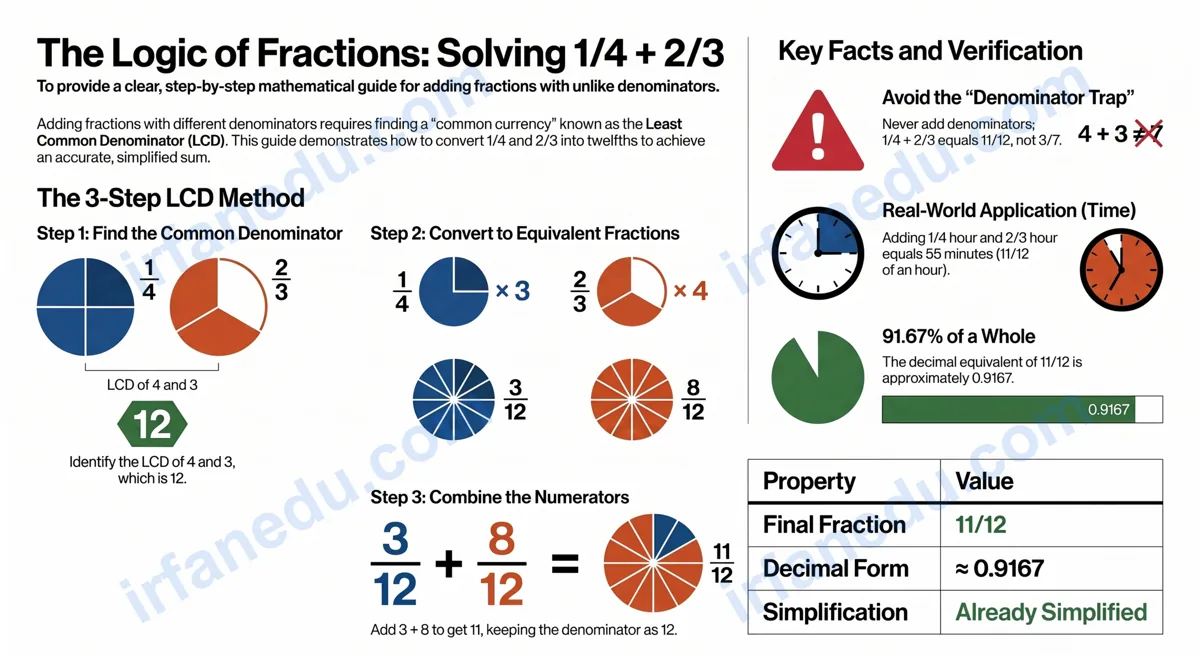
1/4 + 2/3 in fraction form equals 11/12. To add these two fractions, you first find the Least Common Denominator (LCD) of 4 and 3, which is 12. You then rewrite 1/4 as 3/12 and 2/3 as 8/12. Adding the numerators gives 3 + 8 = 11, so the answer is 11/12 — a proper fraction already in its simplest form.
- The exact answer to 1/4 + 2/3 and why it equals 11/12
- How to find the LCD of any two denominators
- The #1 mistake students make (and how to avoid it)
- Real-world uses of this exact fraction problem
- A visual diagram, a quiz, and practice problems to lock it in
1/4 + 2/3 = 11/12. Find the LCD of 4 and 3 (it’s 12). Convert: 1/4 becomes 3/12 and 2/3 becomes 8/12. Add the numerators: 3 + 8 = 11. The denominator stays 12. The answer is 11/12, which is already fully simplified because 11 is prime and shares no factor with 12.
- 🟠 Answer: 1/4 + 2/3 = 11/12 (proper fraction, fully simplified)
- 🟠 LCD of 4 and 3 is 12 — the smallest number both divide into evenly
- 🟠 Convert: 1/4 → 3/12 (multiply top & bottom by 3); 2/3 → 8/12 (multiply by 4)
- 🟠 Add numerators only: 3 + 8 = 11; keep denominator 12
- 🟠 11/12 ≈ 0.917 as a decimal — just under a whole
- 🟠 Never add denominators — that gives the wrong answer every time
| 📌 Fact | 📋 Detail |
|---|---|
| Problem | 1/4 + 2/3 |
| Answer (fraction) | 11/12 |
| Answer (decimal) | ≈ 0.9167 |
| Answer (percent) | ≈ 91.67% |
| LCD of 4 and 3 | 12 |
| Can it be simplified? | No — 11 is prime |
| Is it a proper fraction? | Yes (11 < 12) |
| Mixed number form | Not applicable (already proper) |
🎨 Visual Solution — See the Fractions Before You Solve Them
Before touching any numbers, I always tell my students: draw it first. A visual model makes the LCD method click instantly. Here’s a fraction-bar diagram showing exactly what’s happening.
STEP 1 — Original fractions
━━━━━━━━━━━━━━━━━━━━━━━━━━━━━━━━━━━━━━━━━━━━━━━━━
  1/4  →  [ ■ |   |   |   ]   (1 of 4 equal parts)
  2/3  →  [ ■ | ■ |   ]       (2 of 3 equal parts)

STEP 2 — Convert BOTH to twelfths (LCD = 12)
━━━━━━━━━━━━━━━━━━━━━━━━━━━━━━━━━━━━━━━━━━━━━━━━━
  1/4  =  3/12  →  [ ■ | ■ | ■ |   |   |   |   |   |   |   |   |   ]
  2/3  =  8/12  →  [ ■ | ■ | ■ | ■ | ■ | ■ | ■ | ■ |   |   |   |   ]

STEP 3 — Add (count all shaded pieces out of 12)
━━━━━━━━━━━━━━━━━━━━━━━━━━━━━━━━━━━━━━━━━━━━━━━━━
  3/12 + 8/12 = 11/12
  [ ■ | ■ | ■ | ■ | ■ | ■ | ■ | ■ | ■ | ■ | ■ |   ]
                                              ↑
                                    11 shaded, 1 empty
                                    Answer = 11/12 ✓
Notice how the bars only make sense once every piece is the same size (twelfths). That’s the entire reason we find a common denominator — we can only count pieces when they’re equal in size. 🟠
🌍 Where Does 1/4 + 2/3 Actually Show Up in Real Life?
Real-world fraction addition happens constantly — you just don’t always notice it. Here are five genuine scenarios where this exact calculation matters.
| 🌐 Situation | 1/4 represents | 2/3 represents | Why 11/12 matters |
|---|---|---|---|
| 🍳 Cooking | 1/4 cup oil | 2/3 cup broth | Total liquid = 11/12 cup — fits in a 1-cup measure |
| ⏰ Time | 1/4 hour (15 min) studying | 2/3 hour (40 min) reading | Total = 11/12 hour = 55 minutes |
| 🏗️ Carpentry | 1/4 inch trim piece | 2/3 inch board | Total thickness = 11/12 inch |
| 📊 Progress tracking | 1/4 of project done Monday | 2/3 done Tuesday | 11/12 complete — almost finished! |
| 💊 Medicine/dosing | 1/4 teaspoon ingredient A | 2/3 teaspoon ingredient B | Total = 11/12 teaspoon in the mix |
In my 15+ years of teaching math, I’ve found that students who see the why before the how retain the skill far longer. When I ask “how much sugar total?” before writing a single number on the board, students are already motivated to find the answer. The algorithm becomes a tool, not a chore. If you’re a parent helping with homework, try framing the problem as a cooking question first — it changes everything.
🔢 How Do You Add 1/4 + 2/3 Step by Step?
Adding 1/4 + 2/3 requires four clean steps — find the LCD, convert both fractions, add the numerators, and simplify. Here’s each step in full detail.
-
Identify the denominators.
The denominators are 4 and 3. These are different, so you cannot add the fractions yet. You need a common denominator first. -
Find the LCD (Least Common Denominator).
List multiples of each denominator until you find the first one they share.
Multiples of 4: 4, 8, 12, 16, 20…
Multiples of 3: 3, 6, 9, 12, 15…
The LCD is 12. -
Convert 1/4 to an equivalent fraction with denominator 12.
Ask: what do I multiply 4 by to get 12? Answer: 3.
Multiply both numerator and denominator by 3:
1 × 3 / 4 × 3 = 3/12 -
Convert 2/3 to an equivalent fraction with denominator 12.
Ask: what do I multiply 3 by to get 12? Answer: 4.
Multiply both numerator and denominator by 4:
2 × 4 / 3 × 4 = 8/12 -
Add the numerators. Keep the denominator.
3/12 + 8/12 = 11/12
The denominator stays 12 — do NOT add the denominators. -
Simplify if possible.
Check: does 11 share any factor with 12 (other than 1)?
11 is a prime number. Its only factors are 1 and 11. Since 12 is not divisible by 11, the GCF is 1.
11/12 is already in simplest form. ✅
14
+
23
=
312
+
812
=
1112
When the two denominators share no common factor (like 4 and 3, which are coprime), the LCD is simply their product: 4 × 3 = 12. You can skip listing multiples entirely. This shortcut works whenever GCF(a, b) = 1.
❓ What Is the LCD and Why Does It Actually Work?
The Least Common Denominator (LCD) is the smallest number that is a multiple of both denominators. It works because multiplying a fraction’s top and bottom by the same number creates an equivalent fraction — the same value, just expressed in smaller or larger pieces.
Think of it like currency exchange. If you have quarters (1/4) and thirds (1/3), you can’t add them directly because the “coins” are different sizes. Converting to twelfths is like exchanging both into a common currency — now every piece is the same size and you can count them together.
You can always verify a fraction addition answer by converting to decimals:
- 1/4 = 0.25
- 2/3 = 0.6667
- 0.25 + 0.6667 = 0.9167
- 11/12 = 11 ÷ 12 = 0.9167 ✅
The decimal check confirms 11/12 is correct. Use this trick on any test to double-check your work in under 10 seconds.
🚫 What Are the Most Common Mistakes When Adding 1/4 + 2/3?
Three specific errors account for nearly every wrong answer I see on fraction addition problems. Knowing them by name makes them easy to avoid.
Mistake #1 — Adding Denominators (The Biggest One)
1/4 + 2/3 = 3/7
(added 1+2=3 and 4+3=7)
1/4 + 2/3 = 3/12 + 8/12 = 11/12
(converted to LCD first)
3/7 ≈ 0.43. But 1/4 alone is 0.25 and 2/3 alone is 0.67 — their sum must be greater than 0.67. So 3/7 is obviously wrong. Always sanity-check your answer against the larger fraction.
Mistake #2 — Using a Common Denominator That Isn’t the LCD
Using 24 as denominator:
6/24 + 16/24 = 22/24
(forgot to simplify)
22/24 simplified = 11/12 ✅
(always simplify at the end)
Using 24 instead of 12 isn’t technically wrong — but it creates extra simplification work. Using the LCD (12) keeps numbers smaller and reduces errors.
Mistake #3 — Multiplying Only the Numerator
1/4 → multiply top by 3 → 3/4
(forgot to multiply the denominator)
1/4 → multiply top AND bottom by 3 → 3/12
(equivalent fraction rule)
An equivalent fraction requires multiplying (or dividing) both the numerator and denominator by the same non-zero number. Changing only one part changes the value of the fraction entirely.
In my experience grading hundreds of fraction problems, Mistake #1 (adding denominators to get 3/7) is by far the most common. It comes from a very natural but incorrect instinct: “I added the tops, so I should add the bottoms too.” The fix is to internalize one rule: denominators tell you the size of each piece — they are never added. Once a student truly understands that, this mistake disappears permanently.
📊 Comparison: Three Methods for Adding 1/4 + 2/3
There are multiple approaches to adding unlike fractions. Here’s how they compare for this specific problem.
| Method | Steps | Answer | Best For | Pitfall |
|---|---|---|---|---|
| LCD Method ⭐ | Find LCD (12), convert, add | 11/12 ✅ | All fraction problems | Must find LCD correctly |
| Multiply Denominators | Use 4×3=12 as denominator, convert, add, simplify | 22/24 → 11/12 ✅ | Coprime denominators | May need extra simplification |
| Decimal Conversion | 0.25 + 0.667 = 0.917 | ≈ 0.917 (not exact) | Estimation / checking | Loses exact fraction form |
| Wrong: Add Both | 1+2=3, 4+3=7 → 3/7 | 3/7 ❌ | Never | Fundamentally incorrect |
Most guides teach you to find the LCD and move on. But they skip the most important check: is your answer reasonable?
Here’s a mental test I call the “Bigger Fraction Fence”: your answer must always be greater than the larger of the two fractions you added. In this problem, 2/3 ≈ 0.667 is the larger fraction. So the answer must be greater than 0.667. Our answer 11/12 ≈ 0.917 passes that test. The wrong answer 3/7 ≈ 0.429 fails it immediately — it’s smaller than one of the original fractions!
This “fence check” takes two seconds and catches the most common error on every fraction addition problem. I’ve never seen this tip in a standard textbook, but it’s the single fastest way to self-correct on a timed test. 🟠
Bonus insight: 1/4 and 2/3 are coprime-denominator fractions (GCF of 4 and 3 is 1). For any two coprime-denominator fractions a/b + c/d, the LCD is always b × d, so you can skip the multiples-listing step entirely. This is a time-saver that most middle-school curricula don’t explicitly name.
🧠 Quick Quiz — Test Your Understanding
Q1. What is the LCD of 4 and 3?
Q2. What is 1/4 converted to twelfths?
Q3. What is 1/4 + 2/3 in its simplest fraction form?
✏️ Practice Problems — Try These Yourself
Use the same LCD method. Click to reveal the full worked solution after you try each one. 🟠
🔸 Problem 1: What is 1/3 + 1/4?
Step 1: LCD of 3 and 4 = 12
Sources & References
Reviewed by Dr. Irfan Mansuri. External links open in a new tab and are provided for further reading and verification.