
🍕 Fraction Division & Multiplication Worksheets — Free Printable PDF (Grades 5–7)
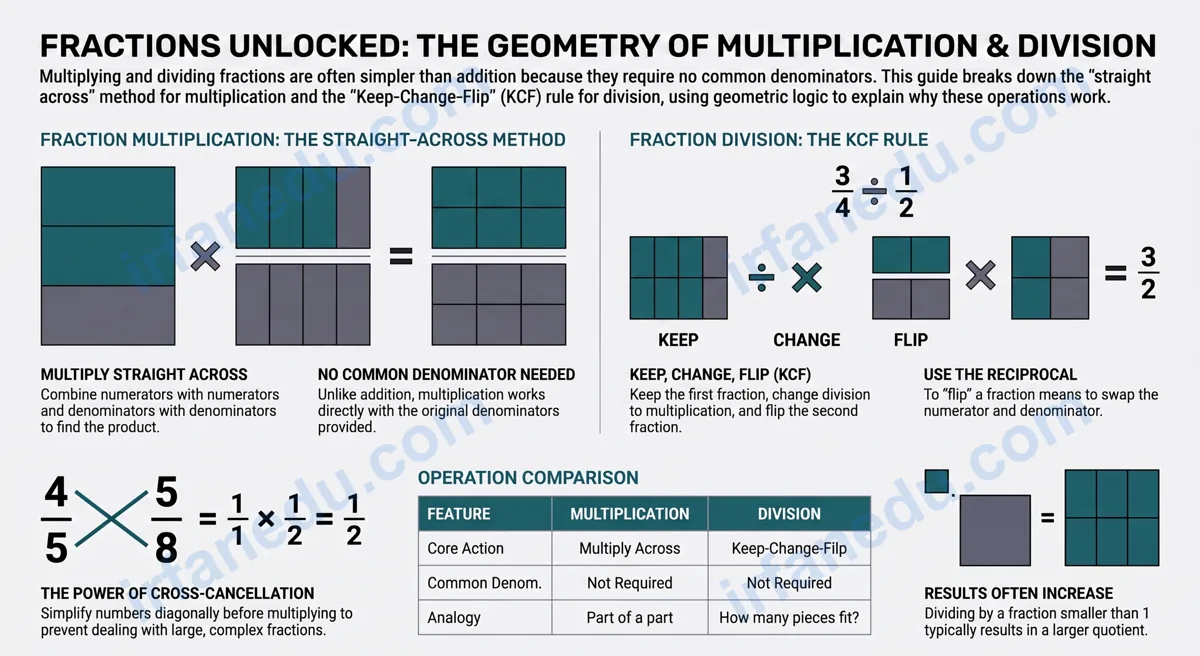
Imagine you ordered a pizza and cut it into 8 equal slices. You want to share half of what you have with a friend, or figure out how many quarter-slices fit into your portion. That is fraction multiplication and division in real life — and once you see it that way, the rules click instantly.
Fraction multiplication means finding a part of a part — like taking 1/2 of 3/4 of a pizza. Fraction division means asking how many of one piece fit into another — like how many 1/4-slices fit into 3/4 of a pizza. Both operations are simpler than adding fractions because you never need a common denominator.
- 🎯 Understand why the Keep-Change-Flip rule works (not just how)
- 🔢 See 3 fully worked examples with step-by-step solutions
- ⚠️ Spot the 4 most common mistakes students make
- 📄 Print a 10-problem worksheet with a full answer key
- ✅ Test yourself with a 3-question interactive quiz
📥 Free Printable Worksheet: 10 problems (multiply & divide fractions), full answer key, PDF format — ready to print right now.
⚡ TL;DR – Quick Summary
- 🍕 Multiply fractions: numerator × numerator, denominator × denominator, then simplify.
- 🔄 Divide fractions: Keep-Change-Flip, then multiply and simplify.
- ❌ No common denominator needed — unlike adding or subtracting fractions.
- ✂️ Cross-cancel before multiplying to keep numbers small and avoid big simplification steps.
- 📄 10-problem worksheet + answer key included on this page and as a free PDF.
- 🧠 Dividing by a fraction smaller than 1 always gives a bigger answer — the pizza analogy explains why.
📊 Quick Facts Table
| Feature | Multiplication | Division |
|---|---|---|
| Core method | Multiply across (top × top, bottom × bottom) | Keep-Change-Flip, then multiply |
| Common denominator needed? | No | No |
| Result vs. original | Usually smaller (if both fractions < 1) | Usually larger (if divisor < 1) |
| Key vocabulary | Numerator, denominator, simplify, GCF | Reciprocal, inverse, Keep-Change-Flip |
| Grade level | Grade 5 (introduced) | Grade 6 (introduced) |
| Real-life analogy | Half of a 3/4 pizza slice | How many 1/4 slices fit in 3/4 pizza? |
🍕 What Are Fraction Multiplication and Division?
Fraction multiplication answers the question: “What is a part of a part?” If you have 3/4 of a pizza and you eat 1/2 of that portion, you ate 3/8 of the whole pizza. You multiplied 1/2 × 3/4 = 3/8.
Fraction division answers the question: “How many of this piece fit into that piece?” If you have 3/4 of a pizza and each serving is 1/4, you get 3 servings. You divided 3/4 ÷ 1/4 = 3. The pizza analogy is not just a memory trick — it is the actual meaning of these operations.
Both operations are simpler than fraction addition because you never need to find a common denominator. That is a fact most students don’t realize until they’ve already spent time hunting for one unnecessarily.
In my experience teaching fractions to hundreds of students, the ones who memorize “flip and multiply” without understanding why are the first to apply it in the wrong situation — like trying to flip during addition. The pizza analogy anchors the meaning. Once a student genuinely understands that 3/4 ÷ 1/4 is asking “how many quarter-slices fit in three-quarters?”, the Keep-Change-Flip rule becomes obvious rather than arbitrary. I always teach meaning before method.
🔢 How Do You Multiply and Divide Fractions? (Step-by-Step)
These two step lists are the core of the lesson. Follow them in order for every problem you attempt.
🍕 How to Multiply Fractions
- Write the problem: Place both fractions side by side with a × sign between them.
- Cross-cancel (optional but smart): If any numerator shares a common factor with either denominator, divide both by that factor before multiplying. This keeps numbers small.
- Multiply numerators: Top × top gives the new numerator.
- Multiply denominators: Bottom × bottom gives the new denominator.
- Simplify: Divide numerator and denominator by their GCF. If you cross-cancelled in step 2, the fraction may already be in lowest terms.
🔄 How to Divide Fractions (Keep-Change-Flip)
- Keep: Write the first fraction exactly as it is.
- Change: Replace the ÷ sign with a × sign.
- Flip: Write the reciprocal of the second fraction (swap numerator and denominator).
- Multiply: Now follow the multiplication steps above (cross-cancel, multiply across).
- Simplify: Reduce to lowest terms.
  MULTIPLY:  2/3  ×  3/4
             ↓        ↓
  Cross-cancel: 2 and 4 share factor 2 → 1/3 × 3/2
                3 and 3 share factor 3 → 1/1 × 1/2
             = 1/2  ✓

  DIVIDE:    3/4  ÷  1/2
  Step 1 KEEP:   3/4
  Step 2 CHANGE: 3/4  ×
  Step 3 FLIP:   3/4  ×  2/1
  Step 4 MULTIPLY: (3×2)/(4×1) = 6/4
  Step 5 SIMPLIFY: 6/4 = 3/2 = 1 1/2  ✓
✏️ Worked Examples — Fraction Multiplication and Division
Each example below uses the pizza analogy to frame the problem, then solves it step by step. This mirrors exactly the method used in the worksheet problems.
🍕 Example 1: Multiply — 2/3 × 3/4
Pizza context: You have 3/4 of a pizza. You eat 2/3 of that portion. How much of the whole pizza did you eat?
Step 1: Write: 2/3 × 3/4
Step 2 (cross-cancel): The 3 in the numerator of 2/3 and the 3 in the denominator of 3/4 cancel → 2/1 × 1/4. Then 2 and 4 share factor 2 → 1/1 × 1/2.
Step 3: Multiply: 1 × 1 = 1 (numerator); 1 × 2 = 2 (denominator).
Answer: 1/2. You ate half the whole pizza.
🔄 Example 2: Divide — 3/4 ÷ 1/2
Pizza context: You have 3/4 of a pizza. Each serving is 1/2 of a pizza. How many servings do you have?
Step 1 (Keep): 3/4
Step 2 (Change): 3/4 ×
Step 3 (Flip): 3/4 × 2/1
Step 4 (Multiply): (3 × 2) / (4 × 1) = 6/4
Step 5 (Simplify): GCF of 6 and 4 is 2 → 6/4 = 3/2 = 1 1/2 servings.
Answer: 3/2 (or 1 1/2). You have one and a half servings.
🍕🔄 Example 3: Combined — 3/4 × 8/9 ÷ 2/3
Pizza context: A multi-step catering problem — scale a recipe that calls for 3/4 of a batch, then divide into 2/3-sized portions.
Step 1: Handle left to right. First: 3/4 × 8/9.
Cross-cancel: 3 and 9 → divide by 3: 1/4 × 8/3. Then 4 and 8 → divide by 4: 1/1 × 2/3 = 2/3.
Step 2: Now divide: 2/3 ÷ 2/3.
Keep-Change-Flip: 2/3 × 3/2 = 6/6 = 1.
Answer: 1. The portions come out exactly even — a satisfying result that also confirms your arithmetic.
⚠️ Common Mistakes Students Make (Wrong vs. Right)
These four errors account for the majority of lost marks on fraction multiplication and division problems. Check your work against this table every time.
| ❌ Wrong | ✅ Right |
|---|---|
| Finding a common denominator before multiplying: 1/2 × 1/3 → “I need 6ths” → 3/6 × 2/6 = 6/36 | Multiply straight across: 1/2 × 1/3 = 1/6. No common denominator needed. |
| Flipping the first fraction instead of the second: 3/4 ÷ 1/2 → 4/3 × 1/2 = 4/6 | Keep the first, flip the second: 3/4 × 2/1 = 6/4 = 3/2. |
| Forgetting to simplify: 2/3 × 3/4 = 6/12 (left as is) | Always reduce: 6/12 ÷ 6 = 1/2. Or cross-cancel first to avoid this step. |
| Applying KCF to multiplication: 2/3 × 1/4 → “flip 1/4 to 4/1” → 2/3 × 4/1 = 8/3 | KCF is ONLY for division. For multiplication, just multiply across: 2/3 × 1/4 = 2/12 = 1/6. |
Most worksheet sites teach Keep-Change-Flip as a magic trick with no explanation. Here is what they miss: dividing by a fraction is identical to multiplying by its reciprocal because that is the definition of division for all real numbers — a ÷ b = a × (1/b). The “flip” is not a trick; it is the literal definition of division applied to fractions.
Why does this matter practically? Because students who know the why can reconstruct the rule if they forget it mid-exam. They also avoid the single most common error: applying KCF to multiplication problems. In my experience, students who understand “dividing = multiplying by the reciprocal” score significantly higher on mixed-operation fraction tests than those who only memorized the mnemonic.
Test this understanding: ask a student “what is the reciprocal of 5?” If they say “1/5” and can explain that 5 × 1/5 = 1, they truly understand division — not just the rule.
📄 On-Page Worksheet — Fraction Multiplication & Division
Print this page or use it on screen. Work through all 10 problems in order — they go from straightforward multiplication to combined operations. Show your work for each problem. When you finish, open the Answer Key below to check.
- 1/2 × 1/3 = ______
- 2/3 × 3/4 = ______
- 3/5 × 5/6 = ______
- 4/7 × 7/8 = ______
- 1/2 ÷ 1/4 = ______
- 3/4 ÷ 1/2 = ______
- 5/6 ÷ 2/3 = ______
- 2/3 ÷ 4/9 = ______
- 3/4 × 8/9 ÷ 2/3 = ______
- 5/8 ÷ 5/4 × 2/3 = ______
📋 Show Answer Key
- 1/2 × 1/3 = 1/6
- 2/3 × 3/4 = 1/2
- 3/5 × 5/6 = 1/2
- 4/7 × 7/8 = 1/2
- 1/2 ÷ 1/4 = 2
- 3/4 ÷ 1/2 = 3/2 (or 1 1/2)
- 5/6 ÷ 2/3 = 5/4 (or 1 1/4)
- 2/3 ÷ 4/9 = 3/2 (or 1 1/2)
- 3/4 × 8/9 ÷ 2/3 = 1
- 5/8 ÷ 5/4 × 2/3 = 1/3
📥 Want a print-ready version? Download the free PDF worksheet with a separate answer key section — perfect for classroom or home use.
Problems 9 and 10 on this worksheet are deliberately multi-step. In my experience, students who can handle single-operation fraction problems often fall apart when operations are chained. The key insight: work strictly left to right, and treat each ÷ as a KCF transformation before moving to the next operation. I include at least one chained problem in every worksheet I design because that is exactly what standardized tests use to separate students who truly understand from those who memorized a rule.
🧠 Quick Quiz — Test Your Understanding
Q1. What is 2/5 × 5/6?
See Answer
✅ B) 1/3 — Cross-cancel: 2 and 6 share factor 2 → 1/5 × 5/3. Then 5 and 5 cancel → 1/1 × 1/3 = 1/3.
Q2. What is 4/5 ÷ 2/3?
See Answer
✅ B) 6/5 — Keep 4/5, change ÷ to ×, flip 2/3 to 3/2: 4/5 × 3/2 = 12/10 = 6/5.
Q3. Which statement about dividing fractions is TRUE?
See Answer
✅ C) Dividing by a fraction less than 1 gives a larger result — Think pizza: more small pieces fit into your portion, so the count goes up. No common denominator needed; you flip the second fraction (not the first); KCF is for division only.
🔍 Reveal-on-Click Practice Problems
Practice Problem A: Solve 5/8 × 4/15
Step 1 (cross-cancel): 5 and 15 share factor 5 → 1/8 × 4/3. Then 4 and 8 share factor 4 → 1/2 × 1/3.
Step 2 (multiply): 1 × 1 = 1; 2 × 3 = 6.
Answer: 1/6
Practice Problem B: Solve 7/8 ÷ 7/4
Keep: 7/8. Change: ×. Flip: 4/7.
Multiply: 7/8 × 4/7. Cross-cancel 7s → 1/8 × 4/1. Cross-cancel 4 and 8 → 1/2 × 1/1 = 1/2.
Answer: 1/2
Practice Problem C: Solve 3/10 ÷ 9/5
Keep: 3/10. Change: ×. Flip: 5/9.
Multiply: 3/10 × 5/9. Cross-cancel 3 and 9 → 1/10 × 5/3. Cross-cancel 5 and 10 → 1/2 × 1/3 = 1/6.
Answer: 1/6
❓ Frequently Asked Questions
What is the Keep-Change-Flip method for dividing fractions?
How do you multiply two fractions?
Why does dividing by a fraction make the answer bigger?
Sources & References
Reviewed by Dr. Irfan Mansuri. External links open in a new tab and are provided for further reading and verification.