
Number Line for Negatives and Positives: The Visual Guide That Actually Sticks
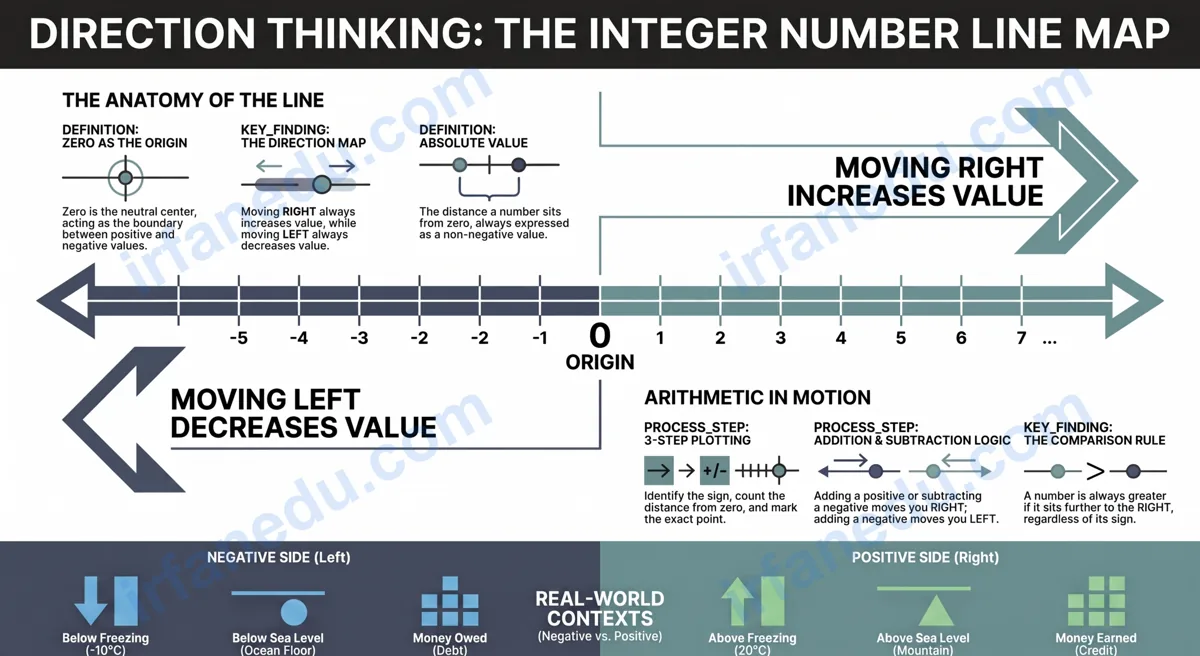
Most students learn the number line by memorizing which side is positive and which is negative. That works for a week — until they hit subtraction of negatives and everything falls apart. There is a better way to think about it, and I want to show you that approach first.
In my experience teaching this concept to hundreds of middle schoolers, the students who truly master negative numbers are the ones who stop seeing the number line as a list of labels and start seeing it as a direction map. That single shift changes everything.
By the end of this guide, you will be able to:
- Read and plot any integer on a number line instantly
- Add and subtract positive and negative numbers using direction logic
- Compare integers correctly — including tricky cases like -3 vs. -8
- Avoid the four most common mistakes students make with negative numbers
- Connect the number line to real-world contexts like temperature and elevation
⚡ TL;DR – Quick Summary
- Zero sits at the center; positives go right, negatives go left.
- Adding a positive = move right; adding a negative = move left.
- Subtracting = add the opposite (a – b = a + (-b)), then move left.
- On the negative side, numbers closer to zero are always greater.
- Absolute value = distance from zero, always positive.
- The number line is a direction map, not just a list of labels.
| Feature | Detail |
|---|---|
| Center point | Zero (0) — neither positive nor negative |
| Positive side | Right of zero: 1, 2, 3, 4 … |
| Negative side | Left of zero: -1, -2, -3, -4 … |
| Direction for addition | Adding positive → move RIGHT; adding negative → move LEFT |
| Direction for subtraction | Rewrite as adding the opposite, then move LEFT |
| Comparing integers | Further right = greater value, always |
| Absolute value | Distance from zero (always ≥ 0) |
| Typical range shown | -10 to +10 for classroom use |
Two Approaches: Counting vs. Direction Thinking
There are two ways students approach the number line — and one of them consistently leads to errors on tests. Understanding the difference is the first step to mastering integers.
| Approach A: Label Counting | Approach B: Direction Thinking |
|---|---|
| Memorizes which side is positive or negative | Understands the line as a direction map with two axes |
| Counts tick marks to find a number | Thinks in terms of distance from zero and direction of travel |
| Breaks down when subtracting negatives (e.g., 2 – (-3)) | Handles all operations by converting to movement |
| Struggles to compare -7 and -2 intuitively | Instantly knows -2 > -7 because -2 is closer to zero (further right) |
| Treats the number line as a static picture | Treats the number line as a dynamic tool for every operation |
| Works for simple problems only | Scales to algebra, coordinate geometry, and beyond |
Approach B is the one I teach, and it is the one this guide builds from the ground up. Once you internalize direction thinking, you will never need to memorize a rule for “adding two negatives” again — the movement tells you the answer.
In my experience, the single biggest reason students fail integer tests is not that they don’t know the rules — it’s that they learned the rules without the visual model. When I started teaching the number line as a direction map first and introducing rules second, test scores on integer operations improved noticeably within two weeks. The diagram is not a crutch; it is the actual concept.
What Is a Number Line for Negatives and Positives?
A number line for negatives and positives is a straight, infinite horizontal line where every real number occupies exactly one point, with zero at the center dividing the positive side (right) from the negative side (left).
Here are the defining properties you need to know:
- Zero is the origin. It is the reference point for all other numbers and is neither positive nor negative.
- Equal spacing. Each integer is exactly one unit from the next. The gap between 3 and 4 is identical to the gap between -3 and -2.
- Infinite in both directions. Arrows on both ends signal that the line continues forever — there is no largest positive or smallest negative integer.
- Every number has an opposite. The opposite of 5 is -5; both sit exactly 5 units from zero, on opposite sides.
Negative vs. Positive Side: The Full Comparison
The two sides of the number line follow mirror-image rules — but several key behaviors differ in ways that trip students up. This table is the centerpiece reference you should bookmark.
| Property | Positive Side (Right of Zero) | Negative Side (Left of Zero) |
|---|---|---|
| Example integers | 1, 2, 3, 4, 5 … | -1, -2, -3, -4, -5 … |
| Direction from zero | Right | Left |
| As you move away from zero, values… | Increase (5 > 4 > 3) | Decrease (-5 < -4 < -3) |
| Comparing two numbers on this side | Larger digit = larger value (7 > 3) | Larger digit = smaller value (-7 < -3) |
| Absolute value relationship | |n| = n (e.g., |4| = 4) | |n| = -n (e.g., |-4| = 4) |
| Adding two numbers on this side | Sum is always positive and larger | Sum is always negative and further from zero |
| Real-world analogy | Floors above ground, degrees above freezing, money earned | Floors below ground, degrees below freezing, money owed |
| Multiplication result (two same-sign numbers) | Positive × Positive = Positive | Negative × Negative = Positive |
How Do You Plot Integers on a Number Line?
Plotting an integer on a number line takes exactly three steps, and the process is the same whether the number is positive or negative.
- Identify the sign. A positive number (or no sign) goes to the right of zero. A negative number (with a minus sign) goes to the left.
- Count the absolute value. Starting from zero, count that many unit spaces in the correct direction.
- Mark the point. Place a dot at that exact location and label it.
– -4: Negative sign → go left. Count 4 units left of zero. Mark it.
– 0: Already at the center. Mark it.
– 6: Positive → go right. Count 6 units right of zero. Mark it.
Result: -4 sits to the left, 0 at center, 6 to the right. Ordering from least to greatest: -4, 0, 6.
[IMAGE: A simple number line from -6 to +7 with dots marked at -4, 0, and 6 | ALT: Number line showing plotted integers at negative four, zero, and positive six]
How Do You Add and Subtract on a Number Line?
Every addition and subtraction problem on a number line reduces to two decisions: where do I start? and which direction do I move? Here is the complete rule set.
Addition Rules
| Operation Type | Direction to Move | Example | Answer |
|---|---|---|---|
| Positive + Positive | Start at first number, move RIGHT | 4 + 3 | 7 |
| Positive + Negative | Start at first number, move LEFT | 4 + (-6) | -2 |
| Negative + Positive | Start at negative, move RIGHT | -3 + 5 | 2 |
| Negative + Negative | Start at negative, move LEFT | -3 + (-4) | -7 |
Subtraction: The Key Trick
Subtraction is the operation that confuses most students. The reliable method is to rewrite every subtraction as adding the opposite:
Example 1: 5 – 8 = 5 + (-8). Start at 5, move 8 steps LEFT. Land on -3. Answer: -3.
Example 2: -2 – 3 = -2 + (-3). Start at -2, move 3 steps LEFT. Land on -5. Answer: -5.
Example 3 (subtracting a negative): 1 – (-4) = 1 + 4. Start at 1, move 4 steps RIGHT. Land on 5. Answer: 5.
Example 3 is the one that surprises students most. Subtracting a negative is the same as adding a positive — the two negatives cancel and you move RIGHT. The number line makes this physically obvious.
I have seen students spend weeks memorizing “two negatives make a positive” as an abstract rule, only to misapply it under test pressure. When I show them 1 – (-4) on a number line — literally drawing the arrow jumping right to 5 — the rule becomes a visual memory, not a verbal one. Visual memories are far harder to forget. I always teach the diagram before the rule, not after.
Visual Solution: Number Line Diagram
Below is a pure HTML/CSS diagram of a number line from -10 to +10, followed by an ASCII model of the addition 3 + (-7) = -4.
NEGATIVE SIDE          ZERO          POSITIVE SIDE
◄─────────────────────────────────────────────────►
-10 -9 -8 -7 -6 -5 -4 -3 -2 -1  0  1  2  3  4  5  6  7  8  9  10
 |   |   |   |   |   |   |   |   |   |   |   |   |   |   |   |   |   |   |   |   |
  ←─── smaller values                    larger values ───►

EXAMPLE: 3 + (-7) = ?
  Start at 3, move LEFT 7 steps:
  3 → 2 → 1 → 0 → -1 → -2 → -3 → -4
                                    ↑
                                 Answer: -4

EXAMPLE: -2 - (-5) = -2 + 5 = ?
  Start at -2, move RIGHT 5 steps:
  -2 → -1 → 0 → 1 → 2 → 3
                         ↑
                      Answer: 3
What Are the Most Common Number Line Mistakes?
Four errors account for the vast majority of wrong answers on integer tests. Knowing them in advance is worth more than any amount of extra practice.
| Wrong Thinking | Correct Thinking |
|---|---|
| “-8 is greater than -3 because 8 is bigger than 3” | -3 is greater because it sits further RIGHT (closer to zero) on the number line |
| “Subtracting always makes a number smaller” | Subtracting a negative (e.g., 2 – (-5)) moves you RIGHT, making the result larger |
| “Zero is a positive number” | Zero is neither positive nor negative; it is its own category |
| “The absolute value of -6 is -6” | Absolute value is always non-negative: |-6| = 6 (distance from zero, no sign) |
Where Do Negative and Positive Numbers Appear in Real Life?
Real-world contexts make negative numbers concrete and memorable. Here are the most useful ones for students.
| Context | Positive Side | Negative Side | Zero Means |
|---|---|---|---|
| Temperature | Above freezing (e.g., 20°C) | Below freezing (e.g., -10°C) | Freezing point |
| Elevation | Above sea level (mountain peak) | Below sea level (ocean floor, Dead Sea) | Sea level |
| Finance | Money in your account (credit) | Money owed (debt, overdraft) | Broke even |
| Time | After an event (T+5 minutes) | Before an event (T-3 minutes: countdown) | Launch/event moment |
| Floors in a building | Floors above ground (1, 2, 3…) | Basement floors (-1, -2…) | Ground floor |
| Sports (golf) | Over par (+2) | Under par (-3) | Par score |
On the number line: start at -6, move RIGHT 9 steps.
-6 + 9 = 3°C.
The noon temperature is 3°C — above freezing. The number line makes this intuitive: you started on the negative (cold) side and crossed zero into the positive (warm) side.
Most number line guides teach the positive and negative sides as two separate regions with different rules. That framing is the root cause of student confusion. In reality, there is only ONE rule: every number is a signed distance from zero. Positive 5 means “5 units to the right of zero.” Negative 5 means “5 units to the left of zero.” The sign is not a label — it is a direction instruction. Once students internalize this, operations like -(-5) become obvious: you are reversing the direction instruction, which points you right. No rule to memorize. No “two negatives make a positive” mantra to misapply. Just direction logic.
Quick Quiz: Test Your Number Line Skills
Q1. Which number is greater: -9 or -2?
Show Answer
Q2. What is -3 + (-5) on the number line?
Show Answer
Q3. What is 2 – (-6)?
Show Answer
Reveal-on-Click Practice Problems
Try each problem on your own, then click to reveal the full solution.
Problem 1: Plot -7, -1, 4, and 9 on a number line and write them in order from least to greatest.
– -7: 7 units left of zero
– -1: 1 unit left of zero
– 4: 4 units right of zero
– 9: 9 units right of zero
Order (left to right on the number line): -7, -1, 4, 9
Problem 2: Use a number line to solve -4 + 7.
Start at -4. Adding a positive → move RIGHT 7 steps.
-4 → -3 → -2 → -1 → 0 → 1 → 2 → 3
Answer: 3
Problem 3: Solve 1 – (-8) using the number line method.
Rewrite: 1 – (-8) = 1 + 8
Start at 1. Move RIGHT 8 steps.
1 → 2 → 3 → 4 → 5 → 6 → 7 → 8 → 9
Answer: 9
Problem 4: The temperature at midnight is -11°C. By 3 PM it has risen 15 degrees. What is the 3 PM temperature?
-11 + 15 = ?
Start at -11, move RIGHT 15 steps.
-11 + 15 = 4°C
Answer: 4°C (above freezing — you crossed zero and ended on the positive side)
Frequently Asked Questions
What is a number line for negatives and positives?
Which direction is negative on a number line?
How do you add negative numbers on a number line?
How do you subtract on a number line?
Is zero positive or negative on a number line?
What is absolute value on a number line?
Sources & References
Reviewed by Dr. Irfan Mansuri. External links open in a new tab and are provided for further reading and verification.