
Find the Area of the Figure Pictured Below – Complete Step-by-Step Guide 📐
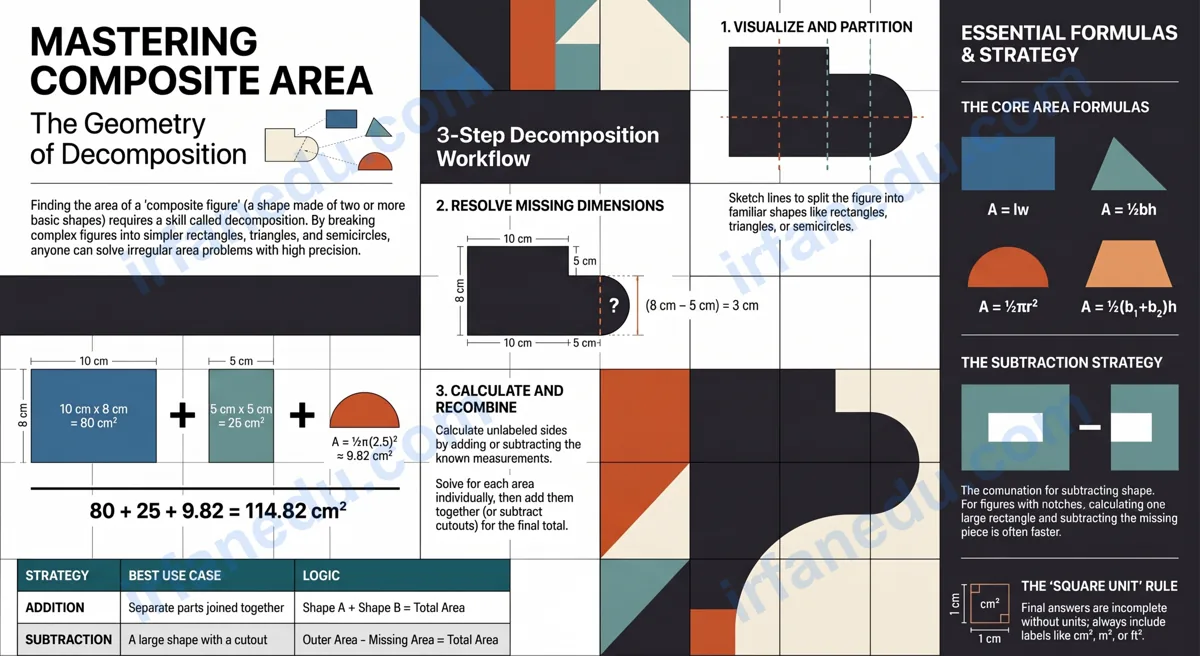
If your teacher just said “find the area of the figure pictured below” and you stared at the page wondering where to even start — you are in exactly the right place. 😊 This guide walks you through every step, from identifying the shapes hiding inside a complex figure, to writing the final answer with the right units. By the end, you will be able to tackle any composite shape your exam throws at you.
To find the area of a composite figure, you split it into simpler shapes (rectangles, triangles, semicircles), calculate each shape’s area using its formula, then add the results. This method — called decomposition — works for every irregular figure you will ever see in a math class.
- ✅ Understand what a composite figure is and how to spot its parts
- ✅ Apply the correct area formula for rectangles, triangles, and semicircles
- ✅ Use both the addition and subtraction strategies for composite area
- ✅ Avoid the three most common mistakes students make
- ✅ Practice with 10 graded problems and check your answers instantly
📄 Free Printable Worksheet Included! Get 10 graded composite-area problems with a full answer key — ready to print or use on screen.
⚡ TL;DR – Quick Summary
- 🔷 A composite figure is made of two or more simpler shapes joined together.
- 🔷 The decomposition method: split → calculate each area → add (or subtract).
- 🔷 Key formulas: Rectangle A = l × w; Triangle A = ½ × b × h; Semicircle A = ½ × π × r².
- 🔷 Always label missing dimensions before you start calculating.
- 🔷 Use subtraction when a shape has a piece cut out of it.
- 🔷 Always include square units (cm², m², ft²) in your final answer.
| Fact | Detail |
|---|---|
| Topic | Area of composite / irregular figures |
| Core method | Decomposition (split into simpler shapes) |
| Grade level | Grades 5–9 (middle school / early high school) |
| Key formulas needed | Rectangle, triangle, semicircle, trapezoid |
| Common shapes inside figures | Rectangles, right triangles, semicircles, squares |
| Two strategies | Addition (join parts) or Subtraction (remove cutout) |
| Units | Always square units: cm², m², in², ft² |
📐 What Does “Find the Area of the Figure” Actually Mean?
When a problem says “find the area of the figure pictured below,” it almost always shows a composite figure — a shape built by combining two or more basic geometric shapes. The area is the total amount of flat surface the figure covers, measured in square units.
A composite figure is not a new kind of shape with its own special formula. It is just a combination of shapes you already know: rectangles, triangles, semicircles, trapezoids, and squares. Your job is to see through the complexity and spot those familiar shapes inside.
For example, an L-shaped figure is really just two rectangles. A house-shaped figure is a rectangle with a triangle on top. A stadium shape is a rectangle with two semicircles on the ends. Once you see the pieces, the rest is arithmetic.
🌍 Why This Skill Matters Beyond the Classroom
Finding the area of an irregular figure is one of the most practical math skills you will ever learn. It shows up constantly in real life — and in every standardized math test.
- Home improvement: Calculating how much flooring, paint, or carpet to buy for an oddly-shaped room.
- Gardening and landscaping: Working out how much grass seed or fertilizer covers an irregular garden bed.
- Architecture and engineering: Designing floor plans, roofs, and land plots that are rarely perfect rectangles.
- Standardized tests: Composite-area questions appear on virtually every middle and high school math exam worldwide.
In my experience teaching geometry, the students who struggle most with composite figures are not struggling with math — they are struggling with seeing. They look at the whole shape and feel overwhelmed. The moment I teach them to physically draw a line that splits the shape, the problem becomes trivial. If I could give one piece of advice: always decompose first, calculate second.
📋 The Area Formulas You Need (Quick Reference)
You only need four formulas to handle the vast majority of composite-area problems. Here they are in one place.
| Shape | Formula | Variables | Example |
|---|---|---|---|
| Rectangle / Square | A = l × w | l = length, w = width | l=6, w=4 → A=24 units² |
| Triangle | A = ½ × b × h | b = base, h = perpendicular height | b=6, h=4 → A=12 units² |
| Semicircle | A = ½ × π × r² | r = radius (half the diameter) | r=3 → A≈14.14 units² |
| Trapezoid | A = ½ × (b₁ + b₂) × h | b₁, b₂ = parallel sides, h = height | b₁=4, b₂=6, h=3 → A=15 units² |
🪜 Step-by-Step: How to Find the Area of Any Composite Figure
Follow these six steps every single time, and composite-area problems become completely predictable.
- Step 1 – Identify the shapes. Look at the figure carefully. Name each simpler shape you can see hiding inside it: rectangles, triangles, semicircles, etc.
- Step 2 – Draw dividing lines. On your paper (or mentally), draw lines that separate the figure into those simpler shapes. There is often more than one valid way to split a figure — choose the easiest.
- Step 3 – Label the dimensions. Write the length, width, base, height, or radius of each smaller shape. Some dimensions will be given directly; others you will need to calculate by adding or subtracting the given measurements.
- Step 4 – Calculate each area. Use the correct formula for each shape. Write each area clearly and label which shape it belongs to.
- Step 5 – Add (or subtract) the areas. Add all individual areas together for the total. If the figure has a hole or cutout, subtract that area instead.
- Step 6 – Write the answer with units. State the total area with the correct square units. Never leave units off — it costs marks every time.
🖼️ Visual: Decomposing an L-Shape into Two Rectangles
┌──────────────┐
│              │  ← Rectangle A
│   6 cm       │    (6 cm × 3 cm = 18 cm²)
│              │
├──────┐       │
│      │       │  ← Rectangle B
│ 4 cm │       │    (4 cm × 2 cm = 8 cm²)
│      │       │
└──────┘       │
         3 cm  │
               └──
  Total Area = 18 + 8 = 26 cm²
✏️ 3 Fully Worked Examples (Easy → Hard)
Example 1 – L-Shaped Figure (Addition Method)
Problem
An L-shaped figure has an outer width of 10 cm and outer height of 8 cm. A rectangular notch of 4 cm × 5 cm is cut from the top-right corner. Find the total area.
Solution
Method A – Subtraction:
Step 1: Area of full outer rectangle
        A = 10 × 8 = 80 cm²

Step 2: Area of the missing notch
        A = 4 × 5 = 20 cm²

Step 3: Subtract
        Total Area = 80 - 20 = 60 cm²
Answer: 60 cm²
Example 2 – Rectangle + Right Triangle
Problem
A figure is made of a rectangle (12 m × 5 m) with a right triangle attached to one short end. The triangle has a base of 5 m and a height of 4 m. Find the total area.
Solution
Step 1: Area of rectangle
        A = 12 × 5 = 60 m²

Step 2: Area of triangle
        A = ½ × 5 × 4 = 10 m²

Step 3: Add
        Total Area = 60 + 10 = 70 m²
Answer: 70 m²
Example 3 – Rectangle + Semicircle (Harder)
Problem
A figure is shaped like a running track end: a rectangle 14 m long and 6 m wide, with a semicircle attached to each short end (diameter = 6 m). Find the total area. Use π = 3.14.
Solution
Step 1: Area of rectangle
        A = 14 × 6 = 84 m²

Step 2: Radius of each semicircle
        r = 6 ÷ 2 = 3 m

Step 3: Area of each semicircle
        A = ½ × 3.14 × 3² = ½ × 3.14 × 9 = 14.13 m²

Step 4: Two semicircles = one full circle
        A = 2 × 14.13 = 28.26 m²
        (or directly: π × r² = 3.14 × 9 = 28.26 m²)

Step 5: Total Area = 84 + 28.26 = 112.26 m²
Answer: 112.26 m²
In my experience, Example 3 is where students lose points on tests — not because they can’t find the area of a semicircle, but because they forget to figure out the radius from the diameter. The diameter is given (6 m), but the formula needs the radius (3 m). Always write “r = diameter ÷ 2” as your very first sub-step when a semicircle is involved. That one habit is worth at least 2–3 marks per exam.
⚠️ Common Mistakes and How to Avoid Them
These are the four errors I see most often when students try to find the area of a composite figure. Knowing them in advance puts you ahead of most of your class.
The height of a triangle must be perpendicular to the base. If the triangle is not a right triangle, the slant side is never the height. Look for the dashed perpendicular line in the diagram — that is the height.
When a figure is split, some sides are not labeled. You must calculate them by adding or subtracting the given measurements. For example, if the total width is 10 cm and one part is 6 cm, the other part is 4 cm.
The formula A = π × r² uses the RADIUS, not the diameter. If the problem gives you a diameter, divide by 2 first. This is the single most common arithmetic error on composite-area tests.
An answer of “26” is incomplete. The answer is “26 cm²” (or m², ft², etc.). Most marking schemes deduct a mark for missing units, even if the number is correct.
| ❌ Wrong Approach | ✅ Right Approach |
|---|---|
| Use slant side as triangle height | Use the perpendicular height (dashed line) |
| Ignore unlabeled sides | Calculate missing dimensions from given ones |
| Plug diameter into πr² | Halve the diameter to get r, then use πr² |
| Write “Area = 60” | Write “Area = 60 cm²” |
| Add overlapping areas twice | Count each region exactly once |
Most textbooks only teach the addition version of decomposition: split the shape into parts and add. But the subtraction strategy is often faster and less error-prone — and most guides barely mention it.
Here is the idea: instead of splitting an L-shape into two rectangles (which requires you to figure out two sets of dimensions), draw the large enclosing rectangle around the whole figure, calculate its area, then subtract the area of the “missing” corner piece. You only need to find one set of missing dimensions instead of two.
In my experience, students who learn both strategies and choose the easier one for each problem consistently score higher than those who always default to splitting. On a timed test, the subtraction method can save 60–90 seconds per problem — which is significant.
Rule of thumb: If the figure has one rectangular notch cut out, use subtraction. If it is built from two clearly separate parts, use addition.
📝 Practice Worksheet: Find the Area of the Figure (10 Problems)
Use the step-by-step method above to solve each problem. Show your work, and always include units. Problems go from easy to challenging — try them all before checking the answer key.
How to use this worksheet: Work through the problems on paper or print the PDF below. After finishing, reveal the Answer Key to self-check. For each wrong answer, go back to the worked example that matches that problem type.
- A figure is made of a rectangle (length 8 cm, width 3 cm) on top of a square (side 3 cm). Find the total area.
- A composite shape has a rectangle (10 m × 4 m) with a right triangle attached on one end (base 3 m, height 4 m). Find the total area.
- An L-shaped figure has an outer rectangle of 9 ft × 6 ft with a rectangular notch of 3 ft × 2 ft cut from one corner. Find the area.
- A figure consists of two rectangles: one is 12 cm × 2 cm and the other is 4 cm × 5 cm. They share no overlap. Find the total area.
- A shape is a rectangle (7 m × 5 m) with a semicircle on top (diameter 5 m). Find the total area. Use π = 3.14.
- A composite figure is made of a large rectangle (10 in × 8 in) minus a small rectangle (2 in × 3 in) cut from one corner. Find the area.
- A T-shaped figure has a top bar (12 cm × 3 cm) and a vertical stem (4 cm × 6 cm). Find the total area.
- A figure has a right triangle (base 6 ft, height 8 ft) attached to a rectangle (6 ft × 5 ft). Find the total area.
- A composite shape has a rectangle (15 m × 4 m) with two identical squares (side 2 m) cut from two corners. Find the area.
- A figure is made of a large square (side 10 cm) with a right triangle (base 4 cm, height 6 cm) added to one side. Find the total area.
✅ Show Answer Key
- 33 cm²
- 46 m²
- 48 ft²
- 44 cm²
- 44.81 m²
- 74 in²
- 60 cm²
- 54 ft²
- 52 m²
- 112 cm²
📄 Want a print-ready version? Download the PDF with all 10 problems and the full answer key — perfectly formatted for classroom or home use.
🧠 Interactive Quiz: Test Your Understanding
🟢 Quick Check – 3 Questions
Q1. A figure is made of a rectangle (5 cm × 4 cm) and a triangle (base 5 cm, height 3 cm). What is the total area?
See Answer
✅ A) 27.5 cm² — Rectangle: 5 × 4 = 20 cm². Triangle: ½ × 5 × 3 = 7.5 cm². Total: 20 + 7.5 = 27.5 cm².
Q2. A large rectangle is 10 m × 6 m. A square of side 2 m is cut from one corner. What is the remaining area?
See Answer
✅ B) 56 m² — Full rectangle: 10 × 6 = 60 m². Cutout square: 2 × 2 = 4 m². Remaining: 60 − 4 = 56 m².
Q3. A semicircle has a diameter of 8 cm. What is its area? (Use π = 3.14)
See Answer
✅ B) 25.12 cm² — Radius = 8 ÷ 2 = 4 cm. Semicircle area = ½ × 3.14 × 4² = ½ × 3.14 × 16 = 25.12 cm².
🔍 Reveal-on-Click Practice Problems
Practice: A figure has a 9 cm × 4 cm rectangle with a 3 cm × 3 cm square attached to one short end. What is the total area?
Rectangle area = 9 × 4 = 36 cm². Square area = 3 × 3 = 9 cm². Total = 36 + 9 = 45 cm².
Practice: An L-shape has an outer rectangle of 8 m × 7 m with a 3 m × 4 m notch removed. What is the area?
Full rectangle = 8 × 7 = 56 m². Notch = 3 × 4 = 12 m². Area = 56 − 12 = 44 m².
Practice: A figure is a rectangle (10 ft × 6 ft) with a right triangle on top (base 10 ft, height 5 ft). What is the total area?
Rectangle = 10 × 6 = 60 ft². Triangle = ½ × 10 × 5 = 25 ft². Total = 60 + 25 = 85 ft².
❓ Frequently Asked Questions
How do you find the area of a composite figure?
Split the composite figure into simpler shapes (rectangles, triangles, semicircles). Calculate each shape’s area using its formula, then add all the areas together. If a shape is cut out, subtract its area instead of adding it. This decomposition method works for every irregular figure you will encounter in school geometry.
What is the area formula for a rectangle?
The area of a rectangle is length multiplied by width: A = l × w. For example, a rectangle 8 cm long and 3 cm wide has an area of 24 cm². For a square, since all sides are equal, the formula simplifies to A = s², where s is the side length.
What is the area formula for a triangle?
The area of a triangle is one-half times base times height: A = ½ × b × h. The height must be the perpendicular distance from the base to the opposite vertex — not the slant side. For a right triangle, the two legs serve as the base and height directly.