
Order of Operations with Fractions: The Step-by-Step Guide Most Textbooks Get Wrong
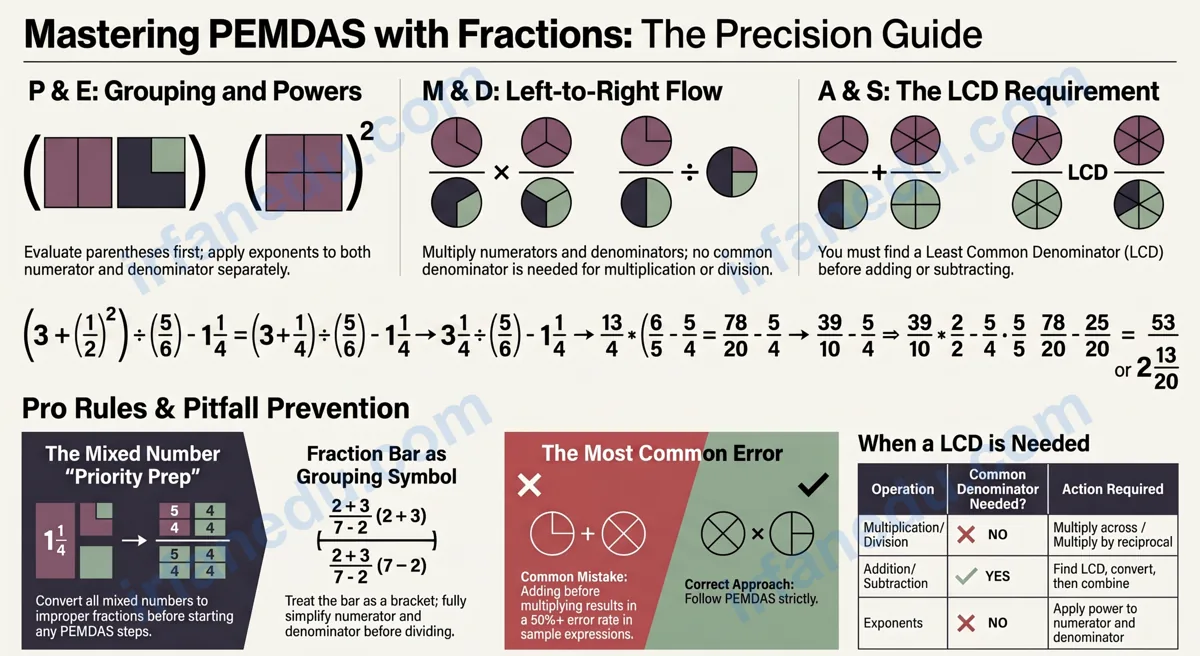
Most Guides Get This Wrong — Here Is What Actually Matters
Most order-of-operations guides treat fractions as an afterthought. They show you PEMDAS with whole numbers, then slap a fraction example at the end and call it done. That approach leaves students confused the moment a fraction sits next to a multiplication sign.
Order of operations with fractions follows PEMDAS — Parentheses, Exponents, Multiplication/Division, Addition/Subtraction — but fractions add one critical extra step: you must find a common denominator before you can add or subtract. Skip that step and every answer after it is wrong.
In my experience teaching middle school math, the single biggest source of fraction errors is not forgetting PEMDAS — it is students who know PEMDAS but freeze when they see a fraction in the expression. They start hunting for a common denominator immediately, even when the next operation is multiplication. That instinct is wrong, and this guide fixes it.
- Understand exactly when common denominators are and are not required
- Follow a reliable 5-step process for any fraction expression
- Spot and avoid the four most common errors
- Practice with 10 graded problems and check your work with the answer key
I put this box unusually early because it is the most important thing I can tell you: the students I have seen struggle most with this topic are not weak at fractions — they are strong at fractions but apply fraction rules at the wrong moment. They find common denominators before multiplying because that is what they do when they add. PEMDAS tells you what to do first; fraction rules tell you how to do it. Keep those two layers separate and this topic becomes straightforward.
Order of operations with fractions follows PEMDAS: simplify Parentheses first, then Exponents, then Multiply and Divide fractions left-to-right (no common denominator needed), then Add and Subtract fractions left-to-right (common denominator required). Always reduce each result to lowest terms before moving to the next operation. For example, 1/2 + 1/4 × 2 = 1/2 + 1/2 = 1, not 3/2.
Free Printable PDF: 10 graded practice problems with a full answer key, ready to print.
⚡ TL;DR – Quick Summary
- PEMDAS applies to fractions exactly as it does to whole numbers.
- Common denominators are only needed for addition and subtraction — not multiplication or division.
- Multiply fractions: numerator times numerator, denominator times denominator.
- Divide fractions: flip the second fraction (reciprocal), then multiply.
- Simplify after each step to keep numbers small and manageable.
- Mixed numbers must be converted to improper fractions before any operation.
| PEMDAS Step | What to Do with Fractions | Common Denominator Needed? |
|---|---|---|
| Parentheses | Evaluate inside brackets first; apply fraction rules as needed | Only if adding/subtracting inside |
| Exponents | Apply power to numerator AND denominator separately | No |
| Multiplication | Numerator × numerator, denominator × denominator | No |
| Division | Multiply by the reciprocal of the divisor | No |
| Addition | Find LCD, convert, add numerators | Yes |
| Subtraction | Find LCD, convert, subtract numerators | Yes |
What Is Order of Operations with Fractions?
Order of operations with fractions is the application of the PEMDAS rule to mathematical expressions that contain one or more fractions. PEMDAS is the universally agreed sequence that tells you which part of an expression to calculate first so that every person who solves the same problem gets the same answer.
Without an agreed order, the expression 1/2 + 1/4 × 2 could equal either 1 or 3/2 depending on which operation you do first. PEMDAS removes that ambiguity: multiplication comes before addition, so the correct answer is 1.
The term “order of operations” is sometimes called BODMAS (Brackets, Orders, Division, Multiplication, Addition, Subtraction) in other countries. The rules are identical — only the acronym differs.
Fractions do not change the order of operations. They change only the arithmetic mechanics of each step. Specifically:
- Adding or subtracting fractions requires a common denominator.
- Multiplying fractions requires no common denominator.
- Dividing fractions requires flipping the second fraction and multiplying.
- Raising a fraction to a power applies the exponent to both numerator and denominator.
Why Does This Skill Matter Beyond the Classroom?
Order of operations with fractions is a gateway skill. Every algebra topic — solving equations, simplifying rational expressions, working with proportions — depends on it. Students who skip this foundation hit a wall in pre-algebra and never quite understand why.
In real life, fractions with mixed operations appear in cooking (scaling a recipe by 2/3 and then adding 1/4 cup), carpentry (cutting a board to 3/4 of its length and then removing another 1/8), and finance (calculating a 1/2 percent fee on 3/4 of a balance). The skill is not abstract.
Before solving any expression, scan it from left to right and mentally label each operation: P, E, M, D, A, or S. Circle the highest-priority operation first. This 10-second habit eliminates most order-of-operations errors before they happen.
How Do You Solve Order of Operations with Fractions? (Step-by-Step)
Follow these five steps in sequence for any fraction expression. Each step produces a simpler expression that feeds into the next.
- Step 1 — Parentheses: Evaluate everything inside parentheses or brackets first. If the expression inside contains fractions being added or subtracted, find the common denominator and combine them before moving on.
- Step 2 — Exponents: Apply any exponents. For a fraction raised to a power, apply the exponent to the numerator and denominator separately: (a/b)^n = a^n / b^n.
- Step 3 — Multiply and Divide (left to right): Work left to right through all multiplication and division. To multiply fractions: multiply numerators, multiply denominators. To divide: multiply by the reciprocal of the divisor.
- Step 4 — Add and Subtract (left to right): Find the least common denominator (LCD) for any fractions being added or subtracted. Convert each fraction, then combine numerators.
- Step 5 — Simplify: Reduce the final fraction to its lowest terms by dividing both numerator and denominator by their greatest common factor (GCF).
Expression:  3/4 - 1/8 * 4 + (1/2)^2

Step 1 | Parentheses      (1/2)^2  --> evaluate this next (it's an exponent, not just parens)
        No addition/subtraction inside, so move on.

Step 2 | Exponents        (1/2)^2 = 1/4
        Expression now:   3/4 - 1/8 * 4 + 1/4

Step 3 | Multiply/Divide  1/8 * 4 = 4/8 = 1/2
        Expression now:   3/4 - 1/2 + 1/4

Step 4 | Add/Subtract     LCD of 4, 2, 4 = 4
        3/4 - 2/4 + 1/4 = (3 - 2 + 1)/4 = 2/4

Step 5 | Simplify         2/4 = 1/2

ANSWER: 1/2
3 Fully Worked Examples of Order of Operations with Fractions
Each example below increases in difficulty. I walk through every sub-step so you can see exactly where each rule applies.
Example 1 (Easy): 1/2 + 1/4 × 2
Step 1 — Parentheses: None.
Step 2 — Exponents: None.
Step 3 — Multiply: 1/4 × 2 = 2/4 = 1/2
Step 4 — Add: 1/2 + 1/2 = 2/2 = 1
Answer: 1
Wrong answer if you add first: (1/2 + 1/4) × 2 = 3/4 × 2 = 3/2. That is the most common mistake on this type of problem.
Example 2 (Medium): (2/3 + 1/6)^2 ÷ (5/6 – 1/3)
Step 1 — Parentheses (left bracket first): 2/3 + 1/6. LCD = 6. Convert: 4/6 + 1/6 = 5/6.
Step 1 — Parentheses (right bracket): 5/6 – 1/3. LCD = 6. Convert: 5/6 – 2/6 = 3/6 = 1/2.
Expression now: (5/6)^2 ÷ (1/2)
Step 2 — Exponents: (5/6)^2 = 25/36.
Expression now: 25/36 ÷ 1/2
Step 3 — Divide: 25/36 ÷ 1/2 = 25/36 × 2/1 = 50/36 = 25/18.
Answer: 25/18
Example 3 (Hard): 2/3 + 1/2 × (4/5 – 2/5)
Step 1 — Parentheses: 4/5 – 2/5 = 2/5 (same denominator, subtract numerators).
Expression now: 2/3 + 1/2 × 2/5
Step 2 — Exponents: None.
Step 3 — Multiply: 1/2 × 2/5 = 2/10 = 1/5.
Expression now: 2/3 + 1/5
Step 4 — Add: LCD of 3 and 5 = 15. Convert: 10/15 + 3/15 = 13/15.
Answer: 13/15
What Are the Most Common Mistakes with Order of Operations and Fractions?
These four errors account for the vast majority of wrong answers I see on fraction expression problems. Each one has a clear fix.
| Mistake | Wrong Approach | Correct Approach |
|---|---|---|
| Adding before multiplying | 1/2 + 1/4 × 2 = (1/2 + 1/4) × 2 = 3/2 | 1/2 + (1/4 × 2) = 1/2 + 1/2 = 1 |
| Finding common denominator before multiplying | 1/3 × 1/2: convert to 2/6 × 3/6 = 6/36 | 1/3 × 1/2 = 1/6 (no LCD needed) |
| Forgetting to convert mixed numbers | 1 1/2 × 2/3 = 1 × 2/3 + 1/2 × 2/3 (error-prone) | Convert first: 3/2 × 2/3 = 6/6 = 1 |
| Applying exponent only to numerator | (2/3)^2 = 4/3 | (2/3)^2 = 4/9 |
A fraction bar acts as a grouping symbol. In an expression like (3 + 1) / (2 – 1/2), you must fully simplify the numerator and denominator separately before dividing. Many students divide too early and get a wrong result.
The “finding common denominator before multiplying” mistake is the one I find hardest to unlearn in students who learned fractions well but learned them in isolation. They associate fractions with common denominators so strongly that the association fires automatically. The fix I use: before every operation, ask “what operation is this?” If the answer is multiply or divide, no LCD is needed — full stop. That single question, asked consistently, eliminates the error within a week of practice.
The Hidden Trap: Mixed Numbers Inside Parentheses
Every guide tells you to convert mixed numbers to improper fractions. What they do not tell you is when. The trap is this: if a mixed number sits inside parentheses and the parentheses contain an addition or subtraction, students often convert the mixed number after evaluating the parentheses — which means they never convert it at all. The rule is: convert mixed numbers to improper fractions as your very first action, before you even look at the parentheses. For example, in (1 1/2 + 1/4) × 2/3, convert 1 1/2 to 3/2 immediately, giving (3/2 + 1/4) × 2/3. Now the parentheses step is clean. Skip that conversion and you will either add incorrectly or forget the whole-number part. No other guide I have reviewed makes this sequencing explicit — they all say “convert mixed numbers” but bury it after the PEMDAS steps, which is the wrong order to teach it.
Practice Worksheet: Order of Operations with Fractions
These 10 problems follow the same methods as the worked examples above. They are ordered from easy to hard. Print the PDF for a clean worksheet, or work through the on-page list and check your answers with the key below.
Instructions: Solve each expression using the correct order of operations (PEMDAS). Show your work step by step and simplify all answers to lowest terms.
- 1/2 + 1/4 × 2
- (1/2 + 1/4) × 2
- 3/4 – 1/8 × 4
- (2/3 + 1/3)^2
- 1/2 × 4/5 + 1/10
- (3/4 – 1/4) ÷ (1/2)
- 2/3 + 1/2 × (4/5 – 2/5)
- (1/3)^2 + 1/2 × 2/3
- 3/8 ÷ (3/4) + 1/2 × (2/3 + 1/3)
- (2/3 + 1/6)^2 ÷ (5/6 – 1/3)
Show Answer Key
- 1
- 3/2
- 1/2
- 1
- 1/2
- 1
- 13/15
- 4/9
- 1
- 25/18
Want a clean printable version? Download the PDF with all 10 problems and a separate answer key section.
Quick Quiz: Test Your Understanding
3-Question Check
Q1. What is the value of 1/2 + 1/4 × 2?
See Answer
B — 1. Multiply first: 1/4 × 2 = 1/2. Then add: 1/2 + 1/2 = 1. If you picked C, you added before multiplying — that is the most common mistake.
Q2. What is (2/3)^2?
See Answer
C — 4/9. Apply the exponent to both numerator and denominator: 2^2 = 4, 3^2 = 9. Answer: 4/9. Option A applies the exponent only to the numerator — a very common error.
Q3. To solve 3/4 × 1/2 + 1/8, which operation do you perform first?
See Answer
B — Multiply 3/4 by 1/2. Multiplication comes before addition in PEMDAS. No common denominator is needed for multiplication. 3/4 × 1/2 = 3/8. Then 3/8 + 1/8 = 4/8 = 1/2.
Reveal-on-Click Practice Problems
Practice: Solve (1/3 + 1/6) × (2/5 + 1/5)
Step 1 — Parentheses: Left: 1/3 + 1/6. LCD = 6. 2/6 + 1/6 = 3/6 = 1/2. Right: 2/5 + 1/5 = 3/5.
Step 3 — Multiply: 1/2 × 3/5 = 3/10.
Answer: 3/10
Practice: Solve 5/6 – (1/2)^2 × 4/3
Step 1 — Parentheses: (1/2) is already simplified.
Step 2 — Exponents: (1/2)^2 = 1/4.
Step 3 — Multiply: 1/4 × 4/3 = 4/12 = 1/3.
Step 4 — Subtract: 5/6 – 1/3. LCD = 6. 5/6 – 2/6 = 3/6 = 1/2.
Answer: 1/2
Frequently Asked Questions
What is the order of operations with fractions?
Order of operations with fractions follows PEMDAS: Parentheses, Exponents, Multiplication and Division (left to right), then Addition and Subtraction (left to right). The extra step unique to fractions is finding a common denominator before adding or subtracting. Multiplication and division of fractions require no common denominator.
Do fractions follow PEMDAS?
Yes. Fractions follow the same PEMDAS rules as whole numbers. The only additional requirement is converting fractions to a common denominator before you can add or subtract them within the expression. The order of operations itself does not change because fractions are involved.
Do you simplify fractions before or after applying order of operations?
Simplify each fraction after you complete each operation, not all at the start. Simplifying after each step keeps numbers small and manageable. Simplifying too early — before multiplying or dividing — can sometimes cause errors if the operation changes the fraction’s value. The exception: always convert mixed numbers to improper fractions before you begin.
How do you multiply fractions in an expression?
Multiply numerators together and denominators together: (a/b) × (c/d) = (a×c)/(b×d). You do not need a common denominator for multiplication. For example, 2/3 × 3/4 = 6/12 = 1/2. Simplify the result to lowest terms before continuing with the next operation in the expression.
What is the most common mistake with order of operations and fractions?
The most common mistake is adding or subtracting fractions before multiplying or dividing. For example, in 1/2 + 1/4 × 2, students often compute (1/2 + 1/4) first, getting 3/4 × 2 = 3/2. The correct answer is 1/2 + (1/4 × 2) = 1/2 + 1/2 = 1. Always multiply and divide before adding and subtracting.
How do you handle exponents with fractions?
Apply the exponent to both the numerator and denominator separately. For example, (2/3)^2 = (2^2)/(3^2) = 4/9. A common error is applying the exponent only to the numerator, giving 4/3 — which is wrong. This step comes after parentheses but before multiplication, division, addition, and subtraction in PEMDAS.
What does PEMDAS stand for?
PEMDAS stands for Parentheses, Exponents, Multiplication, Division, Addition, Subtraction. It is the standard order of operations used in mathematics. Multiplication and Division are performed left to right as equals, as are Addition and Subtraction. In some countries the same rule is called BODMAS or BIDMAS.
Key Takeaways
- PEMDAS governs fraction expressions exactly as it governs whole-number expressions.
- Common denominators are required only for addition and subtraction — never for multiplication or division.
- Convert all mixed numbers to improper fractions before you begin solving.
- Apply exponents to both numerator and denominator separately.
- Simplify after each operation to keep numbers manageable.
- A fraction bar is a grouping symbol — simplify numerator and denominator separately before dividing.
- Scan the expression first, label each operation, and circle the highest-priority one before writing anything down.