
3-Digit by 2-Digit Multiplication: Step-by-Step Guide + Free Worksheet 🧮
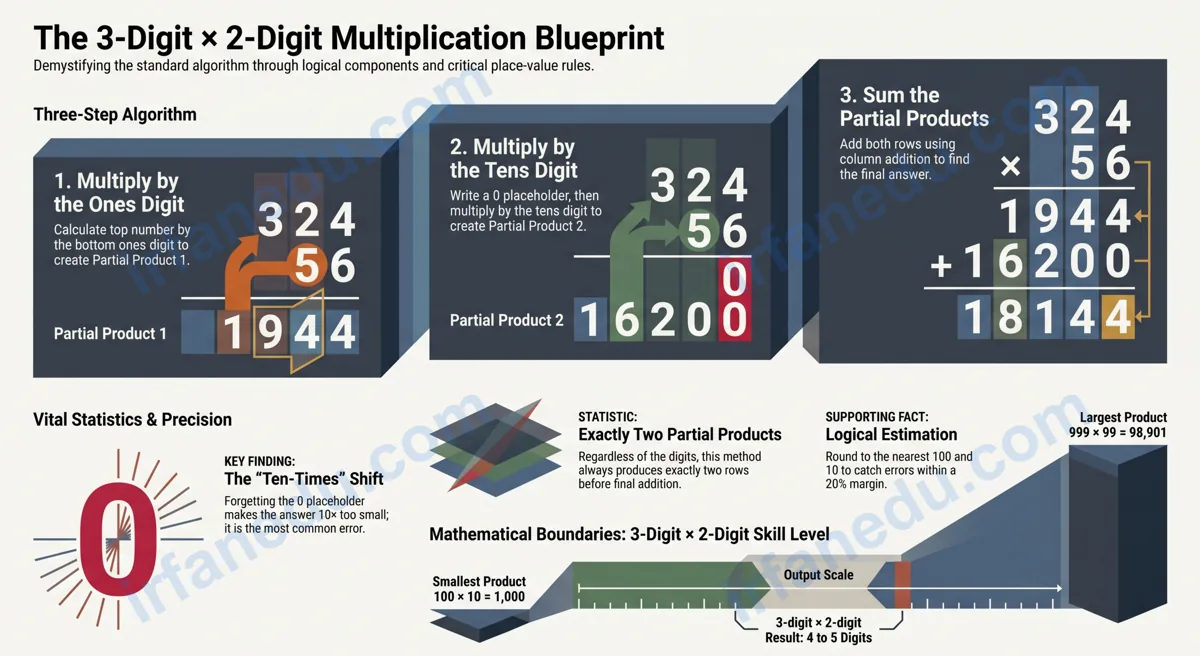
Picture a school fundraiser: 347 students each sell 26 raffle tickets. How many tickets is that in total? You can’t do that in your head — you need a reliable method. That method is 3-digit by 2-digit multiplication, and once you see how it breaks into two simple steps, you’ll wonder why it ever felt hard.
3-digit by 2-digit multiplication uses the standard algorithm: multiply the top number by the ones digit of the bottom number to get the first partial product, then multiply by the tens digit (shifting one column left) to get the second partial product, and add both together. The method works for every combination of 3-digit and 2-digit numbers without exception.
By the end of this guide you will be able to:
- Set up and solve any 3 × 2 digit multiplication problem confidently.
- Understand why the shift happens — not just that it does.
- Spot and fix the three most common errors before they cost marks.
- Print a ready-to-use worksheet with 12 graded problems and a full answer key.
To multiply a 3-digit number by a 2-digit number, use the standard algorithm: multiply the top number by the ones digit of the bottom number (first partial product), then multiply by the tens digit and shift one place left (second partial product), then add both partial products. Example: 347 × 26 = 2082 + 6940 = 9022.
📄 Free printable PDF included! Get all 12 problems + a full answer key — ready to print in one click.
⚡ TL;DR – Quick Summary
- 🔢 Write the 3-digit number on top, 2-digit number below, aligned by place value.
- 1️⃣ Multiply the top number by the ones digit — this is partial product 1.
- 2️⃣ Multiply the top number by the tens digit, shift one place left — partial product 2.
- ➕ Add both partial products to get the final answer.
- ⚠️ Forgetting the left-shift is the #1 mistake — it makes your answer 10× too small.
- ✅ Always estimate first (round to nearest 100 × 10) to catch big errors fast.
| Fact | Detail |
|---|---|
| Skill name | 3-digit by 2-digit multiplication (standard algorithm) |
| Grade level | Grade 4–5 (most curricula) |
| Number of partial products | Exactly 2 |
| Key prerequisite | Times tables (1–9), 2-digit × 1-digit multiplication, place value to thousands |
| Largest possible answer | 999 × 99 = 98,901 (5 digits) |
| Smallest possible answer | 100 × 10 = 1,000 (4 digits) |
| Real-world uses | Area, pricing, event planning, data scaling |
🖼️ See It First: The Big Picture
Before any rules, look at the full algorithm laid out visually. This diagram shows 347 × 26 solved from start to finish — every carry, every shift, every addition step.
        3  4  7
      ×    2  6
      ---------
  STEP 1: Multiply by 6 (ones digit)
        3  4  7
      ×       6
      ---------
    6×7 = 42  → write 2, carry 4
    6×4 = 24 + 4(carry) = 28 → write 8, carry 2
    6×3 = 18 + 2(carry) = 20 → write 20

  Partial Product 1:   2  0  8  2

  STEP 2: Multiply by 2 (tens digit) — SHIFT LEFT 1 PLACE
        3  4  7
      ×    2
      ---------
    2×7 = 14  → write 4, carry 1
    2×4 = 8 + 1(carry) = 9 → write 9
    2×3 = 6 → write 6

  Partial Product 2:   6  9  4  0   ← note the 0 placeholder

  STEP 3: Add the partial products
        2  0  8  2
    +   6  9  4  0
    -------------
        9  0  2  2

  ANSWER: 347 × 26 = 9,022
That diagram is the whole skill. Everything below explains why each step works and how to handle trickier numbers.
What Is 3-Digit by 2-Digit Multiplication?
3-digit by 2-digit multiplication is the process of finding the product of any number from 100–999 and any number from 10–99 using the standard (long multiplication) algorithm. It extends the 2-digit × 2-digit skill by adding one extra column to the top number — which adds zero extra steps to the method, just one more digit to multiply in each row.
The standard algorithm works by using the distributive property of multiplication. When you multiply 347 × 26, you are really computing:
347 × 26 = 347 × (20 + 6) = (347 × 6) + (347 × 20)
The first partial product handles 347 × 6. The second partial product handles 347 × 20. The shift one place left is how you multiply by 20 instead of 2 — it multiplies the result by 10 automatically.
In my experience teaching this skill, students who understand why the shift happens make far fewer errors than those who just memorise “write a zero.” When I ask a student “what are you really multiplying by in the second row?” and they can answer “twenty, not two,” I know they’ve got it. That conceptual anchor is worth ten minutes of drilling.
Why Does This Skill Matter Beyond the Classroom?
3-digit by 2-digit multiplication appears constantly in real life, even when you have a calculator nearby. Understanding the method builds number sense — the ability to estimate, catch errors, and reason about quantities.
| Real-World Scenario | The Multiplication | Answer |
|---|---|---|
| School orders 24 boxes of 144 pencils | 144 × 24 | 3,456 pencils |
| A field is 215 m long × 38 m wide (area) | 215 × 38 | 8,170 m² |
| Concert: 475 seats × $32 ticket price | 475 × 32 | $15,200 |
| Factory makes 628 parts per hour × 45 hours | 628 × 45 | 28,260 parts |
Every one of those calculations uses the same two-partial-product method you are about to master.
How Do You Multiply a 3-Digit Number by a 2-Digit Number? (Step-by-Step)
Follow these four steps every time, and you will get the right answer for any 3 × 2 digit multiplication problem.
- Set up vertically. Write the 3-digit number on top. Write the 2-digit number below it. Align ones under ones, tens under tens.
- Multiply by the ones digit. Starting from the right, multiply every digit of the top number by the ones digit of the bottom number. Carry as needed. Write the result as Partial Product 1.
- Multiply by the tens digit (shift left). Write a 0 placeholder in the ones column of the next row. Then multiply every digit of the top number by the tens digit of the bottom number, left to right, carrying as needed. Write the result to the left of the placeholder. This is Partial Product 2.
- Add the partial products. Add Partial Product 1 and Partial Product 2 using column addition. The sum is your final answer.
Worked Example 1 (Easy): 213 × 32
🔢 Example 1: 213 × 32
Step 1 — Multiply by 2 (ones digit):
- 2 × 3 = 6
- 2 × 1 = 2
- 2 × 2 = 4
- Partial Product 1 = 426
Step 2 — Multiply by 3 (tens digit), shift left:
- Write 0 placeholder in ones column.
- 3 × 3 = 9
- 3 × 1 = 3
- 3 × 2 = 6
- Partial Product 2 = 6390
Step 3 — Add: 426 + 6390 = 6,816
✅ Estimate check: 200 × 30 = 6,000. Answer 6,816 is close. ✓
Worked Example 2 (Medium): 347 × 26
🔢 Example 2: 347 × 26
Step 1 — Multiply by 6 (ones digit):
- 6 × 7 = 42 → write 2, carry 4
- 6 × 4 = 24 + 4 = 28 → write 8, carry 2
- 6 × 3 = 18 + 2 = 20 → write 20
- Partial Product 1 = 2,082
Step 2 — Multiply by 2 (tens digit), shift left:
- Write 0 placeholder.
- 2 × 7 = 14 → write 4, carry 1
- 2 × 4 = 8 + 1 = 9 → write 9
- 2 × 3 = 6 → write 6
- Partial Product 2 = 6,940
Step 3 — Add: 2,082 + 6,940 = 9,022
✅ Estimate check: 300 × 30 = 9,000. Answer 9,022 is close. ✓
Worked Example 3 (Hard, with heavy carrying): 782 × 59
🔢 Example 3: 782 × 59
Step 1 — Multiply by 9 (ones digit):
- 9 × 2 = 18 → write 8, carry 1
- 9 × 8 = 72 + 1 = 73 → write 3, carry 7
- 9 × 7 = 63 + 7 = 70 → write 70
- Partial Product 1 = 7,038
Step 2 — Multiply by 5 (tens digit), shift left:
- Write 0 placeholder.
- 5 × 2 = 10 → write 0, carry 1
- 5 × 8 = 40 + 1 = 41 → write 1, carry 4
- 5 × 7 = 35 + 4 = 39 → write 39
- Partial Product 2 = 39,100
Step 3 — Add: 7,038 + 39,100 = 46,138
✅ Estimate check: 800 × 60 = 48,000. Answer 46,138 is in the right ballpark. ✓
What Are the Most Common Mistakes in 3 × 2 Digit Multiplication?
After reviewing hundreds of student worksheets, I see the same errors appear again and again. Here are the top three, with wrong-vs-right examples.
| ❌ Common Mistake | ✅ Correct Approach |
|---|---|
| Forgetting the 0 placeholder in the second partial product row. Student writes the second row starting in the ones column, not the tens column. Answer is 10× too small. | Always write the 0 placeholder first in the ones column before you start multiplying by the tens digit. Make it a habit — write the zero, then multiply. |
| Dropping a carry digit. Student carries a digit but forgets to add it to the next column. Especially common when the carry is 1 (easy to forget). | Write carry digits small above the next column before you compute that column’s product. Never try to hold carries in your head. |
| Misaligning partial products when adding. Student adds the digits in the wrong columns, especially when Partial Product 1 has fewer digits than expected. | Use graph paper or draw vertical lines to separate place-value columns. Align the rightmost digit of each partial product carefully before adding. |
I always tell my students: “The zero placeholder is not a formality — it is the most important digit you write in the whole problem.” In my experience, students who understand it represents “I am now multiplying by tens, not ones” never forget it. Those who treat it as a rote rule forget it constantly under exam pressure.
The Shift Nobody Explains Properly: Why 20 ≠ 2
Most guides say “shift one place left” or “write a zero” without explaining the underlying logic. Here is what is actually happening: the tens digit of the multiplier represents a value ten times larger than its face value. When you write 26, the “2” is not 2 — it is 20. So when you multiply 347 × 20, every digit in the result is ten times bigger than 347 × 2. Shifting one place left is the written representation of multiplying by 10. This is identical to how scientific notation works: moving a decimal one place left divides by 10; moving a digit one column left multiplies by 10. Once students see this connection to place value — not as a rule but as a consequence of how our number system is built — they never forget the shift, and they can extend the same logic to 3-digit × 3-digit multiplication without being taught a new rule.
📝 Practice Worksheet: 12 Problems (Easy to Hard)
Work through these 12 problems using the standard algorithm. Show your partial products for each one. Problems are ordered from easy (no regrouping) to challenging (heavy carrying). Use the answer key below to self-check.
How to use this worksheet: Print the PDF (button below) or solve the problems here on screen. Write out each step — partial product 1, partial product 2, then the addition. Check your answers with the collapsible key. If you get one wrong, redo it from scratch rather than just looking at the answer.
- 124 × 21 = ___________
- 213 × 32 = ___________
- 312 × 23 = ___________
- 145 × 34 = ___________
- 236 × 42 = ___________
- 347 × 26 = ___________
- 418 × 53 = ___________
- 524 × 67 = ___________
- 635 × 48 = ___________
- 782 × 59 = ___________
- 846 × 73 = ___________
- 967 × 85 = ___________
✅ Show Answer Key
- 124 × 21 = 2,604
- 213 × 32 = 6,816
- 312 × 23 = 7,176
- 145 × 34 = 4,930
- 236 × 42 = 9,912
- 347 × 26 = 9,022
- 418 × 53 = 22,154
- 524 × 67 = 35,108
- 635 × 48 = 30,480
- 782 × 59 = 46,138
- 846 × 73 = 61,758
- 967 × 85 = 82,195
📄 Want a clean print-ready version? Download the PDF — it includes all 12 problems on one page plus a separate answer key section.
🧠 Quick Quiz: Test Your Understanding
3-Digit × 2-Digit Multiplication — 3 Questions
Q1. What is the first partial product when you solve 215 × 34?
Q2. When solving 347 × 26, why do you write a 0 in the ones column before the second partial product?
Q3. A student solves 418 × 53 and gets 6,274. Without recalculating, what is the most likely error?
🔍 Reveal: Bonus Practice Problem — 524 × 67
Step 1 — Multiply by 7: 7×4=28 (write 8, carry 2) | 7×2=14+2=16 (write 6, carry 1) | 7×5=35+1=36. Partial Product 1 = 3,668
Step 2 — Multiply by 6, shift left: Write 0. 6×4=24 (write 4, carry 2) | 6×2=12+2=14 (write 4, carry 1) | 6×5=30+1=31. Partial Product 2 = 31,440
Step 3 — Add: 3,668 + 31,440 = 35,108 ✅
❓ Frequently Asked Questions
What is 3-digit by 2-digit multiplication?
How many partial products does 3 × 2 digit multiplication produce?
Why do you shift the second partial product one place to the left?
What grade level is 3-digit by 2-digit multiplication?
What is the most common mistake in 3 × 2 digit multiplication?
How do I check my answer after multiplying 3 digits by 2 digits?
Can I use the box (area) method instead of the standard algorithm?
🔑 Key Take
Sources & References
Reviewed by Dr. Irfan Mansuri. External links open in a new tab and are provided for further reading and verification.