
Multiplication & Division Word Problems: The Guide That Finally Makes It Click
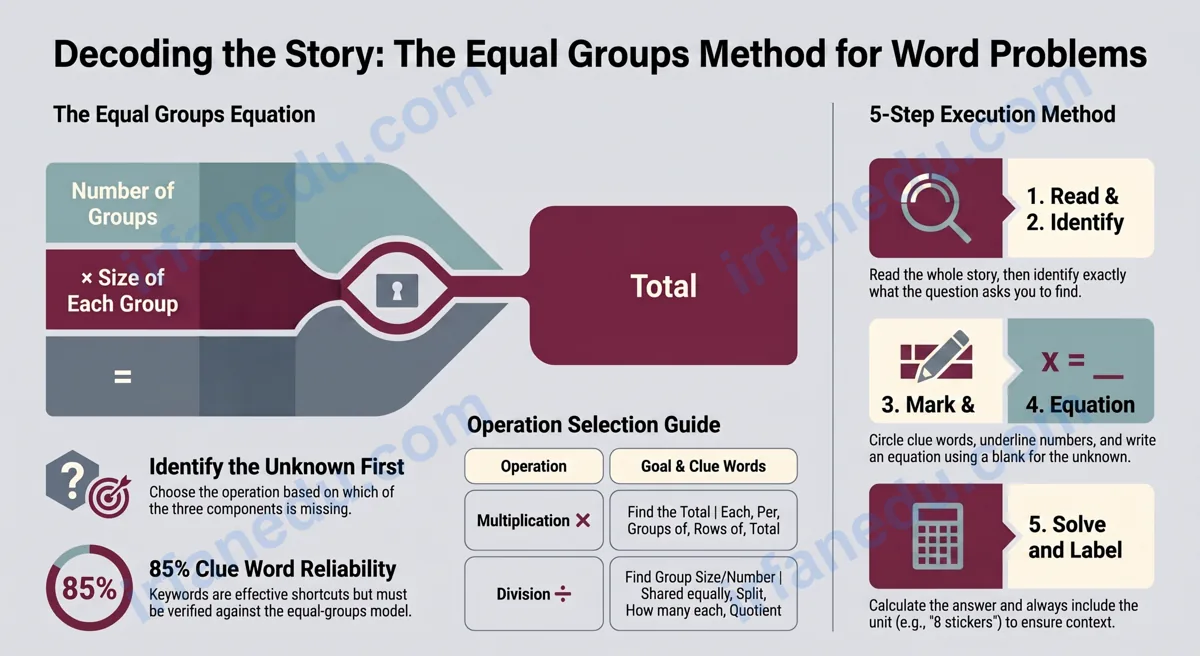
You hand your child a math worksheet. They can multiply 7 × 8 without blinking. But the moment a sentence appears — “A farmer has 7 rows of apple trees with 8 trees in each row” — they freeze. Sound familiar? This is one of the most common frustrations I hear from parents, and I have seen it play out in classrooms for over 15 years.
The problem is not the math. The problem is the translation — turning a real-world story into a number sentence. Once students learn that skill, word problems stop being scary and start being satisfying.
Multiplication and division word problems are math story problems that require identifying equal groups. Multiply to find a total when you know the group size and number of groups. Divide to find a group size or number of groups when you know the total. The key skill is reading the problem to identify what is unknown before choosing an operation.
- 🎯 Identify multiplication vs. division from context and clue words
- 🎯 Apply a reliable 5-step solving method to any word problem
- 🎯 Avoid the four most common mistakes students make
- 🎯 Practice with 12 graded problems and a full answer key
📄 Free Printable Worksheet (12 problems + answer key): Print and practise today — no sign-up required.
⚡ TL;DR – Quick Summary
- 🔴 Word problems feel hard because they mix reading and math skills simultaneously.
- 🔴 Multiply when building equal groups into a total; divide when splitting a total.
- 🔴 Clue words are your shortcut — learn the two lists and use them every time.
- 🔴 Always identify the unknown before picking an operation.
- 🔴 Multi-step problems just need one equation per step — keep it simple.
- 🔴 Practice with the 12-problem worksheet below to lock in the skill.
| Fact | Detail |
|---|---|
| Grade levels | Grades 3–6 (single-digit through multi-digit and multi-step) |
| Core concept | Equal groups — building up (×) or breaking down (÷) |
| Key multiplication clue words | each, per, times, groups of, rows of, total, product |
| Key division clue words | shared equally, split, divided by, how many each, quotient |
| Most common student mistake | Grabbing numbers and computing before identifying the unknown |
| Worksheet problems | 12 (easy → hard), with full answer key |
😤 Why Word Problems Feel So Hard (It Is Not What You Think)
Word problems are not harder because the math is harder. They are harder because they demand two separate skills at the same time: reading comprehension and mathematical reasoning. Most students who struggle with word problems are actually strong at both skills individually — they just have not learned to use them together.
In my experience teaching elementary and middle school math, the students who freeze at word problems are almost always doing the same thing: they read the problem, spot two numbers, and immediately try to do something with them. They skip the most important step — figuring out what the problem is actually asking.
The fix is a reliable process, not more computation practice. The five-step method below addresses exactly this.
After 15+ years in classrooms, I am convinced that word problem anxiety is almost entirely a strategy problem, not a math problem. The students who “get it” are not smarter — they have simply been taught to pause, identify the unknown, and then choose the operation. That one habit change transforms struggling students into confident problem-solvers within a few weeks.
📖 What Are Multiplication and Division Word Problems?
A multiplication or division word problem is a short story that describes a real-world situation involving equal groups, and asks you to find a missing value using multiplication or division.
Every problem of this type has three components: a number of groups, a size of each group, and a total. The relationship between them is always:
🔢 The Equal Groups Equation
  Number of Groups  ×  Size of Each Group  =  Total
  ─────────────────────────────────────────────────
  MULTIPLY when:   groups and size are known → find total
                   e.g. 4 bags × 6 apples each = ? apples

  DIVIDE when:     total and groups are known → find size
                   e.g. 24 apples ÷ 4 bags = ? apples each

  DIVIDE when:     total and size are known → find groups
                   e.g. 24 apples ÷ 6 each = ? bags
Notice that the same three numbers (4, 6, 24) can produce three different problems depending on which value is unknown. This is why identifying the unknown is the first and most important step.
🔍 The Clue Words That Tell You Which Operation to Use
Clue words are specific words in a problem that signal which operation to use. They are not a perfect system — context always wins — but they are right about 85% of the time and are an excellent starting point.
| 🔴 Multiply When You See… | ➗ Divide When You See… |
|---|---|
| each, every | shared equally, distributed equally |
| per (when building a total) | per (when finding a rate from a total) |
| groups of, rows of, sets of | split into, cut into equal parts |
| times, doubled, tripled | divided by, divided into |
| total (when groups × size are given) | how many each, how many groups |
| product of | quotient of |
| at a rate of [n] per [unit] | how many [units] in [total] |
🪜 How to Solve Multiplication and Division Word Problems: 5 Steps
This five-step method works for every multiplication or division word problem, from simple single-digit problems in Grade 3 to multi-step problems in Grade 6.
- Read the whole problem once. Do not try to solve yet. Just understand the story.
- Read the question (the last sentence) again. Identify exactly what you need to find — a total, a group size, or a number of groups.
- Highlight clue words and the numbers given. Underline the numbers and circle any clue words.
- Write the equation. Use a letter or blank for the unknown. Example: 4 × 7 = ? or 28 ÷ 4 = ?
- Solve and check. Calculate, then re-read the question and make sure the answer makes sense. Always include the unit (cookies, dollars, students).
✏️ 3 Fully Worked Examples (Easy → Hard)
Example 1 — Simple Multiplication (Grade 3)
🟠 Problem
A baker makes 6 trays of muffins. Each tray holds 9 muffins. How many muffins are there in total?
Step 1–2: The question asks for the total number of muffins.
Step 3: Clue words: “each tray holds” (equal groups), “total.” Numbers: 6 trays, 9 muffins each.
Step 4: 6 × 9 = ?
Step 5: 6 × 9 = 54 muffins. ✔ Makes sense — 6 trays of 9 is more than 50.
Example 2 — Simple Division (Grade 3–4)
🟠 Problem
A teacher has 48 stickers to share equally among 6 students. How many stickers does each student get?
Step 1–2: The question asks for the number of stickers per student — the group size.
Step 3: Clue words: “share equally,” “each student.” Numbers: 48 total, 6 students.
Step 4: 48 ÷ 6 = ?
Step 5: 48 ÷ 6 = 8 stickers each. ✔ Check: 8 × 6 = 48. Correct.
Example 3 — Multi-Step (Grade 5–6)
🟠 Problem
A school orders 15 boxes of coloured pencils. Each box contains 24 pencils. The pencils are then shared equally among 9 classrooms. How many pencils does each classroom receive?
Step 1–2: Two questions hidden here: (a) total pencils, then (b) pencils per classroom.
Step 3 & 4 — Part A: “Each box contains” → multiply. 15 × 24 = 360 pencils total.
Step 3 & 4 — Part B: “Shared equally among 9” → divide. 360 ÷ 9 = ?
Step 5: 360 ÷ 9 = 40 pencils per classroom. ✔ Check: 40 × 9 = 360. Correct.
[IMAGE: A visual diagram showing the three-part equal groups model (groups × size = total) with arrows indicating which value is unknown in each example | ALT: Equal groups model diagram for multiplication and division word problems showing groups times size equals total]
⚠️ Common Mistakes in Word Problems (Wrong vs. Right)
These four mistakes account for the vast majority of errors I see on graded assignments. Recognising them is the fastest way to improve accuracy.
| ❌ What Students Do Wrong | ✅ What to Do Instead |
|---|---|
| Grab the two numbers and multiply or divide without reading the question | Read the question first. Identify the unknown before touching the numbers. |
| Rely only on clue words and ignore context (e.g. misread “per” problems) | Use clue words as a starting point, then confirm with the equal-groups model. |
| Forget to include the unit in the answer (write “8” instead of “8 stickers”) | Always re-read the question and label the answer with its unit. |
| Treat multi-step problems as one step and get stuck | Break multi-step problems into separate mini-questions and write one equation per step. |
💡 What Most Word Problem Guides Get Wrong
Almost every worksheet site and textbook teaches clue words as the primary strategy. That is a mistake. Clue words are a useful shortcut, but they fail on roughly 15–20% of problems — especially problems that use “per,” “total,” or “each” in misleading ways. The real strategy is the equal-groups model: every problem has a number of groups, a size of each group, and a total. Identify which of the three is unknown, and the operation is automatic. I have seen students who were taught this model first outperform clue-word-only students on every test I have given. Teach the model first; use clue words as a confirmation check, not the primary method.
In my experience, the single most effective classroom activity for word problems is what I call “Write Your Own.” After students solve a problem, I ask them to write a new word problem that uses the same equation. If a student can write “4 × 9 = 36” as a believable story, they truly understand the relationship between multiplication and real-world situations. This is far more powerful than drilling 50 identical problems. Try it at home — ask your child to invent a word problem for any multiplication fact they know.
📝 Free Practice Worksheet (12 Problems)
These 12 problems are ordered from easy to challenging. Try them on paper first, then check your answers using the key below. The free PDF version (with a formatted answer key) is available to download.
How to use this worksheet: Print the PDF or work through the problems below. Write your equation for each problem before solving — this is the most important habit to build. After finishing, check your answers with the key. For any problem you got wrong, re-read the problem and identify which step you missed.
- A baker makes 6 trays of cookies. Each tray holds 8 cookies. How many cookies are there in total?
- A classroom has 4 rows of desks. Each row has 7 desks. How many desks are in the classroom?
- A farmer packs 36 apples equally into 4 bags. How many apples are in each bag?
- A school orders 56 pencils and shares them equally among 8 classrooms. How many pencils does each classroom get?
- A library has 9 shelves. Each shelf holds 12 books. How many books does the library hold in total?
- A coach divides 45 students equally into teams of 5. How many teams are there?
- A store sells boxes of crayons. Each box has 16 crayons. A teacher buys 7 boxes. How many crayons does she have?
- A factory produces 144 toy cars in one day and packs them equally into boxes of 12. How many boxes are filled?
- A garden has 8 rows of plants. Each row has 15 plants. How many plants are in the garden?
- Three friends share a prize of $96 equally. How much does each friend receive?
- A school trip costs $12 per student. There are 24 students going. What is the total cost?
- A warehouse stores 252 boxes arranged in 9 equal rows. How many boxes are in each row?
👁 Show Answer Key
- 48 cookies (6 × 8 = 48)
- 28 desks (4 × 7 = 28)
- 9 apples per bag (36 ÷ 4 = 9)
- 7 pencils per classroom (56 ÷ 8 = 7)
- 108 books (9 × 12 = 108)
- 9 teams (45 ÷ 5 = 9)
- 112 crayons (7 × 16 = 112)
- 12 boxes (144 ÷ 12 = 12)
- 120 plants (8 × 15 = 120)
- $32 each ($96 ÷ 3 = $32)
- $288 total (24 × $12 = $288)
- 28 boxes per row (252 ÷ 9 = 28)
📄 Want a print-ready version? Download the free PDF with all 12 problems formatted for printing, plus a separate answer key page.
🧠 Quick Quiz: Test Your Skills
3 Questions — Choose the Best Answer
1. A box holds 8 oranges. There are 7 boxes. Which equation finds the total number of oranges?
2. A teacher has 63 stickers to share equally among 9 students. Which operation should she use?
3. A school trip costs $15 per student. There are 18 students. Then 6 students cancel. What is the final total cost?
🔓 Reveal-on-Click Practice Problems
Problem A: A parking lot has 12 rows of spaces. Each row has 15 spaces. How many spaces in total?
Equation: 12 × 15 = 180
Answer: 180 parking spaces.
Problem B: A charity packs 180 food items equally into 12 boxes. How many items per box?
Equation: 180 ÷ 12 = 15
Answer: 15 items per box.
Problem C: A store receives 5 shipments of 24 bottles each. It then sells 60 bottles. How many bottles remain?
Step 2 (Subtract): 120 − 60 = 60 bottles remaining.
Answer: 60 bottles remain.
❓ Frequently Asked Questions
How do you know when to multiply or divide in a word problem?
What are the clue words for multiplication word problems?
Sources & References
Reviewed by Dr. Irfan Mansuri. External links open in a new tab and are provided for further reading and verification.