
🔢 Multiplication Worksheets 2 Digit by 1 Digit: 5 Things Nobody Tells You (+ Free PDF)
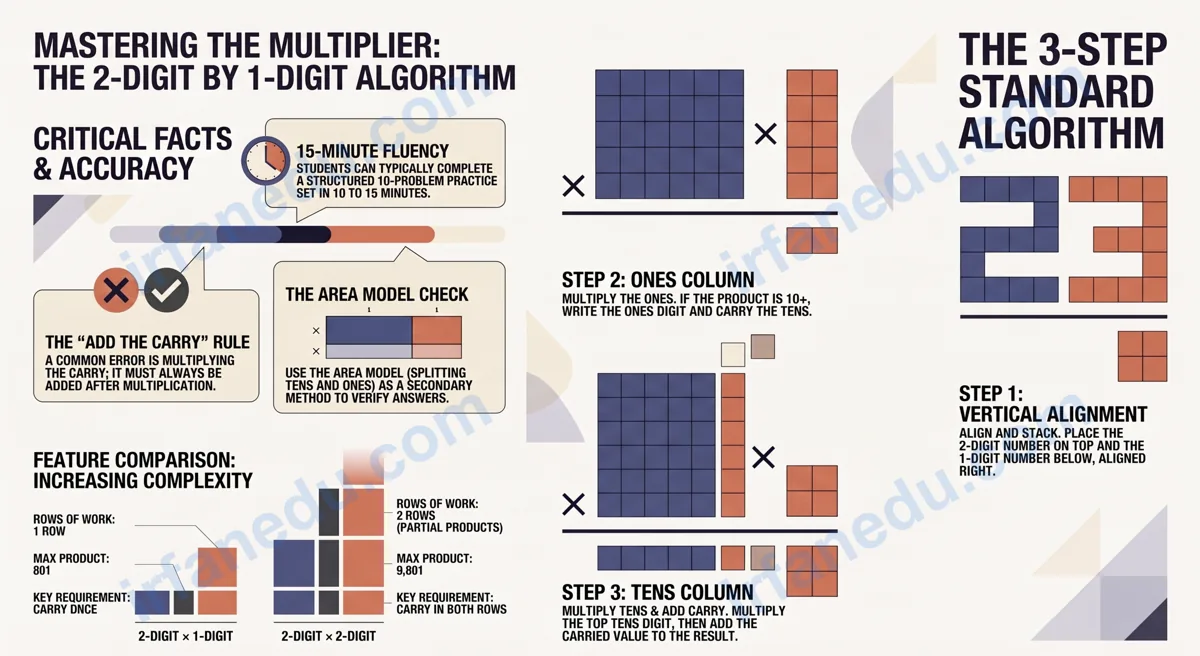
Multiplying a 2-digit number by a 1-digit number is the first big step beyond times tables. Students learn to multiply the ones column, carry the extra tens, then multiply the tens column — a two-step process that builds the foundation for all multi-digit multiplication in later grades.
Most worksheet pages just dump 20 problems on a page and call it a day. In my 15+ years of teaching math, I’ve watched students repeat the same four mistakes week after week — not because they are careless, but because nobody explained the why behind each step.
Below are 5 things nobody tells you about 2-digit × 1-digit multiplication — each one a real insight that changes how quickly students get it right. Then you’ll find a full lesson, 3 worked examples, and a free printable worksheet with 10 problems and a complete answer key. 🎯
- 🎯 Understand the standard algorithm step by step
- 🔍 Spot and fix the 4 most common errors
- 🧮 Work through 3 fully solved examples
- 📄 Download a free printable PDF worksheet with answer key
- ✅ Test yourself with an interactive quiz
- The carry is a helper, not a separate problem. Most students treat the carry as a new number to multiply. It’s not — you only add it after multiplying.
- Column alignment is half the battle. A misaligned digit causes more wrong answers than a forgotten times table. Always write problems vertically and right-align.
- The area model and the standard algorithm give the same answer. Knowing both lets you double-check work in seconds — a test-taking superpower.
- Times-table gaps show up here first. If a student struggles with 2×1 multiplication, the real problem is usually 6×7 or 8×4 — not the algorithm itself.
- Speed comes from pattern recognition, not memorisation drills alone. After 3–4 sessions with a structured worksheet, the brain starts grouping “tens × single digit” automatically.
A 2-digit by 1-digit multiplication worksheet gives students practice multiplying numbers like 34 × 6 or 47 × 8 using the standard algorithm. Multiply the ones digit first, carry if the product exceeds 9, then multiply the tens digit and add the carry. These worksheets target Grade 3–4 learners building fluency before multi-digit multiplication.
📥 Get the full 10-problem worksheet + answer key as a print-ready PDF — free, no sign-up needed.
⚡ TL;DR – Quick Summary
- ✅ Multiply ones digit first, carry the tens if the product is > 9.
- ✅ Multiply tens digit next, then add the carry to get the final answer.
- ✅ The area model (split into tens + ones) is a great self-check method.
- ✅ The 4 biggest mistakes: forgetting the carry, wrong column order, misalignment, and times-table errors.
- ✅ This worksheet has 10 problems ordered easy → hard, plus a full answer key.
- ✅ Suitable for Grade 3–4; builds directly toward 2×2 and 3×1 multiplication.
📊 Quick Facts
| Feature | Detail |
|---|---|
| Skill name | 2-digit × 1-digit multiplication |
| Grade level | Grade 3 (intro), Grade 4 (fluency) |
| Prerequisite | Times tables 1–9, place value (tens & ones) |
| Algorithm used | Standard algorithm (right to left) |
| Key concept | Regrouping / carrying |
| Worksheet problems | 10 (easy → hard) |
| Next skill | 2-digit × 2-digit multiplication |
| Time to complete worksheet | 10–15 minutes |
🔢 What Is 2-Digit by 1-Digit Multiplication?
2-digit by 1-digit multiplication means finding the product of a two-digit number (10–99) and a single-digit number (1–9). It is the first multiplication skill that requires regrouping (carrying), which is why it marks a real step up from basic times tables.
At its core, the skill relies on place value. The 2-digit number has a tens part and an ones part. You multiply the 1-digit number by each part separately, then combine the results. The standard algorithm does this automatically in a compact vertical format.
2×1 vs. 2×2 Multiplication: A Quick Comparison
| Feature | 2-Digit × 1-Digit | 2-Digit × 2-Digit |
|---|---|---|
| Rows of multiplication | 1 | 2 (partial products) |
| Regrouping needed | Sometimes (carry once) | Often (carry in both rows) |
| Max product size | 3 digits (99 × 9 = 891) | 4 digits (99 × 99 = 9,801) |
| Grade introduced | Grade 3 | Grade 4–5 |
| Prerequisite for | 2×2 multiplication | Long multiplication, algebra |
🪜 How Do You Multiply a 2-Digit Number by a 1-Digit Number? (Step-by-Step)
The standard algorithm for 2×1 multiplication takes exactly 4 steps. Follow them in order every time and you will never get confused about where to write the carry.
- Write the problem vertically. Place the 2-digit number on top, the 1-digit number below it, aligned to the right. Draw a line underneath.
- Multiply the ones digit. Take the ones digit of the top number and multiply it by the bottom number. If the result is 9 or less, write it below the line in the ones column. If it is 10 or more, write the ones digit below the line and write the tens digit (the carry) in small writing above the tens column of the top number.
- Multiply the tens digit, then add the carry. Take the tens digit of the top number and multiply it by the bottom number. Add the carry (if any). Write the full result to the left of the ones digit answer.
- Read the answer. The digits below the line, read left to right, are the final product.
In my experience teaching this skill, the single most effective change I made was to have students say the carry out loud as they write it: “I carry 2.” That one habit cut careless carry errors by more than half in my classroom. It forces the brain to register the carry as a real number before moving on.
✏️ 3 Fully Worked Examples of 2-Digit × 1-Digit Multiplication
These three examples progress from no-carry (easy) to double-carry (hard). Work through each one before trying the worksheet.
Example 1 — No Regrouping: 21 × 3
Step 1: Write vertically: 21 on top, 3 below.
Step 2: Ones: 1 × 3 = 3. Write 3 below the line. No carry.
Step 3: Tens: 2 × 3 = 6. Write 6 to the left of 3.
Answer: 63
📐 Visual: 21 × 3 (Standard Algorithm)
    2 1
  ×   3
  -----
    6 3   ← (2×3=6, 1×3=3, no carry)
Example 2 — One Carry: 47 × 4
Step 1: Write vertically: 47 on top, 4 below.
Step 2: Ones: 7 × 4 = 28. Write 8 below the line in the ones column. Carry the 2 above the tens column.
Step 3: Tens: 4 × 4 = 16, plus carry 2 = 18. Write 18 to the left of 8.
Answer: 188
📐 Visual: 47 × 4 (Standard Algorithm)
    ²
    4 7
  ×   4
  -----
  1 8 8   ← ones: 7×4=28 (write 8, carry 2)
            tens: 4×4=16 + 2 carry = 18
Example 3 — Harder Carry: 93 × 8
Step 1: Write vertically: 93 on top, 8 below.
Step 2: Ones: 3 × 8 = 24. Write 4 below the line. Carry the 2.
Step 3: Tens: 9 × 8 = 72, plus carry 2 = 74. Write 74 to the left of 4.
Answer: 744
📐 Visual: 93 × 8 (Standard Algorithm)
    ²
    9 3
  ×   8
  -----
  7 4 4   ← ones: 3×8=24 (write 4, carry 2)
            tens: 9×8=72 + 2 carry = 74
Split 47 into 40 + 7.
40 × 4 = 160 | 7 × 4 = 28
160 + 28 = 188 ✓
This matches the standard algorithm — use it as a self-check on tests!
⚠️ 4 Common Mistakes in 2-Digit × 1-Digit Multiplication (Wrong vs. Right)
These four errors account for the vast majority of wrong answers I see on 2×1 multiplication worksheets. Recognising them is the fastest way to improve accuracy.
Wrong: In 47 × 4, student does 4 × 4 = 16, then 16 × 2 (carry) = 32. Answer: 328.
✅ Right: 4 × 4 = 16, then 16 + 2 (carry) = 18. Answer: 188.
Fix: Write the carry in a different colour and label it “add this.”
Wrong: In 34 × 6, student multiplies 3 × 6 = 18 first, writes 18, then 4 × 6 = 24. Answer: 1824 (nonsense).
✅ Right: Always start with the ones column (right side). 4 × 6 = 24, carry 2. 3 × 6 = 18 + 2 = 20. Answer: 204.
Fix: Draw an arrow pointing right-to-left before starting every problem.
Wrong: In 56 × 5, student does 6 × 5 = 30, writes 0, forgets to carry 3. Then 5 × 5 = 25. Answer: 250 (should be 280).
✅ Right: 6 × 5 = 30, write 0, carry 3. 5 × 5 = 25 + 3 = 28. Answer: 280.
Fix: Always write the carry digit before moving to the next column.
Wrong: In 63 × 7, student thinks 6 × 7 = 48 (should be 42). Gets 483 instead of 441.
✅ Right: Review the 6s and 7s times tables before attempting harder problems.
Fix: Keep a times-table reference card handy until tables are fully memorised.
Mistake 1 — multiplying the carry — is the one that surprises me most. I’ve seen it in students who otherwise understand the algorithm perfectly. The root cause is that the carry looks like a multiplication problem sitting above the column. Colour-coding the carry (write it in red or a circle) is the simplest fix I’ve found, and it works immediately.
💡 Unique Insight: The “Phantom Tens” Problem Most Guides Ignore
Here is something I have never seen explained in any worksheet guide: when the tens digit of a 2-digit number is 1 (e.g. 13, 17, 19), students frequently skip multiplying it entirely. They see “1 × something” and their brain says “that’s just something” — and they write the multiplier itself instead of the actual product.
For example, in 19 × 7: ones column gives 63, carry 6. Tens column: 1 × 7 = 7, plus carry 6 = 13. Answer: 133. But students often write just “7 + 6 = 13” without registering the multiplication step, which is technically correct here — but in 18 × 7, they do 1 × 7 = 7 + 5 (carry) = 12, and write 125 instead of 126 because they dropped a digit. The fix: always write out “1 × [multiplier] = [multiplier]” explicitly, even when it feels obvious. Skipping visible steps is where silent errors hide.
📄 Practice Worksheet: 2-Digit × 1-Digit Multiplication (10 Problems)
Print this page or download the PDF for a clean printable version. Work through all 10 problems, show your working, then check the answer key below. Problems go from easy (no carry) to hard (large carry).
Instructions: Multiply each 2-digit number by the 1-digit number shown. Show your working in the space provided. Check your answers with the answer key below.
- 21 × 3 = ______
- 32 × 2 = ______
- 43 × 2 = ______
- 34 × 3 = ______
- 47 × 4 = ______
- 56 × 5 = ______
- 63 × 7 = ______
- 75 × 6 = ______
- 84 × 9 = ______
- 93 × 8 = ______
✅ Show Answer Key
- 21 × 3 = 63
- 32 × 2 = 64
- 43 × 2 = 86
- 34 × 3 = 102
- 47 × 4 = 188
- 56 × 5 = 280
- 63 × 7 = 441
- 75 × 6 = 450
- 84 × 9 = 756
- 93 × 8 = 744
📥 Download the print-ready PDF version (includes answer key on a separate page).
🧠 Quick Quiz: Test Your 2×1 Multiplication Skills
Answer all three questions, then reveal the explanation for each one.
🟣 Interactive Quiz
Q1. What is 34 × 6?
Reveal answer & explanation
✅ B) 204. Ones: 4 × 6 = 24, write 4, carry 2. Tens: 3 × 6 = 18 + 2 = 20. Final answer: 204.
Q2. In 75 × 6, what digit do you carry after multiplying the ones column?
Reveal answer & explanation
✅ B) 3. 5 × 6 = 30. Write 0 in the ones column and carry the 3 to the tens column.
Q3. Which method can you use to double-check 47 × 4 = 188?
Reveal answer & explanation
✅ B) Area model. 40 × 4 = 160 and 7 × 4 = 28. 160 + 28 = 188. This confirms the standard algorithm answer.
🔍 Reveal-on-Click Practice Problems
Practice: Solve 65 × 7. Show your working.
Step 1 — Ones: 5 × 7 = 35. Write 5, carry 3.
Step 2 — Tens: 6 × 7 = 42 + 3 (carry) = 45. Write 45.
Answer: 455
Practice: Solve 88 × 9. Show your working.
Step 1 — Ones: 8 × 9 = 72. Write 2, carry 7.
Step 2 — Tens: 8 × 9 = 72 + 7 (carry) = 79. Write 79.
Answer: 792
Practice: Use the area model to solve 52 × 6.
Split: 52 = 50 + 2
50 × 6 = 300
2 × 6 = 12
300 + 12 = 312
❓ Frequently Asked Questions
What grade level is 2-digit by 1-digit multiplication?
2-digit by 1-digit multiplication is typically introduced in Grade 3 and practised for fluency in Grade 4. Students should already know their times tables up to 10 and understand place value (tens and ones) before starting this skill.
What is the standard algorithm for 2-digit by 1-digit multiplication?
Write the problem vertically. Multiply the ones digit of the 2-digit number by the 1-digit number first. Write the ones digit of the result below the line and carry the tens digit. Then multiply the tens digit of the 2-digit number by the 1-digit number, add the carry, and write the result to the left.
How do I help my child with 2-digit multiplication at home?
Start by reviewing times tables 1–9 together. Work through 2–3 examples using the standard algorithm, naming each step aloud. Then use this free worksheet for 10-minute daily practice sessions. Self-check with the included answer key and celebrate every correct carry — it’s the hardest part of the skill.
Sources & References
Reviewed by Dr. Irfan Mansuri. External links open in a new tab and are provided for further reading and verification.