
Multi-Step Inequalities: Solve Them Right (Free Worksheet Inside)
Most students learn to solve equations first — and that is a good foundation. But when the equal sign becomes an inequality sign, one rule changes everything. Miss it once, and your entire solution is backwards.
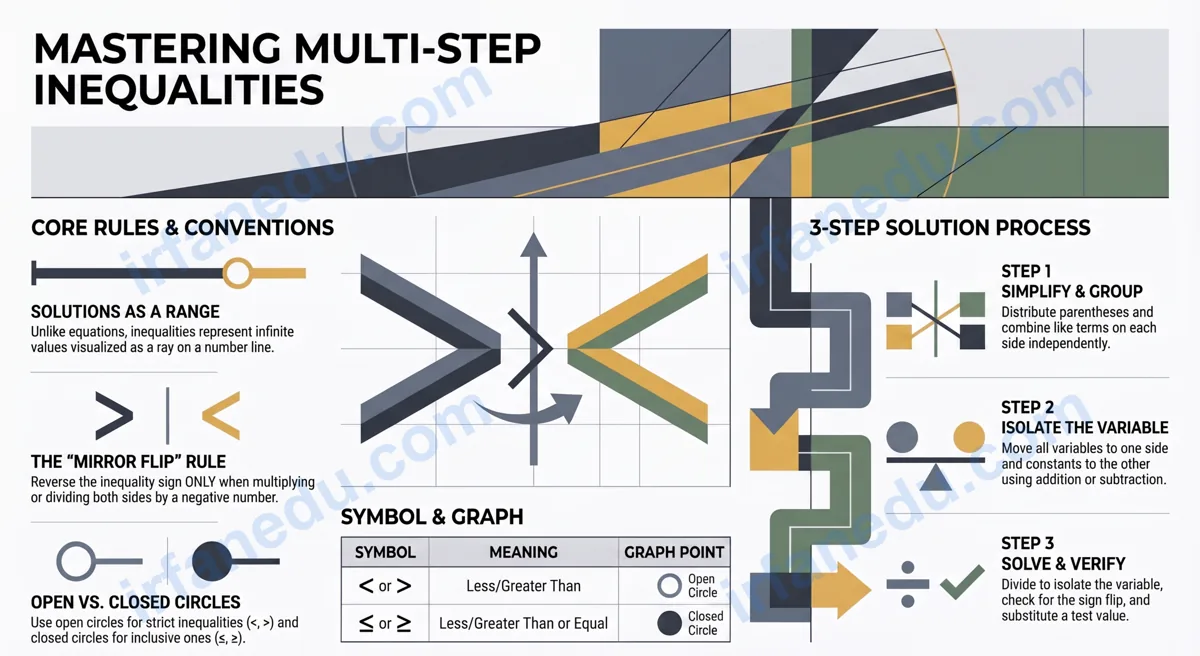
Multi-step inequalities are algebraic statements that require two or more operations to isolate the variable. They work almost identically to equations, with one critical exception: when you multiply or divide both sides by a negative number, you must reverse the inequality sign. The solution is a range of values, graphed on a number line.
- Understand what makes an inequality different from an equation
- Apply the 5-step method to any multi-step inequality
- Avoid the sign-flip mistake that trips up most students
- Practice with 12 graded problems and check your answers instantly
Free Printable PDF: 12 graded practice problems + full answer key, ready to print.
⚡ TL;DR – Quick Summary
- Multi-step inequalities need 2+ operations to isolate the variable.
- Steps mirror equation-solving: simplify, collect, isolate, divide/multiply.
- Flip the inequality sign ONLY when multiplying or dividing by a negative.
- Solutions are ranges, shown with open (strict) or closed (inclusive) circles.
- Variables on both sides: move them first, then isolate.
- Always check your answer by substituting a test value back in.
| Fact | Detail |
|---|---|
| Topic | Multi-Step Inequalities |
| Grade Level | Grades 7-9 / Algebra 1 |
| Prerequisite | One-step and two-step equations |
| Key Rule | Flip sign when multiplying/dividing by a negative |
| Solution Type | Range of values (not a single number) |
| Graph Symbol | Open circle (< >) or closed circle (≤ ≥) |
Equations vs Inequalities: What Is Actually Different?
The fastest way to understand multi-step inequalities is to place them side by side with equations. The solving process is nearly identical — the differences are small but critical.
| Feature | Equation (e.g. 2x + 3 = 7) | Inequality (e.g. 2x + 3 > 7) |
|---|---|---|
| Symbol | = (equal sign) | < > ≤ ≥ (inequality sign) |
| Number of solutions | Usually one value (x = 2) | Infinite values (x > 2) |
| Solution written as | x = 2 | x > 2 or (2, ∞) |
| Graphed as | A single point on a number line | A ray (arrow) on a number line |
| Add/subtract rule | Same on both sides, sign unchanged | Same on both sides, sign unchanged |
| Multiply/divide by positive | Sign unchanged | Sign unchanged |
| Multiply/divide by NEGATIVE | Sign unchanged | Sign REVERSES (the key difference) |
| Check method | Substitute one value | Substitute a test value from the solution range |
In my experience teaching algebra, the comparison table above is the single most useful thing I can show a student before they touch a problem. When you see the two columns together, the sign-flip rule stops feeling arbitrary — it is the only thing that changes. Students who internalize this table make far fewer errors than those who try to memorize the rule in isolation.
What Are Multi-Step Inequalities?
A multi-step inequality is an algebraic inequality that requires at least two inverse operations to isolate the variable. The variable can appear on one side or both sides of the inequality sign.
Here are three examples at increasing difficulty:
- Basic: 2x + 3 > 7 (subtract 3, then divide by 2)
- Intermediate: -3x + 7 ≤ -x + 1 (variables on both sides)
- Advanced: 2(x – 4) + 3 > x – 1 (distribute first, then solve)
The inequality signs used are: < (less than), > (greater than), ≤ (less than or equal to), ≥ (greater than or equal to). Each produces a different endpoint style on the number line.
How Do You Solve Multi-Step Inequalities?
Solving a multi-step inequality follows a clear 5-step process. Apply these steps in order and you will isolate the variable every time.
-
Simplify each side separately
Distribute any parentheses and combine like terms on each side before doing anything else. -
Move all variable terms to one side
Add or subtract variable terms so all x’s are on one side. This does NOT flip the sign. -
Move all constant terms to the other side
Add or subtract numbers to isolate the variable term. This does NOT flip the sign. -
Divide or multiply to get the variable alone
If the coefficient is negative, divide by a negative number — and REVERSE the inequality sign at this exact step. -
Graph and verify
Draw the solution on a number line (open or closed circle, shade the correct direction). Substitute a test value to confirm.
Worked Examples: Two Problems Solved in Full
Example 1 — Variables on One Side
Problem: Solve -3x + 7 ≤ 1 and graph the solution.
Step-by-Step Solution
Start: -3x + 7 ≤ 1
Step 1 — Subtract 7 from both sides:
-3x + 7 – 7 ≤ 1 – 7
-3x ≤ -6
Step 2 — Divide both sides by -3 (NEGATIVE — flip the sign!):
x ≥ 2
Solution: x ≥ 2
Check: Substitute x = 4 (a value ≥ 2):
-3(4) + 7 = -12 + 7 = -5 ≤ 1 ✓
Number Line — x ≥ 2
  <---+----+----[============================>
     0    1    2    3    4    5    6
                    closed circle at 2, shaded right
Example 2 — Variables on Both Sides with Distribution
Problem: Solve 2(x – 4) + 3 > x – 1.
Step-by-Step Solution
Start: 2(x – 4) + 3 > x – 1
Step 1 — Distribute:
2x – 8 + 3 > x – 1
2x – 5 > x – 1
Step 2 — Subtract x from both sides:
2x – x – 5 > x – x – 1
x – 5 > -1
Step 3 — Add 5 to both sides:
x – 5 + 5 > -1 + 5
x > 4
Solution: x > 4
Check: Substitute x = 6:
2(6-4)+3 = 2(2)+3 = 7 > 6-1 = 5 ✓
Number Line — x > 4
  <---+----+----+----o========================>
     1    2    3    4    5    6    7
                    open circle at 4, shaded right
Common Mistakes: Wrong vs Right
These four errors account for the majority of lost marks on inequality problems. Study the wrong column carefully — recognizing the error is half the battle.
| ✘ Wrong | ✔ Right |
|---|---|
| -2x > 8 → x > -4 (forgot to flip) | -2x > 8 → x < -4 (divided by -2, sign flips) |
| Subtracting a negative: -3x – (-5) → -3x – 5 | -3x – (-5) = -3x + 5 (two negatives make a positive) |
| Open circle at 3 for x ≥ 3 | Closed circle at 3 for x ≥ 3 (endpoint included) |
| Distributing: 2(x – 4) → 2x – 4 | 2(x – 4) = 2x – 8 (multiply BOTH terms inside) |
Every textbook tells you to flip the sign when dividing by a negative. But almost none of them explain why — and that gap causes students to apply the rule incorrectly in unfamiliar situations.
Here is the real reason: the number line is ordered. The number 3 is to the right of 1, so 3 > 1. Multiply both by -1: you get -3 and -1. Now -3 is to the LEFT of -1, so -3 < -1. Multiplying by a negative physically reverses the position of every number on the line — so the direction of the inequality must reverse too.
In my teaching, I call this the “mirror flip”: multiplying by -1 mirrors the number line. Once students visualize this, the rule becomes obvious rather than arbitrary — and they stop misapplying it to subtraction steps.
Practice Worksheet: 12 Graded Problems
How to Use This Worksheet
Print the PDF (button below) or work through the problems on screen. Solve each inequality, write your answer as an inequality, and sketch the solution on a number line. When you finish, expand the Answer Key to check your work. Aim to complete the first 6 problems without looking at any notes, then use your notes for problems 7-12.
- 2x + 3 > 7
- 3x – 5 ≤ 10
- 4x + 1 ≥ -11
- -2x + 6 > 12
- 5x – 4 < 2x + 8
- 3(x + 2) ≥ 15
- -3x + 7 ≤ -x + 1
- 2(x – 4) + 3 > x – 1
- 4(2x – 1) ≤ 3x + 11
- -(x + 5) + 2x ≥ 3x – 7
- (x/3) + 2 > 5
- -2(3x – 4) < -x + 3
Show Answer Key
- x > 2
- x ≤ 5
- x ≥ -3
- x < -3
- x < 4
- x ≥ 3
- x ≥ 3
- x > 4
- x ≤ 3
- x ≤ 2
- x > 9
- x > 1
Want a print-ready version? Download the PDF with all 12 problems and the answer key formatted for printing.
I deliberately ordered these 12 problems so the sign-flip rule does not appear until problem 4. In my experience, students who hit the flip rule on problem 1 get confused and give up. Starting with straightforward problems builds the procedural muscle first — then the sign flip feels like a small variation, not a completely new concept. That sequencing is something most worksheet sites ignore entirely.
Quick Quiz: Test Your Understanding
Multi-Step Inequalities — 3-Question Quiz
Q1. Solve: -4x + 8 > 20. What is the solution?
Not quite — remember to flip the sign when dividing by -4.
Correct! -4x > 12, divide by -4 and flip: x < -3.
Not quite — check your subtraction step first.
Close, but recheck: 8 – 20 = -12, not 12.
Q2. Which graph symbol represents x ≥ 5?
Open circle means the endpoint is excluded — but ≥ includes 5.
The direction is right, but ≥ needs a closed circle.
Correct! ≥ means 5 is included (closed circle), and values greater than 5 are shaded right.
The circle is right, but x ≥ 5 means values 5 and above — shade right.
Q3. Solve: 3(x + 2) ≥ 15. What is x?
Recheck the distribution: 3(x+2) = 3x + 6, not 3x + 2.
Correct! 3x + 6 ≥ 15 → 3x ≥ 9 → x ≥ 3.
Distribute first: 3x + 6 ≥ 15, then subtract 6 before dividing.
You divided by a positive 3 — the sign does not flip here.
Frequently Asked Questions
What is a multi-step inequality?
When do you flip the inequality sign?
How is solving an inequality different from solving an equation?
What does an open circle mean on a number line?
Can a multi-step inequality have no solution?
How do you solve an inequality with variables on both sides?
What is interval notation for inequality solutions?
Key Takeaways
- Multi-step inequalities are solved with the same steps as equations — simplify, collect, isolate.
- The only new rule: reverse the inequality sign when multiplying or dividing by a negative number.
- Solutions are ranges of values, graphed with open circles (strict) or closed circles (inclusive).
- Always verify your answer by substituting a test value from the solution range.
- Variables on both sides: move variable terms first, then constants.
- Distribution errors and sign-flip errors are the two most common mistakes — check both every time.