
What Is a Resource Teacher? A Complete Guide for Parents
If your child’s school mentioned a “resource teacher” and you are not sure what that means, you are not alone. The term gets used differently across districts, states, and countries — which creates real confusion for parents trying to advocate for their kids.
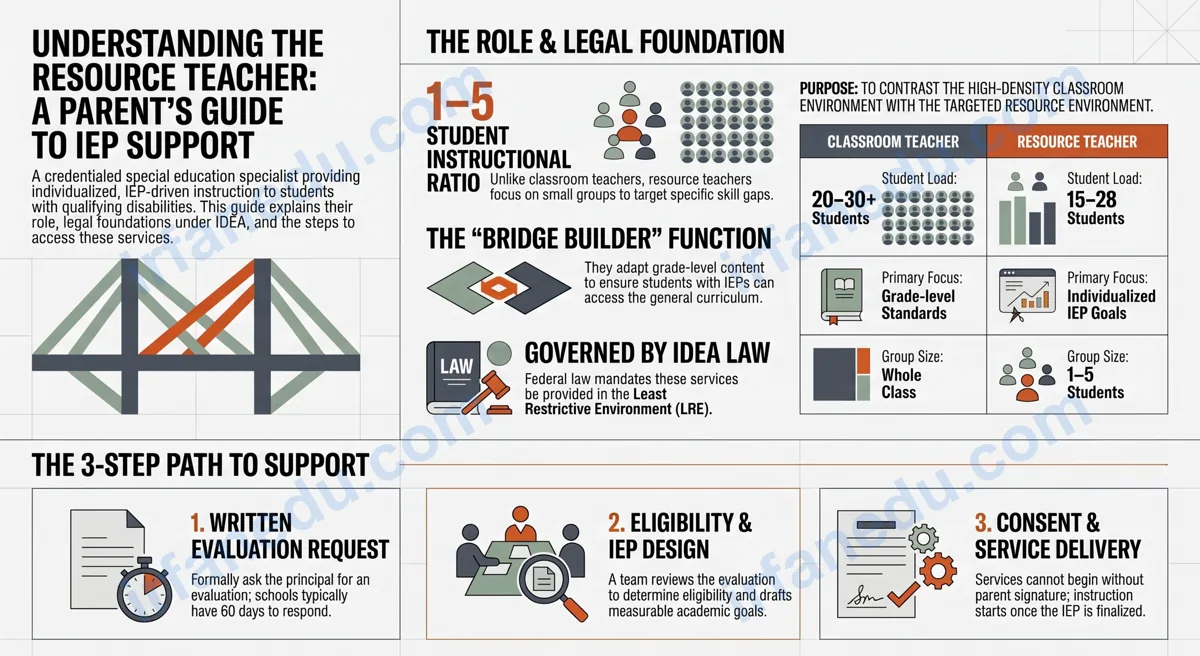
A resource teacher is a credentialed special education professional who delivers targeted instruction to students with learning disabilities, developmental delays, or other qualifying conditions. They work in small groups or one-on-one, design and carry out IEP goals, and collaborate with classroom teachers to make grade-level content accessible.
In my experience working with schools and families, the resource teacher is often the single most important adult in a struggling student’s school day — yet their role is one of the least understood. This guide explains exactly what they do, how the IEP process works, and what you as a parent can do to make the most of this support.
- Understand the resource teacher’s role and legal basis
- See how resource support differs from general classroom teaching
- Learn the step-by-step process to access services for your child
- Identify common misconceptions that hold families back
What You Will Learn
By the end of this guide, you will know exactly what a resource teacher does, how they differ from a classroom teacher, how the IEP connects to their work, and the steps to take if you think your child needs this support.
TL;DR – Quick Summary
- A resource teacher is a special education specialist who serves students with IEPs.
- They work in small groups or one-on-one, not with a full class of 30.
- Their instruction targets specific IEP goals, not the general curriculum alone.
- They collaborate with classroom teachers, parents, and specialists as a team.
- In the US, IDEA law governs eligibility, caseload limits, and IEP timelines.
- Parents have legal rights at every stage — evaluation, IEP meetings, and reviews.
Resource Teacher at a Glance — Cheat Sheet
Each row below is expanded into its own section. Use this as a quick reference or jump to the section you need most.
| Topic | The Short Answer | Jump To |
|---|---|---|
| Who they are | Credentialed special education teacher with a small caseload (15-28 students) | What Is a Resource Teacher? |
| Who they serve | Students with an active IEP (learning disability, ADHD, speech, autism, etc.) | IEP Role |
| Where they work | Resource room (pull-out) and/or inside the general classroom (push-in) | Resource Room |
| What they do daily | Teach IEP goals, co-plan with classroom teachers, track progress, meet with parents | Daily Work |
| How they differ | Smaller groups, specialized credentials, IEP-driven goals vs. grade-level curriculum | Comparison Table |
| How to access | Written evaluation request → eligibility meeting → IEP → services begin | Step-by-Step |
| Qualifications | Bachelor’s + special education credential/endorsement; many hold a master’s degree | Qualifications |
| Biggest misconception | Resource support is NOT a lesser track — it is targeted acceleration toward independence | Common Mistakes |
What Is a Resource Teacher?
A resource teacher is a specially trained educator who provides individualized academic support to students who qualify for special education services. The term “resource” refers to the resource room model — a dedicated space where small-group instruction happens outside the general classroom for part of the school day.
In the United States, the legal foundation for this role is the Individuals with Disabilities Education Act (IDEA). IDEA guarantees students with qualifying disabilities a free and appropriate public education (FAPE) in the least restrictive environment (LRE). The resource teacher is the person who delivers that promise in practice.
You may also hear the role called:
- RSP teacher (Resource Specialist Program — California’s specific term)
- Learning support teacher
- Special education resource teacher
- Resource specialist
- Inclusion support teacher
These titles vary by state and district, but the core function is the same: targeted, IEP-driven instruction for students who need more than the general classroom can provide on its own.
What Does a Resource Teacher Do Every Day?
A resource teacher’s day is far more varied than most people expect. Beyond direct instruction, they carry significant administrative and collaborative responsibilities tied to legal compliance.
Here is a realistic picture of a resource teacher’s daily and weekly tasks:
- Direct instruction: Teaching reading, writing, math, or study skills in small groups (2-5 students) or one-on-one sessions, using evidence-based methods matched to each student’s IEP goals.
- Progress monitoring: Collecting data on each student’s IEP goals — often weekly — using curriculum-based measures, running records, or standardized probes.
- Co-teaching / push-in support: Entering the general classroom alongside the classroom teacher to support students during core instruction without pulling them out.
- IEP writing and maintenance: Drafting annual IEP goals, present levels of performance, and accommodation lists. This is legally binding documentation.
- Collaboration meetings: Meeting with classroom teachers, school psychologists, speech therapists, occupational therapists, and administrators to coordinate each student’s support plan.
- Parent communication: Sending progress reports, holding IEP meetings, and responding to parent concerns — often the primary point of contact for families.
- Transition planning: For older students (age 16+), resource teachers help plan the transition from school to post-secondary education or employment.
[IMAGE: A weekly schedule grid showing a resource teacher’s pull-out and push-in sessions across different classrooms | ALT: resource teacher weekly schedule showing pull-out and push-in sessions]
In my experience observing special education programs across multiple districts, the resource teachers who make the biggest difference are the ones who treat data collection not as paperwork but as a teaching tool. When a resource teacher reviews a student’s reading fluency graph every Friday and adjusts Monday’s lesson accordingly, that student’s growth rate roughly doubles compared to teachers who only check data at quarterly IEP reviews. The daily feedback loop is the secret weapon most guides never mention.
What Is a Resource Room?
A resource room is a dedicated classroom where a resource teacher delivers small-group or one-on-one instruction to students who are pulled out of their general-education class for a portion of the school day. It is not a self-contained special education classroom — students spend most of their day in the general classroom and visit the resource room for targeted sessions only.
The resource room model sits in the middle of the least restrictive environment (LRE) continuum:
MOST INCLUSIVE
|
|  [1] Full Inclusion — student in general class 100% of day
|       (accommodations delivered inside the classroom)
|
|  [2] Resource Room (Pull-Out) — student in general class
|       for most of the day; leaves for 30-90 min/day
|       to work with the resource teacher  ← MOST COMMON
|
|  [3] Partial Special Education Class — student splits
|       time roughly 50/50 between general and special ed
|
|  [4] Self-Contained Class — student in special education
|       classroom for most or all of the day
|
|  [5] Special School — separate facility for students
|       with significant support needs
|
LEAST INCLUSIVE (most restrictive)
Most students who receive resource teacher services fall at level 2 on this continuum. The goal is always to move students toward level 1 — full inclusion — as their skills grow.
Resource Teacher vs. Classroom Teacher: What Is the Difference?
A classroom teacher delivers grade-level curriculum to a full class. A resource teacher delivers IEP-driven, individualized instruction to a small caseload. The table below shows the key differences clearly.
| Factor | Classroom Teacher | Resource Teacher |
|---|---|---|
| Student load | 20-30+ students per class | 15-28 students on caseload |
| Group size | Whole class or small groups | 1-5 students per session |
| Curriculum focus | Grade-level standards for all students | IEP goals specific to each student |
| Credentials | General education teaching license | General license + special education credential/endorsement |
| Legal documents | Lesson plans, grade records | IEPs, evaluation reports, progress monitoring data |
| Location | General classroom | Resource room (pull-out) and/or general classroom (push-in) |
| Assessment type | Grade-level tests and assignments | Curriculum-based measures, IEP goal probes, standardized diagnostic tools |
| Parent meetings | Parent-teacher conferences (2x/year typical) | IEP meetings (minimum 1x/year) + ongoing communication |
Both roles are essential. The classroom teacher sets the grade-level standard; the resource teacher builds the bridge that gets the student there.
How Does a Resource Teacher Work with an IEP?
The Individualized Education Program (IEP) is the legal document that defines every aspect of a student’s special education services. The resource teacher is typically the primary author and implementer of the IEP.
An IEP contains several required components under IDEA:
- Present Levels of Academic Achievement and Functional Performance (PLAAFP): A description of where the student is right now, written by the resource teacher based on assessment data.
- Annual Goals: Specific, measurable targets the student should reach within 12 months. Example: “By June 2027, Marcus will read 90 words per minute with 95% accuracy on grade-level passages.”
- Special Education Services: The type, frequency, and location of services — e.g., “45 minutes of resource room reading support, 5 days per week.”
- Accommodations and Modifications: Changes to how a student accesses the curriculum — extended time, preferential seating, text-to-speech tools.
- Progress Reporting: How and when the school will report progress to parents (at minimum, as often as report cards are issued).
The single most underused parent right in the IEP process is the right to request an IEP meeting at any time — not just at the annual review. In my experience, parents who request a mid-year data review meeting when they notice their child is struggling get faster adjustments to services than those who wait for the annual date. Schools are legally required to hold the meeting within a reasonable time after a written request. Use this right. It is not confrontational — it is exactly what the law intends.
How to Request Resource Teacher Support for Your Child
If you believe your child needs resource teacher support, the process follows a clear legal pathway. Here are the steps in order:
- Submit a written evaluation request. Write a letter or email to your child’s principal or special education coordinator asking for a full special education evaluation. The school must respond within a legally defined timeline — typically 60 days in most US states. Keep a copy of everything you send.
- The school conducts a comprehensive evaluation. A team of specialists (school psychologist, speech therapist, resource teacher, etc.) assesses your child across all areas of suspected disability. This is free and must cover academic, cognitive, social-emotional, and functional areas.
- Attend the eligibility determination meeting. The evaluation team meets with you to review results and determine whether your child qualifies for special education services under one of IDEA’s 13 disability categories. You are a full member of this team — your input matters.
- Participate in the IEP development meeting. If eligible, the team writes the IEP together. You review goals, services, and accommodations. Do not sign until you understand and agree with the document. You can ask for changes.
- Services begin. Once you sign the IEP, services must begin within a reasonable time — often within a few school days. The resource teacher starts delivering the agreed sessions.
- Attend annual IEP reviews. The IEP is reviewed at least once a year. You can also request a review at any time if your child’s needs change significantly.
What Qualifications Does a Resource Teacher Need?
Resource teachers hold credentials that go beyond a standard teaching license. The specific requirements vary by state, but the core qualifications are consistent across the US.
| Qualification | Details |
|---|---|
| Bachelor’s degree | In education, psychology, or a related field |
| State teaching license | General education credential (required in all states) |
| Special education credential/endorsement | Required to serve students with IEPs; covers learning disabilities, autism, emotional/behavioral disorders, etc. |
| Master’s degree | Required in some states; strongly preferred in most districts; common specializations include learning disabilities and special education administration |
| IDEA knowledge | Deep understanding of federal special education law, IEP process, and procedural safeguards |
| Evidence-based intervention training | Structured literacy (Orton-Gillingham, Wilson Reading), explicit math instruction, applied behavior analysis (ABA) basics |
| Continuing education | Most states require ongoing professional development hours to maintain the special education credential |
In California specifically, the RSP (Resource Specialist Program) credential requires a valid California teaching credential plus a special education credential, and the law caps each RSP teacher’s caseload at 28 students.
What Most Guides Get Wrong About Resource Teachers
Most articles about resource teachers repeat the same surface-level description: “they help students with disabilities.” That misses the nuance that actually matters to parents. Here are the most common misconceptions — and the accurate picture.
The goal of resource services is to build skills so students can access grade-level content independently. A well-run resource program is explicitly designed to work itself out of a job — the target is always full inclusion. Placement in resource services does not determine a student’s academic ceiling.
The classroom teacher is still responsible for grade-level curriculum. The resource teacher targets the specific skill gaps named in the IEP. If a student is in 5th grade but reading at a 2nd-grade level, the resource teacher works on the 2nd-grade decoding skills while the classroom teacher (with accommodations) keeps the student engaged in 5th-grade science and social studies content.
Excessive pull-out time can cause students to miss important social and academic experiences in the general classroom. Research consistently shows that students with disabilities make stronger long-term gains in more inclusive settings when appropriate supports are in place. The right amount of resource time is the minimum needed to close the skill gap — not the maximum available.
Many students who receive resource services have average or above-average cognitive ability. Dyslexia, ADHD, dyscalculia, and processing disorders are not measures of intelligence. A student can be gifted and still qualify for resource support if a disability significantly impacts their educational performance.
The most underappreciated outcome of effective resource teacher work is not the academic skill itself — it is metacognitive self-awareness. When a resource teacher explicitly names a student’s learning profile (“You find phoneme blending hard because your brain processes sounds differently — here is the strategy that works for your brain”), something shifts. The student stops attributing failure to being “dumb” and starts attributing it to a specific, fixable process. In my observation, students who receive this kind of explicit self-knowledge alongside skill instruction show dramatically lower rates of learned helplessness and anxiety by middle school — an outcome that no standardized IEP goal ever captures, but that parents consistently report as the most life-changing part of resource support.
Quick Knowledge Check
Select your answer, then click “See Answer” to check.
1. What federal law governs resource teacher services in the United States?
See Answer
2. What is the primary document that defines a student’s resource teacher services?
See Answer
3. What is the typical maximum caseload for a resource teacher in California (RSP)?
See Answer
Practice Problems — Test Your Understanding
Scenario 1: Is this student eligible for resource services?
Scenario: A 3rd grader named Leo struggles significantly with reading. His teacher says he is “just a slow reader.” His parents request a special education evaluation. The evaluation shows Leo has average cognitive ability but a significant discrepancy between his cognitive scores and his reading achievement — consistent with dyslexia.
Question: Does Leo qualify for resource teacher services?
Answer: Yes. Under IDEA, a student qualifies for special education services if they have a disability that adversely affects their educational performance. Dyslexia (classified as a Specific Learning Disability) is one of IDEA’s 13 eligibility categories. Leo’s significant reading discrepancy, confirmed by evaluation, makes him eligible. His average cognitive ability does not disqualify him — resource services are not limited to students with low IQ scores.
Scenario 2: Is this IEP goal well-written?
Goal as written: “Maya will improve her reading skills during the school year.”
Question: Is this a legally compliant, measurable IEP goal? What is wrong with it?
Answer: No. This goal fails the SMART test required by IDEA. It is not Specific (which reading skills?), not Measurable (how will progress be measured?), and has no defined Criterion (what score or level counts as success?). A compliant version would read: “By June 2027, given a grade-2 reading passage, Maya will read 80 words per minute with 95% accuracy on 3 out of 4 consecutive probes, as measured by curriculum-based reading fluency assessments.”
Scenario 3: Pull-out or push-in?
Scenario: A 5th grader with ADHD and a written expression disability needs support during the daily 60-minute writing block. The resource teacher’s schedule allows either a 30
Sources & References
Written and fact-checked by Dr Irfan Mansuri. External links open in a new tab and are provided for further reading and verification.