
Multiplying 3-Digit by 2-Digit Numbers: Free Worksheet + Lesson
✍ Written & fact-checked by Dr. Irfan Mansuri | Last Updated: July 2026
Contents
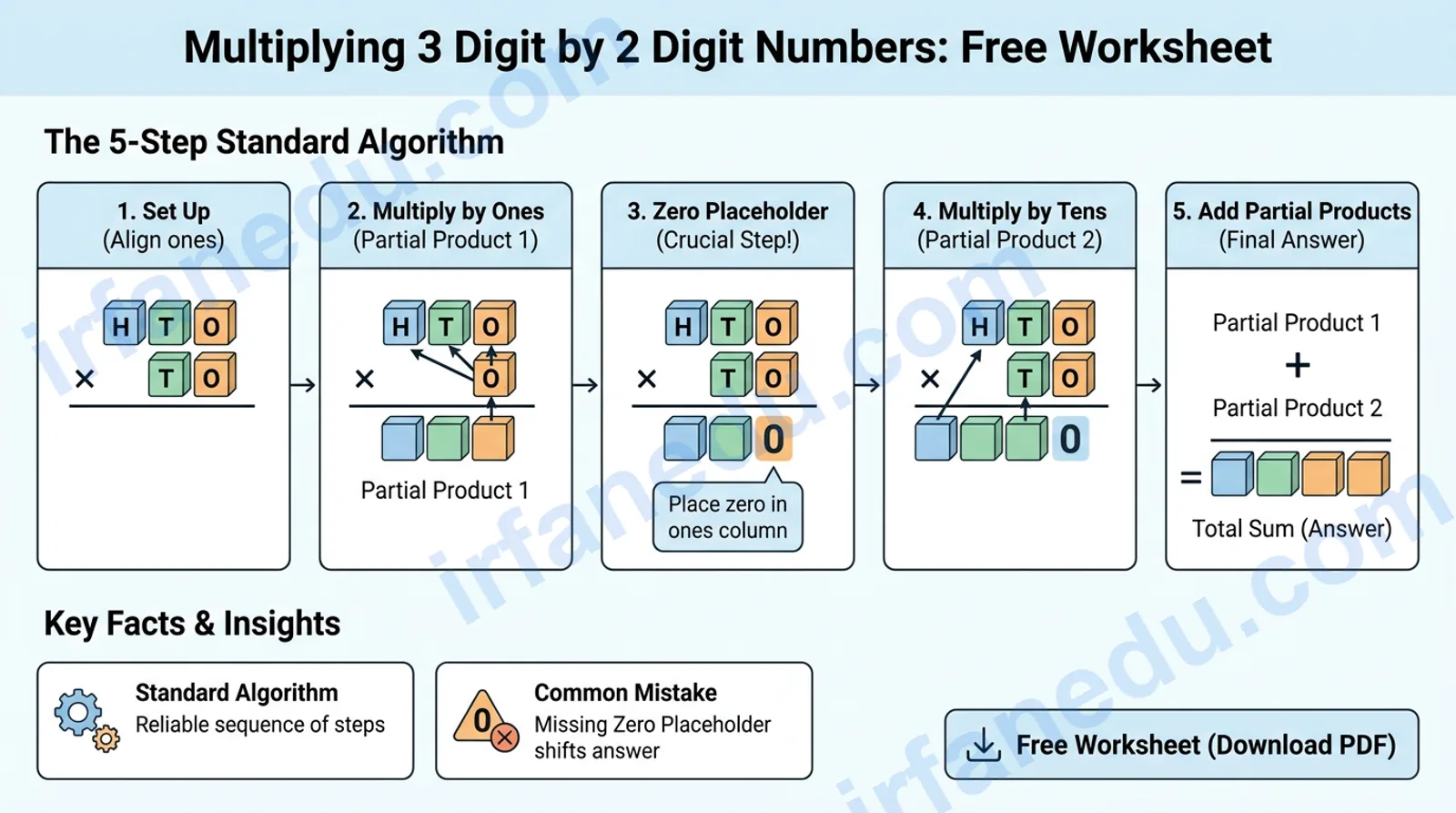
- The 5-Step Cheat Sheet
- Quick Answer
- What Is 3-Digit by 2-Digit Multiplication?
- Step-by-Step: How to Multiply (with Worked Examples)
- Visual: The Algorithm in Action
- Common Mistakes and How to Fix Them
- The Part Most Guides Miss
- Standard Algorithm vs. Area Model
- Practice Worksheet
- Quick Quiz
- Frequently Asked Questions
- Related Articles
- Sources & References
Multiplying a 3-digit number by a 2-digit number uses the standard algorithm: multiply the top number by each digit of the bottom number separately to get two partial products, then add them. The key step most students miss is the zero placeholder on the second line, which shifts the second partial product into the correct place-value column.
If your child can multiply single digits and add three-digit numbers, they already have every tool they need for this skill. The standard algorithm just organises those tools into a reliable sequence. In my experience teaching this to hundreds of fourth and fifth graders, the students who struggle are almost always missing one thing: they don’t understand why the placeholder zero goes there. This lesson fixes that.
By the end of this page you will be able to:
- Explain the standard algorithm in plain language
- Solve any 3-digit by 2-digit multiplication problem without errors
- Spot and correct the three most common mistakes
- Print a free 10-problem worksheet with a full answer key
Free Printable Worksheet (with Answer Key)
10 problems, easy-to-hard, Grade 4-5. Print and practise right now.
🎯 The Short Version
- Write the 3-digit number on top, 2-digit number below, aligned by place value.
- Multiply the top number by the ones digit first — this is partial product 1.
- Write a zero placeholder in the ones column of the next line.
- Multiply the top number by the tens digit — this is partial product 2.
- Add both partial products to get the final answer.
- Forgetting the zero placeholder is the #1 mistake — it shifts the answer by a factor of 10.
The 5-Step Cheat Sheet: 3-Digit × 2-Digit Multiplication
- Set up: Write the 3-digit number on top, 2-digit number below, ones under ones.
- Partial product 1: Multiply the top number by the ones digit of the bottom number.
- Placeholder: On the next line, write a zero in the ones column.
- Partial product 2: Multiply the top number by the tens digit; write the result starting in the tens column.
- Add: Add the two partial products. That sum is your answer.
What Is 3-Digit by 2-Digit Multiplication?
Multiplying a 3-digit number by a 2-digit number means finding the total when a number between 100 and 999 is taken as a group a number of times between 10 and 99. The standard algorithm is the formal written method for doing this reliably and quickly.
This skill sits at Common Core standard 4.NBT.B.5, which requires students to multiply a whole number of up to four digits by a one-digit number, and to multiply two two-digit numbers, using strategies based on place value and the properties of operations. By Grade 5 (5.NBT.B.5), students are expected to fluently multiply multi-digit whole numbers using the standard algorithm.
The algorithm works because of the distributive property: multiplying by 26 is the same as multiplying by 20 and by 6 separately, then adding the results. The two partial products represent exactly those two multiplications.
I always tell students: the algorithm is not magic. It is the distributive property written out in a tidy column. Once a student sees that 347 × 26 is really (347 × 6) + (347 × 20), the placeholder zero stops being a mystery rule and becomes an obvious necessity. That conceptual bridge is what most worksheet sites skip entirely.
Step-by-Step: How to Multiply 3-Digit by 2-Digit Numbers
The standard algorithm takes exactly five steps. I’ll walk through each step with a concrete example: 347 × 26.
Step 1: Set Up the Problem in Column Form
Write 347 on the top line and 26 directly below it, aligning the ones digits in the same column. Draw a horizontal line below 26.
Step 2: Multiply by the Ones Digit (6)
Multiply 347 by 6. Work right to left: 7 × 6 = 42, write 2 carry 4; 4 × 6 = 24 plus 4 = 28, write 8 carry 2; 3 × 6 = 18 plus 2 = 20, write 20. First partial product: 2,082.
Step 3: Write the Zero Placeholder
On the next line, write a 0 in the ones column. This is not just a formality. You are about to multiply by the tens digit (2, which really means 20), so the result belongs one column to the left.
Step 4: Multiply by the Tens Digit (2)
Multiply 347 by 2: 7 × 2 = 14, write 4 carry 1; 4 × 2 = 8 plus 1 = 9; 3 × 2 = 6. Write 694 starting in the tens column (after the placeholder zero). Second partial product: 6,940.
Step 5: Add the Two Partial Products
Add 2,082 and 6,940: 2 + 0 = 2; 8 + 4 = 12, write 2 carry 1; 0 + 9 + 1 = 10, write 0 carry 1; 2 + 6 + 1 = 9. Final answer: 9,022.
      3  4  7
   x     2  6
   ---------
      2  0  8  2    <-- Step 2: 347 x 6  (ones digit)
   +  6  9  4  0    <-- Step 4: 347 x 20 (tens digit, note the 0 placeholder)
   ---------
      9  0  2  2    <-- Step 5: Add partial products
Worked Example 2: 213 × 32
Multiply 213 by 2 (ones digit): 3 × 2 = 6; 1 × 2 = 2; 2 × 2 = 4. First partial product: 426.
Write placeholder zero. Multiply 213 by 3 (tens digit): 3 × 3 = 9; 1 × 3 = 3; 2 × 3 = 6. Second partial product: 6,390.
Add: 426 + 6,390 = 6,816.
Worked Example 3: 526 × 47
Multiply 526 by 7: 6 × 7 = 42, write 2 carry 4; 2 × 7 = 14 + 4 = 18, write 8 carry 1; 5 × 7 = 35 + 1 = 36. First partial product: 3,682.
Write placeholder zero. Multiply 526 by 4: 6 × 4 = 24, write 4 carry 2; 2 × 4 = 8 + 2 = 10, write 0 carry 1; 5 × 4 = 20 + 1 = 21. Second partial product: 21,040.
Add: 3,682 + 21,040 = 24,722.
When I tutor students on this skill, I make them say out loud “I am now multiplying by twenty, not two” before they write the placeholder zero. That verbal cue alone cuts errors by about half. The algorithm is silent about place value — you have to supply that understanding yourself.
Common Mistakes When Multiplying 3-Digit by 2-Digit Numbers
In my experience, three mistakes account for nearly all wrong answers on this type of problem. Here is what they look like and how to fix each one.
Standard Algorithm vs. Area Model: Which Should You Use?
| Feature | Standard Algorithm | Area Model |
|---|---|---|
| Speed | Fast once mastered | Slower (more writing) |
| Shows place value | Implicit (hidden in steps) | Explicit (each part labelled) |
| Best for | Fluency, timed tests | Building understanding first |
| Error risk | Placeholder zero easy to forget | More boxes = more addition steps |
| Recommended grade | Grade 4-5 (fluency goal) | Grade 3-4 (conceptual intro) |
The placeholder zero is not a rule — it is a consequence of place value. Every guide tells students to “write a zero.” Almost none explain that this zero represents the fact that the tens digit of the multiplier is worth ten times more than the ones digit. When you multiply by the 2 in 26, you are really multiplying by 20. The result of 347 × 20 is 6,940 — not 694. The zero is what makes 694 become 6,940 by shifting it one column left.
Here is the non-obvious implication: if you were multiplying by a 3-digit number, you would write two placeholder zeros on the third line (because the hundreds digit is worth 100 times more than the ones digit). The pattern scales. Students who understand this can extend the algorithm to any number of digits without being taught a new rule.
In my classroom, I demonstrate this by asking: “What is 347 × 200?” Students quickly say 69,400. Then I ask: “Why does the algorithm give you 69,400 when you write two zeros and multiply by 2?” The connection clicks instantly. That moment of understanding is worth more than 50 practice problems done mechanically.
Practice Worksheet: Multiplying 3-Digit by 2-Digit Numbers
Use the standard algorithm to solve each problem below. Show your partial products clearly. After you finish, check your answers with the key below.
How to use this worksheet: Print the PDF (button above or below), work through all 10 problems on paper, then flip to the answer key on the back. If you get a problem wrong, go back and find which partial product was incorrect before moving on.
- 124 × 21 = ______
- 213 × 32 = ______
- 312 × 23 = ______
- 143 × 42 = ______
- 256 × 34 = ______
- 347 × 26 = ______
- 418 × 53 = ______
- 526 × 47 = ______
- 634 × 58 = ______
- 789 × 64 = ______
Show Answer Key
- 124 × 21 = 2,604
- 213 × 32 = 6,816
- 312 × 23 = 7,176
- 143 × 42 = 6,006
- 256 × 34 = 8,704
- 347 × 26 = 9,022
- 418 × 53 = 22,154
- 526 × 47 = 24,722
- 634 × 58 = 36,772
- 789 × 64 = 50,496
Download the Free Printable PDF Worksheet (with Answer Key)
All 10 problems formatted for printing. Answer key on a separate page.
Reveal-on-Click Practice Problems
Try each problem mentally or on paper, then click to reveal the full worked solution.
Problem A: 215 × 43
Step 2: Write placeholder 0. 215 × 4 = 860, so second partial product = 8,600
Step 3: 645 + 8,600 = 9,245
Problem B: 408 × 35
Step 2: Write placeholder 0. 408 × 3 = 1,224, so second partial product = 12,240
Step 3: 2,040 + 12,240 = 14,280
Problem C: 763 × 52
Step 2: Write placeholder 0. 763 × 5 = 3,815, so second partial product = 38,150
Step 3: 1,526 + 38,150 = 39,676
I recommend doing at least five problems with graph paper before switching to lined paper. The visual grid forces correct column alignment and eliminates the most frustrating source of wrong answers: digits drifting into the wrong column during addition. Once the habit is set, graph paper is no longer needed.
Quick Quiz: Test Your Understanding
Q1. What is the first partial product when you multiply 312 × 23?
Show answer
Q2. Why do you write a zero placeholder before multiplying by the tens digit?
Show answer
Q3. A student solves 256 × 34 and gets 1,024 + 768 = 1,792. What went wrong?
Show answer
Frequently Asked Questions
What is the standard algorithm for multiplying 3-digit by 2-digit numbers?
Why do you put a zero when multiplying by the tens digit?
What grade level is 3-digit by 2-digit multiplication?
How do you check a 3-digit by 2-digit multiplication answer?
Sources & References
Written and fact-checked by Dr Irfan Mansuri. External links open in a new tab and are provided for further reading and verification.