
Reinforcement scheduler: the complete guide (beginner to advanced)
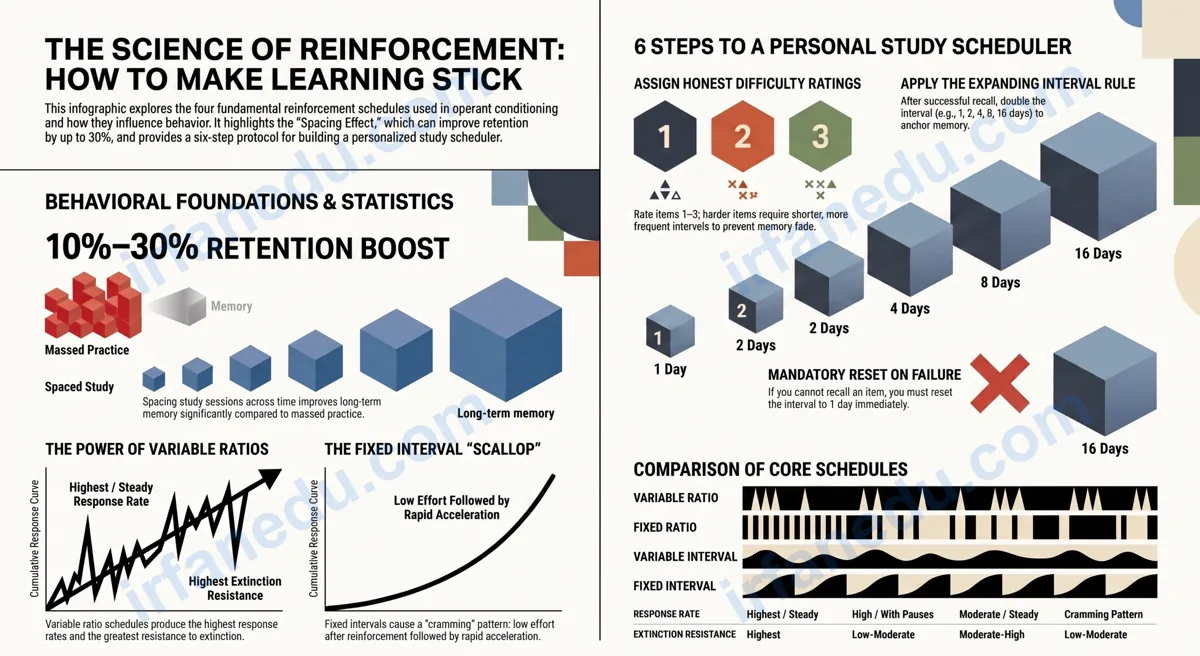
A reinforcement scheduler is a rule that specifies when and how often a behavior receives reinforcement. In psychology, it is a core concept in operant conditioning. In education and study science, it refers to any system — from a simple flashcard app to a hand-drawn calendar — that times your review sessions so memory is strengthened just before it fades.
Whether you are a student who just encountered this term in a psychology class or a parent trying to understand why your child’s study app keeps sending reminders at odd intervals, this guide covers both levels. Each section opens with a plain beginner explanation, then goes deeper for anyone who wants the full picture.
By the end, you will understand every schedule type, know which one produces the strongest learning, and have a concrete six-step system you can use tonight.
- Understand the four classic schedules of reinforcement with real examples
- See how response rate and extinction resistance differ across schedules
- Apply a spaced-repetition reinforcement scheduler to any subject
- Avoid the three most common scheduling mistakes that waste study time
A reinforcement scheduler is a rule that determines when and how often a behavior is reinforced. In psychology, the four main schedules are fixed ratio, variable ratio, fixed interval, and variable interval. In study science, a reinforcement scheduler spaces practice sessions at increasing intervals so memory is strengthened just before it fades — maximizing long-term retention with minimum review time.
The four schedules of reinforcement explained
B.F. Skinner identified four fundamental reinforcement schedules through his operant conditioning research. Each schedule produces a distinct pattern of behavior, and understanding them is the first step to using them intentionally in learning.
Fixed ratio (FR) schedule
A fixed ratio schedule delivers reinforcement after a set, predictable number of responses. The ratio is constant and known in advance.
Beginner example: A teacher gives a sticker after every five completed math problems. The student knows exactly when the reward comes.
Advanced detail: FR schedules produce a characteristic “post-reinforcement pause” — a brief drop in responding immediately after each reward, followed by a rapid burst of responses to reach the next reinforcement. The higher the ratio (e.g., FR-50 vs. FR-5), the longer the pause. In study terms, this maps to a student who works intensely to finish a chapter, then takes a long break before starting the next one.
In my experience teaching psychology, students almost always underestimate how common fixed ratio schedules are in their own academic lives. Every grading rubric that awards points per completed problem is an FR schedule. Once you see it, you cannot unsee it — and you start to notice the post-reinforcement pause in your own study habits.
Variable ratio (VR) schedule
A variable ratio schedule delivers reinforcement after an unpredictable number of responses that averages to a set value. The learner never knows exactly when the next reward will arrive.
Beginner example: A student gets praise from a teacher after answering questions, but not every time — sometimes after the second answer, sometimes after the seventh.
Advanced detail: VR schedules produce the highest and most consistent response rates of all four schedule types. They also show the greatest resistance to extinction — the behavior continues long after reinforcement stops. This is why social media notifications (a VR schedule of social reward) are so difficult to ignore. For learning, a VR-style quiz app that gives a “mastery badge” after a random number of correct answers can sustain engagement better than a predictable reward system.
Fixed interval (FI) schedule
A fixed interval schedule delivers reinforcement for the first response that occurs after a set amount of time has passed. The time gap is constant.
Beginner example: A weekly quiz every Friday. Students can earn points only once per week, no matter how much they study on Tuesday.
Advanced detail: FI schedules produce the “scallop” pattern — low responding right after reinforcement, then a gradual acceleration as the time interval ends. This is the neurological basis of cramming. The brain correctly identifies that effort right before the deadline is most likely to produce a reward. The problem is that information crammed on an FI schedule is forgotten rapidly because it was never spaced.
Variable interval (VI) schedule
A variable interval schedule delivers reinforcement for the first response after an unpredictable amount of time. The interval varies around an average.
Beginner example: A teacher gives pop quizzes at random times during the semester. Students never know when the next one will appear.
Advanced detail: VI schedules produce steady, moderate response rates with very low post-reinforcement pauses. Because the next reinforcement could come at any moment, the learner maintains consistent behavior. In study design, a spaced repetition app that schedules reviews at variable intervals (adjusted by recall difficulty) approximates a VI schedule and produces exactly this steady, sustainable study habit.
Schedule comparison: side-by-side
The table below shows how each schedule differs on the dimensions that matter most for learning. Use it as a quick reference when answering exam questions or designing a study system.
| Schedule | Reinforcement trigger | Response rate | Extinction resistance | Study equivalent |
|---|---|---|---|---|
| Fixed ratio (FR) | After N responses (fixed) | High, with pauses | Low-moderate | Points per problem set |
| Variable ratio (VR) | After ~N responses (random) | Highest, steady | Highest | Random mastery badges |
| Fixed interval (FI) | First response after T time (fixed) | Low, scallop pattern | Low | Weekly scheduled test |
| Variable interval (VI) | First response after ~T time (random) | Moderate, steady | Moderate-high | Spaced repetition app |
Visual: response-rate curves for each schedule
The cumulative response record is the standard way psychologists visualize schedule effects. A steeper slope means more responses per unit of time. Tick marks show when reinforcement was delivered.
Cumulative responses (y-axis) vs. Time (x-axis)
Tick (/) = reinforcement delivered

FIXED RATIO (FR)
  |         /         /         /
  |        /         /         /
  |  ___  /   ___   /   ___   /
  |_/   \/   /   \ /   /   \/
  +--------------------------------> Time
  Pattern: steep bursts + post-reinforcement pauses

VARIABLE RATIO (VR)
  |              /
  |           /
  |        /
  |     /
  |  /
  +--------------------------------> Time
  Pattern: near-straight steep line, almost no pauses

FIXED INTERVAL (FI) — "scallop"
  |       /      /      /
  |      /      /      /
  |    _/     _/     _/
  |___/     _/     _/
  +--------------------------------> Time
  Pattern: slow after reward, fast before next interval ends

VARIABLE INTERVAL (VI)
  |           /
  |         /
  |       /
  |     /
  |   /
  +--------------------------------> Time
  Pattern: steady moderate slope, minimal pauses
How to use a reinforcement scheduler for studying
A study-focused reinforcement scheduler applies the logic of operant conditioning to memory: each successful recall of a fact is a “reinforced response” that strengthens the neural pathway. The scheduler’s job is to time the next reinforcement (the next review) so it arrives just before the memory fades.
This is the core mechanism behind spaced repetition, and it is one of the most replicated findings in cognitive psychology. A 2008 review by Cepeda et al. in Psychological Science in the Public Interest found that spacing study sessions across time improved long-term retention by 10 to 30 percentage points compared to massed practice, depending on the retention interval tested.
When you recall something just before forgetting it, the brain treats it as important and rebuilds the memory trace stronger. Recalling it too soon (before any forgetting has started) provides almost no benefit. A reinforcement scheduler finds the optimal moment between “too soon” and “too late.”
The practical implication: a student who reviews vocabulary 10 times in one evening will remember far less one week later than a student who reviews the same vocabulary once per day for 10 days. Same total time, radically different outcome.
I have used spaced repetition personally for over a decade, and the single biggest mistake I see students make is treating their study app as a task manager rather than a reinforcement scheduler. They mark cards as “easy” to clear the queue faster. That defeats the entire mechanism. The scheduler needs honest difficulty ratings to set the right interval. Honesty with yourself is the most important input.
How to build your personal reinforcement study schedule
You do not need an app to run a reinforcement scheduler. Here is a six-step system you can start with a notebook and a calendar.
- List all topics. Write down every concept, formula, or vocabulary item you need to learn for the unit or exam. Be specific — “Chapter 4” is too broad; “the four reinforcement schedule types and their response-rate patterns” is the right level.
- Assign a difficulty rating. Rate each item 1 (easy), 2 (medium), or 3 (hard). Hard items need shorter intervals because they fade faster.
- Set your first review date. Review each item 1 day after you first study it. This is the initial reinforcement that anchors the memory.
- Apply the expanding interval rule. After each successful recall, roughly double the interval: 1 day, 2 days, 4 days, 8 days, 16 days. For hard items (rating 3), use a slower expansion: 1 day, 2 days, 3 days, 5 days, 8 days.
- Reset on failure. If you cannot recall the item, reset the interval to 1 day and restart. Do not skip this step — a failed recall means the memory trace is weak and needs immediate re-encoding.
- Track and adjust. Keep a simple log. If an item keeps resetting, break it into smaller sub-items. If an item always succeeds, you can safely extend the interval beyond the doubling rule.
This manual system mirrors the SM-2 algorithm used by Anki, the most widely studied spaced repetition software. The key difference is that you control the parameters, which builds metacognitive awareness of your own memory.
[IMAGE: A hand-drawn notebook showing a reinforcement study schedule with expanding intervals | ALT: student reinforcement study schedule notebook showing spaced repetition intervals for exam preparation]
Most guides treat “reinforcement scheduler” as a single concept. It is actually two separate ideas that happen to share a name — and confusing them causes real problems.
In psychology class, a reinforcement scheduler is a behavioral rule that describes how an external reward is delivered. The organism (student, animal, person) is passive — the schedule acts on them.
In study science and ed-tech, a reinforcement scheduler is a cognitive tool that the learner actively controls. The “reinforcement” here is the act of retrieval itself — not an external reward. Recalling a fact strengthens the memory trace, and the scheduler times when that retrieval happens.
Why does this distinction matter? Because the optimal schedule for each purpose is different. For behavioral compliance (getting a child to complete homework), a variable ratio schedule works best. For long-term memory retention, a fixed-but-expanding interval schedule (spaced repetition) works best. Applying the wrong model to the wrong goal is why many “study hacks” fail.
In my experience, students who understand this distinction stop asking “which schedule is best?” and start asking the right question: “best for what goal?” That shift in thinking is worth more than any specific scheduling formula.
Common mistakes students make with reinforcement schedules
Understanding the theory is only half the battle. Here are the three errors I see most often, and how to correct each one.
Mistake 1: treating all material as equally difficult
A reinforcement scheduler only works if the intervals match the actual forgetting rate of each item. If you apply the same expanding schedule to both easy vocabulary and complex calculus proofs, you will over-review easy items (wasting time) and under-review hard ones (losing them before the next session).
Fix: Rate difficulty honestly at the moment of recall, not when you first study the material. Your confidence during initial study is a poor predictor of how quickly you will forget something.
Mistake 2: using a fixed interval schedule for everything
Most students default to a fixed interval schedule without realizing it: study Sunday, study Sunday, study Sunday. This produces the scallop pattern — low effort mid-week, frantic cramming Saturday night. The material is reviewed at the same interval regardless of whether it needs review.
Fix: Let the material’s difficulty drive the interval, not the calendar. Some items need review in 2 days; others can wait 3 weeks. A rigid weekly schedule ignores this entirely.
The fixed interval trap is so common because school itself runs on fixed intervals — weekly quizzes, monthly tests, semester exams. Students internalize the school’s schedule as their personal study schedule. Breaking that habit is one of the highest-leverage changes a student can make. Your brain does not care about the academic calendar.
Mistake 3: confusing recognition with recall
Re-reading notes feels like studying because you recognize the material. But recognition and recall use different memory systems. A reinforcement scheduler that relies on recognition (reading, highlighting) never triggers the retrieval process that actually strengthens the memory trace.
Fix: Every review session must involve active recall — close the book, write the answer from memory, then check. If you cannot produce the answer without looking, the interval was too long. Reset and shorten it.
Quick knowledge check
1. Which reinforcement schedule produces the highest and most persistent response rate?
2. A student reviews flashcards 1 day, 2 days, 4 days, then 8 days after first studying them. This is an example of:
3. The “scallop” pattern in a cumulative response record is associated with which schedule?
Practice problems
Problem 1: Identify the schedule — A factory worker is paid for every 20 units assembled. What schedule is this, and what response pattern would you predict?
Answer: This is a fixed ratio (FR-20) schedule. The reinforcement (payment) is delivered after every 20 responses (units assembled).
Predicted pattern: The worker will show a post-reinforcement pause after completing each set of 20 units, then work rapidly to reach the next reinforcement. Overall response rate is high but not perfectly steady — you would see a “scalloped” burst pattern in the cumulative record.
Problem 2: Design a reinforcement study schedule — You have 4 weeks until an exam and 30 vocabulary terms to learn. How would you structure a reinforcement scheduler?
Answer: Use an expanding-interval spaced repetition schedule:
- Study all 30 terms on Day 1.
- Review all 30 terms on Day 2 (1-day interval). Mark each as easy, medium, or hard.
- Easy terms: next review in 4 days (Day 6). Medium: 2 days (Day 4). Hard: 1 day (Day 3).
- After each successful review, double the interval for that term.
- After a failed recall, reset to a 1-day interval.
- By Week 4, easy terms should be on 16+ day intervals; hard terms on 4-8 day intervals — all still active before the exam.
This ensures every term is reviewed at least 4-6 times, spaced optimally, rather than crammed the night before.
Problem 3: Explain the difference — Why does a variable ratio schedule produce more persistent behavior than a fixed ratio schedule?
Answer: In a fixed ratio schedule, the learner can predict when reinforcement will arrive. After receiving a reward, they “know” they need to complete N more responses before the next one — so a pause is rational. When reinforcement stops (extinction), the absence is immediately detectable after N responses with no reward.
In a variable ratio schedule, the learner cannot predict the next reinforcement. Every response could be the one that triggers the reward. During extinction, the learner cannot distinguish “no reward yet” from “reward coming soon” — so they keep responding far longer. This unpredictability is what makes VR schedules so resistant to extinction.
Frequently asked questions
What is a reinforcement scheduler?
A reinforcement scheduler is a rule or system that determines when and how often a behavior receives reinforcement. In psychology, the four main types are fixed ratio, variable ratio, fixed interval, and variable interval. In education, it refers to a system — often a spaced repetition algorithm — that times review sessions to maximize long-term memory retention by scheduling each review just before the memory fades.
Which reinforcement schedule produces the highest response rate?
The variable ratio schedule produces the highest and most persistent response rate. Because reinforcement arrives after an unpredictable number of responses, the learner maintains consistent behavior to avoid missing a reward. This also makes VR schedules the most resistant to extinction — behavior continues long after rewards stop. Slot machines and social media notifications both exploit this mechanism.
What is the difference between ratio and interval schedules?
Ratio schedules deliver reinforcement based on the number of responses made — the more you respond, the sooner you are reinforced. Interval schedules deliver reinforcement based on the passage of time — only the first response after the time period ends is reinforced. Ratio schedules generally produce faster response rates because effort directly accelerates the next reward, while interval schedules reward patience over productivity.
How does a reinforcement scheduler improve studying?
A study reinforcement scheduler uses spaced repetition: review material at expanding intervals (1 day, 3 days, 7 days, 21 days). Each successful recall is a reinforced response that strengthens the memory trace. This exploits the spacing effect — one of the most replicated findings in cognitive psychology — which shows that distributed practice dramatically outperforms massed practice for long-term retention, often by 10 to 30 percentage points.
What is a fixed interval scallop?
A fixed interval scallop is the characteristic response pattern under a fixed interval schedule: responses slow down immediately after a reinforcement is delivered, then gradually accelerate as the next scheduled time approaches. On a cumulative response graph, this creates a repeating S-shaped (scallop) curve. Students show this pattern when they cram before a scheduled test and relax immediately after — a predictable but inefficient learning habit that reinforcement scheduling can help break.
Key takeaways
- A reinforcement scheduler is a rule that determines when and how often a behavior is reinforced — in psychology (behavioral rule) and in study science (memory timing tool).
- The four classic schedules are fixed ratio, variable ratio, fixed interval, and variable interval — each producing a distinct response-rate pattern.
- Variable ratio schedules produce the highest, most persistent response rates and the greatest resistance to extinction.
- Fixed interval schedules produce the scallop pattern — the neurological basis of cramming behavior.
- For long-term memory retention, an expanding-interval (spaced repetition) scheduler outperforms any fixed-schedule approach.
- The most important input to any reinforcement scheduler is honest difficulty ratings — gaming the system by marking hard items as easy defeats the entire mechanism.
- Active recall (producing the answer from memory) is the only review method that actually triggers the reinforcement effect on memory traces.
Dr. Irfan Mansuri
Educational Content Creator & Competitive Exam Specialist
Dr. Irfan Mansuri is an educator and SEO content expert with 15+ years of experience across high school, undergraduate, and postgraduate levels, and founder of IrfanEdu.com. I combine deep subject knowledge with proven test-taking strategies to make complex ideas simple.
Sources & references
- Cepeda, N. J., Pashler, H., Vul, E., Wixted, J. T., & Rohrer, D. (2006). Distributed practice in verbal recall tasks: A review and quantitative synthesis. Psychological Bulletin, 132(3), 354-380. — Foundational meta-analysis on the spacing effect.
- Skinner, B. F. (1938). The Behavior of Organisms: An Experimental Analysis. Appleton-Century-Crofts. — Original source for the four schedules of reinforcement.
-
Khan Academy: