
AP Business and Personal Finance: The Study Guide That Actually Prepares You

Most AP study guides for Business and Personal Finance give you a list of definitions and call it preparation. That approach fails on exam day, because the AP exam does not ask you to recite definitions — it hands you a scenario and asks you to make a financial decision and justify it. That is a fundamentally different skill.
In my experience teaching personal finance to high school students, the gap between a 2 and a 4 almost always comes down to one thing: students who score well have practiced applying concepts to messy, real-world situations. Students who score poorly have only memorized vocabulary. This guide is built around that insight.
AP Business and Personal Finance is a College Board course that teaches high school students to manage money across six units: financial literacy, budgeting, saving and investing, credit, insurance, and taxes. The exam rewards students who can apply these concepts to real-world scenarios — not just define them.
- Understand all six AP units and their relative exam weight 🎯
- See the contrast between high-scoring and low-scoring exam answers
- Work through a real budgeting example step by step
- Master compound interest and credit score calculations
- Get the non-obvious insight that separates a 4 from a 5
What Is AP Business and Personal Finance?
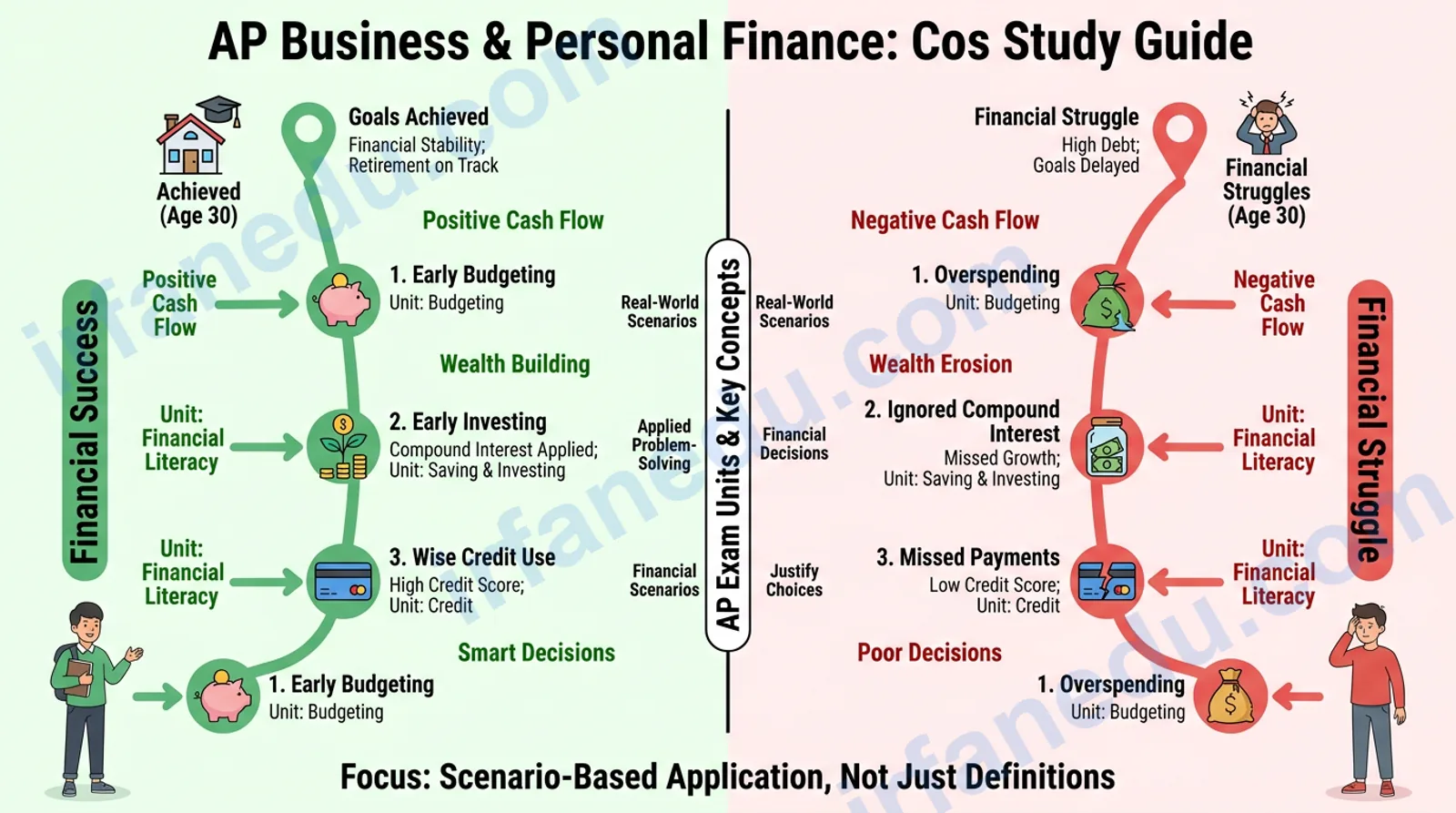
AP Business and Personal Finance is a College Board Advanced Placement course designed to give high school students a practical foundation in managing money. It is one of the newer AP offerings, and it fills a gap that most traditional math or economics courses leave open: the real-world financial skills you actually need after graduation.
The course covers six interconnected units — from reading a pay stub to evaluating an investment portfolio. A qualifying score (typically 3, 4, or 5, depending on the college) can earn you college credit, which translates directly into tuition savings. According to the College Board, AP courses also signal college readiness and strengthen applications.
Unlike AP Calculus or AP Chemistry, this course does not require advanced prerequisite knowledge. The concepts are grounded in everyday life — paying rent, choosing a credit card, filing taxes. That accessibility is a strength, but it also means the exam rewards depth of reasoning, not just recall. Students who treat it as an easy AP often underperform.
Good Answer vs. Bad Answer: The Contrast That Defines Your Score
The single fastest way to understand what the AP exam rewards is to see a high-scoring and a low-scoring answer side by side. Here is a real-style free-response prompt and two student responses.
✅ High-Scoring Answer
“Maya has $300 of surplus income each month ($2,400 – $2,100). To build a $7,200 emergency fund, she should treat savings as a fixed expense — sometimes called ‘paying yourself first’ — and direct her entire $300 surplus to the fund. At $300/month, she will reach $7,200 in exactly 24 months. To accelerate this, she could reduce variable expenses (e.g., dining out) to increase her monthly savings contribution. An emergency fund of 3 months’ expenses ($6,300) is a common benchmark; $7,200 slightly exceeds that, which is prudent.”
❌ Low-Scoring Answer
“Maya should save more money. She earns $2,400 and spends $2,100 so she has some left over. She should put that in a savings account. It will take a while to save $7,200.”
The high-scoring answer does four things the low-scoring one does not: it calculates the surplus, names a strategy (pay yourself first), performs the division to get a specific timeline, and connects to a real-world benchmark (3-month emergency fund). Every one of those elements is a scorable point on the AP rubric.
I have reviewed hundreds of student AP responses, and the most common mistake is writing in generalities. “She should budget better” earns zero points. “She should redirect her $300 monthly surplus to a dedicated savings account, reaching her $7,200 goal in 24 months” earns full credit. The AP exam rewards specificity, and that is a learnable skill — not a talent.
The Six Core Units Explained
The AP Business and Personal Finance curriculum is organized into six units. Each unit builds on the previous one, so gaps in early units create compounding confusion later. Here is what each unit covers and what the exam specifically tests.
Unit 1: Financial Literacy and Decision-Making
This unit establishes the foundation. It covers opportunity cost, the trade-off between needs and wants, and the concept of financial goals (short-term, medium-term, long-term). The exam tests whether you can apply the decision-making process to a financial scenario — not just define it.
Unit 2: Budgeting and Cash Flow
Budgeting is the most heavily tested practical skill in the course. You need to know how to create a monthly budget, identify fixed vs. variable expenses, calculate surplus or deficit, and explain how to adjust a budget when income changes. The 50/30/20 rule (50% needs, 30% wants, 20% savings) is a widely cited framework worth knowing.
Unit 3: Saving and Investing
This unit covers savings accounts, certificates of deposit (CDs), stocks, bonds, mutual funds, and retirement accounts (like a 401(k) or IRA). The key tested concept is compound interest and the relationship between risk and return. Higher potential return always comes with higher risk — the exam will ask you to explain why.
Unit 4: Credit and Debt Management
Credit scores, credit reports, interest rates, and types of debt (secured vs. unsecured, installment vs. revolving) are all tested here. Students frequently lose points by confusing APR (Annual Percentage Rate) with APY (Annual Percentage Yield) — a distinction the exam exploits in scenario questions.
Unit 5: Insurance and Risk Management
This unit covers types of insurance (health, auto, life, renters/homeowners) and key vocabulary: premium, deductible, copay, and coverage limit. The exam often presents a scenario and asks which insurance type is most appropriate and why.
Unit 6: Taxes and Income
Students learn to read a W-2, understand gross vs. net income, and distinguish between tax deductions and tax credits. A tax credit reduces your tax bill dollar-for-dollar; a tax deduction reduces your taxable income. The exam tests whether you know the difference — and which one is more valuable.
How to Build a Budget: Step-by-Step
Building a budget is a core HowTo skill the AP exam tests directly. Here is the exact process the exam expects you to know and apply.
- Calculate Net Income: Start with take-home pay after taxes and deductions. If the problem gives gross income, subtract estimated taxes (or use the given tax rate) to find net income.
- List Fixed Expenses: Identify non-negotiable recurring costs — rent, loan payments, insurance premiums. These do not change month to month.
- List Variable Expenses: Estimate flexible costs — groceries, transportation, entertainment. These can be adjusted.
- Assign Savings First (“Pay Yourself First”): Allocate a savings amount before discretionary spending. The exam rewards this strategy by name.
- Balance the Budget: Total expenses plus savings must not exceed net income. If they do, cut variable expenses first.
- Track and Review: At month-end, compare actual spending to the budget and adjust the next month’s plan accordingly.
  NET INCOME:  $2,400
  ─────────────────────────────────────────
  FIXED EXPENSES
    Rent              $900
    Car insurance      $80
    Phone              $50
  ─────────────────────────────────────────
  VARIABLE EXPENSES
    Groceries         $300
    Transport         $120
    Entertainment     $150
  ─────────────────────────────────────────
  SAVINGS (Pay Yourself First)
    Emergency fund    $300
    Retirement (IRA)  $200
  ─────────────────────────────────────────
  TOTAL ALLOCATED:  $2,100
  REMAINING:          $300  ← discretionary buffer
  ─────────────────────────────────────────
  STATUS: ✅ BALANCED (Total < Net Income)
Why Compound Interest Is the Exam’s Most Tested Concept
Compound interest is interest calculated on both the original principal and the interest already earned. It is the reason starting to save at 18 instead of 28 can mean hundreds of thousands of dollars in retirement — and it is the concept the AP exam tests most creatively.
The formula you need to know is:
A = final amount | P = principal | r = annual rate (decimal) | n = compounding periods/year | t = years
Worked Example: Early Saver vs. Late Saver
✅ Alex — Starts at 20
Invests $2,000/year for 10 years (ages 20-29), then stops. Total invested: $20,000. Assumes 7% annual return, compounded annually. By age 65: approximately $602,000.
⚠️ Jordan — Starts at 30
Invests $2,000/year for 35 years (ages 30-65). Total invested: $70,000. Same 7% return. By age 65: approximately $295,000.
Alex invested less than a third of what Jordan invested and ended up with twice as much. That is the power of compound interest over time — and the AP exam will ask you to explain this difference in a free-response question. The answer is always: time in the market, not timing the market.
How Credit Scores Work — and Where Students Go Wrong
A credit score is a three-digit number (typically 300-850) that represents your creditworthiness — how reliably you repay debt. Lenders use it to decide whether to approve loans and at what interest rate. A higher score means lower interest rates, which saves you significant money over a lifetime.
The five factors that determine a FICO credit score are:
- Payment history (35%): Do you pay on time? This is the single biggest factor.
- Amounts owed / Credit utilization (30%): What percentage of your available credit are you using? Keep it below 30%.
- Length of credit history (15%): How long have your accounts been open?
- Credit mix (10%): Do you have a variety of credit types (credit cards, loans)?
- New credit (10%): Have you applied for new credit recently? Each hard inquiry can lower your score slightly.
In my experience, students consistently underestimate the impact of credit utilization. I have seen students with perfect payment histories get denied for a car loan because they were using 80% of their credit card limit. The AP exam loves this scenario — it tests whether you know that how much you owe matters almost as much as whether you pay on time.
Unit-by-Unit Exam Weight Comparison
Not all units are tested equally. Understanding the relative weight of each unit helps you allocate study time strategically. This comparison is based on the College Board’s published course framework and the distribution of free-response prompts in released practice exams.
| Unit | Topic | Approx. Exam Weight | Key Skill Tested | Difficulty |
|---|---|---|---|---|
| 1 | Financial Literacy & Decision-Making | 10-12% | Opportunity cost, goal-setting | 🟢 Low |
| 2 | Budgeting & Cash Flow | 18-20% | Budget creation, surplus/deficit | 🟡 Medium |
| 3 | Saving & Investing | 22-25% | Compound interest, risk vs. return | 🔴 High |
| 4 | Credit & Debt Management | 20-22% | Credit score factors, APR vs. APY | 🔴 High |
| 5 | Insurance & Risk Management | 12-15% | Insurance type selection, vocabulary | 🟡 Medium |
| 6 | Taxes & Income | 10-12% | W-2 reading, deduction vs. credit | 🟡 Medium |
Units 3 and 4 together represent roughly 42-47% of the exam. If your study time is limited, these two units deserve the most attention.
The AP exam does not test whether you know what a budget is. It tests whether you can defend a financial decision under constraints.
Here is what most study guides miss: the free-response section awards points for justification, not just correct answers. A student who writes “I recommend the Roth IRA because contributions grow tax-free and withdrawals in retirement are not taxed, which benefits a young earner currently in a low tax bracket” scores higher than one who simply writes “Roth IRA.” The rubric explicitly rewards the reasoning chain. In my experience, students who practice writing one-sentence justifications for every financial recommendation they make improve their free-response scores by a full point category. That is the non-obvious preparation habit this exam rewards — and almost no prep guide teaches it explicitly.
Practice Problems
Work through each problem on your own, then click to reveal the full solution. These are styled after real AP free-response scenarios.
Problem 1: Budget Surplus Calculation — Marcus earns $3,200/month after taxes. His fixed expenses total $1,400 and variable expenses total $900. He wants to save 15% of his net income. Does he have enough? How much is left over?
Step 1 — Calculate required savings: 15% × $3,200 = $480/month.
Step 2 — Total allocated: $1,400 (fixed) + $900 (variable) + $480 (savings) = $2,780.
Step 3 — Remaining: $3,200 – $2,780 = $420 discretionary buffer.
Conclusion: Yes, Marcus can meet his 15% savings goal and still has $420 remaining. He could direct part of this buffer toward an emergency fund or additional retirement contributions.
Problem 2: Compound Interest — Priya invests $5,000 at 6% annual interest, compounded monthly, for 10 years. What is the approximate final value?
Formula: A = P(1 + r/n)nt
P = $5,000 | r = 0.06 | n = 12 | t = 10
A = 5,000 × (1 + 0.06/12)12×10 = 5,000 × (1.005)120
(1.005)120 ≈ 1.8194
A ≈ $9,097
Priya’s $5,000 nearly doubles in 10 years. The exam may ask you to explain why monthly compounding produces more than annual compounding — the answer is that interest compounds more frequently, so each period’s interest earns interest sooner.
Problem 3: Credit Score Impact — Lena has a $4,000 credit limit and currently carries a $3,200 balance. Her friend tells her to pay it down to $1,000. Explain why this advice is financially sound using credit score terminology.
Current utilization: $3,200 / $4,000 = 80% — this is very high and significantly damages her credit score.
After paying down to $1,000: $1,000 / $4,000 = 25% — this falls below the recommended 30% threshold.
Why it matters: Credit utilization accounts for 30% of a FICO score. Reducing it from 80% to 25% can raise her score by 50-100 points, potentially moving her from “Fair” to “Good” credit. This would qualify her for lower interest rates on future loans, reducing her long-term borrowing costs.
Problem 4: Insurance Decision — Dario is 23, healthy, and just started his first job. His employer offers health insurance with a $200/month premium and a $1,500 deductible, or a $120/month premium with a $4,000 deductible. Which should he choose and why?
Annual cost comparison:
Plan A: $200 × 12 = $2,400/year in premiums + up to $1,500 deductible = max $3,900 out-of-pocket.
Plan B: $120 × 12 = $1,440/year in premiums + up to $4,000 deductible = max $5,440 out-of-pocket.
Recommendation: If Dario is healthy and rarely uses medical care, Plan B saves him $960/year in premiums. He should deposit the $80/month savings into a Health Savings Account (HSA) to cover the higher deductible if needed. However, if he anticipates regular medical needs, Plan A’s lower deductible may be worth the higher premium. The AP exam rewards this conditional reasoning — there is no single “correct” answer, only a well-justified one.
Frequently Asked Questions
What is AP Business and Personal Finance?
AP Business and Personal Finance is a College Board course and exam for high school students that covers budgeting, saving, investing, credit, insurance, and taxes. It prepares students to make sound financial decisions and can earn college credit with a qualifying score of 3, 4, or 5 depending on the institution.
How hard is the AP Business and Personal Finance exam?
The exam is considered moderate in difficulty — more accessible than AP Calculus or AP Chemistry because it focuses on real-world scenarios rather than abstract theory. The challenge is not memorizing facts but applying concepts to unfamiliar situations. Consistent practice with free-response questions is the most effective preparation strategy.
What units are covered on the AP Business and Personal Finance exam?
The six core units are: (1) Financial Literacy and Decision-Making, (2) Budgeting and Cash Flow, (3) Saving and Investing, (4) Credit and Debt Management, (5) Insurance and Risk Management, and (6) Taxes and Income. Units 3 and 4 carry the most exam weight.
What score do you need to earn college credit for AP Business and Personal Finance?
Most colleges accept a score of 3, 4, or 5 for credit or placement. Selective institutions often require a 4 or 5. Always verify the specific college’s AP credit policy before assuming credit will transfer — policies vary significantly between schools and even between departments at the same school.
What is compound interest and why does it matter for this exam?
Compound interest is interest calculated on both the principal and previously earned interest. It matters because the exam tests students’ ability to calculate future value and explain why starting to save early dramatically increases long-term wealth. The formula A = P(1 + r/n)nt is essential to know and apply in free-response questions.
How is the AP Business and Personal Finance exam structured?
The exam includes multiple-choice questions and free-response questions. Multiple-choice tests factual recall and scenario analysis. Free-response requires students to apply financial concepts to real-world situations, justify decisions, and perform calculations. The free-response section is where most students lose points — and where specific, justified answers earn the most credit.
What is the difference between a tax deduction and a tax credit?
A tax deduction reduces your taxable income, so its value depends on your tax bracket. A tax credit reduces your actual tax bill dollar-for-dollar, making it more valuable. For example, a $1,000 tax credit saves you exactly $1,000 in taxes. A $1,000 deduction saves you $220 if you are in the 22% bracket. The AP exam tests whether you know which is more beneficial.
What is the best way to study for AP Business and Personal Finance?
The most effective approach combines three habits: (1) study one unit at a time using real-world examples, (2) practice writing justified free-response answers weekly — not just identifying the right answer but explaining why, and (3) review mistakes on credit and investing questions specifically, since those two units carry the most exam weight and require the most applied reasoning.