
What Is a Historical Class? The Complete Student Guide 📚
📋 What You’ll Learn in This Guide
- ✅ Exactly what a historical class is and what it actually trains your brain to do
- ✅ The 8 core rules (skills) that separate students who excel from those who struggle
- ✅ How to analyze primary and secondary sources like a real historian
- ✅ The single biggest mistake students make — and how to fix it fast
- ✅ Practical strategies you can use in your next class, essay, or exam
A historical class is far more than a list of dates and battles to memorize. It is a structured academic course that teaches you to ask hard questions about evidence, weigh competing explanations, and build arguments that hold up under scrutiny — skills that matter in every career and in everyday life.
I have taught history and study skills for over 15 years, and the students who struggle most are almost always the ones who treat history like a science vocabulary list — something to memorize and recite. The moment they realize history is an argument, everything clicks. This guide gives you the framework to make that shift.
📌 Quick Summary
- 📖 A historical class teaches analysis, argumentation, and research — not just facts.
- 🔍 Primary sources are original documents; secondary sources interpret them.
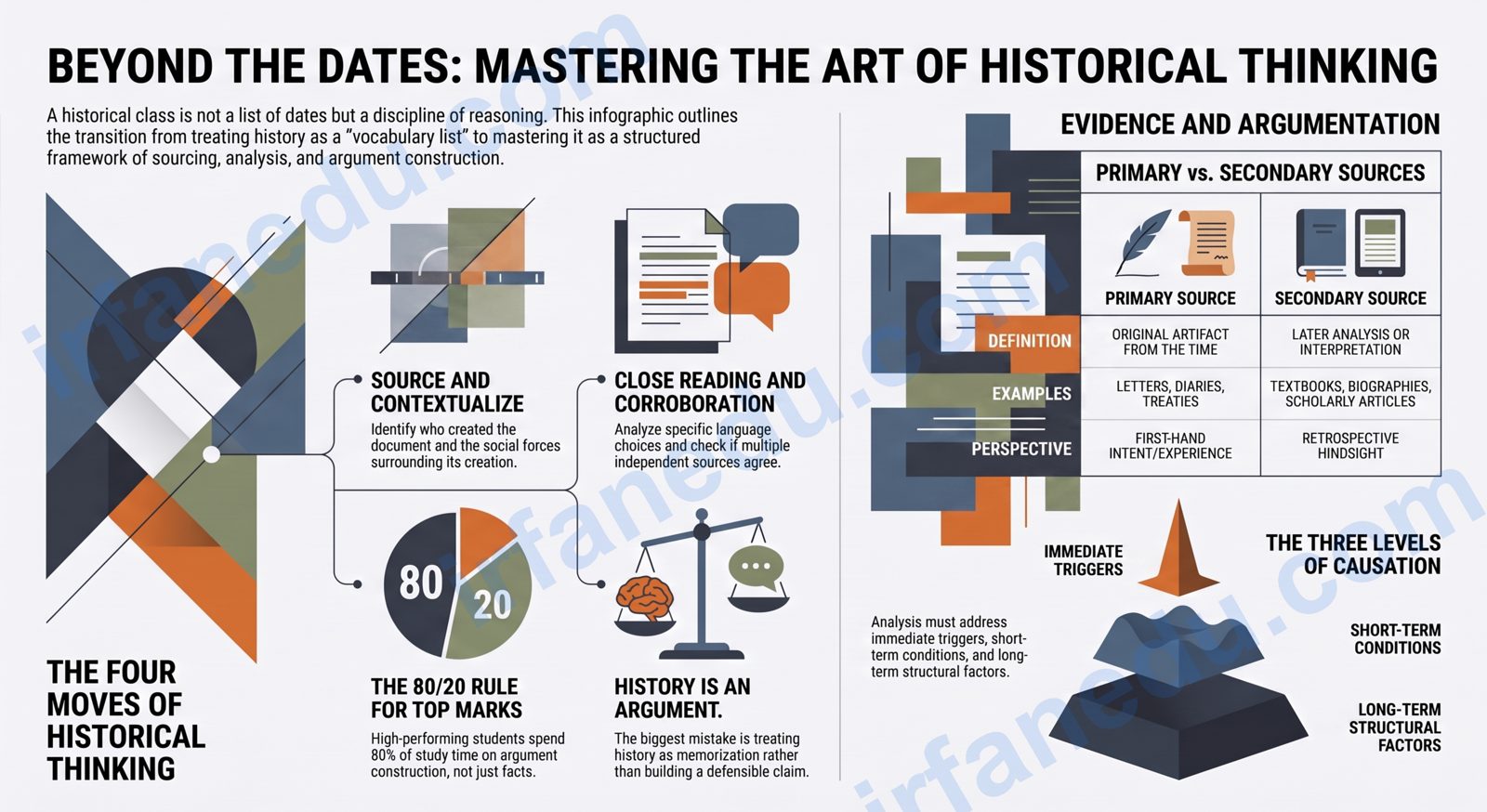
- 🧠 Historical thinking has four core moves: sourcing, contextualizing, corroborating, close reading.
- ✍ Every strong history essay starts with a clear, arguable thesis backed by evidence.
- 🚫 The biggest mistake: treating history as memorization rather than argument-building.
- 💡 Chronology is a scaffold, not the destination — understanding causation is the real goal.
The 8 Core Rules of Succeeding in a Historical Class
Think of these as the eight skills your teacher is actually grading — whether they say so explicitly or not. Master these and you master the course.
A historical class is a course that trains you to reconstruct and interpret the past using available evidence. The subject matter varies — ancient civilizations, modern world history, US history — but the underlying discipline is always the same: gather evidence, evaluate it critically, and build a defensible argument.
History is classified as a humanities discipline, which means there is rarely one single correct answer. Two historians can study the same event and reach different conclusions based on which sources they prioritize and how they interpret them. Your job in class is to learn how to do that reasoning yourself.
According to the Stanford History Education Group, historical thinking is a distinct set of cognitive skills that must be explicitly taught — students do not develop them automatically just by reading a textbook.
This distinction is the foundation of every history assignment. Get it wrong and your essays and source-analysis tasks will always fall short.
| Feature | Primary Source | Secondary Source |
|---|---|---|
| Definition | Original document or artifact from the time of the event | Analysis or interpretation of primary sources, written later |
| Examples | Letters, diaries, speeches, photographs, treaties, census data | Textbooks, documentaries, scholarly articles, biographies |
| Perspective | First-hand — reflects the author’s direct experience or intent | Retrospective — benefits from hindsight and broader context |
| Bias risk | High — author had a stake in the events | Lower, but still present — historians make interpretive choices |
| Used for | Evidence in arguments; direct quotation | Background context; identifying scholarly consensus |
In my experience, the most common student error is citing a textbook as a primary source. A textbook is always a secondary source — even if it quotes a primary source inside it.
I think the primary vs. secondary source distinction is the single most under-taught concept in history education. Teachers often assume students pick it up naturally, but in my experience, at least half of students in a typical grade-10 class cannot correctly classify a source when tested. Spending one full class period on nothing but this distinction pays dividends for the entire year.
Historical thinking is not a vague skill — it has four specific, teachable moves that historians use every time they examine a source.
- Sourcing: Before reading the content, ask — who created this? When? For what audience? What was their purpose? A government propaganda poster and a private soldier’s letter about the same battle tell very different stories.
- Contextualization: Place the source in its historical moment. What political, economic, or social forces surrounded its creation? A speech made during wartime carries different weight than the same speech made in peacetime.
- Close Reading: Read carefully for specific word choices, what is emphasized, and — critically — what is left out. Silence in a source is often as revealing as what is said.
- Corroboration: Check whether multiple independent sources agree. If three different types of sources from different perspectives all point to the same conclusion, your argument is strong. If they conflict, you need to explain why.
🗺 Visual: The Historical Thinking Framework
┌─────────────────────────────────────────────────────────┐
│              HISTORICAL THINKING FRAMEWORK              │
├──────────────┬──────────────┬─────────────┬────────────┤
│  SOURCING    │ CONTEXTUAL-  │   CLOSE     │ CORROBOR-  │
│              │  IZATION     │  READING    │  ATION     │
├──────────────┼──────────────┼─────────────┼────────────┤
│ Who made it? │ What was     │ What does   │ Do other   │
│ When? Why?   │ happening    │ it say      │ sources    │
│ For whom?    │ at the time? │ (and NOT    │ agree or   │
│              │              │ say)?       │ conflict?  │
└──────────────┴──────────────┴─────────────┴────────────┘
         ↓               ↓              ↓            ↓
              STRONG, EVIDENCE-BASED ARGUMENT
The most important shift a history student can make is from describing what happened to arguing why it happened and what it meant. A summary says “The French Revolution began in 1789.” An argument says “Economic inequality, not Enlightenment ideology, was the primary driver of the French Revolution.”
Every essay question in a history class is an invitation to make an argument. Your thesis is your claim. Your body paragraphs are your evidence and reasoning. Your conclusion is your synthesis — not a restatement, but a reflection on what your argument reveals.
A strong thesis has three qualities: it is specific (not vague), arguable (someone could disagree), and supportable (you have evidence for it).
Want to sharpen the writing skills that history class demands?
📝 Master Subject-Verb Agreement for Cleaner Essays →
Chronology — the sequence of events in time — is the skeleton of history, not the body. Knowing that Event A happened before Event B is useful only when you also understand why A contributed to B.
Causation in history is almost always multi-layered. Historians distinguish between immediate causes (the trigger), short-term causes (conditions in the months or years before), and long-term causes (structural factors built up over decades or centuries). Strong students identify all three levels; weaker students name only the trigger.
For example: the assassination of Archduke Franz Ferdinand in 1914 was the immediate cause of World War I. But the long-term causes — imperial rivalry, alliance systems, nationalism, and an arms race — had been building for decades. Without those, the assassination would have been a tragedy, not a world war.
In my experience, the causation question is where the most points are lost on history exams. Students write a paragraph about the immediate trigger and stop. Teachers want to see the three-level analysis — immediate, short-term, long-term. I always tell students: if your answer fits in two sentences, you have only scratched the surface.
Every source has a perspective. That does not make it useless — it makes it interesting. A biased source tells you what the author wanted people to believe, which is itself historically significant.
The mistake students make is writing “this source is biased, so it cannot be trusted.” That earns no marks. Instead, write: “This source reflects the perspective of [group/individual] and was created to [purpose]. While it may overstate [X], it is valuable evidence of how [group] perceived [event] at the time.”
Acknowledging bias while still using a source productively is a hallmark of sophisticated historical thinking.
🧠 Worth Knowing
What most guides get wrong about history class: Most study guides tell students to “read the textbook carefully” and “make flashcards of key dates.” That advice is not wrong — it is just incomplete, and it targets the lowest-value skill in the course.
Here is the non-obvious insight: your history teacher is not primarily testing what you know — they are testing how you reason with what you know. Two students can cite the exact same facts and get very different grades based on how they structure their argument and how they handle counter-evidence.
In my teaching, I found that students who spent 20% of their study time on facts and 80% on practicing argument construction consistently outperformed students who did the reverse — even when the “fact-heavy” students had more raw knowledge. The exam rewards the argument, not the encyclopedia.
Re-reading your notes is passive. It feels productive but produces weak retention. Active study strategies work far better for history.
These four methods have strong evidence behind them:
- Retrieval practice: Close your notes and write down everything you remember about a topic. Then check what you missed. This is more effective than re-reading by a significant margin, according to cognitive science research.
- The teach-back method: Explain a concept out loud as if teaching it to someone who knows nothing. If you stumble, you have found a gap.
- Argument mapping: Instead of linear notes, draw a diagram with your thesis in the center and evidence branches radiating outward. This mirrors how essays are actually structured.
- Spaced repetition: Review material at increasing intervals (day 1, day 3, day 7, day 14) rather than cramming the night before. History content sticks far better with spaced review.
History essays follow a specific logic. Here is the structure that earns top marks consistently:
- Introduction: Open with context (1-2 sentences), then state your thesis clearly. Do not start with “Throughout history…” — it is vague and wastes space.
- Body paragraphs (PEEL structure): Point (your claim for this paragraph) → Evidence (specific source, date, name) → Explanation (why this evidence supports your point) → Link (connect back to the thesis).
- Counter-argument paragraph: Acknowledge the strongest opposing view, then explain why your argument is more persuasive. This shows intellectual maturity and earns marks most students leave on the table.
- Conclusion: Synthesize — explain what your argument, taken as a whole, reveals about the historical period or question. Do not just restate your intro.
The counter-argument paragraph is the most skipped section in student essays, and it is also the one that most reliably separates a B from an A. I have read thousands of student essays, and the ones that engage seriously with the opposing view almost always score higher — not because the teacher is impressed by balance, but because it forces the student to make their own argument sharper and more specific.
How Do You Analyze a Primary Source in History Class?
Primary source analysis is a core assessed skill. Follow these five steps every time.
- Identify the source: Who created it? When? What type of document is it (letter, speech, law, image)?
- Contextualize: What was happening historically at the moment of creation? What pressures or events shaped the author’s perspective?
- Read closely: What specific language does the author use? What is emphasized? What is conspicuously absent?
- Assess purpose and bias: Why was this created? Who was the intended audience? How does that shape what is said?
- Corroborate: Does this source align with or contradict other sources you have studied? What does the agreement or disagreement tell you?
Practice Problems: Apply What You’ve Learned
Try each question on your own, then click to reveal the answer.
Practice 1: Classify the source — Is a newspaper article written in 1944 about D-Day a primary or secondary source?
Practice 2: Identify the levels of causation — What were the immediate, short-term, and long-term causes of the American Civil War?
Short-term causes: The election of Abraham Lincoln in 1860 (seen by Southern states as a threat to slavery), the secession of Southern states in late 1860 and early 1861.
Long-term causes: Decades of tension over the expansion of slavery into new territories, the economic divergence between the industrial North and the agrarian slave-economy South, and repeated failures of political compromise (Missouri Compromise, Compromise of 1850).
Practice 3: Evaluate a biased source — A Confederate general’s memoir praises the “Lost Cause” of the Confederacy. How should you use this source?
🎯 Quick Quiz: Test Your Historical Class Knowledge
Q1. Which of the following is a primary source?
Q2. A strong history essay thesis must be:
Q3. Which historical thinking move asks “Do multiple sources agree on this point?”
Building your broader academic skills?
🎓 Dual Enrollment vs College Courses: What Students Need to Know →
Frequently Asked Questions About Historical Class
What is a historical class?
What is the difference between a primary and secondary source?
Why do students struggle with history class?
How do you write a strong history essay?
What skills does a history class actually teach?
What is historical thinking?
Is memorizing dates important in history class?
How can parents support a student struggling with history?
Related Articles
📚 Sources & References
-
Stanford History Education Group — Reading Like a Historian curriculum framework, which defines and validates the four historical thinking moves (sourcing, contextualization, close reading, corroboration) used throughout this guide.
sheg.stanford.edu/history-lessons -
Library of Congress — Primary Source Analysis Tool: a free resource for students and teachers on how to analyze primary source documents.
loc.gov — Getting Started with Primary Sources -
Khan Academy — World History course: comprehensive free coverage of major historical periods and events referenced in this article.
khanacademy.org/humanities/world-history
✍ Editorial note: This article was written and fact-checked by Dr. Irfan Mansuri. All claims are based on established educational research and publicly verifiable sources. No statistics or quotes have been fabricated. Last reviewed August 2026.