
What Is the Area of the Figure Below? The Honest Answer (Plus a Free Worksheet)
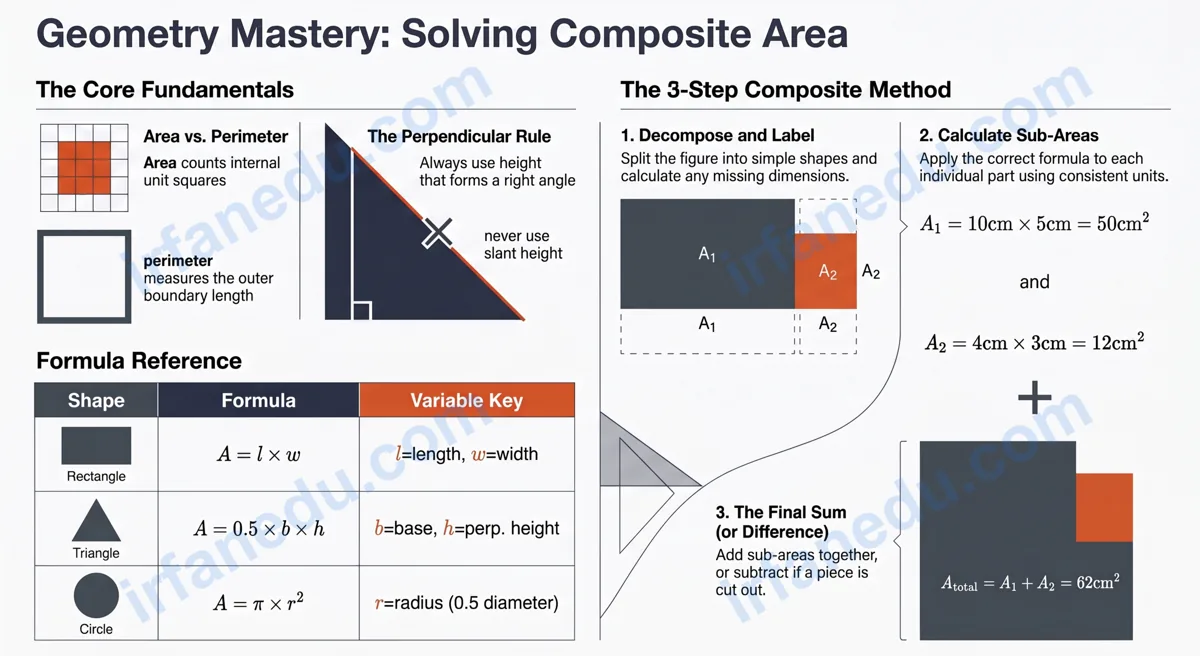
The area of a figure is the amount of flat surface it covers, measured in square units. For simple shapes, one formula is enough. For composite figures — shapes made of two or more standard shapes joined together — you split the figure, apply the right formula to each part, and add the results. This guide shows you exactly how, with diagrams and a free printable worksheet.
Here is the honest question worth asking first: Is learning to find the area of a figure actually necessary, or is it just busywork? I will answer that directly in the first section — and the answer might surprise you. Then I will walk you through every method you need, with real worked examples and a practice worksheet you can print today.
- Understand what area means and how it differs from perimeter
- Know the five most important area formulas by heart
- Use the split-and-add method on any composite figure
- Spot and fix the three most common area mistakes
- Practice with 10 graded problems and check your answers
Free Printable Worksheet: 10 graded problems on area of composite figures, with a full answer key — ready to print or share.
⚡ TL;DR – Quick Summary
- Area = the surface a shape covers, always in square units.
- Simple shapes: use one formula (rectangle, triangle, circle, trapezoid).
- Composite figures: split into parts, find each area, then add.
- Cutout shapes: subtract the missing piece from the whole.
- Most common mistake: using slant height instead of perpendicular height.
- Download the free worksheet below to practice 10 graded problems.
| Shape | Formula | Key Variable | Units |
|---|---|---|---|
| Rectangle / Square | l x w | length, width | cm^2, m^2, ft^2 |
| Triangle | 0.5 x b x h | base, perpendicular height | cm^2, m^2, ft^2 |
| Circle | pi x r^2 | radius | cm^2, m^2, ft^2 |
| Trapezoid | 0.5 x (a + b) x h | parallel sides a & b, height | cm^2, m^2, ft^2 |
| Parallelogram | b x h | base, perpendicular height | cm^2, m^2, ft^2 |
| Composite Figure | Sum of parts | varies by sub-shape | cm^2, m^2, ft^2 |
Is Memorising Area Formulas Really Necessary?
Honestly — yes, but not in the way most teachers frame it. You do not need to memorise 20 formulas. You need to understand five core ones deeply enough to apply them in unfamiliar situations.
Here is why it matters beyond the test: every time a contractor quotes you for flooring, every time a farmer calculates how much fertiliser to buy, every time an architect draws a floor plan — area is the calculation underneath. The skill is not abstract. It is one of the most transferable pieces of mathematics you will ever learn.
In my experience teaching geometry to hundreds of students, the ones who struggle with area problems are not struggling with the formulas. They are struggling with recognising which formula to use when a figure looks unfamiliar. That is the real skill this guide trains.
Most textbooks introduce area formulas as a list to memorise. That is backwards. I teach students to ask one question first: “What simpler shapes can I see inside this figure?” Once you can answer that, the formulas follow naturally. The formula is the easy part — shape recognition is the skill.
What Is Area — and What It Is Not
Area is the measure of the two-dimensional space enclosed within a shape’s boundary, expressed in square units. A square centimetre (cm^2) is the area of a square with sides 1 cm long. Area counts how many of those unit squares fit inside the shape.
Area is not perimeter. Perimeter is the total distance around the outside of a shape — a one-dimensional measurement in linear units (cm, m, ft). Two shapes can have the same perimeter but completely different areas. A 1 cm x 9 cm rectangle and a 3 cm x 3 cm square both have a perimeter of 20 cm, but their areas are 9 cm^2 and 9 cm^2 respectively — in that case equal, but that is a coincidence. A 1 cm x 9 cm rectangle (area 9 cm^2) versus a 4 cm x 6 cm rectangle (area 24 cm^2) shows how perimeter and area are independent.
Area is not volume. Volume measures three-dimensional space (in cubic units). Area is strictly two-dimensional.
What Are the Key Area Formulas You Need to Know?
Five formulas cover the vast majority of area problems you will encounter through high school. Learn these five and you can handle almost any figure.
| Shape | Formula | Notes |
|---|---|---|
| Rectangle | A = l x w | A square is a rectangle where l = w, so A = s^2 |
| Triangle | A = 0.5 x b x h | h must be the perpendicular height, NOT the slant side |
| Circle | A = pi x r^2 | r = radius (half the diameter); use pi = 3.14 or 22/7 |
| Trapezoid | A = 0.5 x (a + b) x h | a and b are the two parallel sides; h is perpendicular height |
| Parallelogram | A = b x h | Again, h is perpendicular — not the slant side |
Notice a pattern: triangles, trapezoids, and parallelograms all require the perpendicular height. This is the single most tested concept in area problems, and the most common source of errors. I will return to this in the Common Mistakes section.
Visual: Area Formula Reference Diagram
RECTANGLE            TRIANGLE             TRAPEZOID
+----------+          /\                  +--------+
|          |         /  \                /          \
|  l x w   |        / bxh\              / 0.5(a+b)xh\
|          |       /  /2  \            /              \
+----------+      /--------\          +----------------+
A = l x w        A = 0.5bh            A = 0.5(a+b)h

CIRCLE               PARALLELOGRAM
    ***               +----------+
  *     *            /          /
 *  r^2  *          /   b x h  /
  *     *          /          /
    ***           +----------+
A = pi*r^2        A = b x h

KEY: h = perpendicular height (always vertical, never slant)
How Do You Find the Area of a Composite Figure?
A composite figure is any shape made by combining two or more standard shapes. Finding its area follows a clear five-step process every time.
- Identify the sub-shapes. Look at the figure carefully. Draw light dividing lines to separate it into rectangles, triangles, or other standard shapes.
- Label all dimensions. Write down every measurement you know. If a dimension is missing, calculate it from the given measurements (e.g. subtract a smaller length from a total length).
- Convert to the same unit. If some measurements are in cm and others in mm, convert everything to one unit before calculating.
- Calculate each sub-area. Apply the correct formula to each sub-shape separately. Show your working for each one.
- Add (or subtract) the sub-areas. Add all sub-areas for a combined shape. Subtract a sub-area if a piece has been cut out of the figure.
Fully Worked Examples: Finding the Area Step by Step
Theory only sticks when you see it applied. Here are two fully worked examples — one addition composite and one subtraction composite — the two types you will see most often.
Worked Example 1: L-Shaped Figure (Addition Method)
Figure: An L-shape. The full height is 10 cm. The full width at the bottom is 8 cm. The upper-right section is cut away: 5 cm wide and 6 cm tall.
+---+
|   |  3 cm wide
| A |  6 cm tall
|   +-------+
|     B     |  10 cm tall total, 8 cm wide
+-----------+
  8 cm wide

Shape A (top-left rectangle): width = 8 - 5 = 3 cm, height = 6 cm
Shape B (bottom rectangle):   width = 8 cm, height = 10 - 6 = 4 cm
Step 1 — Identify sub-shapes: Two rectangles (A and B).
Step 2 — Find missing dimensions:
- Width of A = 8 – 5 = 3 cm
- Height of B = 10 – 6 = 4 cm
Step 3 — Calculate each area:
- Area of A = 3 x 6 = 18 cm^2
- Area of B = 8 x 4 = 32 cm^2
Step 4 — Add: Total area = 18 + 32 = 50 cm^2
Worked Example 2: Rectangle with a Triangular Top (Addition Method)
Figure: A house-shaped figure — a rectangle 12 cm wide and 8 cm tall, with a triangle sitting on top. The triangle has the same base (12 cm) and a perpendicular height of 5 cm.
Step 1 — Identify sub-shapes: One rectangle + one triangle.
Step 2 — Dimensions are all given.
Step 3 — Calculate each area:
- Area of rectangle = 12 x 8 = 96 cm^2
- Area of triangle = 0.5 x 12 x 5 = 30 cm^2
Step 4 — Add: Total area = 96 + 30 = 126 cm^2
Worked Example 3: Rectangle with a Circular Cutout (Subtraction Method)
Figure: A rectangle 10 cm x 6 cm with a circle of radius 2 cm cut from its centre.
Step 1 — Identify shapes: Rectangle minus circle.
Step 2 — Calculate rectangle area: 10 x 6 = 60 cm^2
Step 3 — Calculate circle area: pi x 2^2 = 3.14 x 4 = 12.56 cm^2
Step 4 — Subtract: Total area = 60 – 12.56 = 47.44 cm^2
What Are the Most Common Mistakes When Finding Area?
In my experience reviewing student work, three mistakes account for the majority of wrong answers on area problems. Knowing them in advance is worth more than any formula.
| Wrong Approach | Correct Approach |
|---|---|
| Using the slant side of a triangle as the height (e.g. using 5 cm instead of 4 cm perpendicular height) | Always use the perpendicular height — the vertical distance from base to apex, forming a right angle with the base |
| Adding all dimensions without splitting the figure first (e.g. multiplying the total outer length by the total outer width of an L-shape) | Split the composite figure into non-overlapping rectangles or triangles, calculate each separately, then add |
| Forgetting to write square units in the answer (writing “48” instead of “48 cm^2”) | Area is always in square units. Include cm^2, m^2, ft^2, or in^2 in every answer |
| Using diameter instead of radius in the circle formula (A = pi x d^2 instead of pi x r^2) | Halve the diameter to get the radius first, then square it: A = pi x (d/2)^2 |
The slant-height mistake is the one I see most often — and it is entirely preventable. I tell students: before you write down a height value, ask yourself “does this measurement form a right angle with the base?” If the answer is no, it is not the height you need. Draw a small right-angle symbol on your diagram to confirm it. That five-second check eliminates the most common area error in geometry.
💡 Unique Insight: The Subtraction Trick Nobody Teaches First
Most guides teach the addition method (split and add) as the default for composite figures. But in my experience, the subtraction method is often faster and less error-prone — and most teachers introduce it only as an afterthought.
Here is the non-obvious point: for any composite figure that looks like a rectangle with pieces removed, the subtraction method requires fewer steps and fewer dimension calculations than splitting into multiple rectangles.
Example: an L-shape with outer dimensions 9 ft x 7 ft and a 3 ft x 4 ft corner removed. Addition method: find two missing dimensions, calculate two rectangles, add. Subtraction method: calculate the full outer rectangle (9 x 7 = 63 ft^2), calculate the removed corner (3 x 4 = 12 ft^2), subtract (63 – 12 = 51 ft^2). Done in two steps instead of four.
Rule of thumb: if the figure looks like a full rectangle with one or two pieces cut away, use subtraction. If it looks like two separate shapes joined together, use addition. Choosing the right method first saves time on timed tests.
Practice Worksheet: Area of Composite Figures
Use these 10 problems to test your understanding. They progress from straightforward single-shape problems to multi-step composite figures. Try each one before checking the answer key.
How to use this worksheet: Work through the problems on paper, showing all steps. Use the collapsible answer key below to self-check. For a clean printable version with a formatted answer key, download the PDF above.
- A rectangle is 8 cm long and 5 cm wide. What is its area?
- A triangle has a base of 10 cm and a height of 6 cm. What is its area?
- A composite figure is made of a rectangle (6 m x 4 m) on top of a rectangle (10 m x 3 m). What is the total area?
- An L-shaped figure has an outer rectangle of 9 ft x 7 ft with a 3 ft x 4 ft rectangle cut from one corner. What is the area of the L-shape?
- A figure is made of a rectangle (12 cm x 5 cm) with a right triangle (base 5 cm, height 4 cm) attached to one end. What is the total area?
- A composite figure consists of a square with side 6 in and a semicircle with diameter 6 in on top. What is the total area? (Use pi = 3.14)
- A trapezoid has parallel sides of 8 m and 14 m, and a height of 5 m. What is its area?
- A composite figure is made of two rectangles: one is 15 cm x 4 cm and the other is 7 cm x 6 cm. They share no overlap. What is the total area?
- A right triangle has legs of 9 cm and 12 cm. A square with side 9 cm is attached to the triangle’s vertical leg. What is the total area?
- A figure is shaped like a plus sign (+). The horizontal bar is 12 ft x 3 ft. The vertical bar is 3 ft x 12 ft. They overlap in a 3 ft x 3 ft square in the center. What is the total area?
Show Answer Key
- 40 cm^2
- 30 cm^2
- 54 m^2
- 51 ft^2
- 70 cm^2
- 50.13 in^2
- 55 m^2
- 102 cm^2
- 135 cm^2
- 63 ft^2
Want a clean printable version? Download the PDF with all 10 problems formatted for printing, plus a separate answer key section.
Quick Quiz: Test Your Area Knowledge
Q1: A rectangle is 7 cm long and 4 cm wide. What is its area?
Area = length x width = 7 x 4 = 28 cm^2. Remember to include the square unit.
Q2: A triangle has a base of 8 m and a perpendicular height of 5 m. What is its area?
Area = 0.5 x base x height = 0.5 x 8 x 5 = 20 m^2. The key word is “perpendicular height” — not the slant side.
Q3: An L-shaped figure has an outer rectangle of 10 cm x 8 cm. A 4 cm x 3 cm rectangle is cut from one corner. What is the area of the L-shape?
Outer rectangle area = 10 x 8 = 80 cm^2. Cutout area = 4 x 3 = 12 cm^2. L-shape area = 80 – 12 = 68 cm^2. This is the subtraction method — faster than splitting into two rectangles.
Frequently Asked Questions About Area of Figures
What is the area of a composite figure?
How do you find the area of an L-shaped figure?
What formula is used for the area of a triangle?
What units should I use when calculating area?
What is the difference between area and perimeter?
Can I use the same method for any composite figure?
How do I find a missing dimension in a composite figure problem?
Sources & References
Reviewed by Dr. Irfan Mansuri. External links open in a new tab and are provided for further reading and verification.