
Pythagorean Theorem Calculator: Solve a²+b²=c² ⚡
Before you read anything else, look at these two students tackling the same ACT geometry problem. One gets it right in 20 seconds. The other wastes two minutes and still gets it wrong.
✅ The Smart Approach
Problem: A right triangle has legs of 5 and 12. Find the hypotenuse.
Student A recognizes the 5-12-13 Pythagorean triple instantly. Writes “13” in 5 seconds. Moves on.
❌ The Costly Mistake
Same problem.
Student B writes a² + b² = c², plugs in 5² + 12² = 169, then tries to calculate √169 by hand, makes an arithmetic error, and writes “12.9.” Wrong answer, wasted time.
The difference is not intelligence. It is knowing the formula, the triples, and the shortcuts cold. This calculator and guide give you all three — plus the step-by-step work so you understand every move.
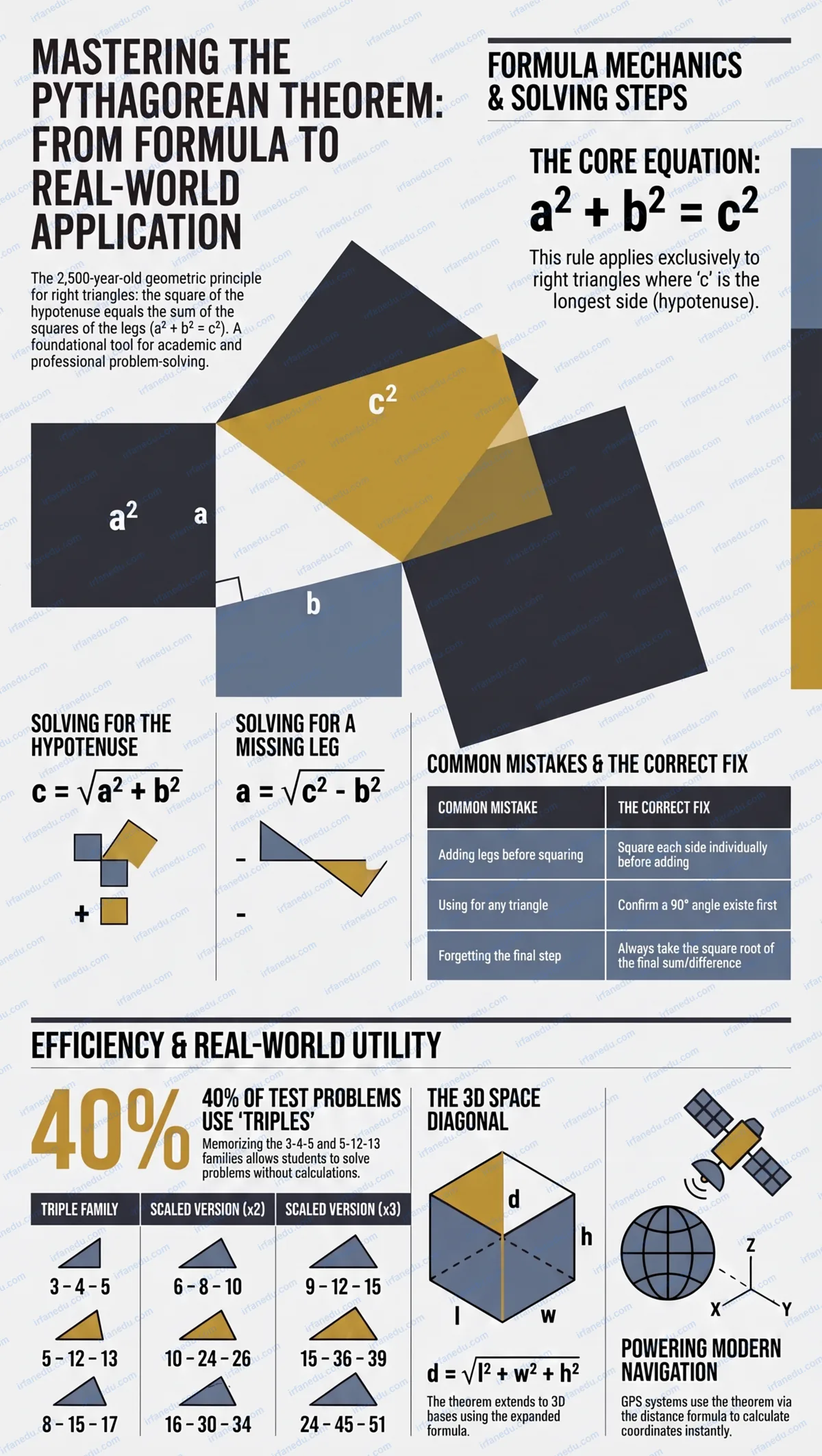
The Pythagorean theorem states that in any right triangle, a² + b² = c², where c is the hypotenuse (the longest side, opposite the right angle) and a and b are the two legs. Use it to find any missing side when the other two are known.
- 🔢 Instantly calculate the hypotenuse or either leg
- 📐 See a numbered, step-by-step solution for every calculation
- 🎯 Learn the Pythagorean triples that save time on the ACT
- ⚠️ Avoid the three most common mistakes students make
⚡ TL;DR – Quick Summary
- 📐 Formula: a² + b² = c² — only works for right triangles.
- 🔺 Hypotenuse c is always the side opposite the 90° angle.
- 🔢 Key triples to memorize: 3-4-5, 5-12-13, 8-15-17, 7-24-25.
- 📏 The distance formula IS the Pythagorean theorem on a coordinate grid.
- ⚠️ Biggest mistake: using the theorem on non-right triangles.
- 🎯 ACT tip: spot the triple first — skip the square root entirely.
| Fact | Detail |
|---|---|
| Theorem name | Pythagorean theorem (Pythagoras’ theorem) |
| Formula | a² + b² = c² |
| Applies to | Right triangles only (one 90° angle) |
| c is always | The hypotenuse — longest side, opposite the right angle |
| Inverse (find leg) | a = √(c² − b²) | b = √(c² − a²) |
| Most common triple | 3-4-5 (and multiples: 6-8-10, 9-12-15…) |
| ACT frequency | Appears in ~4–6 questions per test (geometry + coordinate) |
🧮 Pythagorean Theorem Calculator
Pythagorean Theorem Calculator
Enter any two sides — get the third side instantly with step-by-step solution
Select what you want to solve for, then enter the other two values.
units
units
The Pythagorean Theorem Formula
Find a: a = √(c² − b²)
Find b: b = √(c² − a²)
| Symbol | Meaning | Unit (SI) |
|---|---|---|
| a | One leg of the right triangle | metres (m) |
| b | Other leg of the right triangle | metres (m) |
| c | Hypotenuse (longest side, opposite 90°) | metres (m) |
| ² | Squared (raised to the power of 2) | — |
| √ | Square root | — |
Dimensions note: All three sides must be in the same unit. The theorem gives a length (dimension: L), so a² + b² = c² has dimension L².
What Is the Pythagorean Theorem?
The Pythagorean theorem is a fundamental relation in Euclidean geometry. It states: in a right triangle, the area of the square on the hypotenuse equals the sum of the areas of the squares on the other two sides.
Algebraically: a² + b² = c², where c is the hypotenuse and a, b are the legs.
What it is NOT: It does not apply to obtuse or acute triangles. For those, use the Law of Cosines.
Related concepts: distance formula, 45-45-90 triangle, 30-60-90 triangle, Law of Cosines, trigonometric ratios (SOH-CAH-TOA).
How Do You Use This Pythagorean Theorem Calculator?
Using this calculator takes under 10 seconds. Here is the exact process:
- Choose what to solve for — click “Find Hypotenuse (c)”, “Find Leg a”, or “Find Leg b”.
- Enter the two known side lengths in the input boxes. Use any unit (cm, m, inches) — just keep both values in the same unit.
- Click Calculate (or press Enter). The result appears instantly with a big number and its unit.
- Read the step-by-step solution — it shows every arithmetic step using your actual numbers, so you can follow the logic and learn, not just copy the answer.
- Click Reset to clear everything and start a new problem.
What Is the Pythagorean Theorem?
The Pythagorean theorem is a mathematical rule that relates the three sides of any right triangle. It states: the square of the hypotenuse equals the sum of the squares of the other two sides.
A right triangle has exactly one 90-degree angle. The side directly opposite that angle is the hypotenuse — always the longest side. The
Sources & References
Reviewed by Dr. Irfan Mansuri. External links open in a new tab and are provided for further reading and verification.