
Triangle Inequality Theorem: The Rule That Decides If a Triangle Can Exist
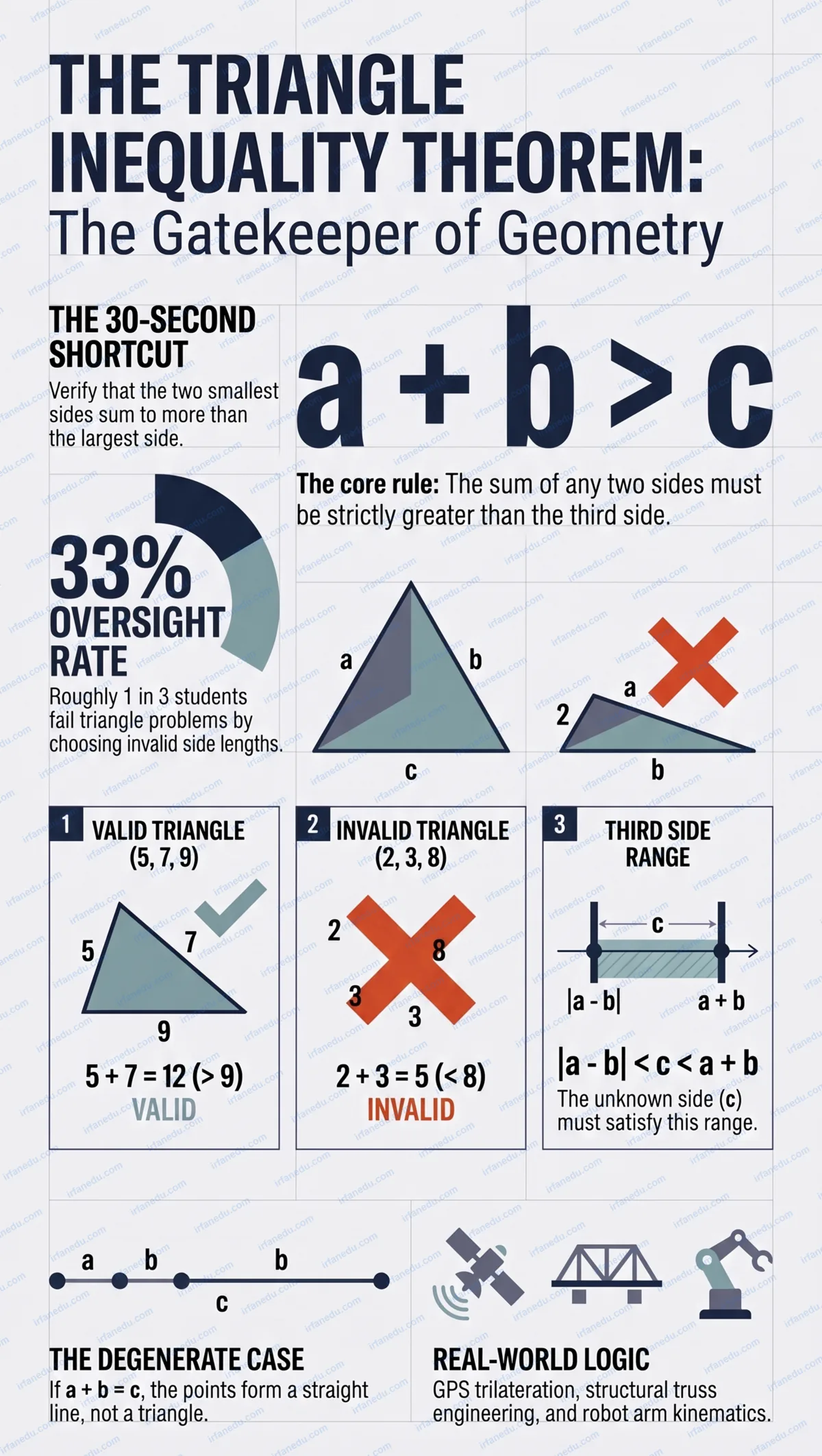
Did you know that roughly 1 in 3 students who attempt triangle problems on standardized tests pick an invalid set of side lengths without realizing it?
That single oversight costs real points. The triangle inequality theorem is the gatekeeper rule that tells you whether three lengths can even form a triangle before you spend time solving for angles or area. Once you understand it deeply, an entire category of geometry questions becomes almost automatic.
The triangle inequality theorem states that in any triangle with sides a, b, and c, the sum of any two sides must be strictly greater than the third side: a + b > c, a + c > b, and b + c > a. If any one of these three conditions fails, the three lengths cannot form a valid triangle.
In this guide, I walk you through the theorem’s definition, a clear proof, a step-by-step method, worked examples, common mistakes, and real-world applications. By the end, you will be able to answer any triangle inequality question with confidence.
- Understand exactly what the triangle inequality theorem says and why it is true.
- Apply the three-check method to any set of side lengths in under 30 seconds.
- Find the range of possible values for an unknown third side.
- Avoid the most common errors students make on tests.
- Connect the theorem to real-world engineering and navigation problems.
⚡ TL;DR – Quick Summary
- The sum of any two sides of a triangle must exceed the third side.
- Check all three combinations: a+b>c, a+c>b, b+c>a.
- The shortcut: verify the two smallest sides sum to more than the largest.
- Third side range formula: |a – b| < c < a + b.
- Equal sums (a+b=c) produce a degenerate line, not a triangle.
- This rule applies to every triangle type: right, obtuse, equilateral.
Quick Facts at a Glance
| Property | Detail |
|---|---|
| Theorem name | Triangle Inequality Theorem |
| Core rule | a + b > c, a + c > b, b + c > a (for all three side pairs) |
| Shortcut check | Two smallest sides must sum to more than the largest side |
| Third side range | |a – b| < c < a + b |
| Degenerate case | a + b = c means collinear points, zero area, not a triangle |
| Applies to | All triangles: acute, right, obtuse, equilateral, isosceles, scalene |
| Does NOT apply to | Quadrilaterals or polygons with more than 3 sides (different rules) |
| Related theorem | Pythagorean theorem (right triangles only, separate rule) |
| First formal proof | Euclid’s Elements, Book I, Proposition 20 (~300 BCE) |
| Test relevance | ACT Math, SAT Math, geometry courses worldwide |
What Is the Triangle Inequality Theorem?
The triangle inequality theorem is a foundational rule in Euclidean geometry. It tells you whether three given lengths are physically capable of forming a closed triangle.
Imagine you have three sticks. You want to lay them end-to-end to form a triangle. If two of the sticks together are shorter than or equal to the third stick, they cannot reach around to close the shape. The triangle inequality theorem formalizes exactly this physical intuition.
The formal statement is: for a triangle with sides of length a, b, and c, all three of the following must hold simultaneously:
Formal Statement
a + b > c
a + c > b
b + c > a
All three conditions must be true. If any single one fails, the three lengths do not form a triangle.
Notice the inequality is strict. The sum must be greater than, not greater than or equal to. When a + b = c exactly, the three points lie on a straight line. That is called a degenerate triangle, and it has zero area. Most geometry courses and tests do not count it as a valid triangle.
  VALID TRIANGLE (sides 5, 7, 9)
  --------------------------------
  5 + 7 = 12  >  9   PASS
  5 + 9 = 14  >  7   PASS
  7 + 9 = 16  >  5   PASS
  Result: Triangle EXISTS

        B
       /\
    7 /  \ 9
     /    \
    A------C
        5

  INVALID TRIANGLE (sides 2, 3, 8)
  ----------------------------------
  2 + 3 = 5   <  8   FAIL  (x)
  2 + 8 = 10  >  3   pass
  3 + 8 = 11  >  2   pass
  Result: Triangle DOES NOT EXIST

  A---B        C
  (sticks 2 and 3 cannot reach C)
Why Is It True? A Simple Proof
The triangle inequality theorem is not just a rule someone invented. It follows directly from a basic property of straight lines: the shortest distance between two points is a straight line.
Consider two points A and C. The direct distance from A to C is the length b. Now place a third point B anywhere not on line AC. The path from A to B to C has total length a + c (where a = BC and c = AB). Because a straight line is the shortest path, the direct route AC must be shorter than the detour through B:
Proof Sketch
Direct path: A to C = b
Indirect path: A to B to C = c + a
Since the straight line is always shortest: b < a + c, which gives a + c > b
Repeat the same argument for the other two pairs, and all three inequalities follow.
This proof is essentially Euclid’s argument from Book I, Proposition 20 of the Elements. It is elegant because it requires no algebra, only the geometric fact that a straight path is the shortest path between two points.
In my experience teaching geometry, students who understand the “shortest path” proof remember the theorem for life. Students who just memorize “sum of two sides greater than the third” often mix it up under exam pressure. Spend two minutes understanding the proof once, and you will never forget the rule. That is time well invested.
How to Apply the Theorem: Step-by-Step
Applying the triangle inequality theorem is a four-step process. Once you practice it a few times, you can run through it mentally in under 30 seconds.
- Label the three side lengths as a, b, and c.
- Identify the largest value among the three. Call it the “critical side.”
- Add the two smaller values together.
- Compare: if the sum of the two smaller values is greater than the largest value, the triangle is valid. If not, it is invalid.
Here is why the shortcut works: suppose sides are 3, 5, and 7. The largest is 7. Check: 3 + 5 = 8 > 7. Valid. The other checks (3 + 7 = 10 > 5 and 5 + 7 = 12 > 3) are trivially true because adding the largest side to anything positive always beats the smallest remaining side.
Worked Examples
Let me walk through five examples that cover the range of question types you will see on tests and in class.
Example 1: Can 6, 10, 13 form a triangle?
Largest side: 13. Check: 6 + 10 = 16 > 13. Yes, valid triangle.
Example 2: Can 4, 5, 9 form a triangle?
Largest side: 9. Check: 4 + 5 = 9. This equals 9, it does not exceed it. No, not a valid triangle (degenerate case).
Example 3: Can 1, 2, 10 form a triangle?
Largest side: 10. Check: 1 + 2 = 3, which is not greater than 10. No, invalid.
Example 4: Can 8, 8, 8 form a triangle?
Largest side: 8. Check: 8 + 8 = 16 > 8. Yes, valid (equilateral triangle).
Example 5: Can 7, 7, 14 form a triangle?
Largest side: 14. Check: 7 + 7 = 14. Equal, not greater. No, degenerate case, not valid.
Notice that Example 5 is a common trap on tests. Students see two equal sides and assume it must be a valid isosceles triangle. But 7 + 7 = 14 is the degenerate case, so it fails.
Finding the Range of the Third Side
A very common test question gives you two sides and asks for the range of possible values for the third side. This is a direct application of the triangle inequality theorem.
If two sides are a and b, the third side c must satisfy both of these conditions simultaneously:
- c < a + b (from the rule a + b > c)
- c > a – b (from the rule b + c > a, rearranged) and c > b – a (from a + c > b, rearranged)
Combining both rearrangements gives the clean formula:
The third side must be strictly greater than the absolute difference of the two known sides, and strictly less than their sum.
Example: Two sides are 5 and 9. Find the range for the third side.
Lower bound: |9 – 5| = 4, so c > 4.
Upper bound: 9 + 5 = 14, so c < 14.
Answer: 4 < c < 14
The third side can be any value between 4 and 14, not including 4 or 14 themselves.
Example: Two sides are 6 and 6. Find the range for the third side.
Lower bound: |6 – 6| = 0, so c > 0.
Upper bound: 6 + 6 = 12, so c < 12.
Answer: 0 < c < 12
Any positive length less than 12 works, which makes sense for an isosceles triangle.
Common Mistakes and How to Avoid Them
These are the four errors I see most often when students work with the triangle inequality theorem. Knowing them in advance is a significant advantage on any test.
| Wrong Approach | Correct Approach |
|---|---|
| Checking only one combination (e.g., only a + b > c) and assuming the others pass automatically when the sides are close in value. | Use the shortcut: identify the largest side and check whether the other two sum to strictly more than it. This one check is sufficient. |
| Accepting a + b = c as valid (“they’re equal, so it works”). | The inequality is strict. Equal means degenerate (a straight line). The answer is “not a valid triangle.” |
| Confusing the triangle inequality with the Pythagorean theorem and trying to verify a² + b² = c². | The Pythagorean theorem checks if a triangle is right-angled. The triangle inequality checks if a triangle can exist at all. They are different questions. |
| When finding the range of a third side, writing c <= a + b or c >= |a – b| (using non-strict inequalities). | Both bounds are strict: |a – b| < c < a + b. The endpoints are excluded because they produce degenerate cases. |
In my view, the most damaging mistake is confusing the triangle inequality with the Pythagorean theorem. I have seen students check a² + b² > c² when the question only asks whether a triangle can exist. That is a completely different question. Before you do any calculation, ask yourself: “Am I checking existence, or am I checking type?” The triangle inequality answers existence. The Pythagorean theorem answers type. Keep them separate.
Real-World Applications
The triangle inequality theorem is not just a classroom rule. It shows up in engineering, computer science, navigation, and even animation.
Structural engineering: Engineers designing trusses and roof frames must verify that the lengths of structural members can form valid triangles. A truss with invalid side lengths would simply collapse. The triangle inequality is a basic feasibility check before any load calculation begins.
GPS and trilateration: GPS receivers determine your position by measuring distances to multiple satellites. The algorithm uses triangle inequality logic to verify that the measured distances are geometrically consistent before computing a location fix.
Computer graphics and animation: 3D character rigs use triangulated meshes. Every triangle in a mesh must satisfy the triangle inequality, or the mesh will have degenerate faces that cause rendering errors. Animation software automatically validates this constraint.
Network routing: In computer networking, the triangle inequality is used to reason about routing paths. If the direct distance from node A to node C is greater than the path A to B to C, the routing algorithm knows something is wrong with the distance metric.
[IMAGE: A structural truss diagram showing triangular members with labeled side lengths | ALT: structural truss triangle inequality theorem real-world engineering example]
Robotics: Robot arm kinematics use the triangle inequality to determine whether a target position is reachable. If the two arm segments cannot form a triangle with the distance to the target, the position is out of reach.
Quick Quiz: Test Your Understanding
Question 1: Can sides of length 5, 12, and 13 form a triangle?
Question 2: Two sides of a triangle are 4 and 11. Which value CANNOT be the third side?
Question 3: Which set of side lengths forms a valid triangle?
Practice Problems (Click to Reveal Solutions)
Problem 1: Can sides 7, 15, and 20 form a triangle?
Problem 2: Two sides are 8 and 15. Find the range of the third side.
Lower bound: |15 – 8| = 7, so c > 7.
Upper bound: 15 + 8 = 23, so c < 23.
Answer: 7 < c < 23. The third side must be strictly between 7 and 23.
Problem 3: A triangle has sides x, x+2, and 10. Find the values of x for which a valid triangle exists.
Check 1: x + (x+2) > 10 → 2x + 2 > 10 → x > 4.
Check 2: x + 10 > x + 2 → 10 > 2. Always true.
Check 3: (x+2) + 10 > x → x + 12 > x → 12 > 0. Always true.
Also, all sides must be positive: x > 0 (already covered by x > 4).
Answer: x > 4.
Problem 4: The sides of a triangle are 2k, k+3, and 5. For what integer values of k does a valid triangle exist?
Check 1: 2k + (k+3) > 5 → 3k + 3 > 5 → 3k > 2 → k > 2/3.
Check 2: 2k + 5 > k + 3 → k > -2. (Always true for positive k.)
Check 3: (k+3) + 5 > 2k → k + 8 > 2k → 8 > k → k < 8.
All sides positive: 2k > 0 → k > 0; k + 3 > 0 always for k > 0.
Combining: k > 2/3 and k < 8. For integer values: k = 1, 2, 3, 4, 5, 6, 7.
Frequently Asked Questions
What is the triangle inequality theorem?
Can sides of 3, 4, and 8 form a triangle?
What is the range of the third side of a triangle?
Does the triangle inequality theorem apply to right triangles?
What happens when two sides equal the third side?
How is the triangle inequality theorem used in real life?
Is the triangle inequality theorem the same as the Pythagorean theorem?
Do I need to check all three inequality conditions every time?
Key Takeaways
- The triangle inequality theorem requires a + b > c, a + c > b, and b + c > a for all three side pairs.
- The practical shortcut: the two smaller sides must sum to strictly more than the largest side.
- The degenerate case (a + b = c) produces a straight line, not a triangle. The inequality is strict.
- The range formula for an unknown third side is: |a – b| < c < a + b.
- This theorem applies to every triangle type: acute, right, obtuse, equilateral, isosceles, scalene.
- Do not confuse this theorem with the Pythagorean theorem. They answer different questions.
- Real-world uses include structural engineering, GPS, 3D animation, robotics, and network routing.
Related Articles
Sources & References
Reviewed by Dr. Irfan Mansuri. External links open in a new tab and are provided for further reading and verification.