
Algebraic Reasoning: The Thinking Skill That Makes Algebra Click
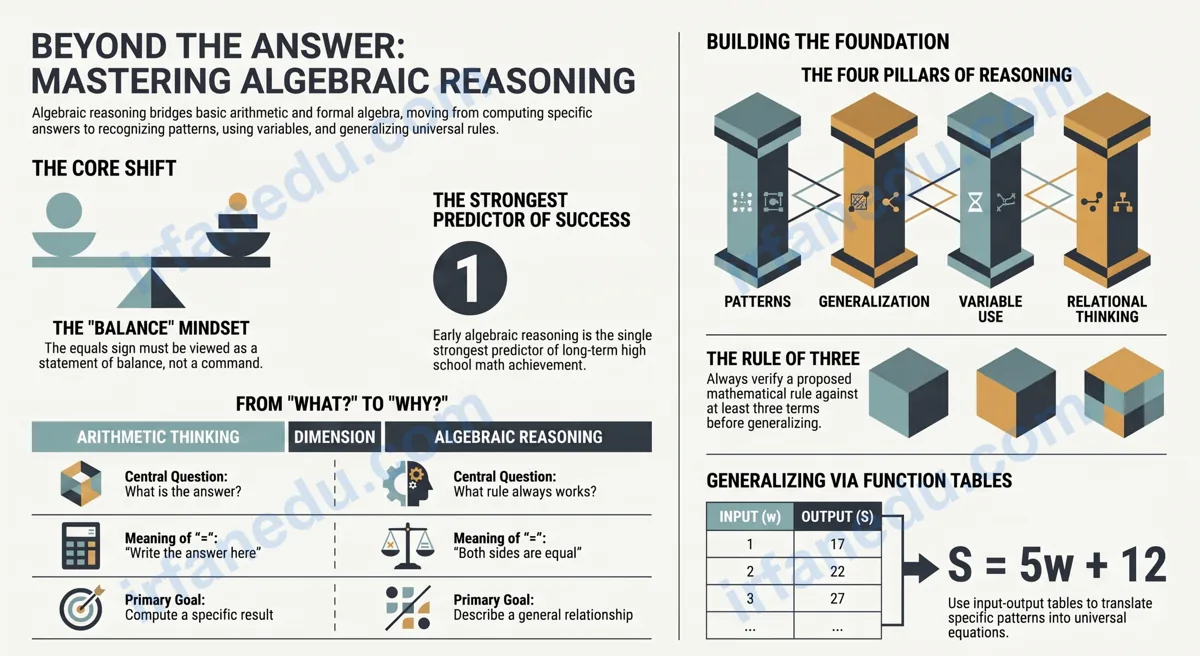
Algebraic reasoning is the mathematical thinking skill that lets students move beyond computing specific answers and start recognizing patterns, using variables, and generalizing rules. It is the mental bridge between arithmetic and formal algebra — and research consistently shows it is the strongest predictor of long-term math success.
Most students hit a wall somewhere around Grade 6. The arithmetic they mastered suddenly feels useless, and “algebra” feels like a foreign language. In my experience teaching math across multiple grade levels, that wall is almost never about the algebra itself. It is about a missing thinking skill that nobody explicitly taught: algebraic reasoning.
In this guide, I will show you exactly what algebraic reasoning is, how it differs from arithmetic, and — most importantly — how to build it deliberately, with worked examples you can use today.
- Understand the precise difference between arithmetic and algebraic thinking
- Learn the four pillars every student needs before formal algebra
- Follow a six-step development path with real examples
- Avoid the three most common mistakes that stall progress
- Apply algebraic reasoning to real-world and exam problems
Quick Answer: Algebraic reasoning is the ability to identify patterns, represent unknowns with variables, and generalize mathematical relationships into rules or equations. It bridges basic arithmetic and formal algebra. A student uses algebraic reasoning when they move from “what is the answer?” to “what rule always works here?” — typically developed from Grade 3 onward through pattern work, function tables, and balance-equation problems.
⚡ TL;DR – Quick Summary
- Definition: Algebraic reasoning = pattern recognition + variable use + generalization.
- Key difference: Arithmetic computes specific answers; algebraic reasoning finds universal rules.
- Four pillars: Patterns, Generalization, Variables, Relational thinking (equals as balance).
- Biggest mistake: Treating “=” as “write the answer” instead of “both sides are equal.”
- How to build it: Pattern tables, balance problems, function rules, word-problem translation.
- Why it matters: Algebraic reasoning predicts success in algebra, geometry, and beyond.
| Fact | Detail |
|---|---|
| Formal definition | Recognizing patterns, using variables, and generalizing mathematical relationships |
| Grade range | Informally Grades 1-2; explicitly Grades 3-8; formalized in algebra courses |
| Core components | Patterns, Variables, Generalization, Relational thinking |
| Prerequisite for | Algebra I, Algebra II, Geometry proofs, Calculus, Statistics |
| Common assessment | Function tables, equation solving, pattern extension, word-problem translation |
| Key research finding | Early algebraic reasoning is one of the strongest predictors of high school math achievement |
Arithmetic vs. Algebraic Reasoning: The Core Contrast
Arithmetic and algebraic reasoning are not opposites — one grows out of the other. But they ask fundamentally different questions, and confusing them is the root cause of most algebra struggles.
| Dimension | Arithmetic Thinking | Algebraic Reasoning |
|---|---|---|
| Central question | What is the answer? | What rule always works? |
| Operates on | Specific, known numbers | Variables and general quantities |
| Meaning of “=” | “Write the answer here” (operational) | “Both sides are equal” (relational) |
| Example | 3 + 5 = 8 | a + b = b + a (for any a, b) |
| Pattern task | What is the 5th term: 2, 4, 6, 8, __? | What is the nth term? (Answer: 2n) |
| Unknown | A missing number to find once | A variable representing any value |
| Goal | Compute a specific result | Describe a general relationship |
| Typical grade | K-5 focus | Grades 3-8 and beyond |
The critical shift: A student who only thinks arithmetically sees the problem “3 + ? = 7” and finds the missing number once. A student with algebraic reasoning sees “x + 3 = 7” and understands that x represents a class of relationships — and that the same logic applies to x + 3 = 100, x + 3 = 1000, or any equation of that form.
What Exactly Is Algebraic Reasoning?
Algebraic reasoning is the capacity to think about mathematical situations in terms of patterns, relationships, and general rules rather than specific numerical answers. It is not a single skill — it is a cluster of related thinking habits.
According to the National Council of Teachers of Mathematics (NCTM), algebraic reasoning includes recognizing and analyzing patterns, representing mathematical situations using symbols, and drawing conclusions about general relationships. In simpler terms: it is the difference between knowing that something works and knowing why it always works.
Concrete Example
Arithmetic approach: “What is 7 × 8?” → Answer: 56. Done.
Algebraic reasoning approach: “Why does the order of multiplication not matter?” → Because a × b = b × a for all real numbers. This is the commutative property — a generalized rule, not a single computation.
The second question is algebraic reasoning. The student is not just computing; they are identifying a universal relationship.
Algebraic reasoning is also about relational thinking — understanding that an equation is a statement of balance. The expression 4 + 3 = 3 + 4 is not just a calculation. It is a claim that two quantities are equal. That distinction sounds small, but it is enormous in practice.
What Are the Four Pillars of Algebraic Reasoning?
Algebraic reasoning rests on four interconnected pillars. A student who is weak in any one of them will struggle when formal algebra arrives.
Pillar 1: Pattern Recognition
Pattern recognition is the ability to spot a repeating or growing structure and describe it precisely. This starts in early elementary school with shape patterns (circle, square, circle, square) and grows into number sequences and function rules.
Pillar 2: Generalization
Generalization is the leap from “this works in these three cases” to “this works for all cases.” It is the heart of algebraic reasoning. A student who can say “the perimeter of a square with side length s is always 4s” has generalized — they have written a rule that covers infinitely many specific cases.
Pillar 3: Variable Use
Variables are symbols (usually letters) that represent unknown or changing quantities. Students often first meet variables as mystery numbers to find. Later, variables represent any value in a relationship. Understanding this dual role — unknown vs. general quantity — is essential.
Pillar 4: Relational Thinking
Relational thinking means understanding the equals sign as a balance symbol, not a “do something” command. A student with relational thinking can look at 8 + 4 = ? + 5 and reason: “The right side must equal 12, so the missing number is 7” — without computing 8 + 4 first and then subtracting 5.
In my experience, Pillar 4 — relational thinking — is the most underteached of the four. Most curricula spend enormous time on pattern recognition and variable notation, but almost no time explicitly teaching what the equals sign actually means. I have watched high school students solve equations correctly by rote procedure while having no idea that both sides of the equation represent the same quantity. That gap catches up with them in calculus and beyond.
How to Develop Algebraic Reasoning Step by Step
Algebraic reasoning is built deliberately, not absorbed passively. Here is the six-step path I recommend, based on both research and classroom experience.
-
Master pattern recognition first. Before introducing any variable, spend time identifying and extending sequences. Use both visual patterns (tile arrangements) and number patterns (3, 7, 11, 15…). Ask: “What changes? What stays the same?”
-
Reframe the equals sign explicitly. Tell students directly: “The equals sign means both sides are worth the same amount — like a balance scale.” Use physical or digital balance-scale tools. Give problems like 5 + 3 = ? + 2 before any equation-solving.
-
Introduce variables through context, not notation. Start with a box: “3 + □ = 10.” Then a question mark: “3 + ? = 10.” Then a letter: “3 + x = 10.” The concept should feel natural before the symbol is introduced.
-
Build function tables. Create input-output tables and ask students to find the rule. Start with additive rules (add 4), then multiplicative (multiply by 3), then two-step (multiply by 2, then add 1). Always ask: “Can you write the rule as an equation?”
-
Generalize from specific examples. After solving three or four specific cases, pause and ask: “What rule works for ALL cases?” Write it with a variable. This is the generalization step — the most algebraic moment in the process.
-
Apply to word problems and real contexts. Translate a real-world situation into an algebraic expression, solve it, and verify the answer makes sense. This closes the loop between abstract reasoning and practical meaning.
Pro Tip: The single most powerful question you can ask a student at any stage is: “Does this always work, or just this time?” That question forces the shift from arithmetic to algebraic thinking every single time.
Worked Examples: Seeing Algebraic Reasoning in Action
Abstract definitions only go so far. Here are two original worked examples that show algebraic reasoning in practice — the kind of examples I use in my own teaching.
Example 1: The Tile Border Problem
Problem
A square pool has a side length of n tiles. You want to build a border of single tiles around the outside. How many border tiles do you need?
Arithmetic approach (specific cases):
- n = 1: border tiles = 8
- n = 2: border tiles = 12
- n = 3: border tiles = 16
- n = 4: border tiles = 20
Algebraic reasoning step: The pattern adds 4 each time the side grows by 1. So the rule is: border tiles = 4n + 4.
Verification: For n = 3: 4(3) + 4 = 16. Correct.
Why this is algebraic reasoning: The student did not just find the answer for n = 3. They found a rule that works for any n — including n = 100, where computing by hand would be tedious.
  T T T T T
  T . . . T
  T . . . T
  T . . . T
  T T T T T

  Side length n = 3 (inner pool: 3×3 tiles)
  Border tiles = 4 sides × 3 + 4 corners = 12 + 4 = 16
  General rule: 4n + 4  (or equivalently: 4(n + 1))
Example 2: The Savings Problem (Function Table)
Problem
A student saves $5 every week. They already have $12 saved. How much will they have after w weeks?
| Weeks (w) | Total Savings ($) |
|---|---|
| 0 | 12 |
| 1 | 17 |
| 2 | 22 |
| 3 | 27 |
| w | 5w + 12 |
Algebraic reasoning: The starting value is 12. The rate of change is +5 per week. The general rule is S = 5w + 12. This is a linear function — the foundation of all linear algebra.
Practical use: How many weeks to save $62? Solve 5w + 12 = 62 → 5w = 50 → w = 10 weeks.
Common Mistakes in Algebraic Reasoning (Wrong vs. Right)
These are the three mistakes I see most often. Each one has a specific fix.
| Common Mistake (Wrong) | Correct Algebraic Reasoning (Right) |
|---|---|
| Treating “=” as “write the answer here.” Student writes 3 + 5 = 8 + 2 = 10 in a chain, meaning “and then.” | Each “=” is a claim of equality. 3 + 5 = 8 is true. 8 + 2 = 10 is true. But 3 + 5 = 8 + 2 is false. Write separate equations. |
| Thinking a variable always means “find the one answer.” Student sees 2x = 10 and thinks x is a mystery to solve, not a general symbol. | Understand that in an equation, x has a specific value. In an expression like 2x, x can be any number. Context determines which role the variable plays. |
| Guessing the pattern rule from just two terms. Student sees 2, 4 and assumes the rule is “multiply by 2” (giving 8, 16…) without checking if it could be “add 2” (giving 6, 8…). | Always check a proposed rule against at least three terms before generalizing. Two data points are never enough to confirm a pattern. |
The chain-equals mistake — writing 3 + 5 = 8 + 2 = 10 to mean “and then I added 2” — is so common that I have started calling it the “calculator mindset.” Students who grew up pressing equals on a calculator internalize it as a sequential action, not a relational statement. The fix is simple but must be explicit: draw a balance scale next to every equation for the first few weeks of algebra instruction and ask, “Is the left side equal to the right side?” That one habit change prevents dozens of downstream errors.
Real-World Applications of Algebraic Reasoning
Algebraic reasoning is not confined to math class. It shows up in everyday decisions, science, and technology — which is exactly why it is worth building early.
- Personal finance: Calculating how long to save for a goal (the savings problem above) is pure algebraic reasoning. So is comparing two phone plans with different monthly rates and upfront costs.
- Science experiments: When a student writes “the temperature drops 2°C every hour,” they are expressing a linear relationship — algebraic reasoning in a science context.
- Coding and algorithms: Writing a loop that runs n times is a direct application of variable use and generalization. Every for-loop is an algebraic expression.
- Sports statistics: “A team scores an average of 3 points per possession. How many possessions to reach 60 points?” This is a one-step linear equation.
- Cooking and scaling: Doubling a recipe for n people instead of 4 requires proportional algebraic reasoning.
[IMAGE: A split illustration showing four real-world contexts (piggy bank, thermometer, laptop code, recipe book) each connected to a simple algebraic expression | ALT: Real-world applications of algebraic reasoning including finance, science, coding, and cooking]
Most algebraic reasoning guides treat it as a prerequisite for algebra — something you learn before the “real” math starts. That framing is backwards, and it causes real harm. Algebraic reasoning is not a gateway skill; it is a parallel track. Research from the University of Wisconsin’s Cognitively Guided Instruction project found that students who develop algebraic reasoning alongside arithmetic — not after it — show significantly stronger number sense and problem-solving flexibility than students who learn arithmetic first and algebra second. The implication for parents and teachers is concrete: do not wait until Grade 6 to ask “what’s the rule?” Ask it in Grade 2 when a child is adding even numbers. The habit of generalization, started early, compounds dramatically.
Quick Quiz: Test Your Algebraic Reasoning
1. A sequence reads: 5, 8, 11, 14, 17. What is the rule for the nth term?
Show Answer
2. Which of these is an example of RELATIONAL thinking (not just arithmetic)?
Show Answer
3. A student earns $8 per hour. They already earned $24 today. Which equation represents their total earnings T after h more hours?
Show Answer
Practice Problems: Try These Yourself
Problem 1: A square has a perimeter of 4s. If the perimeter is 52 cm, what is the side length?
Set up the equation: 4s = 52
Divide both sides by 4: s = 13
Answer: The side length is 13 cm.
Algebraic reasoning used: We generalized the perimeter rule (4s), then used it to find a specific value — moving from general to specific, which is the reverse of the usual direction.
Problem 2: A pattern reads: 2, 5, 10, 17, 26. What is the next term, and what is the general rule?
Differences: +3, +5, +7, +9 — the differences increase by 2 each time (second differences are constant at +2).
Next difference: +11, so next term = 26 + 11 = 37.
General rule: The nth term = n² + 1 (check: n=1: 2, n=2: 5, n=3: 10, n=4: 17, n=5: 26). Correct.
Algebraic reasoning used: Analyzing second differences to identify a quadratic pattern, then generalizing to a formula.
Sources & References
Reviewed by Dr. Irfan Mansuri. External links open in a new tab and are provided for further reading and verification.