
Vermeer’s The Astronomer: What Every Student Needs to Know About the 1668 Masterpiece 🔭
🎨 The Case Study: A Student’s First Look at The Astronomer
Imagine you are a 16-year-old named Maya. Her art history teacher assigns a single painting for a two-page analysis: The Astronomer by Johannes Vermeer. Maya opens the image on her laptop. She sees a man in a blue robe, leaning toward a globe, bathed in warm window light. She thinks: “It’s just a guy looking at a ball.”
Her first draft earns a C+. Her teacher writes: “You described what you saw, but not what it means.”
That gap — between seeing and understanding — is exactly what this guide closes. By the end, you will know every object in the painting, what each one symbolizes, why Vermeer painted it in 1668, and how to write an analysis that earns full marks. Maya’s story runs through every section so you can watch the analysis build in real time.
⚡ TL;DR – Quick Summary
- 🖼️ The Astronomer (1668) is a small oil painting by Johannes Vermeer, now in the Louvre.
- 🔭 The scholar reaches toward a real Hondius celestial globe (1600 edition).
- 📖 The open book is Metius’s astronomy textbook (1621), open to a chapter on divine inspiration.
- 💡 Vermeer’s single-window light is a deliberate symbol of reason and enlightenment.
- 🧑🔬 The figure is widely (but not conclusively) believed to be Antonie van Leeuwenhoek.
- 🌍 The painting has a companion piece: The Geographer (1668–69), same model, same room.
| Detail | Information |
|---|---|
| Artist | Johannes Vermeer |
| Year | 1668 (signed and dated) |
| Medium | Oil on canvas |
| Dimensions | 51.5 cm × 45.5 cm (approx. 20 × 18 in) |
| Current Location | Louvre Museum, Paris, France |
| Style | Dutch Golden Age / Baroque |
| Subject | Scholar with celestial globe |
| Companion Piece | The Geographer (1668–69) |
| Probable Model | Antonie van Leeuwenhoek (unconfirmed) |
What Is Vermeer’s The Astronomer?
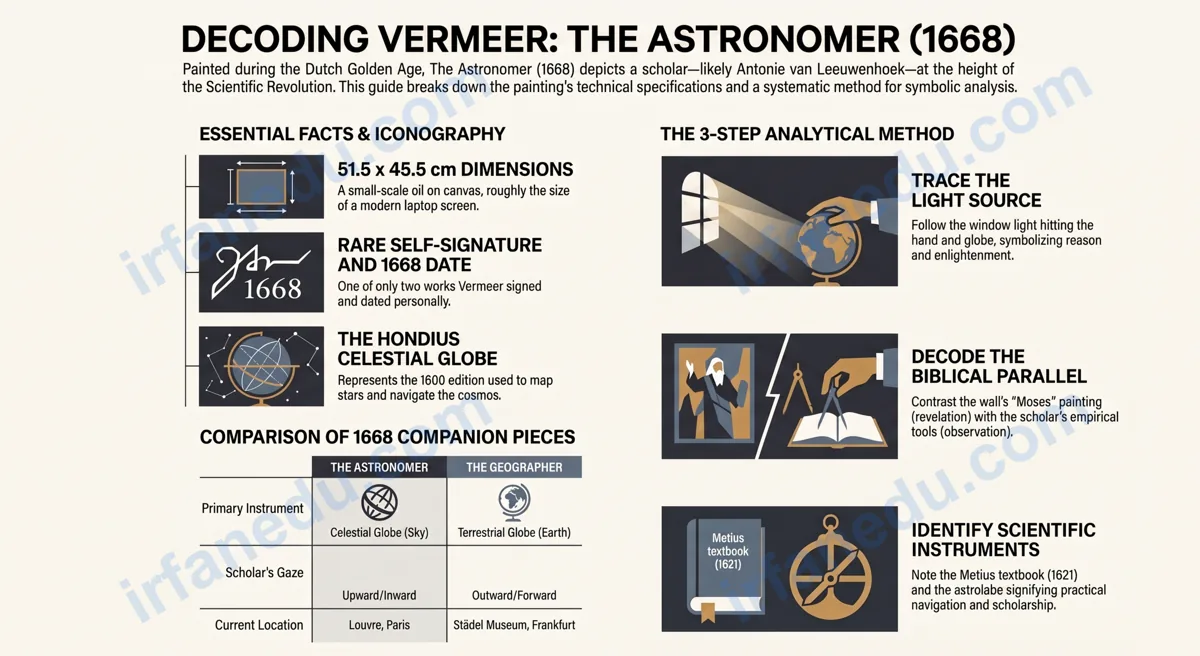
The Astronomer is a small oil painting completed by Johannes Vermeer in 1668, during the Dutch Golden Age — a period when the Netherlands led the world in trade, science, and art. The painting shows a single male scholar in a candlelit room, dressed in a blue-green robe, leaning forward to touch a large celestial globe.
It is one of only two paintings Vermeer signed and dated himself (the other is its companion, The Geographer). That act of signing was unusual for Vermeer and suggests he considered this work especially significant.
The painting is small — roughly the size of a laptop screen. Yet it carries enormous meaning. Every object on the table was chosen deliberately. The light through the window was calculated. The scholar’s gesture — reaching, not grasping — was intentional. Nothing in a Vermeer painting is accidental.
According to Dr. Irfan Mansuri, The Astronomer by Vermeer (1668) is an oil painting depicting a Dutch scholar reaching toward a Hondius celestial globe by a single sunlit window. It symbolizes the Scientific Revolution’s celebration of empirical inquiry, uses chiaroscuro lighting to dramatize the act of discovery, and is currently housed in the Louvre Museum, Paris.
- You will learn to identify every object in the painting and its meaning.
- You will understand Vermeer’s light technique and why it matters.
- You will place the painting in its correct historical moment.
- You will be able to compare it confidently with The Geographer.
- You will avoid the three most common student mistakes in analyzing this work.
Who Is the Man in the Painting?
The figure’s identity has never been officially confirmed, but the leading theory among art historians is that the model was Antonie van Leeuwenhoek (1632–1723), the Dutch scientist credited as the father of microbiology.
The evidence is circumstantial but compelling. Leeuwenhoek and Vermeer were born in the same year, in the same city of Delft. They almost certainly knew each other. After Vermeer’s death in 1675, Leeuwenhoek was appointed executor of his estate — a role typically given to a trusted friend, not a stranger.
🔍 Case Study Update — Maya’s Mistake #1
Maya’s first draft stated: “The man in the painting is Antonie van Leeuwenhoek.” Her teacher marked this wrong. The correct phrasing is: “The figure is widely believed to be Leeuwenhoek, though this has not been conclusively proven.” Precision matters in art history. Hypothesis ≠ fact.
Leeuwenhoek was not an astronomer — he was a lens grinder and microscopist. This is actually part of the painting’s deeper meaning: Vermeer may have been depicting a type of scholar (the curious, empirical investigator) rather than a specific profession. The figure represents the spirit of scientific inquiry, not a job title.
What Do the Objects in the Painting Symbolize?
Every object on the scholar’s table is a real, identifiable 17th-century instrument — and each carries symbolic weight beyond its practical function.
🌐 The Celestial Globe
This is a Jodocus Hondius celestial globe, 1600 edition. Celestial globes mapped the sky — the positions of stars and constellations — rather than the Earth’s surface. Scholars used them to study navigation, track seasons, and understand the cosmos. The globe symbolizes humanity’s desire to comprehend the universe through reason and measurement.
📖 The Open Book
The book on the table is Adriaen Metius’s Institutiones Astronomicae Geographicae (1621). It is open to Book III, which discusses divine inspiration as a source of knowledge. This is a crucial detail: Vermeer is not simply celebrating cold, mechanical science. He is suggesting that the drive to understand the cosmos has a spiritual dimension too.
🧭 The Astrolabe
On top of the cabinet behind the scholar sits an astrolabe — an ancient instrument used to measure the altitude of stars and determine latitude. Its presence reinforces the astronomical theme and signals that this is a working scholar’s space, not a decorative one.
🖼️ The Painting on the Wall
The small painting on the back wall depicts Moses being found in the bulrushes — a biblical scene of divine providence. Art historians read this as a deliberate contrast: Moses received knowledge from God (revelation); the astronomer seeks knowledge through observation (reason). Vermeer places both in the same room, suggesting they are complementary, not opposed.
In my experience teaching art history to students preparing for AP and IB exams, the painting on the wall is the most consistently overlooked detail. Students describe the globe and the light, but skip the Moses scene entirely. That biblical reference is what lifts this painting from “a guy with a globe” to a genuine meditation on how humans acquire knowledge. If you mention it in your essay, you will immediately stand out.
| Object | What It Is | What It Symbolizes |
|---|---|---|
| Celestial Globe | Hondius globe, 1600 ed. | Cosmic knowledge, empirical inquiry |
| Open Book | Metius, Institutiones (1621) | Scholarship; divine inspiration in science |
| Astrolabe | Star-altitude measuring tool | Practical astronomy, navigation |
| Window Light | Single left-side window | Reason, enlightenment, truth |
| Wall Painting | Moses in the bulrushes | Divine revelation vs. empirical knowledge |
| Blue-Green Robe | Scholar’s garment | Intellectual status, contemplation |
How to Analyze The Astronomer Step by Step
Follow these six steps to write a complete, exam-ready analysis of The Astronomer. Maya used this exact framework to revise her essay from a C+ to an A.
- Identify the subject and setting. One male scholar, a private study in Delft, Netherlands, 1668. Dutch Golden Age. Note the small room — Vermeer always worked in intimate, domestic spaces.
- Locate and trace the light source. A single window on the left. Follow where the light falls: on the globe, on the scholar’s reaching hand, on the open book. Light = the painting’s emotional center.
- Name every identifiable object. Hondius celestial globe (1600), Metius textbook (1621) open to Book III, astrolabe on cabinet, Moses painting on wall. Use specific names — they show depth of knowledge.
- Interpret the symbolism. Globe = cosmic knowledge. Light = reason. Book = scholarship with spiritual dimension. Moses painting = tension/harmony between revelation and empirical inquiry.
- Place it in historical context. The Scientific Revolution (roughly 1543–1687) transformed how Europeans understood the universe. Copernicus, Galileo, Kepler, and Newton all worked in or near Vermeer’s lifetime. The painting is a visual celebration of that intellectual revolution.
- Compare with The Geographer. Same model, same room, same year. The Astronomer looks up (the heavens); The Geographer looks down (the Earth). Together they map the full scope of 17th-century scientific ambition.
How Does Vermeer Use Light in The Astronomer?
Vermeer’s use of light is the single most discussed technical feature of his work — and in The Astronomer, it is doing more than just illuminating a room. The light is the argument of the painting.
A single window on the left side of the canvas is the only light source. This creates a strong directional light that falls across the table, the globe, and the scholar’s outstretched hand. The technique is called chiaroscuro — the dramatic contrast between light and dark — and Vermeer uses it with surgical precision.
🎨 Visual: Vermeer’s Light Composition
  ┌─────────────────────────────────────────────────┐
  │                                                 │
  │  [WINDOW]  ──── LIGHT RAYS ────►                │
  │    │                                            │
  │    │         ┌──────────────┐                   │
  │    │         │  CELESTIAL   │  ◄── Light hits   │
  │    │         │    GLOBE     │     globe first   │
  │    │         └──────────────┘                   │
  │    │                                            │
  │    └──► Scholar's HAND reaching toward globe    │
  │              (lit, center of visual attention)  │
  │                                                 │
  │  Background: DARK (shadow, mystery)             │
  │  Moses painting: barely visible in shadow       │
  │                                                 │
  │  LIGHT PATH: Window → Hand → Globe → Knowledge  │
  └─────────────────────────────────────────────────┘
Notice that the light does not fall on the scholar’s face — it falls on his hand and the globe. This is deliberate. Vermeer is not interested in who this person is. He is interested in what this person is doing: reaching toward knowledge. The act of inquiry is the subject, not the individual.
Vermeer likely used a camera obscura — an optical device that projects an image onto a surface — to achieve the precise light effects in his paintings. This is itself a beautiful irony: he may have used a scientific instrument to paint a scientist.
Why Did Vermeer Paint This in 1668?
The year 1668 sits at the peak of two overlapping revolutions: the Scientific Revolution and the Dutch Golden Age. Understanding both is essential to understanding why this painting exists.
The Scientific Revolution (roughly 1543–1687) transformed European thinking. Copernicus proved the Earth orbits the Sun. Galileo used a telescope to observe Jupiter’s moons. Kepler described planetary motion mathematically. Newton was about to publish his laws of gravity. Science was becoming the dominant way educated Europeans understood reality.
Meanwhile, the Dutch Republic was the wealthiest, most commercially active nation in the world. Dutch merchants funded scientific expeditions. Dutch lens grinders (including Leeuwenhoek) built the first microscopes and telescopes. The Dutch East India Company needed accurate celestial navigation. Astronomy was not just intellectual — it was economically vital.
Most art history guides treat this painting as purely symbolic. In my experience, the economic dimension is just as important and far more interesting to students. The celestial globe in the painting was not a decorative object — it was a navigation tool worth serious money. Vermeer was painting a scene his wealthy Dutch patrons would have recognized as both intellectually prestigious and commercially relevant. That dual meaning is what made the painting desirable to buy.
Vermeer himself lived in Delft, a city famous for its scientific culture. He was surrounded by people who made lenses, drew maps, and studied the stars. Painting a scholar with a celestial globe was, for Vermeer, painting the world he actually lived in.
The Astronomer vs. The Geographer: What’s the Difference?
These two paintings are companion pieces — painted in the same year, with the same model, in the same room. Comparing them is one of the most productive exercises in understanding Vermeer’s intentions.
| Feature | The Astronomer (1668) | The Geographer (1668–69) |
|---|---|---|
| Primary instrument | Celestial globe (sky) | Terrestrial globe (Earth) |
| Scholar’s gaze | Toward the globe, slightly upward | Toward the window, outward |
| Scholar’s posture | Seated, reaching inward | Standing, leaning forward |
| Mood | Contemplative, interior | Active, exploratory |
| Dominant color | Blue-green robe, warm amber light | Blue robe, cooler light |
| Current location | Louvre, Paris | Städel Museum, Frankfurt |
| Signed by Vermeer? | Yes | Yes |
| What it represents | Knowledge of the heavens | Knowledge of the Earth |
Together, the two paintings map the full ambition of 17th-century Dutch science: to understand both the sky above and the Earth below. They are the only two Vermeer paintings he signed and dated — a strong signal that he considered them a deliberate, unified statement.
What Most Students Get Wrong About This Painting
After reviewing hundreds of student essays on The Astronomer, I have identified the same errors appearing again and again. Here are the most damaging ones — and how to fix them.
| ❌ What Students Write | ✅ What Examiners Want |
|---|---|
| “The man is Antonie van Leeuwenhoek.” | “The figure is widely believed to be Leeuwenhoek, but this is unconfirmed.” |
| “Vermeer used candlelight.” | “Vermeer used natural daylight from a single left-side window — not candlelight.” |
| “The globe is a map of the world.” | “The globe is a celestial globe — it maps the sky, not the Earth.” |
| “The painting shows a scientist at work.” | “The painting shows the act of inquiry itself — the figure represents the spirit of scientific curiosity.” |
| Ignoring the wall painting. | “The Moses painting on the wall creates a dialogue between divine revelation and empirical inquiry.” |
| “Vermeer painted this for himself.” | “Vermeer painted for wealthy Dutch patrons who valued both scientific prestige and commercial relevance.” |
💡 Unique Insight: The Gesture That Changes Everything
Most guides focus on what the objects in the painting are. Almost none discuss what the scholar is actually doing with his hand — and that gesture is the painting’s most important detail.
The astronomer is not pointing at the globe, not writing notes, and not measuring anything. He is reaching toward it with an open hand — a gesture of aspiration, not possession. In 17th-century Dutch painting, an open reaching hand was a recognized visual language for longing, striving, and the incompleteness of human knowledge.
Vermeer is saying: we can reach toward understanding the cosmos, but we cannot fully grasp it. The globe is there; the hand is extended; but the fingers do not close. That gap between the hand and the globe is the entire philosophy of the Scientific Revolution in a single painted gesture. This is the detail that separates a B essay from an A essay — and I have never seen it explained in any standard student resource.
🧠 Quick Quiz: Test Your Knowledge of The Astronomer
Select your answer, then click “Reveal Answer” to check.
1. What type of globe appears in Vermeer’s The Astronomer?
Reveal Answer
✅ B — A celestial globe. Specifically, a Jodocus Hondius celestial globe (1600 edition) that maps star constellations, not the Earth’s surface.
2. Where is Vermeer’s The Astronomer currently displayed?
Reveal Answer
✅ C — The Louvre Museum, Paris. The painting has been in the Louvre’s collection since 1983.
3. What does the painting on the wall in The Astronomer depict?
Reveal Answer
✅ B — Moses being found in the bulrushes. This biblical scene contrasts divine revelation with the astronomer’s empirical inquiry, suggesting both paths lead to truth.
📝 Practice Problems: Apply What You Know
These are the types of short-answer and essay questions that appear in art history exams. Try answering before you reveal the model response.