
5 Things Nobody Tells You About Integer Rules (That Finally Make Them Click) 🔢
✍ Written & fact-checked by Dr. Irfan Mansuri | Last Updated: July 2026
Most students learn integer rules as a list of memorized steps. They pass the quiz, then blank out on the next test. The reason? Nobody explained the why behind the rules — and without the why, the rules feel arbitrary and slip away fast.
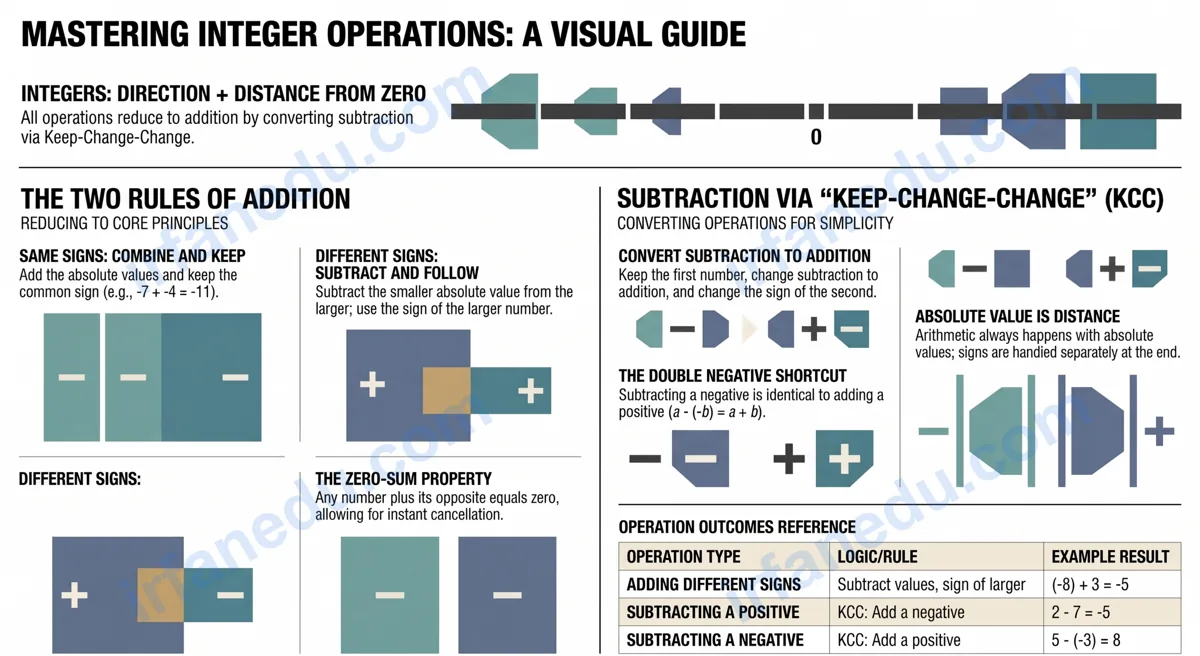
The rules for adding and subtracting integers are built on one idea: every integer is a direction and a distance on a number line. Once you see that, the rules stop being random and start being obvious. This guide gives you the rules, the reasoning, worked examples, and a free printable worksheet — everything in one place.
By the end of this page you will be able to:
- State and apply all four integer addition rules from memory 🧠
- Convert any subtraction problem into addition using Keep-Change-Change
- Spot and fix the three mistakes that cost students the most points
- Download and print a 12-problem worksheet with a full answer key
To add integers with the same sign, add the absolute values and keep that sign. To add integers with different signs, subtract the smaller absolute value from the larger and use the sign of the larger number. To subtract any integer, use Keep-Change-Change: keep the first number, change subtraction to addition, change the sign of the second number, then apply the addition rules above.
Get the full 12-problem printable worksheet with a separate answer key — ready to print and use right now.
- ➕ Same signs? Add absolute values, keep the sign.
- ➕➖ Different signs? Subtract absolute values, use the bigger number’s sign.
- ➖ Subtracting? Always convert with Keep-Change-Change first.
- ➖➖ Subtracting a negative = adding a positive (two negatives cancel).
- 🎯 Absolute value is just the distance from zero — always positive.
- 📏 Every rule makes sense visually on a number line.
What Are Integers, and Why Do Their Signs Matter? 🔍
An integer is any whole number — positive, negative, or zero. No fractions, no decimals. The set looks like this: { …, -3, -2, -1, 0, 1, 2, 3, … }.
The sign of an integer tells you its direction from zero on the number line. Positive integers sit to the right of zero; negative integers sit to the left. When you add or subtract integers, you are really combining directed movements along that line.
  Negative direction ◄────────────────────────────────► Positive direction

  ←  -6  -5  -4  -3  -2  -1   0  +1  +2  +3  +4  +5  +6  →
                               │
                             ZERO

  Moving LEFT  = adding a negative (or subtracting a positive)
  Moving RIGHT = adding a positive (or subtracting a negative)
This direction-and-distance model is the engine behind every rule on this page. Keep it in mind as you read.
5 Things Nobody Tells You About Integer Rules 🚀
Most worksheets hand you the rules without context. Here are the five insights that turn confusion into confidence.
-
The rules are really just two rules, not four.
Every integer operation reduces to one of two cases: same-direction (same sign) or opposite-direction (different sign). All four “rules” you see in textbooks are just those two cases applied to addition and subtraction separately. -
Subtraction doesn’t actually exist for integers.
That sounds wild, but it’s true. Mathematically, subtraction is defined as adding the opposite. The moment you apply Keep-Change-Change, subtraction vanishes and you only ever do addition. This is why mathematicians say “integers are closed under addition.” -
Absolute value is the only number that matters in the calculation.
The sign tells you direction; the absolute value tells you distance. The actual arithmetic — the adding or subtracting of numbers — always happens with absolute values. Signs are handled separately, at the end. -
Two negatives making a positive only applies to subtraction, not addition.
(-3) + (-5) = -8, not +8. The “two negatives make a positive” rule applies when you subtract a negative (i.e., a – (-b) = a + b). Students who mix these up lose easy marks every time. -
Zero is the most powerful integer in these problems.
Any number plus its opposite equals zero (e.g., 7 + (-7) = 0). This is called the additive inverse property, and it’s the fastest way to simplify multi-step problems. Spot zero-sum pairs first, cancel them, then handle what’s left.
Step-by-Step: The Complete Integer Rules 📐
There are exactly four cases to master. I’ll give you the rule, the logic, and an example for each.
Rule 1: Adding Integers with the Same Sign
Add the absolute values. Keep the common sign.
Both numbers move in the same direction, so the total distance from zero increases.
Formula: (+a) + (+b) = +(a + b) and (-a) + (-b) = -(a + b)
(-7) + (-4)
Both negative → add absolute values: 7 + 4 = 11 → keep negative sign → -11
(+5) + (+9)
Both positive → add: 5 + 9 = 14 → keep positive sign → +14
Rule 2: Adding Integers with Different Signs
Subtract the smaller absolute value from the larger. Use the sign of the integer with the larger absolute value.
The two numbers pull in opposite directions. The one with greater distance from zero “wins.”
Formula: (-a) + (+b) → if a > b: -(a - b); if b > a: +(b - a)
(-9) + 4
Absolute values: 9 and 4. Larger is 9 (negative). Subtract: 9 – 4 = 5. Sign follows the 9 → -5
(-3) + 10
Absolute values: 3 and 10. Larger is 10 (positive). Subtract: 10 – 3 = 7. Sign follows the 10 → +7
Rule 3: Subtracting Integers — Keep-Change-Change (KCC)
Keep the first integer. Change subtraction to addition. Change the sign of the second integer. Then apply Rule 1 or Rule 2.
This works because subtracting a number is identical to adding its opposite.
5 - (-3)
Keep 5 → Change (-) to (+) → Change (-3) to (+3) → 5 + 3 = 8
(-6) - 4
Keep (-6) → Change (-) to (+) → Change 4 to (-4) → (-6) + (-4) = -10 (Rule 1)
Rule 4: Subtracting a Negative Integer
a – (-b) = a + b. Two negatives (the subtraction sign and the negative sign) combine to make a positive.
This is just KCC applied to the specific case where the second integer is negative — but it’s worth memorizing as its own pattern because it appears constantly on tests.
12 - (-4) = 12 + 4 = 16
0 - (-11) = 0 + 11 = 11
Integer Rules at a Glance: Comparison Table 📊
Use this table as a quick reference. Each row shows the operation type, the rule to apply, and a fast example.
| Operation Type | Rule | Example | Result |
|---|---|---|---|
| ➕ Adding same signs (both +) | Add absolute values, keep + | (+6) + (+4) | +10 |
| ➕ Adding same signs (both −) | Add absolute values, keep − | (−6) + (−4) | −10 |
| ➕ Adding different signs | Subtract abs. values, sign of larger | (−8) + 3 | −5 |
| ➖ Subtracting a positive | KCC → becomes adding a negative | 2 − 7 | −5 |
| ➖ Subtracting a negative | KCC → becomes adding a positive | 5 − (−3) | +8 |
| ➖ Negative minus negative | KCC → add the opposite | (−4) − (−9) | +5 |
3 Fully Worked Examples (Step by Step) 🔬
Let’s go beyond single-operation problems and show how the rules chain together in realistic questions.
Worked Example 1: Multi-Step Addition
Solve: (-13) + (-7) + 5
Step 1: Group the two negatives first (same sign): (-13) + (-7) = -20
Step 2: Now add the result to +5 (different signs): |-20| = 20, |5| = 5. Larger absolute value is 20 (negative). 20 – 5 = 15. Sign is negative.
Answer: -15
Worked Example 2: Subtraction Converted to Addition
Solve: 20 – (-8) + (-12)
Step 1: Apply KCC to the subtraction: 20 – (-8) → 20 + 8 = 28
Step 2: Now: 28 + (-12). Different signs. 28 – 12 = 16. Larger is 28 (positive).
Answer: +16
Worked Example 3: Negative Minus Negative
Solve: (-25) – (-10) + (-5)
Step 1: KCC on the subtraction: (-25) – (-10) → (-25) + 10
Step 2: Different signs: |-25| = 25, |10| = 10. Larger is 25 (negative). 25 – 10 = 15. Result: -15
Step 3: (-15) + (-5). Same signs (both negative): 15 + 5 = 20. Keep negative.
Answer: -20
In my 15+ years of teaching math, the single biggest source of integer errors is students skipping Keep-Change-Change when they see a subtraction sign. They try to “just do it in their head” and apply the wrong rule. My advice: write KCC out every single time until it’s automatic. It takes 10 seconds and eliminates the most common mistake on integer tests. Speed comes after accuracy, not before it.
Common Mistakes — And How to Fix Them ⚠️
These three errors account for the majority of lost points on integer problems. Recognizing them is half the battle.
Thinking (-3) + (-5) = +8 because “two negatives make a positive.”
That rule applies to multiplication and division — and to subtracting a negative. It does NOT apply to adding two negatives. (-3) + (-5) = -8. Always.
Forgetting to change the sign of the second number in KCC.
Students often change the operation sign but leave the second number’s sign unchanged. In 5 – (-3), both the minus sign AND the negative sign on 3 must change. The result is 5 + 3 = 8, not 5 + (-3) = 2.
Using the sign of the first number instead of the larger absolute value.
In (-3) + 10, the answer is +7, not -7. The sign follows the number with the bigger absolute value (10), not the first number listed (-3). Order doesn’t determine the sign — magnitude does.
The “different signs” rule is secretly just the distance between two points on a number line.
When you add (-9) + 4, you are really asking: what is the net displacement if you walk 9 steps left, then 4 steps right? The answer is 5 steps left (-5). This is identical to finding the signed distance between the points 0 and -9 after a +4 shift.
Here’s the non-obvious payoff: this means you can always check your different-signs answer by plotting both integers on a number line and counting the gap between them. If your calculated answer doesn’t match the gap, you made an error. Most guides never mention this visual check — but in my experience, it catches mistakes faster than re-doing the algebra.
Bonus insight: The additive inverse property (a + (-a) = 0) is the fastest simplification tool in multi-term integer problems. Before calculating anything, scan the problem for pairs that sum to zero and cancel them. In (-13) + 7 + (-7) + 3, the +7 and -7 cancel immediately, leaving (-13) + 3 = -10. Students who spot zero-sum pairs finish these problems in half the time.
Practice Worksheet: 12 Integer Problems 📝
Work through these problems on paper. They follow the same methods from the worked examples above, ordered from easy to challenging. Use the answer key below to self-check.
Instructions: Solve each problem using the integer rules. Show your work where possible.
- (-4) + (-9) = ___
- 7 + (-3) = ___
- (-8) + 5 = ___
- (-6) – (-6) = ___
- 12 – (-4) = ___
- (-15) + 9 = ___
- (-7) – 3 = ___
- 0 – (-11) = ___
- (-13) + (-7) + 5 = ___
- 20 – (-8) + (-12) = ___
- (-25) – (-10) + (-5) = ___
- (-3)^2 + (-4) – 2 = ___
Show Answer Key
- (-4) + (-9) = -13
- 7 + (-3) = 4
- (-8) + 5 = -3
- (-6) – (-6) = 0
- 12 – (-4) = 16
- (-15) + 9 = -6
- (-7) – 3 = -10
- 0 – (-11) = 11
- (-13) + (-7) + 5 = -15
- 20 – (-8) + (-12) = 16
- (-25) – (-10) + (-5) = -20
- (-3)^2 + (-4) – 2 = 3 (note: (-3)^2 = 9; then 9 + (-4) – 2 = 9 – 4 – 2 = 3)
💡 How to use this worksheet: Print the page or download the PDF below. Cover the answer key, work each problem independently, then reveal answers to self-check. Repeat any problem you got wrong before moving on.
Download the printable version with a clean layout and a separate answer key section — perfect for classroom or home use.
Reveal-on-Click Practice Problems 🎯
Try each problem on your own first, then click to reveal the worked solution.
Problem A: What is (-18) + 6?
Different signs. Absolute values: 18 and 6. Larger is 18 (negative).
18 – 6 = 12. Sign follows the 18 (negative).
Answer: -12
Problem B: What is (-5) – (-14)?
Apply KCC: (-5) – (-14) → (-5) + 14
Different signs. |14| = 14, |-5| = 5. Larger is 14 (positive).
14 – 5 = 9. Sign is positive.
Answer: +9
Problem C: What is (-4) + (-11) + 8?
Step 1 — Group same signs: (-4) + (-11) = -15
Step 2 — Different signs: (-15) + 8. |15| = 15, |8| = 8. Larger is 15 (negative).
15 – 8 = 7. Sign is negative.
Answer: -7
Problem D: What is 3 – (-3) – 3?
Step 1 — KCC on first subtraction: 3 – (-3) → 3 + 3 = 6
Step 2 — Now: 6 – 3 = 3 (straightforward positive subtraction)
Answer: 3
Frequently Asked Questions ❓
What is the rule for adding two negative integers?
When you add two negative integers, add their absolute values and keep the negative sign. For example, (-5) + (-3) = -(5+3) = -8. Both numbers pull in the same direction on the number
Sources & References
Written and fact-checked by Dr Irfan Mansuri. External links open in a new tab and are provided for further reading and verification.