
Honors Geometry: The Complete Guide (Beginner to Advanced)
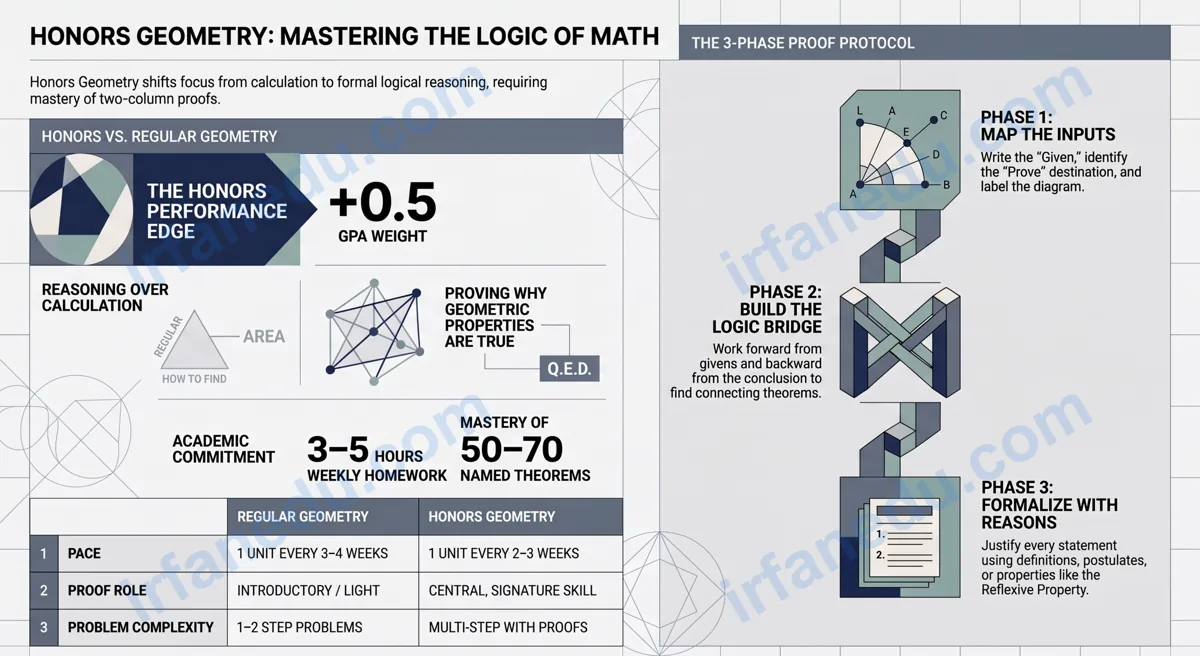
Honors geometry is an accelerated high school math course that covers congruence, similarity, circles, coordinate geometry, and 3D solids alongside formal two-column proofs and transformations. It moves faster and demands more abstract reasoning than regular geometry, preparing students for honors algebra 2, pre-calculus, and standardized tests.
Whether you are a student deciding whether to enroll, a parent trying to understand what your child is getting into, or a current honors geometry student who needs a clearer map of the course, this guide serves both levels. Each section opens with the beginner-friendly version of the idea, then layers in the advanced detail. You do not need to read linearly — jump to what you need.
Honors geometry is an accelerated high school math course that covers all standard geometry topics — congruence, similarity, circles, coordinate geometry, and 3D solids — plus formal two-column proofs, transformations, and deeper problem-solving than a regular geometry class. Most students take it in 9th or 10th grade as part of an honors or advanced math track.
⚡ TL;DR – Quick Summary
- Honors geometry covers the same topics as regular geometry but adds formal proofs and greater depth.
- The biggest jump from regular geometry is the proof requirement — logic, not just calculation.
- Core units: points/lines/angles, triangles, similarity, circles, coordinate geometry, transformations, 3D solids.
- Two-column proofs are the signature skill; mastering them early makes every later unit easier.
- Consistent daily review (20-30 min) beats marathon cramming for geometry retention.
- Taking honors geometry strengthens your math track for SAT, ACT, and college admissions.
| Fact | Detail |
|---|---|
| Typical grade level | 9th or 10th grade (sometimes 8th on accelerated track) |
| Prerequisite | Algebra 1 (honors preferred) |
| Follows this course | Honors Algebra 2 or Pre-Calculus |
| Signature skill | Two-column and paragraph proofs |
| Standardized test relevance | SAT Math, ACT Math, AP Calculus AB/BC (coordinate geometry) |
| Average weekly homework | 3-5 hours (varies by school) |
| GPA weight | Typically +0.5 quality points (weighted GPA) |
What Is Honors Geometry?
Honors geometry is the accelerated version of high school geometry. It covers the same foundational concepts as a standard geometry course — shapes, angles, area, volume — but it goes deeper into each topic, moves faster through the material, and adds formal mathematical proof as a core skill.
At the beginner level, geometry is about recognizing and measuring shapes. At the honors level, it is about proving why those shapes behave the way they do. That shift from calculation to logical argument is the defining feature of the course.
The course sits inside the standard US high school math sequence: Algebra 1 → Geometry → Algebra 2. The honors version of that sequence is: Honors Algebra 1 → Honors Geometry → Honors Algebra 2 → Pre-Calculus → AP Calculus or AP Statistics. Taking honors geometry keeps that advanced track open.
Honors vs. Regular Geometry: What Actually Changes?
The difference between honors and regular geometry is not just speed — it is the type of thinking required. Regular geometry builds geometric intuition; honors geometry demands geometric reasoning.
| Dimension | Regular Geometry | Honors Geometry |
|---|---|---|
| Pace | 1 unit every 3-4 weeks | 1 unit every 2-3 weeks |
| Proofs | Introduced lightly; mostly fill-in | Central skill; write from scratch |
| Problem complexity | Single-step or two-step | Multi-step, often requiring proof first |
| Algebra integration | Basic substitution | Systems of equations, quadratics in geometry context |
| Transformations | Identify and describe | Compose, prove properties, use in coordinate plane |
| Trigonometry | Basic SOH-CAH-TOA | SOH-CAH-TOA + inverse trig + law of sines/cosines (some schools) |
| Homework volume | Low-medium | Medium-high |
| GPA weight | Standard (4.0 scale) | Weighted (+0.5 quality points, typically) |
In my experience teaching both levels, the students who struggle in honors geometry are not the ones who find shapes hard — they are the ones who expect geometry to be like algebra, where you follow a formula and get an answer. Honors geometry rewards students who can argue, not just calculate. If your student enjoys puzzles, debates, or “why” questions, they will likely thrive here. If they prefer clear procedures with predictable answers, they need to build that tolerance for ambiguity before the proof units hit.
What Topics Are Covered in Honors Geometry?
Honors geometry covers eight major units. Below, each topic is labeled with its depth level so both beginners and advanced students know what to expect.
1. Foundations: Points, Lines, Planes, and Angle Relationships Beginner
This unit defines the basic objects of geometry and introduces the vocabulary you use for the rest of the course. You learn about collinear points, coplanar lines, segment bisectors, and angle bisectors. At the honors level, you also prove basic angle relationships (vertical angles, linear pairs) from postulates rather than just stating them.
2. Triangle Congruence Beginner Advanced
Two triangles are congruent if all their corresponding sides and angles are equal. The key skill is identifying which congruence shortcut applies: SSS, SAS, ASA, AAS, or HL (for right triangles). At the honors level, you write full two-column proofs using these shortcuts, not just identify them.
3. Triangle Similarity Beginner Advanced
Similar triangles have the same shape but different sizes. The similarity shortcuts are AA, SAS~, and SSS~. Honors students use similarity to set up proportions, prove theorems about parallel lines cutting transversals, and solve indirect measurement problems.
4. Quadrilaterals and Polygons Beginner
This unit covers parallelograms, rectangles, rhombuses, squares, trapezoids, and kites. You learn their properties and, in honors, prove those properties using triangle congruence. A classic honors task: prove that the diagonals of a rectangle are congruent.
5. Circles Advanced
Circles introduce arc measure, chord relationships, inscribed angles, tangent lines, and the power of a point. The inscribed angle theorem — an inscribed angle equals half the intercepted arc — is one of the most tested theorems in honors geometry. At the advanced level, you prove it and apply it to multi-step problems.
6. Coordinate Geometry Beginner Advanced
Coordinate geometry connects algebra and geometry on the coordinate plane. You use the distance formula, midpoint formula, and slope to prove geometric properties. A typical honors problem: prove that a quadrilateral with given vertices is a parallelogram using slopes and distances.
7. Transformations Advanced
Transformations include reflections, rotations, translations, and dilations. At the honors level, you compose transformations (apply two in sequence), prove that rigid motions preserve congruence, and use dilations to prove similarity.
8. Surface Area, Volume, and 3D Solids Beginner
This unit covers prisms, cylinders, pyramids, cones, and spheres. The formulas are testable on the SAT and ACT. Honors students also apply these formulas in multi-step problems involving similar solids and scale factors.
How Do You Write a Two-Column Proof in Geometry?
A two-column proof is a formal argument organized into two columns: Statements on the left, Reasons on the right. Every statement must be justified by a definition, postulate, property, or previously proven theorem.
This is the skill that separates honors geometry from every other math course students have taken. Here is the exact process I teach:
- Read the Given and the Prove. Write the Given information as your first statement(s). The Prove is your destination — keep it visible at the top.
- Draw and label a diagram. Mark all given information on the diagram. Visual cues reveal which theorems apply.
- Work forward from the Given and backward from the Prove. Ask: “What do I know?” and “What do I need one step before the conclusion?”
- Fill in the middle. Connect the two ends using definitions, postulates, and properties. Each step must follow logically from the previous one.
- Write the Reason for every Statement. Never leave a reason blank. “Given,” “Definition of midpoint,” “SAS Postulate,” and “CPCTC” are common reasons.
- Check that your final Statement matches the Prove exactly. Word-for-word match is required.
GIVEN:  AB bisects angle CAD; angle CAB = angle DAB
PROVE:  triangle CAB ≅ triangle DAB

┌──────────────────────────────────┬──────────────────────────────────┐
│ STATEMENTS                       │ REASONS                          │
├──────────────────────────────────┼──────────────────────────────────┤
│ 1. AB bisects angle CAD          │ 1. Given                         │
│ 2. angle CAB = angle DAB         │ 2. Definition of angle bisector  │
│ 3. AB = AB                       │ 3. Reflexive Property            │
│ 4. AC = AD                       │ 4. Given                         │
│ 5. triangle CAB ≅ triangle DAB   │ 5. SAS Postulate                 │
└──────────────────────────────────┴──────────────────────────────────┘
Worked Examples: One Beginner, One Advanced
Beginner Example: Finding a Missing Angle Using Triangle Congruence
Step 1: Find angle R in triangle PQR.
Angles in a triangle sum to 180°: angle R = 180 – 47 – 63 = 70°
Step 2: Use the congruence correspondence.
PQR ≅ STU means P↔S, Q↔T, R↔U.
So angle U = angle R = 70°
Answer: Angle U = 70°
Advanced Example: Coordinate Geometry Proof
Strategy: A quadrilateral is a parallelogram if both pairs of opposite sides are parallel (equal slopes).
Slope of AB: (0-0)/(4-0) = 0/4 = 0
Slope of DC: (3-3)/(5-1) = 0/4 = 0
AB ∥ DC (equal slopes).
Slope of BC: (3-0)/(5-4) = 3/1 = 3
Slope of AD: (3-0)/(1-0) = 3/1 = 3
BC ∥ AD (equal slopes).
Since both pairs of opposite sides are parallel, ABCD is a parallelogram by definition. ∎
Honors-level extension: Also verify using the distance formula that AB = DC and BC = AD to confirm via the “both pairs of opposite sides congruent” theorem.
[IMAGE: Coordinate plane showing quadrilateral ABCD with vertices labeled at A(0,0), B(4,0), C(5,3), D(1,3), with slope annotations | ALT: coordinate geometry proof of parallelogram ABCD honors geometry example]
What Are the Most Common Honors Geometry Mistakes?
These are the errors I see most often in student work — and the fixes that actually stick.
| Wrong | Right |
|---|---|
| Using CPCTC before proving triangles congruent | Establish congruence first (SSS, SAS, ASA, AAS, HL), then use CPCTC |
| Assuming angles are equal because they “look equal” in a diagram | Only use what is explicitly given or proven; diagrams are not drawn to scale |
| Confusing congruence (≅) with equality (=) for segments vs. lengths | Segments are congruent (AB ≅ CD); their lengths are equal (AB = CD) |
| Skipping the Reflexive Property in proofs | Always state “AB = AB” (Reflexive Property) when a shared side is used |
| Mixing up arc measure and arc length in circle problems | Arc measure is in degrees; arc length is in units and requires the radius |
| Forgetting to check all conditions for a special quadrilateral | A rectangle needs four right angles AND both pairs of opposite sides parallel |
Most honors geometry guides treat proofs as a separate “proof unit” — something you learn once and move on from. That framing is exactly why students hit a wall in later units.
In my experience, the students who master honors geometry fastest are the ones who treat every problem — even a simple angle calculation — as a mini-proof. They ask: “What is my justification for this step?” before writing anything down. This habit means that when formal two-column proofs arrive, the logic is already automatic.
The other insight most guides miss: the Reflexive Property is the most underrated tool in the course. In roughly 60% of triangle congruence proofs, the key step is recognizing that a shared side or angle equals itself. Students who internalize “look for the shared element” solve proof problems far faster than those who try to memorize proof templates.
Study Strategies That Actually Work for Honors Geometry
Geometry is a visual and logical subject. The study strategies that work for algebra (practice problems, formula memorization) only partially transfer. Here is what actually moves the needle.
For Beginners: Build the Vocabulary First
Geometry has more defined vocabulary than any other high school math course. Before you can solve problems, you need to know what “bisect,” “perpendicular,” “inscribed,” and “supplementary” mean instantly. Make a running glossary from day one — one term per index card, with a diagram on the back.
For Advanced Students: Proof Fluency Over Proof Memorization
Do not memorize proof templates. Instead, practice identifying the structure of a proof: what type of conclusion is needed (congruence? parallelism? equality?), which theorem family applies, and where the Reflexive or Transitive Property connects the chain. Fluency comes from writing 3-4 proofs per week, not from re-reading solutions.
The single best study habit I have seen in honors geometry students is what I call the “explain it back” method: after each class, the student spends 10 minutes writing a plain-English explanation of the day’s theorem as if teaching it to a younger sibling. This forces active recall, exposes gaps in understanding, and builds the verbal reasoning that proof-writing demands. Students who do this consistently outperform students who spend the same time doing extra practice problems — because they understand the why, not just the how.
Spaced Repetition for Theorems
There are roughly 50-70 named theorems in a full honors geometry course. You cannot memorize them all in a cram session. Use a spaced repetition app (Anki works well) or a physical flashcard deck reviewed in 3-day cycles. Focus on the theorem statement, its converse (if it has one), and one example of each.
Use Coordinate Geometry as a Proof Backup
When you are stuck on a synthetic proof (using only geometric reasoning), try the coordinate geometry approach: assign coordinates to the vertices, calculate slopes and distances, and verify the property algebraically. This does not always match what the question asks for, but it confirms your answer and often reveals the logical path for the synthetic proof.
Quick Quiz: Test Your Honors Geometry Knowledge
1. Two triangles have two pairs of equal angles. Which similarity shortcut applies?
2. An inscribed angle intercepts an arc of 80°. What is the measure of the inscribed angle?
3. In a two-column proof, you have proven triangles ABC and DEF congruent. You now want to state that angle A = angle D. What reason do you use?
Practice Problems: Reveal-on-Click Solutions
Problem 1 (Beginner): The angles of a triangle are in the ratio 2:3:7. Find each angle.
Let the angles be 2x, 3x, and 7x.
Sum of angles = 180°: 2x + 3x + 7x = 180 → 12x = 180 → x = 15
Angles: 2(15) = 30°, 3(15) = 45°, 7(15) = 105°
Check: 30 + 45 + 105 = 180 ✓
Problem 2 (Intermediate): Prove that the diagonals of a parallelogram bisect each other.
Given: ABCD is a parallelogram with diagonals AC and BD intersecting at E.
Prove: AE = CE and BE = DE.
1. AB ∥ DC (Given — opposite sides of parallelogram)
2. Angle ABE = angle CDE (Alternate Interior Angles, AB ∥ DC)
3. Angle BAE = angle DCE (Alternate Interior Angles, AB ∥ DC)
4. AB = DC (Opposite sides of a parallelogram are congruent)
5. Triangle ABE ≅ Triangle CDE (ASA)
6. AE = CE and BE = DE (CPCTC) ∎
Problem 3 (Advanced): Circle O has center (3, 2). Point P(7, 5) is on the circle. Find the equation of the tangent line at P.
Step 1: Find the
Sources & References
Written and fact-checked by Dr Irfan Mansuri. External links open in a new tab and are provided for further reading and verification.