
Cement Block Calculator: Blocks, Mortar & Fill Estimator
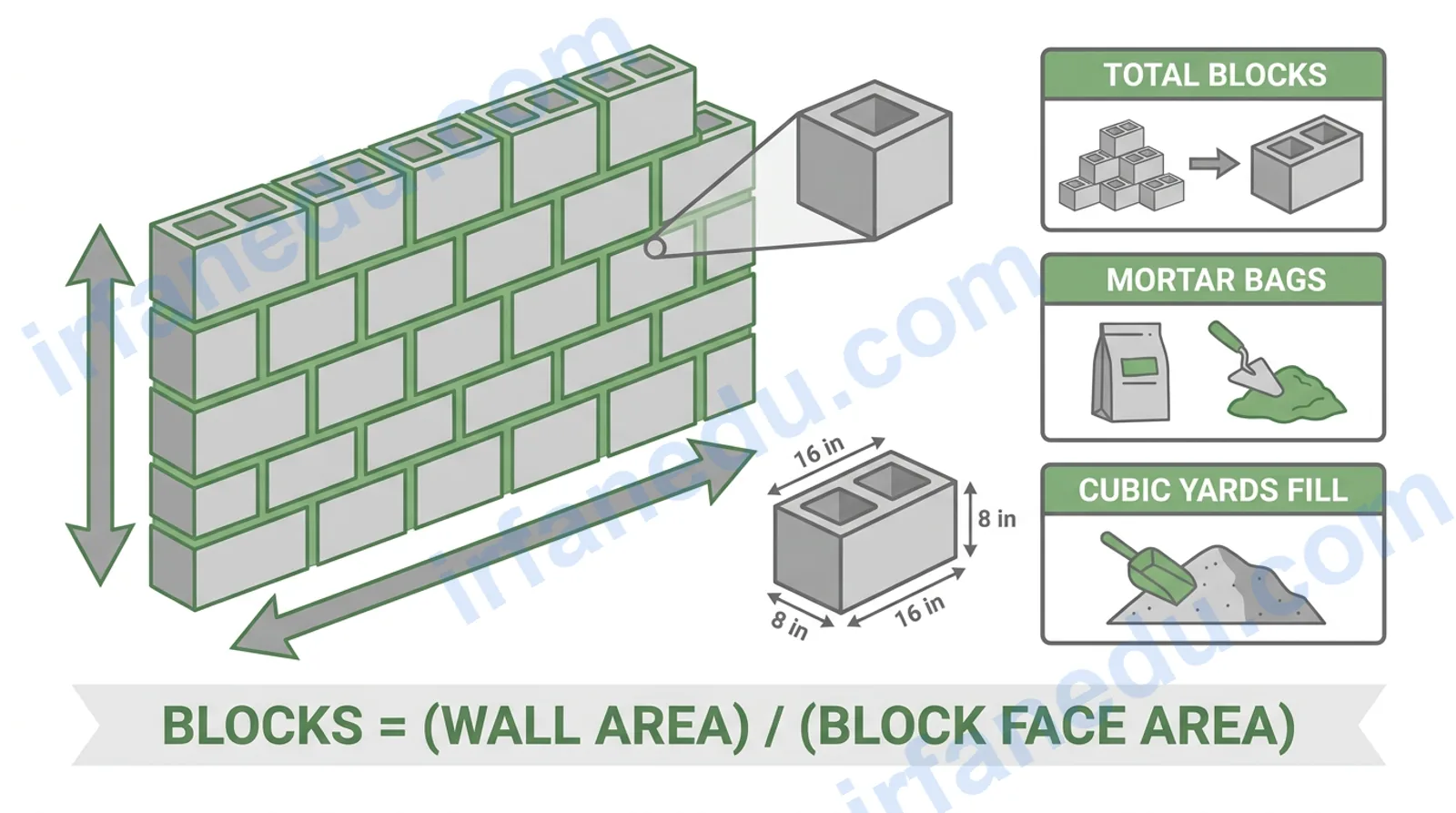
Planning a block wall and not sure how many bags to order? You’re in the right place. This guide walks you through everything — from the exact formula to a fully working calculator — so you can order the right amount of cement blocks, mortar, and fill without a single wasted trip to the hardware store.
A cement block calculator estimates the number of standard CMU (concrete masonry unit) blocks needed for a wall by dividing the total wall face area by the face area of one block, then adding a waste allowance. It also calculates mortar bags and optional grout fill volume, giving you a complete materials list before you buy.
- 🧱 Understand the correct CMU block formula and units
- 🔢 Use the interactive calculator for instant results
- 📐 See 2 fully worked examples with step-by-step solutions
- 🚫 Learn the three most common ordering mistakes
A cement block calculator divides your wall’s total face area (length × height) by the face area of one CMU block (typically 0.889 sq ft for a standard 16×8-inch block), then adds 5–10% for waste. For a 10 ft × 10 ft wall, you need roughly 126 blocks, about 5 bags of mortar, and 0.14 cu yd of grout fill if all cores are filled.
🎯 The Short Version
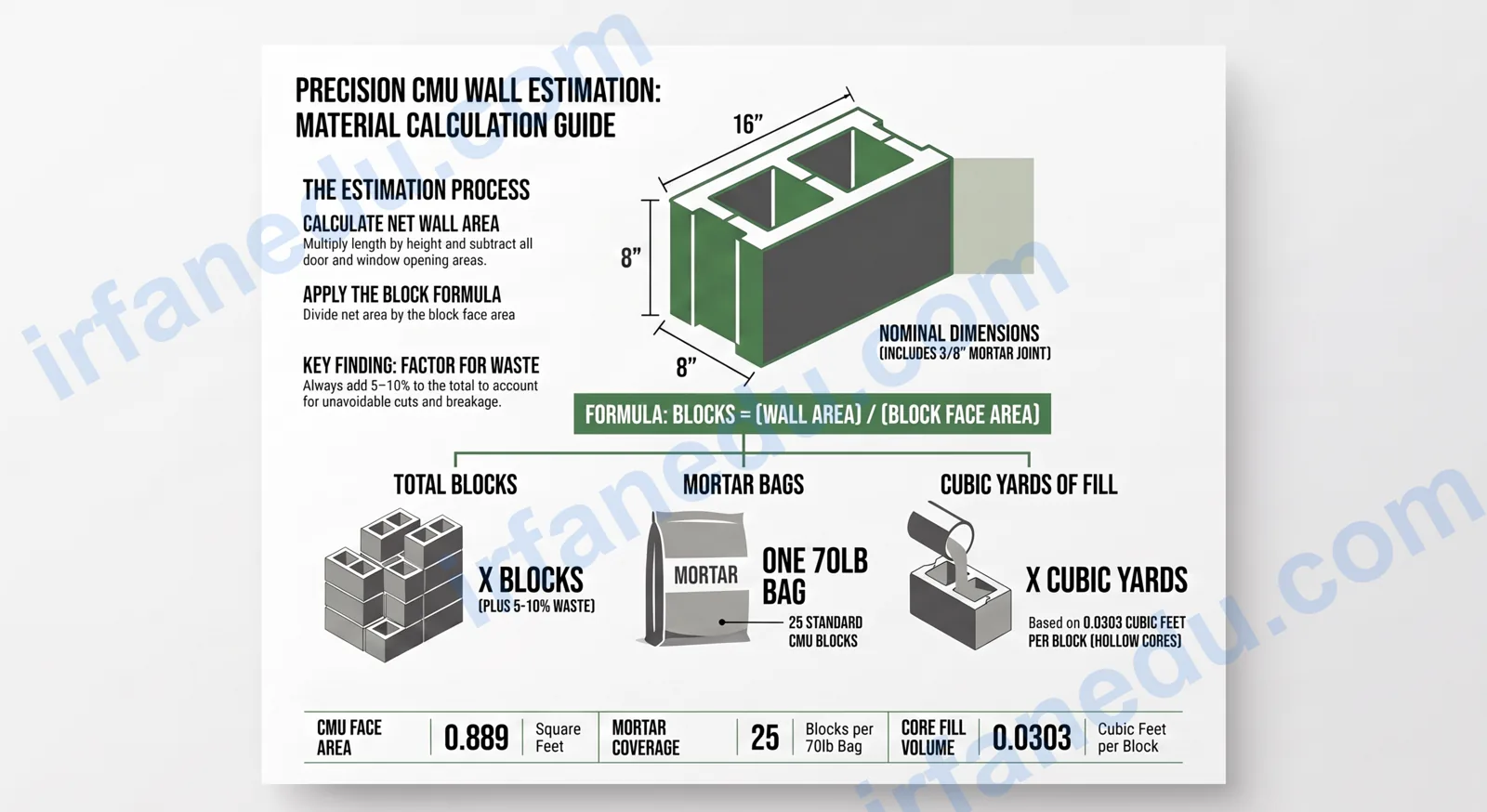
- 🧱 Standard CMU = 16 × 8 in face; covers 0.889 sq ft per block
- 📐 Formula: Blocks = (Wall Area ÷ Block Face Area) × (1 + Waste%)
- 🪣 Mortar: budget 1 bag (70 lb) per 25 blocks
- 💧 Fill: each standard block has ~0.0303 cu ft of core volume (2 cores)
- ✅ Always add at least 5% waste — cuts and breakage are unavoidable
- 🏗️ Check local code before deciding whether to grout cores
Cement Block Calculator
Blocks · Mortar bags · Grout fill volume
📋 Step-by-step solution
How to use this cement block calculator
You can get your full materials list in under 30 seconds. Here’s how:
- Choose your mode. Pick “Wall dimensions” if you know length and height, or “Known area” if you already have the square footage.
- Enter wall length and height in feet. For a wall with doors or windows, enter the total opening area in the openings field — the calculator subtracts it automatically.
- Check block dimensions. The default is 16 × 8 inches (standard US CMU). Change these if you’re using a different block size.
- Set your waste %. Use 5% for a simple straight wall, 10% for walls with cuts, and up to 15% for complex shapes.
- Click Calculate. You’ll see total blocks, mortar bags, and fill volume with a numbered step-by-step solution.
What is a cement block (CMU)?
A cement block — correctly called a concrete masonry unit (CMU) — is a precast rectangular block made from Portland cement, aggregate, and water, used to build walls, foundations, and retaining structures. The standard US nominal size is 16 inches long × 8 inches tall × 8 inches deep, with two hollow cores running through the depth.
The term “cinder block” is still widely used, but it’s technically outdated. True cinder blocks used coal cinder as aggregate and are rarely manufactured today. Modern CMU blocks are stronger and more consistent.
The formula explained
The core formula for a cement block calculator is straightforward: divide the net wall area by the face area of one block, then scale up for waste.
Blocks = ⌈ (Wall Area − Openings Area) / Block Face Area × (1 + Waste%) ⌉

Block Face Area = (Block Length ÷ 12) × (Block Height ÷ 12)   [in sq ft]

Mortar Bags = ⌈ Total Blocks ÷ 25 ⌉

Fill Volume (cu ft) = Total Blocks × Core Volume per Block
Fill Volume (cu yd) = Fill Volume (cu ft) ÷ 27
The ⌈ ⌉ symbol means “ceiling” — always round up, because you can’t buy a fraction of a block.
Variables and symbols table
| Symbol | Meaning | Unit |
|---|---|---|
| Awall | Total wall face area | sq ft |
| Aopen | Total area of openings (doors/windows) | sq ft |
| Anet | Net wall area = Awall − Aopen | sq ft |
| Ablk | Block face area (nominal L × H) | sq ft |
| W | Waste allowance percentage | % |
| N | Total blocks needed (rounded up) | blocks |
| M | Mortar bags needed (70 lb bag, ~25 blocks/bag) | bags |
| Vfill | Grout fill volume if all cores are filled | cu yd |
SI units note: In metric countries, substitute meters for feet. Block face area in m², wall area in m². The formula structure is identical; only the units change.
Worked examples
📌 Example 1 — Simple garden wall (10 ft × 4 ft, no openings)
- Wall area = 10 ft × 4 ft = 40 sq ft
- Block face area = (16 ÷ 12) × (8 ÷ 12) = 1.333 × 0.667 = 0.889 sq ft
- Base blocks = 40 ÷ 0.889 = 44.99 ≈ 45 blocks
- Add 10% waste: 45 × 1.10 = 49.5 → 50 blocks
- Mortar bags = ⌈50 ÷ 25⌉ = 2 bags
- Fill volume = 50 × 0.0303 cu ft = 1.515 cu ft = 0.056 cu yd (if all cores grouted)
📌 Example 2 — Garage wall (20 ft × 8 ft) with one window (3 ft × 4 ft = 12 sq ft)
- Wall area = 20 × 8 = 160 sq ft
- Subtract window: 160 − 12 = 148 sq ft net
- Block face area = 0.889 sq ft (standard 16 × 8 CMU)
- Base blocks = 148 ÷ 0.889 = 166.5 blocks
- Add 10% waste: 166.5 × 1.10 = 183.1 → 184 blocks
- Mortar bags = ⌈184 ÷ 25⌉ = 8 bags
- Fill volume = 184 × 0.0303 = 5.57 cu ft = 0.21 cu yd
  ┌─────────────────────────────────────────┐
  │  CMU WALL — FACE VIEW (Example 2)       │
  │                                         │
  │  ←────────── 20 ft ──────────→          │
  │  ┌──┬──┬──┬──┬──┬──┬──┬──┬──┬──┐  ↑   │
  │  │  │  │  │  │  │  │  │  │  │  │  │   │
  │  ├──┼──┼──┼──┼──┼──┼──┼──┼──┼──┤  8   │
  │  │  │  │  │  │  │  │  │  │  │  │  ft  │
  │  ├──┼──┼──┼──┼──┼──┼──┼──┼──┼──┤  │   │
  │  │  │  │░░░░░░░░│  │  │  │  │  │  │   │
  │  ├──┼──┼──┼──┼──┼──┼──┼──┼──┼──┤  │   │
  │  │  │  │░ WIN ░│  │  │  │  │  │  ↓   │
  │  └──┴──┴──┴──┴──┴──┴──┴──┴──┴──┘      │
  │                                         │
  │  ░ = Window opening (3 ft × 4 ft)       │
  │  Each block = 16 in × 8 in (nominal)    │
  │  Net area = 160 − 12 = 148 sq ft        │
  │  Blocks needed = 184 (incl. 10% waste)  │
  └─────────────────────────────────────────┘
Common mistakes when ordering CMU blocks
| ❌ Wrong approach | ✅ Correct approach |
|---|---|
| Using actual block size (15⅝ × 7⅝ in) in the formula | Use nominal size (16 × 8 in) — it already includes the mortar joint |
| Forgetting to subtract door and window openings | Subtract all opening areas from total wall area before dividing |
| Ordering exactly the calculated number (no waste) | Always add 5–10% waste; cuts and breakage are unavoidable on any real job |