
Julius Caesar Summary Shakespeare: The Complete Guide for Every Level
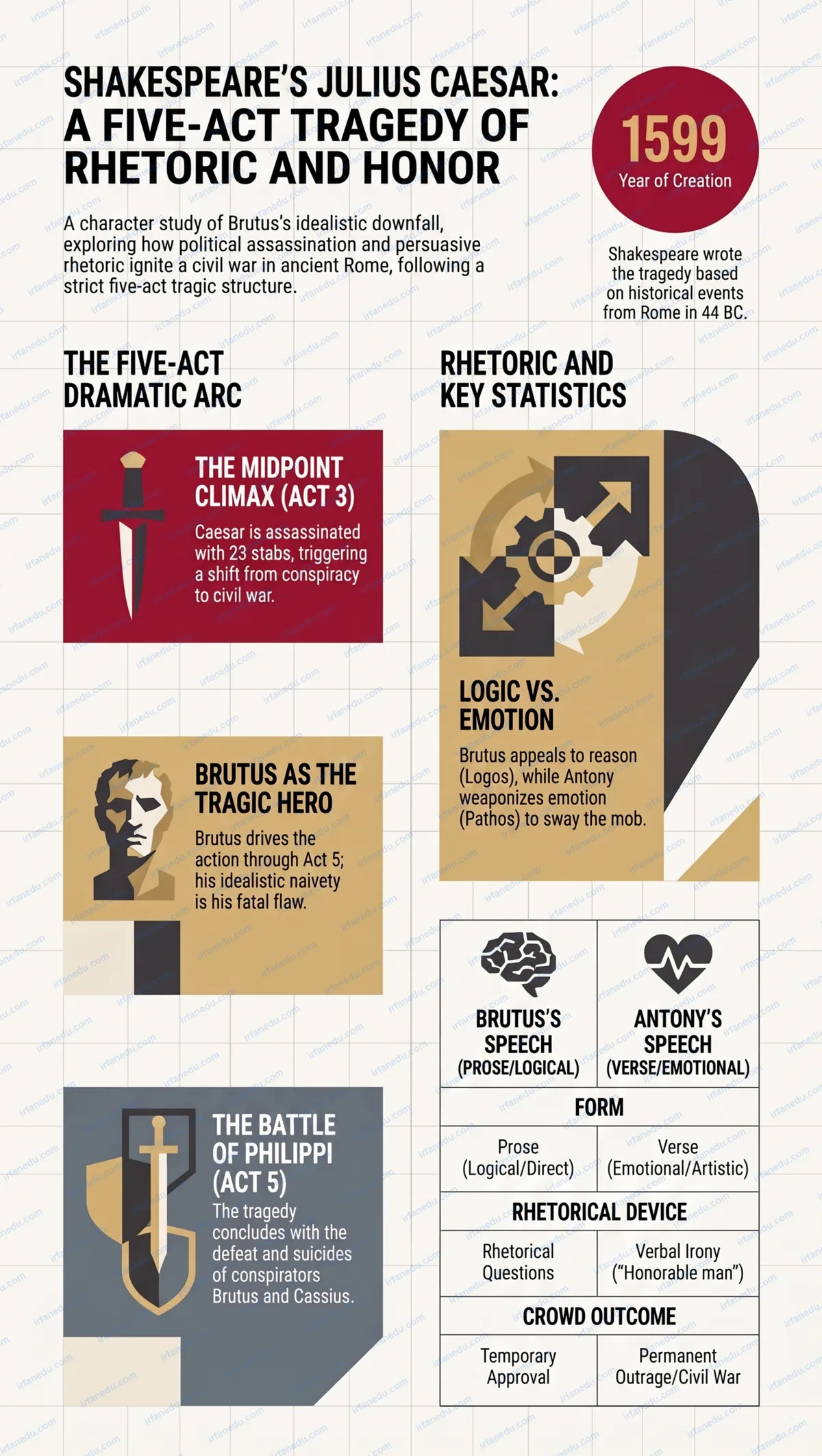
Whether you just need to know what happens in Shakespeare’s Julius Caesar before tomorrow’s class, or you want to write a top-grade essay on its rhetoric and tragic structure — this guide serves both goals at once. I’ve designed every section with a beginner layer (the plain-English version) and an advanced layer (the analytical depth), so you can read at the level you need right now and come back for more later.
Shakespeare wrote Julius Caesar around 1599, and it remains one of the most studied plays in the world. It is a story about a political assassination — but more importantly, it is a story about the people who carry it out and what it costs them.
By the end of this guide, you will be able to:
- Summarize every act of the play clearly and accurately
- Identify the major characters and their roles
- Explain the key themes with textual evidence
- Analyze the two funeral speeches for rhetorical technique
- Avoid the most common exam mistakes students make about this play
TL;DR – Quick Summary
- Cassius manipulates Brutus into joining a plot to kill Caesar (Acts 1-2)
- Caesar is stabbed 23 times at the Senate on the Ides of March (Act 3)
- Antony’s funeral speech turns Rome against the conspirators (Act 3)
- Civil war breaks out; Cassius and Brutus flee Rome (Act 4)
- Both Cassius and Brutus die at the Battle of Philippi (Act 5)
- Brutus is the tragic hero; his idealism is his fatal flaw
Quick Facts at a Glance
| Detail | Information |
|---|---|
| Author | William Shakespeare |
| Written | Approx. 1599 |
| Genre | Tragedy (classified in the First Folio) |
| Setting | Rome and the plains of Philippi, 44-42 BC |
| Number of Acts | 5 |
| Source Material | Plutarch’s Lives of the Noble Greeks and Romans |
| Tragic Hero | Brutus |
| Most Famous Line | “Et tu, Brute?” (Act 3, Scene 1) |
| Second Most Famous Line | “Friends, Romans, countrymen, lend me your ears” (Act 3, Scene 2) |
| Key Themes | Power, betrayal, rhetoric, fate, honor |
What Is Julius Caesar? (Beginner + Advanced)
Beginner version: Julius Caesar is a play about a group of Roman politicians who believe their leader, Julius Caesar, is becoming too powerful. They kill him to protect the republic. But the plan backfires. Caesar’s friend Mark Antony gives a speech that turns everyone against them, and a war begins that destroys the conspirators.
Advanced version: Shakespeare uses the historical assassination of Caesar (44 BC) as a vehicle to explore the moral complexity of political violence. The play asks: can murder ever be justified for the greater good? Brutus believes it can — and that belief destroys him. Shakespeare draws heavily from Plutarch’s Lives but compresses and reshapes events to create a tight five-act tragic structure centered on Brutus’s internal conflict between private loyalty and public duty.
The play is also a masterclass in rhetoric. The two funeral speeches in Act 3 are among the finest examples of persuasive technique in all of English literature, and understanding how they work is essential for any advanced analysis.
Key Characters: Who’s Who
Here is a clear breakdown of every major character. Beginners: focus on the one-line role. Advanced students: read the analytical note too.
| Character | Role (Beginner) | Analytical Note (Advanced) |
|---|---|---|
| Julius Caesar | The man who is killed; the most powerful person in Rome | More symbol than character. His pride (refusing to heed warnings) mirrors Brutus’s idealism as a parallel fatal flaw. |
| Brutus | Caesar’s friend who joins the conspiracy out of duty to Rome | The tragic hero. His hamartia is idealistic naivety — he projects his own honor onto others, making fatal misjudgments. |
| Cassius | The man who convinces Brutus to join the plot | A skilled manipulator who uses envy and flattery. His “lean and hungry look” signals danger from the start (Act 1, Sc. 2). |
| Mark Antony | Caesar’s loyal friend who turns Rome against the conspirators | The master rhetorician. His funeral speech is a textbook example of irony, pathos, and crowd psychology. |
| Casca | The first conspirator to stab Caesar | His cynical, plain-spoken commentary provides dramatic irony throughout Acts 1-2. |
| Portia | Brutus’s wife; she senses something is wrong | Represents the private, domestic world that Brutus sacrifices for public duty. Her death in Act 4 signals his complete isolation. |
| Calpurnia | Caesar’s wife; she warns him not to go to the Senate | Her prophetic dreams represent the theme of fate. Caesar’s dismissal of her warning is his fatal error. |
| Octavius Caesar | Caesar’s heir; arrives after the assassination | His calm authority at the end foreshadows his future as Rome’s first emperor, suggesting the cycle of power continues. |
In my experience teaching this play, students almost always focus on Caesar and miss the point. Once I explain that Brutus is the real protagonist — that the play is about his moral journey, not Caesar’s death — everything clicks. The title is deliberately misleading, and that misdirection is part of Shakespeare’s genius.
Act-by-Act Plot Summary
Each act summary below gives you the plain-English plot first, followed by the key analytical point for advanced study.
Act 1: The Conspiracy Begins
What happens: Rome is celebrating Caesar’s military victories. A soothsayer warns Caesar to “beware the Ides of March” — he ignores it. Cassius begins working on Brutus, planting seeds of doubt about Caesar’s ambition. He forges letters from Roman citizens praising Brutus and urging him to act. By the end of Act 1, Cassius has assembled a group of conspirators.
Advanced note: Act 1 establishes the central tension between public perception and private reality. Caesar appears powerful in public but is physically frail (he is deaf in one ear, had a fever in Spain). Shakespeare uses this gap between image and reality to question the nature of political power from the very first scene.
Act 2: Brutus Makes His Decision
What happens: Brutus wrestles with the decision to join the conspiracy. He convinces himself that killing Caesar is necessary for Rome’s future, not personal gain. The conspirators meet at his house and finalize the plan. Portia notices Brutus is troubled and begs him to confide in her. Calpurnia has nightmares about Caesar’s death and pleads with him to stay home. Decius (a conspirator) reinterprets the dream favorably and flatters Caesar into going to the Senate anyway.
Advanced note: Act 2 is the moral heart of the play. Brutus’s soliloquy (“It must be by his death”) is crucial: he admits Caesar has not yet done anything wrong, but argues he might in the future. This “preventive murder” logic is the foundation of his tragic error — he acts on speculation, not evidence.
Act 3: The Assassination and Its Aftermath
What happens: Caesar arrives at the Senate on March 15 (the Ides of March). The conspirators stab him 23 times. Caesar’s last words — “Et tu, Brute?” — are directed at Brutus. Brutus allows Mark Antony to speak at Caesar’s funeral, against Cassius’s advice. Brutus speaks first and wins the crowd with a logical, unemotional argument. Then Antony speaks — and everything changes.
Advanced note: Act 3 is the structural and dramatic climax. The assassination happens at the midpoint of the play, which is unusual — most tragedies build to the death at the end. Shakespeare does this deliberately: the real tragedy is not Caesar’s death but what follows it. Brutus’s decision to let Antony speak is his most catastrophic mistake, born directly from his idealism.
Act 4: Conflict and Deterioration
What happens: Antony, Octavius, and Lepidus form a triumvirate and begin eliminating their enemies. Brutus and Cassius argue bitterly in camp — their alliance is fracturing. Brutus reveals that Portia has died. Caesar’s ghost appears to Brutus, warning him they will meet again at Philippi. Brutus overrules Cassius’s military strategy and insists on marching to Philippi.
Advanced note: Act 4 shows the consequences of the assassination rippling outward. Brutus’s overruling of Cassius at Philippi is his second major military mistake (the first was allowing Antony to speak). Both stem from the same flaw: he trusts his own judgment absolutely, even when wiser counsel is available.
Act 5: The Battle of Philippi and the Tragic End
What happens: The two armies meet at Philippi. Cassius, believing the battle is lost due to a misread signal, asks his servant Pindarus to kill him. Brutus discovers Cassius is dead. Brutus’s forces are defeated. Rather than be captured and paraded through Rome, Brutus falls on his own sword. Antony delivers the final eulogy, calling Brutus “the noblest Roman of them all.”
Advanced note: Antony’s final tribute to Brutus is deeply ironic. It validates Brutus’s honor — but that same honor caused the tragedy. Shakespeare’s ending is deliberately ambiguous: was Brutus right to act? Was Caesar truly a threat? The play refuses to answer, leaving the audience to judge.
The ending of Julius Caesar is one of Shakespeare’s most underrated achievements. Antony’s eulogy for Brutus — “This was the noblest Roman of them all” — is not simple praise. It is a tragic acknowledgment that good intentions, without wisdom, can destroy everything. I always ask my students: do you agree that Brutus was noble? Their answers reveal exactly how well they understand the play.
The Two Funeral Speeches: Rhetoric Unpacked
The two speeches in Act 3, Scene 2 are the most analytically rich passages in the play. Understanding them is essential for any essay or exam question on rhetoric, persuasion, or character.
Brutus’s Speech: Logic Without Emotion
Brutus speaks in prose (not verse), which signals directness and sincerity. He appeals to the crowd’s reason: Caesar was ambitious, so he had to die for Rome’s freedom. The crowd is convinced — briefly. But Brutus makes three critical errors: he speaks in abstractions, he leaves before Antony speaks, and he trusts the crowd’s rationality.
Antony’s Speech: Emotion Over Logic
Antony speaks in verse, which signals elevated emotion and artistry. He uses the phrase “Brutus is an honorable man” repeatedly — each time more sarcastically — until the word “honorable” becomes an insult. He shows Caesar’s wounds. He mentions Caesar’s will (leaving money to every Roman citizen). He uses pathos, irony, and physical evidence to dismantle Brutus’s case without ever directly accusing him.
| Feature | Brutus’s Speech | Antony’s Speech |
|---|---|---|
| Form | Prose | Verse (iambic pentameter) |
| Primary Appeal | Logos (logic/reason) | Pathos (emotion) + Ethos (credibility) |
| Tone | Formal, detached | Emotional, intimate, ironic |
| Key Device | Rhetorical questions | Repeated irony (“honorable man”) |
| Effect on Crowd | Temporary approval | Permanent outrage against conspirators |
| Outcome | Brutus leaves satisfied | Antony ignites civil war |
Major Themes in Depth
Every major theme in Julius Caesar operates on two levels. Here is the beginner explanation and the advanced analytical angle for each.
1. Power and Ambition
Beginner: The play asks whether Caesar is too powerful and whether that power should be stopped.
Advanced: Shakespeare never confirms that Caesar is actually a tyrant — he only shows that people fear he might become one. This ambiguity forces the audience to question whether the conspirators’ fears are justified or self-serving. Power corrupts not just those who hold it but those who fear losing it.
2. Betrayal and Loyalty
Beginner: Brutus betrays his best friend. Antony stays loyal to Caesar even after his death.
Advanced: Shakespeare presents betrayal as a spectrum. Brutus betrays Caesar out of principle; Cassius betrays him out of envy. Antony’s loyalty, meanwhile, is channeled into political revenge. No character in this play has purely clean motives — and that moral complexity is what makes it great literature.
3. Rhetoric and Persuasion
Beginner: Words are weapons in this play. Antony’s speech is more powerful than any sword.
Advanced: Shakespeare dramatizes the danger of rhetoric divorced from truth. Cassius uses persuasion to manipulate Brutus. Antony uses it to manipulate the mob. The play suggests that in a democracy, the most skilled speaker — not the most righteous person — wins. This is a deeply unsettling political insight.
4. Fate vs. Free Will
Beginner: Caesar is warned multiple times about his death and ignores every warning.
Advanced: The omens, the soothsayer, Calpurnia’s dreams, and Caesar’s ghost all suggest a fatalistic universe. Yet every character also makes choices that drive the plot. Shakespeare holds both ideas in tension: fate sets the stage, but human pride and error perform the tragedy.
5. Honor and the Public Good
Beginner: Brutus kills Caesar because he thinks it is the right thing to do for Rome.
Advanced: “Honor” is the play’s most contested word. Brutus uses it to justify murder. Antony weaponizes it as irony. By the end, Antony applies it sincerely to Brutus’s corpse. Shakespeare shows that honor is not a fixed quality — it is a narrative that powerful speakers construct and destroy.
Common Student Mistakes (Wrong vs. Right)
These are the errors I see most often in essays and exams. Correct them before they cost you marks.
| Wrong | Right |
|---|---|
| “Julius Caesar is the tragic hero of the play.” | Brutus is the tragic hero. Caesar dies in Act 3; Brutus drives the action through Act 5. |
| “Antony directly calls Brutus a murderer in his speech.” | Antony never directly accuses Brutus. He uses irony and implication, which is far more powerful rhetorically. |
| “Cassius is purely evil.” | Cassius is complex — envious and manipulative, but also genuinely concerned about Caesar’s power. He is not a simple villain. |
| “The play supports the assassination.” | Shakespeare deliberately leaves the moral question open. The play neither condemns nor endorses the killing — it shows consequences. |
| “Brutus is weak because he is manipulated by Cassius.” | Brutus is manipulated because of his strength — his honor and idealism. His flaw is excess of virtue, not weakness. |
| “‘Et tu, Brute?’ is the climax of the play.” | The climax is Antony’s funeral speech, which triggers the civil war. Caesar’s death is the inciting incident of the second half. |
Visual Structure of the Play
RISING ACTION          CLIMAX           FALLING ACTION
     |                   |                    |
Act 1    Act 2       Act 3 (mid)       Act 4       Act 5
  |        |              |              |            |
Cassius  Brutus      ASSASSINATION    Quarrel     Battle of
plots    decides     + Antony's       + Ghost     Philippi
         to join     speech           appears     Cassius &
                                                  Brutus die
                                                       |
                     TENSION PEAK                  RESOLUTION
                     (crowd turns)              "Noblest Roman"

TRAGIC FLAW TRACK (Brutus):
  Idealism --> Joins plot --> Allows Antony to speak
           --> Overrules Cassius at Philippi --> Defeat --> Death
Notice how the assassination falls at the structural midpoint. This is unusual for tragedy — Shakespeare uses it to show that the real story is the consequence of violence, not the violence itself.
Quick Knowledge Check (3 Questions)
1. Who is the tragic hero of Julius Caesar?
2. What is the primary rhetorical device Antony uses in his funeral speech?
3. What is Brutus’s fatal mistake in Act 3 that leads directly to the civil war?
Practice Problems: Test Your Analysis
Practice 1: Explain why Brutus, not Caesar, is the tragic hero. Use at least two pieces of evidence.
Model Answer: Brutus is the tragic hero because he meets all the classical criteria: high status, a fatal flaw, a moral journey, and a fall from greatness. First, Caesar dies in Act 3 Scene 1 — if he were the hero, the play would end there. Brutus continues to drive the action through Act 5. Second, Brutus has a clear hamartia (fatal flaw): his idealistic belief that all people share his honor. This flaw leads him to trust Cassius’s manipulation (Act 1), allow Antony to speak (Act 3), and overrule Cassius’s military strategy (Act 4). Third, Antony’s final eulogy — “This was the noblest Roman of them all” — is a tragic tribute to Brutus, not Caesar. Shakespeare reserves this structural honor for the true tragic protagonist.
Practice 2: Compare how Brutus and Antony use rhetoric differently in Act 3, Scene 2.
Model Answer: Brutus speaks in prose and appeals to logos (reason): he presents a logical case that Caesar’s ambition threatened Roman freedom. His speech is structured, unemotional, and abstract. It convinces the crowd temporarily but leaves no lasting emotional impression. Antony speaks in verse and appeals to pathos (emotion) and ethos (credibility as Caesar’s loyal friend). He uses irony (“Brutus is an honorable man”), physical evidence (Caesar’s wounds and will), and direct emotional address to the crowd. Where Brutus argues, Antony feels — and in a crowd setting, feeling wins. The contrast shows Shakespeare’s understanding that persuasion is more about emotion than logic.
Practice 3: How does Shakespeare use omens and the supernatural in Julius Caesar?
Model Answer: Shakespeare uses omens to create a fatalistic atmosphere and to heighten dramatic irony. In Act 1, a soothsayer warns Caesar to “beware the Ides of March” — Caesar dismisses him as a dreamer. In Act 2, Calpurnia’s nightmares of Caesar’s statue spouting blood prompt her to beg him to stay home. In Act 4, Caesar’s ghost appears to Brutus, warning “thou shalt see me at Philippi.” Each omen is ignored or reinterpreted, and each proves accurate. The pattern suggests that the characters have the information they need to avoid their fates — but pride and ambition prevent them from acting on it. This makes the tragedy feel both inevitable and avoidable, which is the hallmark of great dramatic writing.
Frequently Asked Questions
What is Julius Caesar by Shakespeare about?
Who are the main characters in Julius Caesar?
What happens in Act 3 of Julius Caesar?
What is the tragic flaw of Brutus in Julius Caesar?
What does “Et tu, Brute?” mean?
What are the main themes of Julius Caesar?
Is Julius Caesar a tragedy or a history play?
Key Takeaways
- Brutus, not Caesar, is the tragic hero — his idealism and naivety drive the entire plot
- The assassination happens at the midpoint (Act 3); the real tragedy is what follows it
- Antony’s funeral speech is more powerful than Brutus’s because it appeals to emotion, not just reason
- “Et tu, Brute?” expresses ultimate betrayal — Caesar accepts death once he sees Brutus has turned
- Every major theme (power, betrayal, rhetoric, fate) operates on both a personal and political level
- Shakespeare never tells you whether the assassination was right — the moral ambiguity is the point
- Cassius is complex, not simply evil; Antony is loyal but also politically ruthless
- The play’s source is Plutarch’s Lives, but Shakespeare reshapes events for tragic effect
About Dr. Irfan Mansuri
Dr. Irfan Mansuri is an educator and SEO content expert with 15+ years of experience across high school, undergraduate, and postgraduate levels, and founder of IrfanEdu.com. I combine deep subject knowledge with proven test-taking
Sources & References
Reviewed by Dr. Irfan Mansuri. External links open in a new tab and are provided for further reading and verification.