
MLA Format Citation Example: The Complete 2026 Guide
You have a research paper due tomorrow and your teacher just wrote “cite your sources in MLA format” at the top of the assignment sheet. If you have never done this before, that sentence can feel like a wall. I have been there, and I have helped thousands of students get past it.
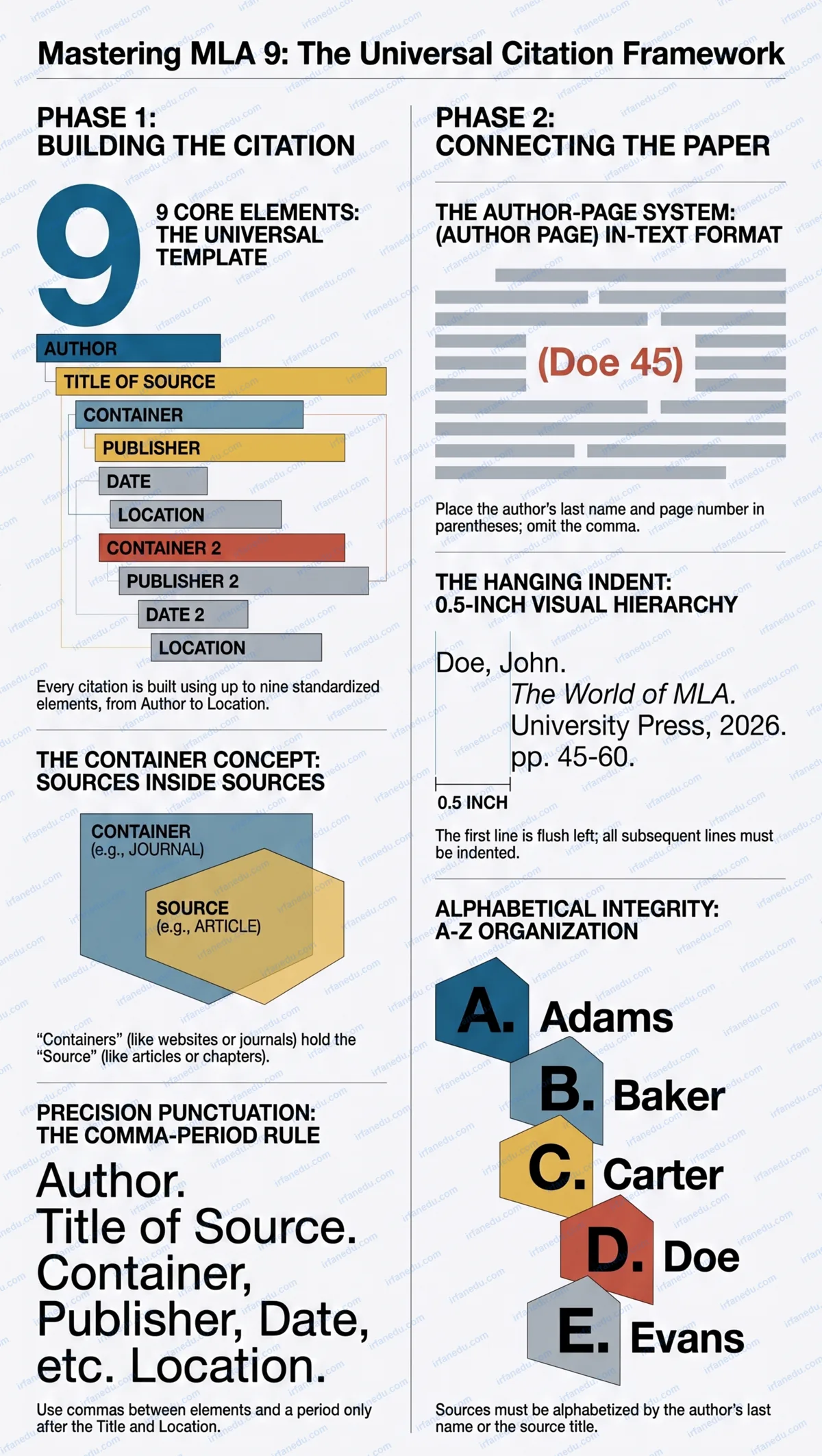
An MLA format citation is a standardized way to credit sources in academic writing. A Works Cited entry lists the author, title, container (book or website), publisher, and date. An in-text citation adds the author’s last name and page number in parentheses — like (Smith 45) — right inside your paper. MLA 9th edition is the current standard as of 2026.
In this guide, I start with a fast, complete example so you can copy the pattern right away. Then I slow down and build a citation piece by piece so you understand every decision. By the end, you will be able to cite any source type confidently.
- Understand the structure of an MLA Works Cited entry
- Write correct in-text citations for any source
- Avoid the five most common MLA formatting errors
- Apply MLA 9th edition rules to books, websites, and journals
TL;DR – Quick Summary
- MLA 9th edition uses 9 core elements: Author, Title, Container, Other Contributors, Version, Number, Publisher, Date, Location.
- Works Cited format: Author Last, First. Title. Publisher, Year.
- In-text citation format: (Author Page) — example: (Morrison 112).
- Italicize book and website names; put article and chapter titles in quotation marks.
- Works Cited page uses hanging indent and double-spacing throughout.
- When no author exists, use a shortened title in the in-text citation instead.
| Item | Detail |
|---|---|
| Current edition | MLA 9th Edition (2021, updated 2026) |
| Published by | Modern Language Association (MLA) |
| Primary use | Humanities: literature, language, film, arts |
| In-text citation style | Author-page: (Smith 45) |
| End-of-paper list | Works Cited (not “Bibliography” or “References”) |
| Title formatting | Italics for containers; quotation marks for parts |
| Spacing | Double-spaced throughout; hanging indent 0.5 in |
Quick Example First: See MLA in 60 Seconds
Before anything else, here is a complete, correct MLA citation for a book. Read it once, note the pattern, and then I will explain every part in the next sections.
Morrison, Toni. Beloved. Vintage Books, 1987.
Sethe's memories haunt her long after the war ends (Morrison 112).
That is the core pattern. Author last name, comma, first name, period. Italicized title, period. Publisher, comma, year, period. In the text, just the last name and page number in parentheses. Clean and simple.
Now here is a website example, because that is what most students cite most often:
Rosen, Rebecca J. "Why We Forget Most of the Books We Read." The Atlantic, 18 Jan. 2018, www.theatlantic.com/science/archive/2018/01/what-was-this-article-about-again/551603/.
Reading retention drops sharply within 24 hours of finishing a text (Rosen).
Notice that the website in-text citation has no page number — websites do not have pages. Just the author’s last name is enough.
In my experience, students spend too long trying to memorize MLA rules before they have seen a single example. I always flip that. Show the finished product first, then reverse-engineer the logic. Your brain locks onto patterns far faster than it locks onto abstract rules. Start with the example above, copy its shape, and the rules will make sense on their own.
What Is MLA Format and Why Does It Matter?
MLA format is a citation and formatting system created by the Modern Language Association. It gives every reader a reliable, predictable way to trace any source you used back to its origin.
Teachers and professors require it for two reasons. First, it prevents plagiarism by making source credit visible and verifiable. Second, it trains you to read and write like a scholar — someone who builds arguments on evidence, not just opinion.
MLA is used primarily in humanities subjects: literature, language studies, film, cultural studies, and the arts. If you are writing a science paper, your instructor will likely ask for APA or Chicago style instead. When in doubt, ask.
The current standard is MLA 9th edition, released in 2021 and still the authoritative version in 2026. Its biggest change from earlier editions was introducing the concept of “containers” — a flexible way to handle sources that live inside other sources, like an article inside a journal inside a database.
The 9 Core Elements of Every MLA Citation
MLA 9th edition organizes every citation around nine core elements. You do not always use all nine — you only include the ones that apply to your specific source. This is what makes the system flexible enough to handle everything from a 500-year-old book to a YouTube video.
| # | Element | Example | Punctuation After |
|---|---|---|---|
| 1 | Author | Morrison, Toni. | Period |
| 2 | Title of Source | Beloved. or “The Road Not Taken.” | Period |
| 3 | Title of Container | The New Yorker, | Comma |
| 4 | Other Contributors | edited by Jane Doe, | Comma |
| 5 | Version | 3rd ed., | Comma |
| 6 | Number | vol. 5, no. 2, | Comma |
| 7 | Publisher | Vintage Books, | Comma |
| 8 | Publication Date | 2020, | Comma |
| 9 | Location | pp. 45-67. or www.example.com. | Period |
The key rule: each element is followed by a comma, and the last element in the entry ends with a period. When an element does not apply, skip it entirely — do not leave a blank space or placeholder.
  Morrison, Toni.  Beloved.  Vintage Books,  1987.
  |___________|  |________|  |____________|  |___|
   Element 1      Element 2    Element 7     Element 8
   (Author)       (Title)      (Publisher)   (Date)

  Rosen, Rebecca J.  "Why We Forget..."  The Atlantic,  18 Jan. 2018,  www.theatlantic.com/...
  |_______________|  |_______________|  |____________|  |___________|  |___________________|
     Element 1          Element 2        Element 3       Element 8         Element 9
     (Author)       (Title of Source)  (Container)       (Date)           (Location/URL)
Detailed Example: Building a Citation Step by Step
Now I will slow down and build a full citation from scratch. This is the “thorough” example promised in the guide’s structure. I will use a journal article found in an online database — the source type that trips up most students.
Source: An article titled “The Neuroscience of Reading” by Anika Patel, published in the journal Cognitive Science Quarterly, volume 14, issue 2, in 2024, on pages 88-105, found via JSTOR at doi.org/10.xxxx/csq.2024.88.
Step 1 — Write the Author (Element 1)
Patel, Anika.
Last name first, comma, first name, period. If there are two authors, write the first author last-name-first, then “and” and the second author first-name-first: Patel, Anika, and James Liu.
Step 2 — Add the Article Title (Element 2)
Patel, Anika. "The Neuroscience of Reading."
Article titles go in quotation marks. The period at the end of the title goes inside the closing quotation mark. Do not italicize the article title.
Step 3 — Add the Container: Journal Name (Element 3)
Patel, Anika. "The Neuroscience of Reading." Cognitive Science Quarterly,
The journal name is the container. Italicize it. Follow it with a comma, not a period, because more elements are coming.
Step 4 — Add Volume, Issue, and Pages (Elements 6 and 9)
Patel, Anika. "The Neuroscience of Reading." Cognitive Science Quarterly, vol. 14, no. 2, 2024, pp. 88-105,
Step 5 — Add the DOI or URL (Element 9 continued)
Patel, Anika. "The Neuroscience of Reading." Cognitive Science Quarterly, vol. 14, no. 2, 2024, pp. 88-105, doi.org/10.xxxx/csq.2024.88.
That is a complete, correct MLA 9th edition journal article citation. Every element is present, punctuated correctly, and in the right order.
Recent brain imaging studies show that skilled readers process text in distinct neural pathways (Patel 92).
The step-by-step approach above changed how I teach citation. Instead of handing students a rule sheet, I give them a source and walk through each element one at a time. By step three, they are doing it themselves. The “container” concept in MLA 9th edition is genuinely brilliant — it handles podcasts, streaming videos, and database articles with the same logic as a printed journal. Once you understand containers, no source type will confuse you again.
MLA Citation Examples by Source Type
The nine-element framework works for every source type. Here are ready-to-use examples for the sources students cite most often.
Book by One Author
Orwell, George. Nineteen Eighty-Four. Secker and Warburg, 1949.
Book by Two Authors
Gilbert, Sandra M., and Susan Gubar. The Madwoman in the Attic. Yale UP, 1979.
Edited Book / Anthology
Gates, Henry Louis, Jr., editor. The Norton Anthology of African American Literature. 3rd ed., W. W. Norton, 2014.
Chapter in an Edited Book
hooks, bell. "Eating the Other." Black Looks: Race and Representation, South End Press, 1992, pp. 21-39.
Website Article
Knapton, Sarah. "Reading Fiction Improves Empathy, Study Finds." The Telegraph, 8 Oct. 2023, www.telegraph.co.uk/science/2023/10/08/reading-fiction-empathy/.
Journal Article (Print)
Nguyen, Linh. "Metaphor and Memory in Postcolonial Fiction." PMLA, vol. 138, no. 1, 2023, pp. 112-130.
Newspaper Article
Alter, Alexandra. "The Novel That Predicted Everything." The New York Times, 14 Mar. 2024, p. A1.
YouTube Video
Khan Academy. "MLA Style: Introduction." YouTube, 5 Feb. 2022, www.youtube.com/watch?v=example.
No Author (Website)
"What Is Climate Change?" United Nations, 2024, www.un.org/en/climatechange/what-is-climate-change.
Global temperatures have risen by 1.1°C since pre-industrial times ("What Is Climate Change").
| Source Type | Title Formatting | Key Elements to Include |
|---|---|---|
| Book | Italics | Author, Title, Publisher, Year |
| Website article | Article: quotes; Site: italics | Author, Article Title, Site Name, Date, URL |
| Journal article | Article: quotes; Journal: italics | Author, Article Title, Journal, Vol., No., Year, Pages, DOI |
| Newspaper | Article: quotes; Paper: italics | Author, Article Title, Paper Name, Date, Page |
| YouTube video | Video title: quotes; YouTube: italics | Uploader, Video Title, YouTube, Date, URL |
| No author | Same as source type | Start with title; use shortened title in-text |
How to Write MLA In-Text Citations
In-text citations are the short references you place inside your paper, right where you use a source. They connect your writing to the full entry on the Works Cited page.
The standard format is: (Author Page) — no comma between them. Place the parenthetical citation at the end of the sentence, before the final period.
Language shapes how we perceive color (Berlin and Kay 17).
When You Name the Author in Your Sentence
If you already mention the author’s name in the sentence, you only need the page number in parentheses.
Berlin and Kay argue that color perception is shaped by language (17).
No Page Numbers (Websites, Videos)
When a source has no page numbers, use only the author’s last name. Do not add “n.p.” or “web” — just the name alone.
Coral reefs cover less than 1% of the ocean floor but support 25% of marine species (Rosen).
Long Quotations (Block Quotes)
If a quotation runs more than four lines, format it as a block quote: indent the entire passage 0.5 inches from the left margin, do not use quotation marks, and place the citation in parentheses after the final period.
...end of the quotation. (Morrison 45)
Common MLA Mistakes (and How to Fix Them)
After reviewing hundreds of student papers, I see the same errors appear over and over. Here is a quick reference table so you can check your own work before submitting.
| Mistake | Wrong | Correct |
|---|---|---|
| Comma in in-text citation | (Smith, 45) | (Smith 45) |
| Wrong list title | Bibliography / References | Works Cited |
| No hanging indent | All lines flush left | First line flush; second+ indented 0.5 in |
| Underlining instead of italics | Beloved | Beloved |
| Alphabetizing by first name | Toni Morrison | Morrison, Toni |
| Period after URL | www.example.com/page. | www.example.com/page. (period is correct here — it ends the entry) |
| Forgetting the period after the title | Beloved, Vintage | Beloved. Vintage |
| Using “p.” for multiple pages | p. 45-67 | pp. 45-67 |
Setting Up Your Works Cited Page
The Works Cited page is a separate page at the end of your paper. It lists every source you cited — and only the sources you cited. Here is how to format it correctly.
- Start on a new page. Press Ctrl+Enter (or Cmd+Enter) to insert a page break after your last paragraph.
- Center the heading. Type “Works Cited” (no quotation marks, no bold, no underline) centered at the top of the page.
- Double-space everything. This includes the heading, between entries, and within entries. No extra blank lines between entries.
- Alphabetize by author’s last name. If no author, alphabetize by the first significant word of the title (ignore “A,” “An,” “The”).
- Apply a hanging indent. In Word: select all entries, go to Paragraph settings, set Special indent to “Hanging,” 0.5 inches.
- Use the same font as your paper. Typically Times New Roman 12pt or a similarly readable serif font.
Works Cited
Morrison, Toni. Beloved. Vintage Books, 1987.
Nguyen, Linh. "Metaphor and Memory in Postcolonial Fiction." PMLA, vol. 138,
no. 1, 2023, pp. 112-130.
Patel, Anika. "The Neuroscience of Reading." Cognitive Science Quarterly,
vol. 14, no. 2, 2024, pp. 88-105, doi.org/10.xxxx/csq.2024.88.
Rosen, Rebecca J. "Why We Forget Most of the Books We Read." The Atlantic,
18 Jan. 2018, www.theatlantic.com/science/archive/2018/01/551603/.
Quick Quiz: Test Your MLA Knowledge
MLA Format Citation Quiz
Question 1: Which format is correct for an MLA in-text citation?
Question 2: How should the title of a novel appear in a Works Cited entry?
Question 3: What is the correct heading for the source list at the end of an MLA paper?
Practice Problems: Build These Citations Yourself
Try formatting each citation before clicking to reveal the answer.
Practice 1: Cite this book — Author: James Baldwin, Title: The Fire Next Time, Publisher: Dial Press, Year: 1963
Baldwin, James. The Fire Next Time. Dial Press, 1963.
In-text: (Baldwin 32)
Practice 2: Cite this website — Author: Maria Chen, Article: “How Sleep Affects Memory,” Site: Scientific American, Date: 3 Mar. 2025, URL: www.scientificamerican.com/sleep-memory
Chen, Maria. "How Sleep Affects Memory." Scientific American, 3 Mar. 2025, www.scientificamerican.com/sleep-memory.
In-text (no page number): (Chen)
Practice 3: Cite this journal article — Author: David Park, Article: “Urban Green Spaces and Mental Health,” Journal: Environmental Psychology Review, Vol. 9, No. 1, Year: 2024, Pages: 14-29
Park, David. "Urban Green Spaces and Mental Health." Environmental Psychology Review, vol. 9, no. 1, 2024, pp. 14-29.
In-text: (Park 21)
Practice 4: Write the in-text citation when no author is listed for a web article titled “The History of the Internet”
("The History of the Internet")
Use a shortened version of the title in quotation marks when no author is available. If the title is long, shorten it to the first few key words.
Frequently Asked Questions
What is the basic MLA format for a book citation?
Smith, John. The Art of Writing. Penguin Books, 2020. Always italicize the book title and end the entry with a period. Include the edition if it is not the first.How do I write an MLA in-text citation?
(Smith 45). No comma between the name and number. If no author is listed, use a shortened version of the title instead: ("Article Title" 3).What edition of MLA should I use in 2026?
How do I cite a website in MLA format?
Doe, Jane. "Climate Change Facts." National Geographic, 12 Mar. 2024, www.nationalgeographic.com/climate. Omit elements that do not exist for your specific source.Does MLA format require a Works Cited page?
What is a hanging indent in MLA Works Cited?
How do I cite a journal article in MLA 9th edition?
Patel, Anika. "Memory and Learning." Journal of Cognitive Science, vol. 12, no. 3, 2023, pp. 45-67. Always include the DOI when available — it is more stable than
Sources & References
Reviewed by Dr. Irfan Mansuri. External links open in a new tab and are provided for further reading and verification.