
Night by Elie Wiesel Summary: Your Complete Chapter-by-Chapter Guide 📖
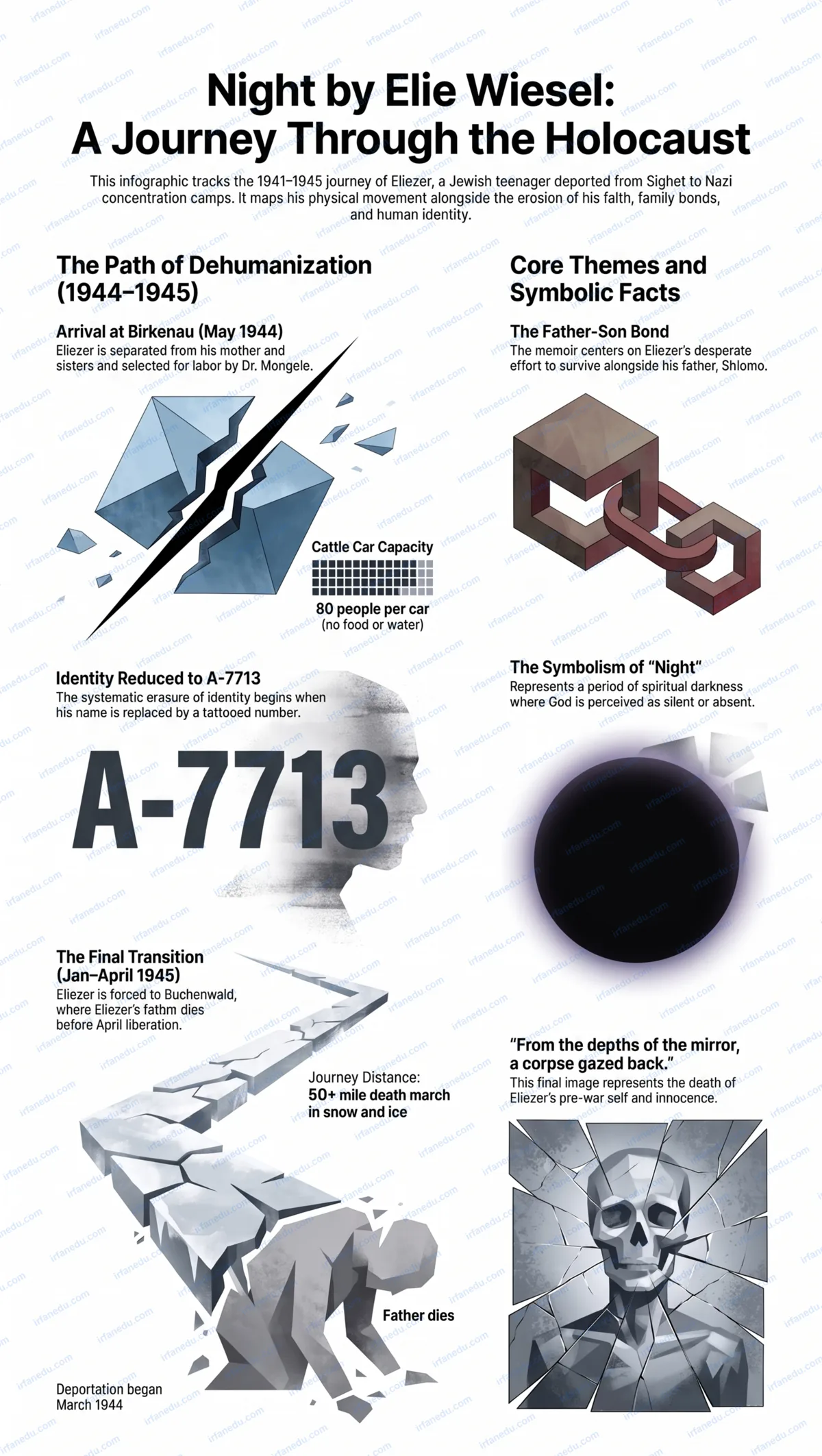
If you have a test, essay, or reading assignment on Night by Elie Wiesel, you are in the right place. I am going to walk you through every section of this powerful Holocaust memoir — clearly, honestly, and without the fluff. By the time you finish this guide, you will understand the full story, the major themes, the key characters, and the quotes that matter most.
Think of this as a guided tour. I will take you through the book section by section, point out what is important, and explain why it matters. Let’s start from the very beginning.
After reading this guide, you will be able to:
- Summarize every chapter of Night accurately
- Identify and explain the book’s major themes
- Describe the key characters and their roles
- Quote and analyze the most important passages
- Answer essay and exam questions with confidence
📋 Table of Contents — Your Guided Tour
- TL;DR Quick Summary
- Quick Facts at a Glance
- Background: Who Was Elie Wiesel?
- Chapter-by-Chapter Summary (All 9 Sections)
- Major Themes in Night
- Key Characters
- Key Quotes and Analysis
- Common Mistakes Students Make
- Visual Timeline of the Journey
- Quick Knowledge Quiz
- Practice Essay Questions
- Frequently Asked Questions
- Key Takeaways
- Related Articles
- About the Author
- Sources & References
⚡ TL;DR – Quick Summary
- 📍 Night follows Eliezer, a Jewish teen deported from Sighet to Auschwitz in 1944.
- 👨👦 The memoir centers on his desperate effort to stay alive alongside his father, Shlomo.
- 🔥 Eliezer witnesses horrific atrocities that destroy his childhood faith in God.
- ❄️ A brutal death march leads them to Buchenwald, where his father dies in January 1945.
- 🗽 American forces liberate Buchenwald on April 11, 1945; Eliezer survives.
- 🪞 The final image — a corpse in the mirror — defines the book’s devastating emotional impact.
📊 Quick Facts at a Glance
| Detail | Information |
|---|---|
| Author | Elie Wiesel (born 1928, died 2016) |
| Original Language | Yiddish (published 1956); French edition 1958; English 1960 |
| Genre | Memoir / Autobiographical Fiction |
| Number of Sections | 9 (often called chapters) |
| Page Count | ~120 pages (varies by edition) |
| Setting | Sighet (Romania); Auschwitz-Birkenau; Buna; Gleiwitz; Buchenwald |
| Time Period | 1941–1945 (Holocaust era) |
| Narrator | Eliezer (semi-autobiographical stand-in for Wiesel) |
| Award | Wiesel won the Nobel Peace Prize in 1986 |
| Reading Level | Grade 6–8 text; Grade 9–12 themes |
🌍 Background: Who Was Elie Wiesel?
Elie Wiesel was born on September 30, 1928, in Sighet, a small town in what is now Romania. He grew up in a devout Jewish family and was deeply interested in religious study from a young age. His world was turned upside down when the Nazis occupied Hungary in 1944 and began deporting Jewish communities.
Wiesel was 15 years old when he arrived at Auschwitz. He survived multiple camps, including Buna and Buchenwald. After liberation, he became a journalist and author, dedicating his life to ensuring the Holocaust was never forgotten. He died on July 2, 2016, at age 87.
Night was originally written in Yiddish as a 900-page manuscript titled Un di velt hot geshvign (“And the World Remained Silent”). Wiesel condensed it dramatically before French publication. That act of compression itself carries meaning — some things are too large for words.
📖 Chapter-by-Chapter Summary (All 9 Sections)
Section 1: Life in Sighet (Before Deportation)
The memoir opens in Sighet, where Eliezer is a devout 12-year-old studying the Talmud and Kabbalah. His spiritual guide is Moshe the Beadle, a poor but wise man who teaches him mysticism. In 1942, foreign Jews — including Moshe — are expelled from Sighet. Moshe is taken by the Gestapo, witnesses a mass execution in the Galician forest, and escapes to return and warn the community. Nobody believes him. They think he has gone mad.
By 1944, the Nazis occupy Hungary. Jewish life in Sighet is systematically dismantled: yellow stars, curfews, confiscation of property, and finally, the creation of a ghetto. The community still does not grasp what is coming.
Moshe the Beadle’s ignored warning is the book’s first and most chilling symbol of the world’s refusal to see the truth. His transformation from joyful teacher to hollow-eyed prophet foreshadows everything that follows.
Section 2: Deportation and Arrival at Birkenau
In spring 1944, the Jews of Sighet are loaded into cattle cars — 80 people per car, no food, no water. During the journey, a woman named Madame Schächter has visions of fire and screams about flames. The others beat her to silence her. When the train arrives at Birkenau (the reception center for Auschwitz), they see the flames she described: the crematoria.
Eliezer and his father are separated from his mother and sisters. He never sees them again. An inmate tells them to lie about their ages. A prisoner named Dr. Mengele conducts the selection — pointing left (death) or right (labor). Eliezer and his father go right. They pass the flames of a burning pit where babies are being thrown.
— Elie Wiesel, Night, Section 2
Section 3: Inside Auschwitz — Dehumanization Begins
Eliezer and his father are processed: heads shaved, clothes stripped, numbers tattooed on their arms. Eliezer becomes A-7713. They are no longer people — they are numbers. The prisoners are assigned to blocks and given their first taste of the brutal camp hierarchy.
A veteran prisoner warns them: “Here, there are no fathers, no brothers, no friends. Everyone lives and dies for himself alone.” Eliezer resists this idea — his father is his anchor. But the warning proves prophetic as the memoir progresses.
In my experience teaching this text, students often underestimate Section 3. The tattooing scene is brief, but it is the hinge of the entire memoir. The moment Eliezer becomes A-7713, the systematic erasure of his identity begins. I always ask students: what does it mean to be reduced to a number? That question unlocks the whole book.
Section 4: Buna — Labor, Cruelty, and the Hanging of a Child
Eliezer and his father are transferred to the Buna labor camp, a sub-camp of Auschwitz. Eliezer works in an electrical warehouse. He befriends a French girl who comforts him after a beating. He is beaten by a foreman named Idek for no reason. His gold crown is extracted by a prisoner named Franek.
The most devastating event in this section — and arguably in the entire book — is the hanging of a young child. The child, described as having “the face of a sad angel,” is hanged alongside two adult prisoners for sabotage. The adults die quickly; the child, too light, hangs dying for over half an hour. A man behind Eliezer asks, “Where is God now?” Eliezer hears a voice inside him answer: “Where is He? Here He is — He is hanging here on this gallows.”
Section 5: Rosh Hashanah, Yom Kippur, and the Selection
It is the Jewish New Year (Rosh Hashanah). Thousands of prisoners pray, but Eliezer feels only rebellion. He refuses to bless a God who has allowed this suffering. On Yom Kippur, he deliberately eats — an act of defiance against God and tradition.
A new selection occurs. Dr. Mengele returns. Eliezer’s father is initially selected for death but manages to rejoin the living group. Eliezer’s relief is overwhelming. An older prisoner named Akiba Drumer loses his faith and is selected — as if faith itself was keeping him alive.
Section 6: The Death March — January 1945
As Soviet forces approach, the Nazis evacuate Auschwitz. Prisoners are forced to run through snow and ice for miles in a death march. Anyone who stops is shot. Eliezer runs with a badly injured foot. He and his father push each other forward.
Rabbi Eliahou searches for his son during the march. Eliezer realizes the son deliberately fell behind to abandon his father — a survival instinct that horrifies him. He prays he will never do the same to his own father. The march ends at Gleiwitz, where they are loaded into open cattle cars in the freezing cold and transported to Buchenwald, Germany.
During the cattle car journey, a man named Juliek plays his violin in the darkness — a fragment of a Beethoven concerto. He is found dead the next morning, his violin crushed beside him. This scene is one of the most haunting in the book: beauty and humanity persisting even at the edge of death.
Section 7: Buchenwald — The Father’s Death
At Buchenwald, Eliezer’s father is gravely ill with dysentery. He is beaten by guards and fellow prisoners for being weak. Eliezer cares for him desperately but also begins to feel the terrible pull of self-preservation. One morning, Eliezer wakes to find his father’s bunk occupied by another prisoner. Shlomo Wiesel has died during the night, likely beaten by an SS officer for calling out Eliezer’s name.
Eliezer feels something he is ashamed of: relief. He has no more responsibility. He has no more reason to feel guilty for eating his own food. This moment of moral ambiguity is one of the most honest and devastating passages in all of Holocaust literature.
I think Wiesel’s willingness to admit that feeling of relief is what makes Night a masterpiece rather than just a testimony. He could have written a heroic account. Instead, he wrote a true one. That honesty is what makes this book so hard to put down — and so hard to forget. When I teach this section, students go very quiet. That silence says everything.
Section 8: Liberation
After his father’s death, Eliezer stops caring whether he lives or dies. He focuses only on getting food. On April 5, 1945, the SS announces that all Jews will be shot the next day. But on April 10, the camp resistance rises up. On April 11, 1945, American tanks roll into Buchenwald. The prisoners are free.
Section 9: The Mirror — Final Image
After liberation, Eliezer is hospitalized with food poisoning. When he recovers enough to stand, he looks at himself in a mirror for the first time since leaving the ghetto. He sees a corpse staring back at him. The memoir ends there. That image — a living person who sees a corpse — is the book’s final and most enduring statement about what the Holocaust did to its survivors.
🔑 Major Themes in Night
| Theme | How It Appears in the Text | Key Passage |
|---|---|---|
| Loss of Faith | Eliezer’s rebellion against God on Rosh Hashanah; the hanging of the child | “Never shall I forget those flames…” |
| Dehumanization | Tattooed numbers, shaved heads, stripped identities | Eliezer becomes A-7713 |
| Father-Son Bond | Eliezer’s survival tied to keeping his father alive | Death march — pushing each other forward |
| Silence | The world’s failure to act; God’s silence; Wiesel’s duty to speak | Moshe’s ignored warnings |
| Survival vs. Morality | Rabbi Eliahou’s son; Eliezer’s feeling of relief at his father’s death | Section 7 — the morning after |
| Memory and Witness | The entire memoir is an act of bearing witness | The preface by Wiesel (2006 edition) |
👥 Key Characters
Eliezer — The narrator and protagonist. A devout Jewish teenager whose faith, identity, and innocence are destroyed by the Holocaust. His relationship with his father is the emotional core of the memoir.
Shlomo Wiesel (Eliezer’s father) — A respected community leader in Sighet. In the camps, he becomes dependent on Eliezer. His death at Buchenwald is the memoir’s most devastating moment.
Moshe the Beadle — Eliezer’s spiritual teacher. His transformation from joyful mystic to unbelieved prophet represents the world’s failure to heed warnings about the Holocaust.
Dr. Josef Mengele — The SS doctor who conducts selections at Birkenau. He represents the cold, bureaucratic face of Nazi evil.
Juliek — A young Polish violinist who plays Beethoven in the darkness of the cattle car. He dies that night. He represents the persistence of beauty and humanity even in the worst conditions.
Akiba Drumer — A prisoner who loses his faith and is subsequently selected for death. His fate suggests Wiesel’s belief that faith — even misplaced — can be a survival mechanism.
💬 Key Quotes and What They Mean
— Section 2. This is the most famous passage in the book. It functions as a secular prayer — a vow to remember. The repetition of “never shall I forget” mirrors the structure of Jewish prayer.
— Section 4. The hanging of the child. Wiesel’s most theologically complex moment — God either dies here, or God suffers here. Both readings are valid.
— Final lines of the memoir. The corpse in the mirror is Eliezer’s lost self — his pre-war identity, his faith, his childhood. He survived physically but was transformed beyond recognition.
— Wiesel’s preface. This quote explains why he wrote the book at all, and why bearing witness is a moral obligation.
❌ Common Mistakes Students Make About Night
| ❌ Common Mistake | ✅ The Correct Understanding |
|---|---|
| Calling it a novel | It is a memoir — a true, autobiographical account |
| Saying Eliezer completely loses his faith | His relationship with God becomes one of anger and questioning — not simple atheism |
| Confusing Elie Wiesel with Eliezer | Eliezer is the narrator; Wiesel is the author. They are nearly identical but not identical. |
| Saying his whole family dies | His mother and sisters die, but Wiesel had two older sisters who survived the war |
| Saying liberation is a happy ending | Wiesel explicitly shows liberation as hollow — he sees a corpse in the mirror |
| Ignoring Moshe the Beadle | Moshe is essential — he sets up the book’s central tragedy: the ignored warning |
🗺️ Visual Timeline of Eliezer’s Journey
1941-1944   ──► SIGHET (Romania)
                Eliezer studies Kabbalah with Moshe the Beadle
                Moshe deported → witnesses massacre → returns, ignored
                Nazis occupy Hungary (March 1944)
                Yellow stars → ghetto → cattle cars

May 1944    ──► BIRKENAU (Auschwitz Reception)
                Separation from mother & sisters
                Selection by Dr. Mengele → "right" = labor
                Flames of the crematoria
                Tattooed: Eliezer = A-7713

Summer 1944 ──► BUNA (Auschwitz sub-camp)
                Labor in electrical warehouse
                Beatings, gold crown extracted
                Hanging of the child → faith crisis

Sept 1944   ──► ROSH HASHANAH / YOM KIPPUR
                Eliezer refuses to pray
                Father survives selection

Jan 1945    ──► DEATH MARCH (Auschwitz → Gleiwitz)
                Snow, ice, 50+ miles on foot
                Rabbi Eliahou's son abandons his father
                Juliek plays violin in the dark → dies

Jan 1945    ──► BUCHENWALD (Germany)
                Father gravely ill with dysentery
                Father dies (beaten by SS guard)
                Eliezer feels relief → shame

Apr 11, 1945 ─► LIBERATION
                American forces enter Buchenwald
                Eliezer hospitalized, recovers

After Lib.  ──► THE MIRROR
                Eliezer sees a corpse staring back
                ─────────────────────────────────
                "The look in his eyes has never left me."
🧠 Quick Knowledge Quiz
Test Your Knowledge of Night 📝
1. What is the number tattooed on Eliezer’s arm at Auschwitz?
2. Who is the first person to warn the Jews of Sighet about the Nazi threat?
3. What does Eliezer see in the mirror at the very end of the memoir?
✍️ Practice Essay Questions
Practice Q1: How does Eliezer’s faith change throughout Night?
- Opening faith: Eliezer begins as a deeply devout boy studying Kabbalah, believing in a just and present God.
- First crack: Arrival at Birkenau and the flames of the crematoria — “Why should I bless His name?”
- Breaking point: The hanging of the child (Section 4) — God either dies or suffers on the gallows.
- Open rebellion: Rosh Hashanah — Eliezer refuses to pray; Yom Kippur — he deliberately eats.
- Nuanced reading: Wiesel never becomes a simple atheist. His anger at God is itself a form of relationship with God — he continues to address God, even in accusation.
Practice Q2: Analyze the father-son relationship as a survival mechanism in Night.
- Initial dynamic: Shlomo is the respected, protective father; Eliezer is the dependent son.
- Role reversal: As the memoir progresses, Eliezer increasingly becomes the caretaker — protecting his father’s food, pushing him through the death march.
- Moral tension: Eliezer struggles against the camp’s logic of “every man for himself” (the veteran prisoner’s warning, Rabbi Eliahou’s son).
- The death: Shlomo’s death and Eliezer’s moment of relief show the camp’s ultimate victory — it made survival and love incompatible.
- Conclusion: The father-son bond is both what keeps Eliezer alive and what the camp systematically destroys.
Practice Q3: What does the title Night symbolize in the memoir?
- Literal darkness: Many of the memoir’s most traumatic events happen at night — arrival at Birkenau, the death march, Shlomo’s death.
- Moral darkness: The Holocaust represents a period of moral night for humanity — the failure of civilization.
- Spiritual darkness: God’s silence, Eliezer’s lost faith — a night of the soul.
- Endless duration: “Which has turned my life into one long night” — night is not temporary. It is a permanent condition for survivors.
- No dawn: Even liberation does not bring morning — the corpse in the mirror shows that the night continues inside the survivor.
❓ Frequently Asked Questions
What is Night by Elie Wiesel about?
How many chapters does Night have?
What are the main themes in Night?
Who is Moshe the Beadle in Night?
What happens at the end of Night?
Is Night a true story?
Sources & References
Reviewed by Dr. Irfan Mansuri. External links open in a new tab and are provided for further reading and verification.