
Tangent Calculator: Find the Slope of Any Tangent Line
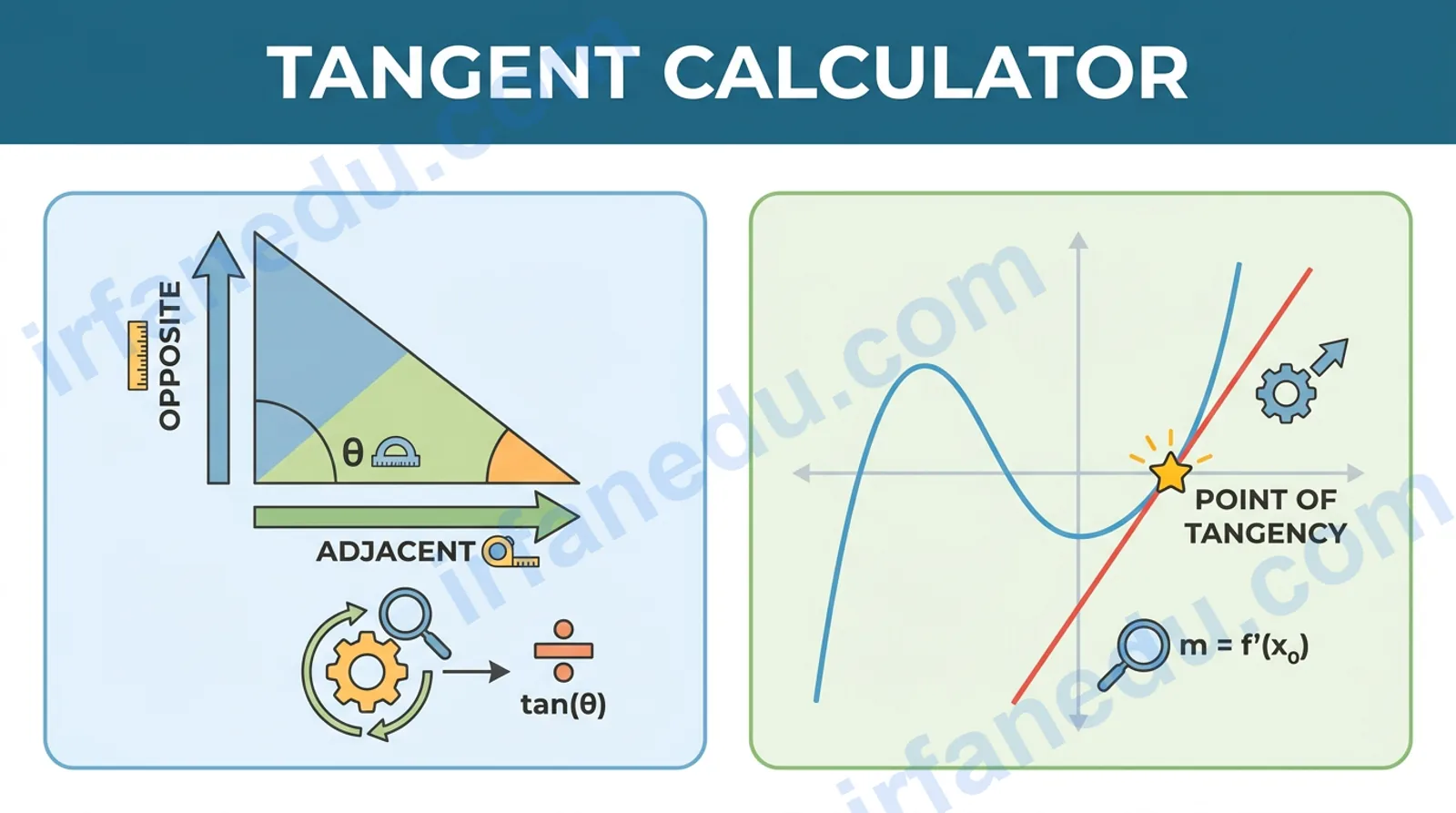
Engineers designing road curves in California calculate the tangent of a grade angle before a single foot of asphalt is poured. Architects in Texas use the slope of a tangent line to model the curvature of a roof arch. Both operations — finding tan(θ) and finding the slope of a tangent line — come down to the same underlying idea: how steeply does one quantity change relative to another at a specific point?
This calculator handles both tasks in one place. Enter an angle in degrees or radians to get the trigonometric tangent, or enter a polynomial function and a point to get the exact slope of the tangent line at that point — with full step-by-step working every time.
The tangent of an angle θ equals the ratio of the opposite side to the adjacent side in a right triangle: tan(θ) = opposite ÷ adjacent. In calculus, the slope of a tangent line at point x₀ on a curve equals the derivative f′(x₀). This calculator handles both: enter an angle in degrees or radians, or enter a polynomial function and a point, to get the exact result with step-by-step working.
⚡ TL;DR
- tan(θ) = opposite ÷ adjacent = sin(θ) ÷ cos(θ).
- Slope of tangent line = derivative f′(x₀) at the given point.
- tan(30°) = 0.5774, tan(45°) = 1, tan(60°) = 1.7321.
- Tangent is undefined at 90° and 270° (division by zero).
- The tangent line equation is y − f(x₀) = f′(x₀)(x − x₀).
Tangent Calculator
°
Step-by-Step Solution
Use * for multiply, ^ for power. Supports ax^n + bx + c terms.
Step-by-Step Solution
How to Use This Calculator
- Pick a mode: Trig Tangent for tan(angle), or Tangent Line Slope for the slope of a curve.
- Trig Tangent: type your angle, choose Degrees or Radians, then click Calculate.
- Tangent Line Slope: type a polynomial like
x^2 + 3*x - 5and the x-value of your point. - Read the big result number. Scroll down in the result card to see the full step-by-step solution.
- Click Reset to clear and start fresh.
What Is the Tangent Function?
The tangent of an angle is the ratio of the opposite side to the adjacent side in a right triangle. It is one of the six core trigonometric functions and appears in everything from surveying land in Texas to calculating the pitch of a roof in Ohio.
On the unit circle, tan(θ) equals sin(θ) divided by cos(θ). This definition extends the function beyond the 0°-90° range of a right triangle to all real angles except where cos(θ) = 0.
Quick Facts: Tangent at Key Angles
| Angle (°) | Angle (rad) | tan(θ) | Exact Form |
|---|---|---|---|
| 0° | 0 | 0 | 0 |
| 30° | π/6 | 0.5774 | 1/√3 |
| 45° | π/4 | 1 | 1 |
| 60° | π/3 | 1.7321 | √3 |
| 90° | π/2 | Undefined | — |
| 135° | 3π/4 | -1 | -1 |
| 180° | π | 0 | 0 |
The Formula Explained
Calculus: m = f′(x₀) | Tangent line: y − f(x₀) = f′(x₀)(x − x₀)
Variables & Symbols Table
| Symbol | Meaning | Unit / Notes |
|---|---|---|
| θ | Angle | Degrees or radians |
| opposite | Side opposite θ in a right triangle | Any length unit (ft, in, etc.) |
| adjacent | Side adjacent to θ (not the hypotenuse) | Same unit as opposite |
| f(x) | A function of x | Dimensionless or any unit |
| f′(x₀) | Derivative of f evaluated at x₀ | Rise per unit run (slope) |
| m | Slope of the tangent line | Dimensionless ratio |
The tangent function is periodic with period 180° (π radians). It repeats its full range of values — from negative infinity to positive infinity — in every 180° interval. This is unlike sine and cosine, which repeat every 360°.
  TRIG TANGENT                     TANGENT LINE (CALCULUS)

       /|                           y
      / |                           |        . curve f(x)
  hyp / | opposite                  |      ./ tangent line
    /   |                           |    ./
   /  θ |                           |  ./  slope = f'(x₀)
  /_____|                           |./_____________ x
   adjacent                              x₀
                                    Point: (x₀, f(x₀))
  tan(θ) = opp / adj               slope m = f'(x₀)
Worked Examples
Example 1: Find tan(60°)
- Convert: 60° × π/180 = π/3 rad = 1.0472 rad
- sin(60°) = √3/2 = 0.8660; cos(60°) = 1/2 = 0.5
- tan(60°) = 0.8660 / 0.5 = 1.7321
Example 2: Slope of f(x) = x² + 3x at x = 2
- Derivative: f′(x) = 2x + 3 (power rule)
- At x₀ = 2: f′(2) = 2(2) + 3 = 7
- f(2) = 4 + 6 = 10, so the tangent point is (2, 10)
- Tangent line: y − 10 = 7(x − 2) → y = 7x − 4
Example 3: Road Grade Angle (Real-World)
A highway engineer in Colorado measures a road rising 12 feet over a 100-foot horizontal run. The grade angle θ satisfies tan(θ) = 12/100 = 0.12, so θ = arctan(0.12) = 6.84°. The Federal Highway Administration uses exactly this calculation when setting maximum grade limits for interstate highways.
In my experience teaching trigonometry to high school juniors, the biggest confusion is treating “tangent” as two separate topics — one in trig, one in calculus. They are the same idea: how steep is the line at this exact point? Once students see that the derivative IS the tangent ratio applied to a curve, both chapters click at once.
Trig Tangent vs. Tangent Line Slope: Side-by-Side
| Feature | Trig Tangent tan(θ) | Tangent Line Slope f′(x₀) |
|---|---|---|
| Input | An angle (degrees or radians) | A function + a point x₀ |
| Output | A dimensionless ratio | A slope (rise/run) |
| Formula | opposite / adjacent | Power rule derivative |
| Undefined when | cos(θ) = 0 (90°, 270°…) | f is not differentiable at x₀ |
| Used in | Surveying, navigation, physics | Calculus, optimization, physics |
| Connection | Both measure steepness at a point — one for a triangle, one for a curve | |
Most tangent guides treat degrees and radians as interchangeable with a simple conversion note. But there is a deeper issue: when you use tan(θ) to find a slope in a real-world problem, the angle must be measured from the horizontal, not from the vertical. A roof pitch of “6 in 12” means 6 inches of rise per 12 inches of run — the angle from horizontal is arctan(6/12) = 26.57°, not arctan(12/6) = 63.43°. I have seen students in US construction math courses lose half a problem’s points by measuring from the wrong baseline. Always confirm: is your angle from the horizontal or the vertical before you plug it in.