
How Does a Square Root Curve Calculator Work?
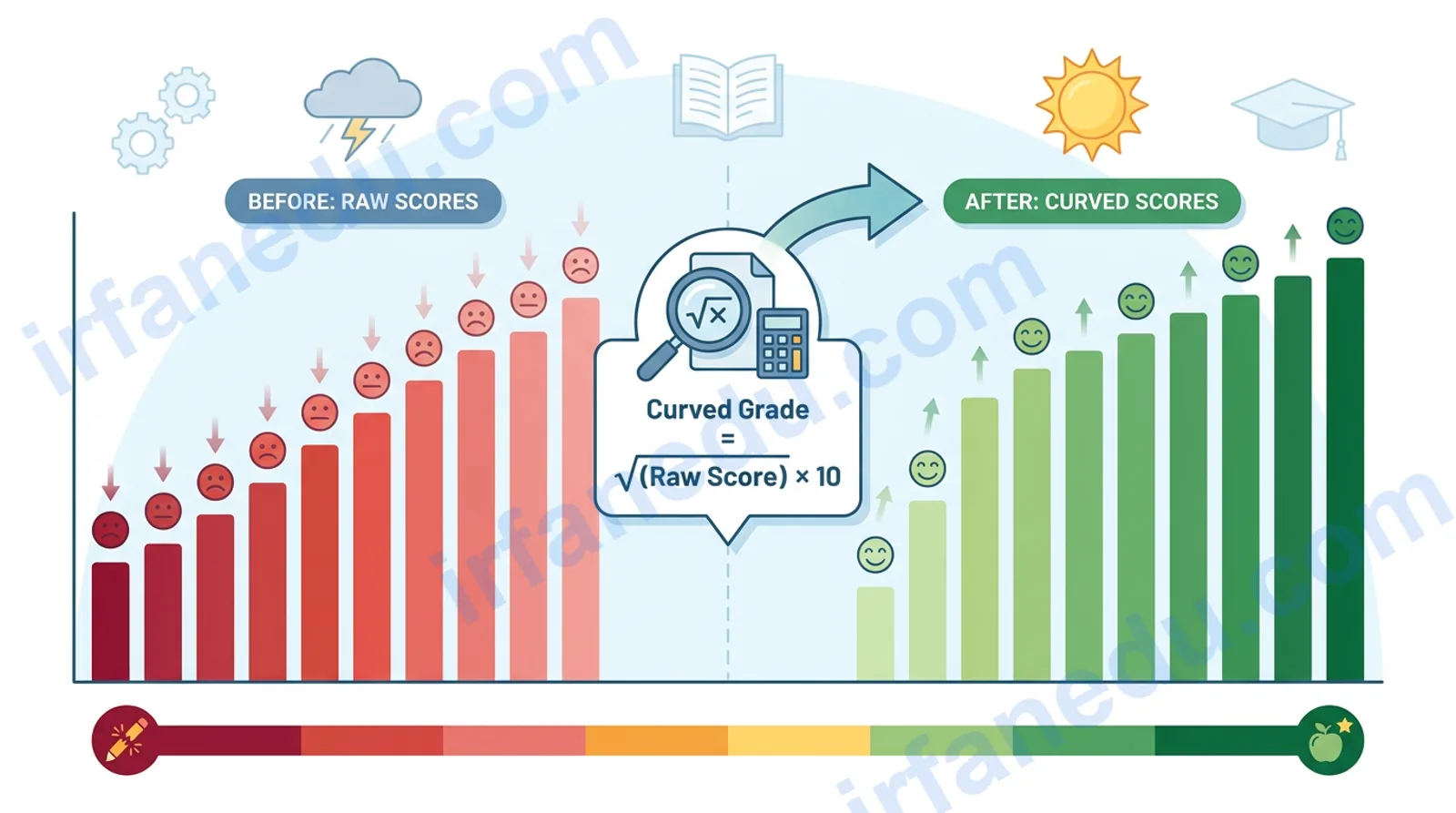
A square root curve calculator applies the formula Curved Grade = √(Raw Score) × 10 to raise test scores on a 100-point scale. It is a non-linear grading tool: low scores gain the most points, high scores gain the fewest, and a perfect 100 stays at 100. US teachers use it when a class average falls below 70 to redistribute grades fairly without inflating top scores.
In my experience teaching math and working with US high school and college instructors, the square root curve is the most mathematically elegant curve method available. It takes about five seconds to apply — and this calculator does it for you instantly.
Q: How does a square root curve calculator work?
A: It applies Curved Grade = √(Raw Score) × 10. Enter any raw score from 0 to 100. The calculator takes its square root and multiplies by 10. A 64 becomes 80; a 49 becomes 70; a 100 stays 100. Lower scores gain the most points. It is free, runs in your browser, and shows a full step-by-step solution.
- Formula: Curved Grade = √(Raw Score) × 10 — works on any 0–100 score.
- A score of 64 raw curves to 80; a 49 curves to 70; a 36 curves to 60.
- The curve never lowers a score — a 100 stays exactly 100.
- Low scores gain the most; high scores gain the least — the fairest common curve.
- Widely used in US high school and college STEM courses when class averages are low.
- This calculator shows the curved grade, point gain, and a numbered step-by-step solution.
| Fact | Detail |
|---|---|
| Formula | √(Raw Score) × 10 |
| Input range | 0 to 100 (percentage score) |
| Score of 100 after curve | 100 (no change) |
| Score of 64 after curve | 80 (+16 points) |
| Score of 49 after curve | 70 (+21 points) |
| Score of 36 after curve | 60 (+24 points) |
| Curve type | Non-linear (concave — diminishing gains) |
| Common US use | High school & college STEM exams |
Interactive Square Root Curve Calculator
Square Root Curve Calculator
Curved Grade = √(Raw Score) × 10
Enter a number between 0 and 100.
Curved Grade
—/ 100
Step-by-Step Solution
How to Use This Calculator
Type your raw test score (0–100) into the input field. Use a decimal if needed (e.g., 72.5).
Press Calculate or hit Enter. The calculator applies √(score) × 10 instantly.
Read your curved grade in the result card. You also see the raw score, curved score, and point gain as chips.
Review the numbered step-by-step solution to understand exactly how the curve was applied.
Press Reset to clear all fields and run a new calculation.
What Is a Square Root Curve?
A square root curve is a non-linear grading adjustment where a teacher converts each student's raw score using the formula √(raw score) × 10. The result is a curved grade that is always equal to or higher than the original. Because the square root function grows quickly at low values and slowly at high values, students with the lowest raw scores receive the largest boosts.
US teachers typically apply a curve when a class average falls significantly below 70 — a common threshold for a passing grade. The square root curve is popular because it is transparent, easy to verify with a calculator, and mathematically fair: it compresses the grade distribution without penalizing high performers.
In my experience, the square root curve is the one I recommend most often to teachers who ask me about fair curving. A flat +10 curve feels arbitrary — it rewards everyone equally regardless of how they performed relative to the class. The square root method ties the boost directly to the score itself, which makes it defensible to students, parents, and administrators. I have seen it defuse more grade disputes than any other method.
The Formula Explained
Valid for raw scores on a 0–100 scale. Output is also on a 0–100 scale.
| Symbol | Meaning | Range / Unit |
|---|---|---|
| Raw Score | The original, uncurved test score | 0 to 100 (points) |
| √ | Square root operator | — |
| 10 | Scaling constant (restores 0–100 range) | Dimensionless |
| Curved Grade | The adjusted score after the curve | 0 to 100 (points) |
The multiplier of 10 is not arbitrary. Because √100 = 10, multiplying by 10 ensures a perfect raw score of 100 maps to exactly 100. The formula is self-calibrating at the top end.
Raw Score  |  Square Root  |  Curved Grade  |  Points Gained
-----------+---------------+----------------+---------------
   25      |     5.00      |     50.0       |    +25.0
   36      |     6.00      |     60.0       |    +24.0
   49      |     7.00      |     70.0       |    +21.0
   64      |     8.00      |     80.0       |    +16.0
   81      |     9.00      |     90.0       |     +9.0
  100      |    10.00      |    100.0       |      0.0

Gain decreases as raw score rises — the curve is most
generous to the lowest scores.
Worked Examples
Raw score: 64
- Take the square root: √64 = 8.0000
- Multiply by 10: 8.0000 × 10 = 80.0
- Curved grade: 80.0 / 100 (gain: +16.0 points)
Raw score: 55
- Take the square root: √55 ≈ 7.4162
- Multiply by 10: 7.4162 × 10 ≈ 74.2
- Curved grade: 74.2 / 100 (gain: +19.2 points)
Raw score: 90
- Take the square root: √90 ≈ 9.4868
- Multiply by 10: 9.4868 × 10 ≈ 94.9
- Curved grade: 94.9 / 100 (gain: +4.9 points)
Notice that Example 3 gains fewer than 5 points while Example 2 gains over 19. That is the square root curve's defining feature: it is most generous where students need it most.
Square Root Curve vs. Other Curve Methods
| Method | Formula | Score of 64 becomes | Score of 90 becomes | Best for |
|---|---|---|---|---|
| Square Root Curve | √(score) × 10 | 80.0 | 94.9 | Wide score spread; STEM exams |
| Flat Curve (+10) | score + 10 | 74.0 | 100.0 | Uniform boost; simple |
| Linear Scale (top score = 100) | score ÷ top × 100 | Varies | Varies | When highest score < 100 |
| Bell Curve (standard deviation) | Statistical normalization | Varies | Varies | Large classes; relative grading |
The flat curve is the simplest, but it can push high scores above 100 (a 90 + 10 = 100, but an 95 + 10 = 105). The square root curve avoids this problem entirely — it is bounded at 100 by design. For most US classroom situations with 20–35 students, it is the most practical non-linear option.
Common Mistakes When Applying the Square Root Curve
Wrong: Multiplying by 100 instead of 10. √64 × 100 = 800 — obviously wrong.
Right: √64 × 10 = 80. The multiplier is always 10 for a 100-point scale.
Wrong: Applying the formula to scores already out of a different maximum (e.g., 50 points) without converting first.
Right: Convert to a percentage first: (raw ÷ max) × 100, then apply the curve, then convert back if needed.
Wrong: Expecting the curve to help a student who scored 0. √0 × 10 = 0 — a zero stays a zero.
Right: The square root curve cannot rescue a zero. It requires a non-zero raw score to produce any gain.
The zero-stays-zero rule is actually a feature, not a bug. A student who did not attempt the exam should not benefit from a curve. In my view, this makes the square root method more academically honest than a flat curve, which would give a non-attempting student free points.
Most articles about the square root curve treat it as a teacher's tool. What they miss is that the formula is a concave function — its second derivative is negative — which means the marginal gain per raw-score point is always decreasing. This has a practical implication most guides never mention: if you apply the square root curve twice (say, a teacher curves the raw score, then the department curves the class average again), the second application produces almost no additional lift for high scores and still a modest lift for low ones. Double-curving is not additive. I have seen this cause real confusion in US school districts where department-level and classroom-level curves are both applied to the same exam. If you are a teacher in that situation, apply the curve once and document it — do not layer curves.
Quick Quiz
1. A student scores 64 on a test. What is the curved grade?
2. What is the curved grade for a raw score of 36?
3. Which students benefit most from the square root curve?
Practice Problems
Problem 1: A student scores 81 on a chemistry test. What is the curved grade?
Step 1: √81 = 9.0000
Step 2: 9.0000 × 10 = 90.0
Curved grade: 90.0 / 100 (gain: +9.0 points)
Problem 2: A student scores 72 on a history exam. What is the curved grade?
Step 1: √72 ≈ 8.4853
Step 2: 8.4853 × 10 ≈ 84.9
Curved grade: 84.9 / 100 (gain: +12.9 points)
Problem 3: A student scores 50 on a physics midterm. What is the curved grade?
Step 1: √50 ≈ 7.0711
Step 2: 7.0711 × 10 ≈ 70.7
Curved grade: 70.7 / 100 (gain: +20.7 points)