
Personal Laws Explained: Types, Examples and How They Really Work
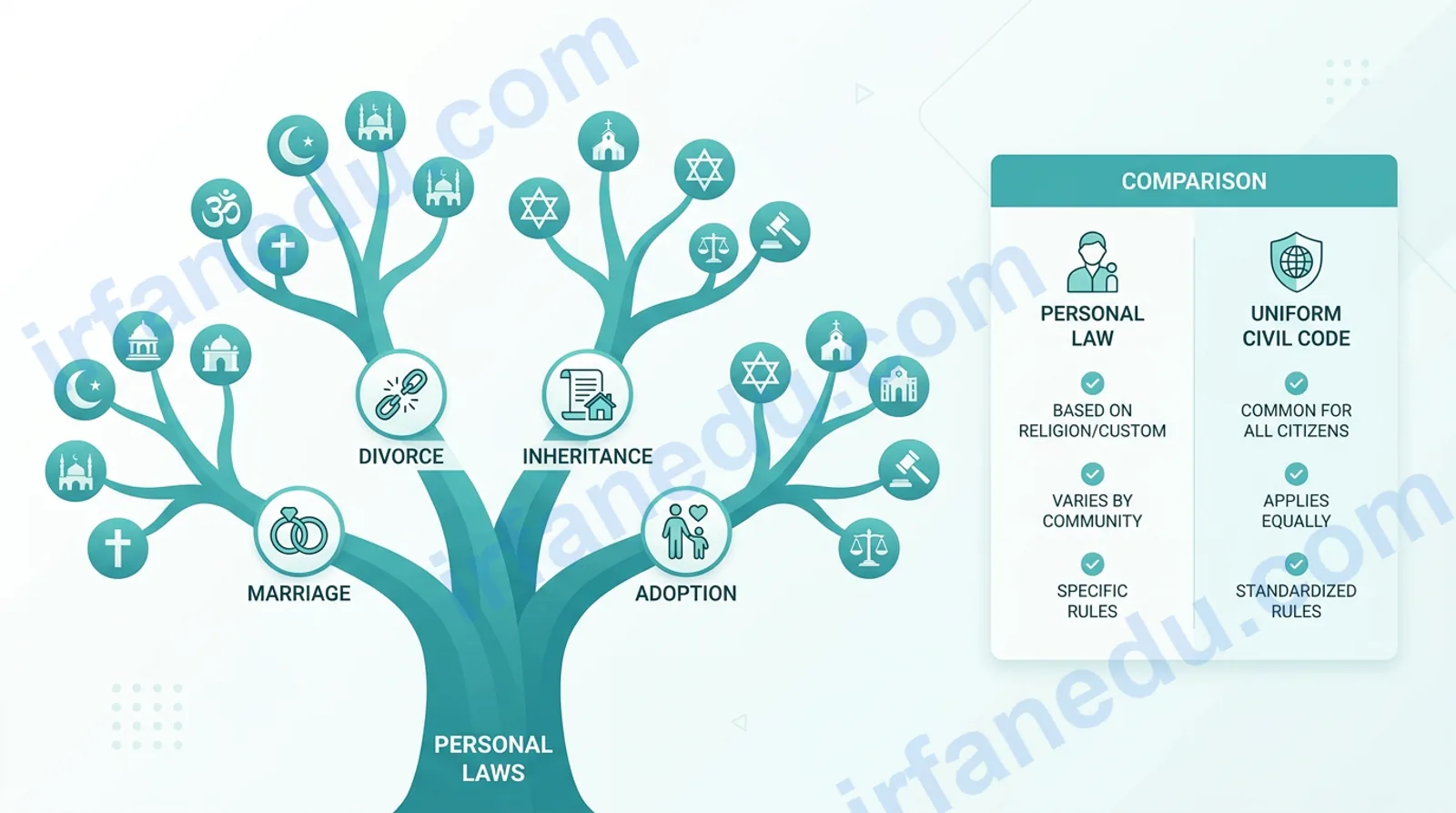
Before reading further, lock in these six terms. Every section below uses them — knowing them now makes the rest click instantly.
- Personal Law
- A set of legal rules that apply to a person based on their religion, ethnicity, or community identity rather than a single national statute.
- Civil Law (General)
- A uniform body of law that applies equally to all citizens of a country, regardless of religion or background.
- Codified Personal Law
- A personal law that has been written into a formal statute by the legislature (e.g., a Hindu Marriage Act), as opposed to uncodified customary practice.
- Uniform Civil Code (UCC)
- A proposed single civil law that would replace all separate personal law systems and apply to every citizen equally.
- Succession / Inheritance Law
- Rules that determine who inherits a person’s property and assets after death.
- Customary Law
- Unwritten rules based on long-standing community traditions that courts may recognize as legally binding.
Imagine two people living in the same city, paying the same taxes, and subject to the same criminal code — yet governed by completely different rules when they marry or inherit property. That is not a hypothetical. It is how personal laws work in dozens of countries right now, and it is one of the most misunderstood areas of legal studies.
In my experience teaching civics and legal studies, students often confuse personal laws with religious laws, or assume they only exist in one region of the world. Both assumptions are wrong — and clearing them up is exactly what this guide does.
Personal laws are state-recognized legal rules that apply to individuals based on their religion, ethnicity, or community rather than a single national statute. They govern private family matters — marriage, divorce, inheritance, adoption, and guardianship — and exist alongside a country’s general civil and criminal codes.
- The precise definition of personal laws and the six terms you need to understand them
- The main types of personal laws and what subjects each covers
- How personal law differs from civil law — with a side-by-side comparison
- Real-world examples from multiple countries
- The debate between personal laws and a Uniform Civil Code
- A non-obvious insight about personal laws that most textbooks skip
Personal laws are a set of legal rules that apply to individuals based on their religion, ethnicity, or community rather than a single national statute. They typically govern private family matters such as marriage, divorce, inheritance, adoption, and guardianship. Many countries with religiously diverse populations maintain separate personal law systems alongside their general civil or criminal codes.
- Personal laws govern family matters (marriage, divorce, inheritance) based on religion or community identity.
- They exist alongside — not instead of — a country’s general civil and criminal law.
- Different communities in the same country can follow different personal law rules.
- Codified personal laws are written statutes; uncodified ones rely on custom and court interpretation.
- A Uniform Civil Code would replace all personal laws with one set of rules for everyone.
- Personal law is NOT the same as full religious law — it is only the state-recognized subset.
What Are Personal Laws?
Personal laws are legally binding rules that a state applies to a person based on that person’s religion, ethnicity, or community membership rather than their nationality alone. They answer questions like: Is this marriage legally valid? Who inherits this estate? Can this couple adopt a child?
The key word is state-recognized. A personal law is not simply a community’s internal custom — it is a rule that courts will enforce. That is what separates personal law from mere religious practice.
Personal laws typically cover five subject areas:
- Marriage — validity, age of consent, prohibited relationships, registration
- Divorce and separation — grounds, procedures, waiting periods
- Inheritance and succession — who gets what when someone dies
- Adoption and guardianship — who may adopt, custody rules
- Maintenance and alimony — financial support obligations after separation
Personal laws almost never cover criminal matters. If you commit a crime, the state’s uniform criminal code applies regardless of your religion. Personal laws operate in the private, family sphere.
Scenario: Two citizens of the same country — one from Community A, one from Community B — both die without a written will. Under Community A’s personal law, the eldest son inherits the entire estate. Under Community B’s personal law, the estate is split equally among all children. Both outcomes are legally valid in that country because each person is governed by their own community’s personal law. The state enforces whichever rule applies to each individual.
What Are the Main Types of Personal Laws?
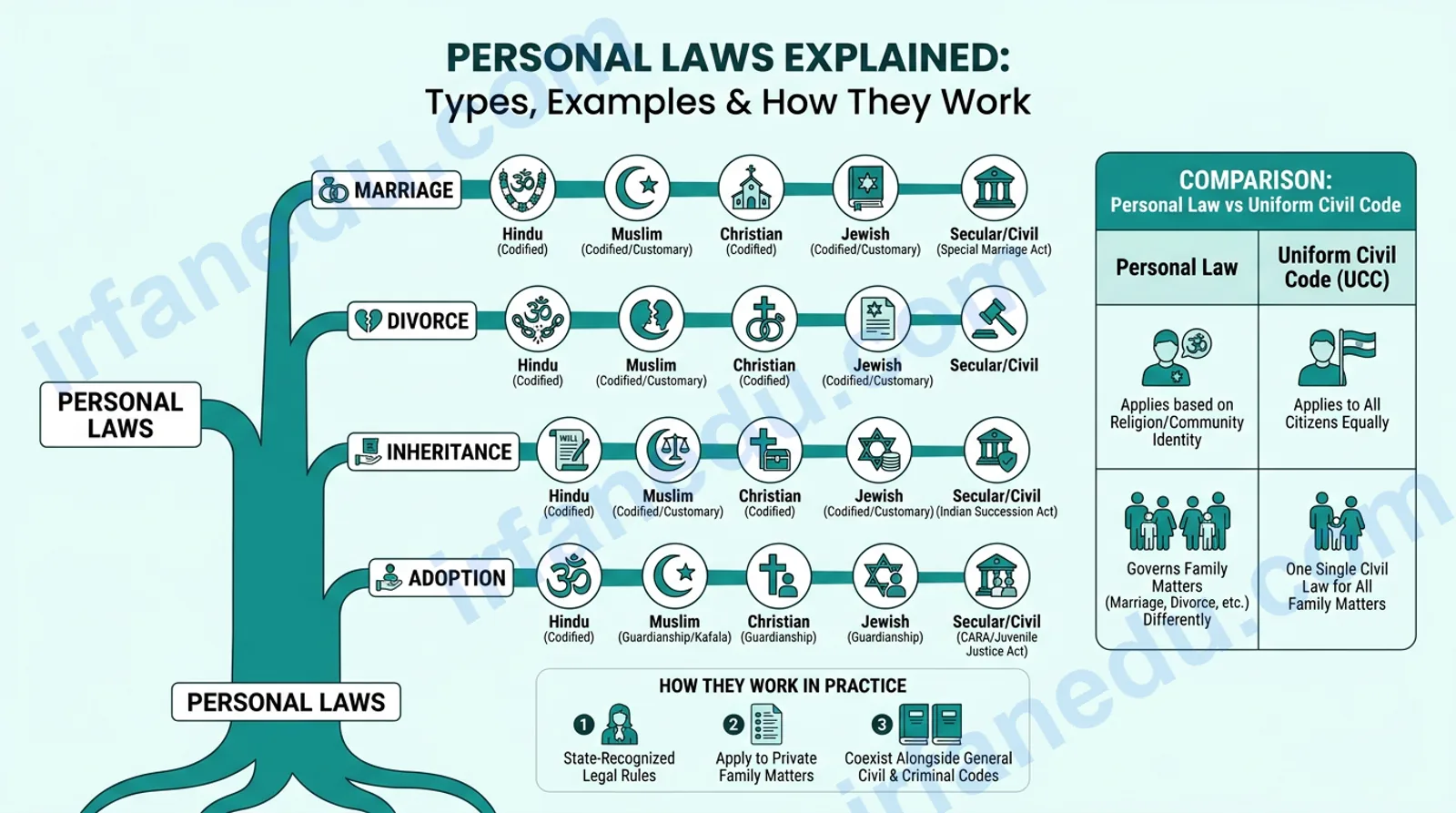
Personal laws are generally classified by the community they apply to. The most widely recognized types globally are based on major religious traditions, but ethnic and tribal personal laws also exist.
Religion-Based Personal Laws
Islamic Personal Law (Muslim Personal Law): Derived from the Quran, Hadith, and classical jurisprudence (fiqh). Covers marriage (nikah), divorce (talaq, khul’), inheritance (mirath), and maintenance. Applied in various forms across Muslim-majority countries and as a recognized personal law for Muslim citizens in pluralistic states.
Hindu Personal Law: Applies to Hindus, Buddhists, Jains, and Sikhs in several countries. Covers marriage, divorce, succession, adoption, and guardianship. In many jurisdictions it has been codified into formal statutes.
Christian Personal Law: Governs marriage and divorce for Christians in some countries. Historically rooted in Canon Law but largely codified into civil statutes in most modern states.
Jewish Personal Law (Halakha): Covers marriage and divorce for Jewish communities. In some countries, rabbinical courts have state-recognized authority over personal status matters for Jewish citizens.
Parsi Personal Law: Applies to the Zoroastrian Parsi community in certain countries, covering marriage and succession.
Customary and Tribal Personal Laws
Beyond religious personal laws, many countries recognize customary personal laws for indigenous or tribal communities. These are based on long-standing community traditions rather than written religious texts. Tribal nations in the United States, for example, exercise sovereign legal authority over family and inheritance matters for their members.
In my view, the most important distinction students miss is between codified and uncodified personal laws. A codified personal law is a written statute passed by a legislature — it is precise, predictable, and relatively easy to look up. An uncodified personal law relies on judicial interpretation of religious texts and community custom, which means two courts can reach different conclusions on the same question. When students ask “what does personal law say about X?”, the honest answer often depends on whether the relevant law has been codified and, if not, which school of interpretation the local court follows.
Comparison: Major Types of Personal Laws at a Glance
| Type | Primary Source | Subjects Covered | Codified? |
|---|---|---|---|
| Islamic Personal Law | Quran, Hadith, fiqh | Marriage, divorce, inheritance, maintenance | Varies by country (often partially) |
| Hindu Personal Law | Dharmashastra, custom | Marriage, divorce, succession, adoption | Often fully codified |
| Christian Personal Law | Canon Law, civil statute | Marriage, divorce | Largely codified |
| Jewish Personal Law | Halakha, Talmud | Marriage, divorce (get) | Partially (rabbinical courts) |
| Parsi Personal Law | Zoroastrian tradition | Marriage, succession | Partially codified |
| Tribal / Customary Law | Community tradition | Marriage, inheritance, land rights | Rarely codified |
How Does Personal Law Differ from Civil Law?
Civil law (in the sense of a uniform national code) applies the same rules to every citizen. Personal law applies different rules to different citizens based on their community identity. That single difference has enormous practical consequences.
| Feature | Personal Law | Uniform Civil Law |
|---|---|---|
| Who it applies to | Members of a specific religion or community | All citizens equally |
| Source | Religious texts, custom, community tradition | Legislature, constitution |
| Subjects covered | Marriage, divorce, inheritance, adoption | All civil matters (contracts, property, family) |
| Consistency | Varies by community; can conflict | Uniform across all citizens |
| Can you opt out? | Sometimes (civil marriage option) | Generally no — it applies by default |
| Examples | Muslim Personal Law, Hindu Succession Act | French Civil Code, US state family law |
Personal law is NOT the opposite of criminal law. Criminal law is a separate category entirely. Personal law sits within civil law — it is a community-specific subset of civil rules. The contrast is between uniform civil law (same for everyone) and personal civil law (varies by community).
How Do Personal Laws Work in Practice?
Understanding the theory is one thing. Seeing how personal laws actually operate in a legal system is what makes the concept concrete. Here is a step-by-step look at the process.
Step-by-Step: How a Personal Law Applies to a Real Case
- Identify the person’s community. The court first establishes which personal law applies — usually determined by the religion the person was born into or has formally adopted.
- Locate the relevant statute or precedent. If the personal law is codified, the court reads the statute. If uncodified, the court examines religious texts and prior case law.
- Apply the rule to the facts. The court applies the community-specific rule to the specific dispute (e.g., who inherits a particular property).
- Check for constitutional limits. Most countries impose constitutional guardrails — a personal law rule that violates fundamental rights (e.g., equality, non-discrimination) can be struck down by a higher court.
- Issue a judgment. The court’s ruling is enforceable by the state, just like any other civil judgment.
 Person has a family law dispute
          |
          v
 What is the person's community/religion?
          |
    ______|______
   |             |
Codified      Uncodified
personal law  personal law
   |             |
Statute        Religious texts
applies        + court precedent
   |             |
   |_____________|
          |
          v
 Constitutional guardrails checked
 (Does the rule violate fundamental rights?)
          |
    ______|______
   |             |
  No            Yes
   |             |
Judgment      Rule struck down;
enforced      civil law fills gap
One practical detail that surprises students: in many countries, citizens can choose to marry under a civil (secular) law instead of their personal law. This is called a civil marriage option. Once a couple marries civilly, civil law — not personal law — governs their divorce and inheritance. The choice of marriage law can lock in a whole chain of downstream legal consequences.
What Are Real-World Examples of Personal Laws Across the Globe?
Personal law systems are not confined to one region. They exist on every inhabited continent, though the specific structure varies widely.
South Asia
Several South Asian countries maintain distinct personal law codes for different religious communities covering marriage, divorce, and inheritance. These are among the most detailed and extensively litigated personal law systems in the world, with dedicated family courts and a large body of case law.
Middle East and North Africa
Many countries in this region apply Islamic personal law (derived from Sharia) to Muslim citizens for family matters, while non-Muslim minorities (Christians, Jews) are often governed by their own community’s personal law for the same subjects. The state enforces both through separate personal status courts.
Israel
Israel has no civil marriage law. Marriage and divorce are handled exclusively through religious courts — rabbinical courts for Jews, Sharia courts for Muslims, and ecclesiastical courts for Christians. This means an atheist Israeli citizen who wants to marry must either travel abroad for a civil ceremony or affiliate with a religious community.
Lebanon
Lebanon recognizes 18 officially registered religious communities, each with its own personal status law governing marriage, divorce, and inheritance. There is no civil marriage option within the country.
United States
The US does not have religion-based personal laws in the formal sense. Family law is governed by state statutes that apply to all residents. However, two important nuances exist: (1) Native American tribal nations exercise sovereign jurisdiction over family and inheritance matters for their members; (2) private religious arbitration bodies (such as a Jewish Beth Din or an Islamic arbitration panel) can issue binding rulings on family disputes when both parties voluntarily consent, and state courts may enforce those rulings under general arbitration law.
Sub-Saharan Africa
Many African countries operate a dual system: statutory law (inherited from colonial-era codes) runs alongside customary personal law for indigenous communities. Customary marriage, bride price, and inheritance rules are legally recognized in numerous jurisdictions.
The Israeli Civil Marriage Problem: A secular Israeli couple who do not wish a religious ceremony cannot legally marry inside Israel. They typically fly to Cyprus, marry civilly there, and return — at which point Israeli law recognizes the foreign civil marriage. This workaround has become so common it has its own informal name in Israeli culture. It illustrates a direct, real-world consequence of a personal law system with no civil opt-out: citizens must leave the country to exercise a right that most democracies provide domestically. I use this example in class because it makes the abstract stakes of personal law immediately concrete.
Personal Laws vs Uniform Civil Code: What Is the Difference?
A Uniform Civil Code (UCC) is a single set of civil laws that applies to every citizen of a country regardless of religion or community. It would replace all separate personal law systems for the subjects they cover.
Supporters of a UCC argue it promotes equality (everyone is treated the same), simplifies the legal system, and prevents situations where one community’s personal law gives its members fewer rights than another community’s law. Critics argue that personal laws protect cultural and religious identity, and that imposing a single code amounts to cultural erasure for minority communities.
This debate is active in several pluralistic democracies. It is a recurring topic in constitutional law courses and civic education curricula worldwide.
I find the UCC debate genuinely hard, and I think students benefit from sitting with that difficulty rather than rushing to a position. The strongest argument for a UCC is not efficiency — it is the situation where two citizens of the same country have unequal inheritance rights purely because of the community they were born into. The strongest argument against is not tradition for its own sake — it is the legitimate concern that a “uniform” code designed by a majority legislature may quietly encode the majority community’s norms while claiming neutrality. Both concerns are real. The most intellectually honest thing I can tell a student is: the right answer depends heavily on how the UCC is designed, who designs it, and what safeguards protect minority communities in the process.
Personal laws are not static relics — they are actively litigated and judicially updated, often faster than legislatures act.
Most textbook treatments present personal laws as fixed ancient codes. In reality, courts in many countries have been quietly modernizing personal laws through constitutional review for decades. A court can strike down a personal law provision that violates constitutional equality guarantees — and this happens regularly. The result is a living, hybrid system where the written personal law statute may say one thing, but a series of court rulings has effectively amended it.
This matters for students because it means you cannot understand what a personal law actually requires today by reading only the original statute. You must also know the major court decisions that have modified it. In my experience, exam questions that ask “what does personal law X say about Y?” are often testing whether students know the judicially-updated version, not just the text of the original act. That gap between the statute and the current legal reality is where most guides — and most students — get tripped up.
Reveal-on-Click Practice Problems
Test your understanding. Click each problem to reveal the answer and explanation.
Problem 1: Identify the applicable law
Scenario: Two citizens of the same country — one Hindu, one Muslim — both die intestate (without a will). Their estates are distributed differently. Is this legally possible, and why?
Answer: Yes, it is legally possible in countries that maintain separate personal law systems. Each person is governed by their own community’s personal law for inheritance. The Hindu citizen’s estate is distributed according to Hindu succession law; the Muslim citizen’s estate is distributed according to Islamic inheritance law. Both outcomes are enforced by the same state courts. This is the defining feature of a personal law system: same country, same courts, different rules based on community identity.
Problem 2: Codified vs uncodified
Question: A student says “I just need to read the Muslim Personal Law Act to know exactly what the law requires.” What is the key limitation of this approach?
Answer: The limitation is that Muslim personal law in many jurisdictions is only partially codified. Significant areas — such as detailed inheritance shares or specific divorce procedures — may rely on judicial interpretation of religious texts and case law rather than a single comprehensive statute. Reading only the codified act gives an incomplete picture. The student must also consult relevant court decisions that have interpreted, modified, or struck down provisions of the original act.
Problem 3: Constitutional limits
Question: A personal law provision states that daughters cannot inherit property. A court finds this violates the constitutional right to equality. What happens next?
Answer: The court strikes down the provision. The unconstitutional rule is no longer enforceable. The gap is typically filled either by a constitutional directive (e.g., equal shares for all children) or by the legislature amending the personal law statute. This illustrates the constitutional guardrail on personal laws: community-specific rules cannot override fundamental constitutional rights. Courts in several countries have used exactly this mechanism to expand inheritance rights for women under personal law systems.
Problem 4: Civil marriage opt-out
Question: A couple from different religious communities wants to marry. Neither wants to convert or follow the other’s personal law. What legal option might be available to them?
Answer: In countries that offer a civil marriage option, the couple can marry under the general civil marriage law rather than either personal law. This means their marriage, divorce, and inheritance rights are governed by the uniform civil law, not by either community’s personal law. The availability of this option varies significantly by country — some offer it freely, others make it difficult, and some (like Lebanon or Israel) do not offer it domestically at all.
Frequently Asked Questions About Personal Laws
What are personal laws?
How do personal laws differ from civil laws?
Which matters do personal laws typically cover?
What is a Uniform Civil Code?
Are personal laws the same as religious laws?
Do personal laws exist in the United States?
-
Britannica Editors. “Personal law.” Encyclopaedia Britannica.
britannica.com/topic/personal-law -
Cornell Law School Legal Information Institute. “Family Law — Overview.”
law.cornell.edu/wex/family_law -
Wikipedia contributors. “Personal law.” Wikipedia, The Free Encyclopedia.
en.wikipedia.org/wiki/Personal_law -
United Nations Human Rights Office. “Equality and Non-Discrimination in Family Law.”
ohchr.org
Editorial note: This article was written and fact-checked by Dr. Irfan Mansuri. All claims are based on publicly verifiable sources. No statistics or quotes have been fabricated. Last reviewed August 2, 2026.