
Truss Calculator: Solve Member Forces Without the Guesswork
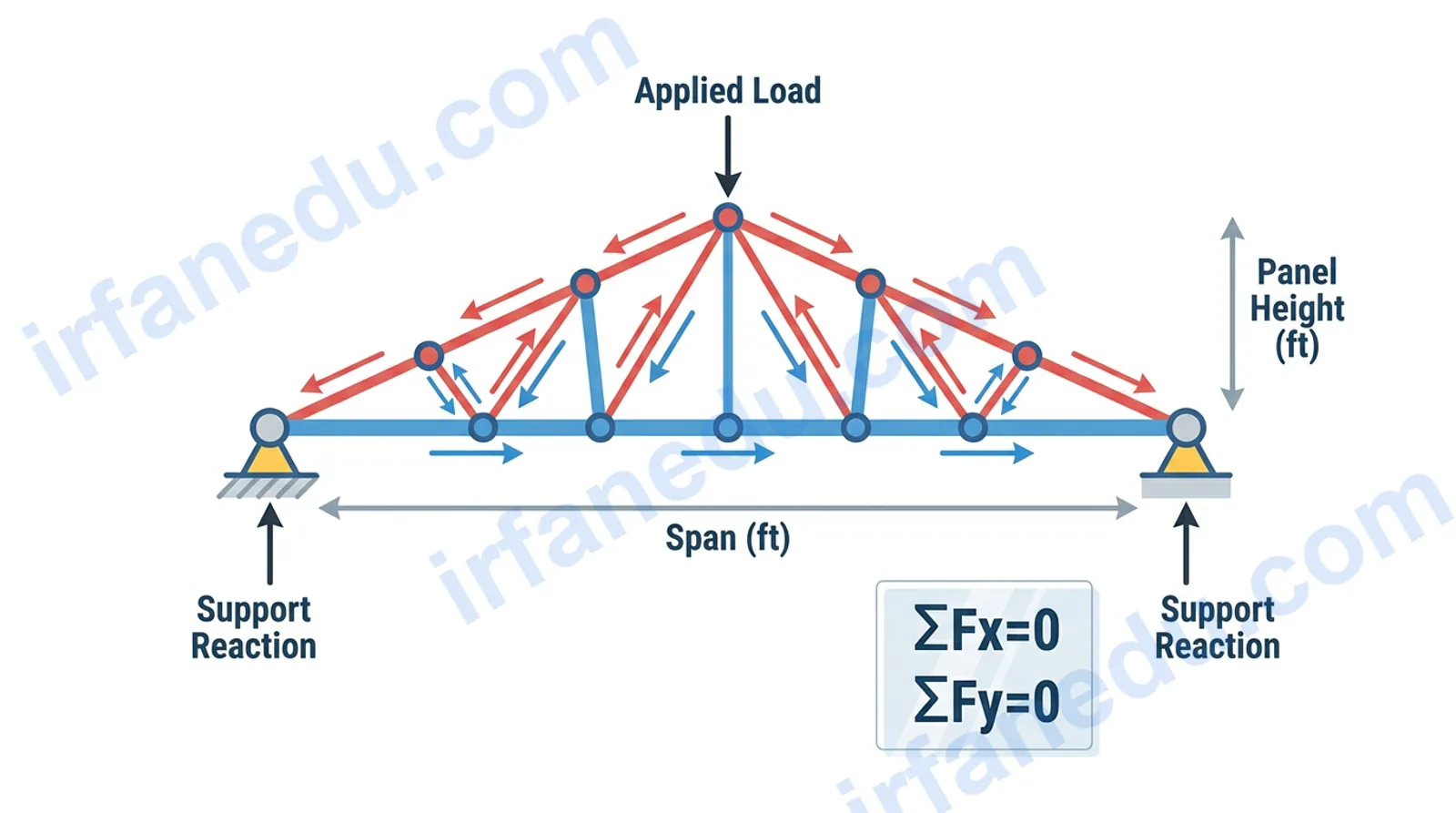
You’ve probably been told that truss analysis is just “plug and chug” with a formula. That’s wrong — and it’s the reason so many students get the sign convention backwards, label tension as compression, and lose points on every statics exam. Truss analysis is a systematic process, and once you see the logic, it clicks permanently.
This calculator handles the most common case in US structural courses and residential construction: a simple symmetric triangular truss (king-post style) with a single vertical load at the apex, supported by a pin on the left and a roller on the right. Enter span, height, and load in US customary units — you get every member force and reaction in pounds, with a numbered solution you can follow step by step.
- Find support reactions at both supports instantly
- Get every member force labeled tension or compression
- See the full Method of Joints solution, not just a number
- Understand why the bottom chord is always in tension for this geometry
A truss calculator solves the internal forces in each truss member and the support reactions at each pin or roller. Enter span, height, and applied load; the calculator applies the Method of Joints — summing forces at each joint (ΣFx = 0, ΣFy = 0) — and returns every member force labeled tension or compression, in pounds.
Truss Member Force Calculator
Truss Calculator
Simple symmetric triangular truss — Method of Joints — US customary units
How to Use This Calculator
- Span (L): Enter the total horizontal distance between the two support points in feet. For a 24-foot wide building, enter 24.
- Height (h): Enter the vertical rise from the bottom chord to the apex joint in feet. A 4-in-12 pitch on a 24-ft span gives h = 8 ft.
- Apex Load (P): Enter the total vertical load applied at the peak joint in pounds. This typically represents the tributary roof load (dead + live) delivered to the apex.
- Click Calculate. The result card shows both support reactions, a member-force table, and a numbered step-by-step solution.
- Click Reset to clear and start over.
What Is a Truss?
A truss is a structural framework made of straight members connected at joints (nodes) to form triangles. Triangles are the only shape that cannot deform without changing member length, which makes trusses extremely rigid and efficient. Every member in an ideal truss carries only axial force — pure tension or pure compression — with no bending.
The Wikipedia article on trusses covers the full taxonomy, but in US residential and light commercial construction, the two most common types are the Pratt truss (vertical members in tension, diagonals in compression under gravity load) and the Warren truss (alternating diagonal members, no verticals). This calculator models the simplest case: a symmetric triangular truss with a king post, the geometry underlying most residential roof trusses.
        C (Apex, Load P ↓)
       /|\
      / | \
  AB /  |  \ BC
    /   |   \
   / king|   \
  /  post|    \
A --------+-------- B
(Pin)    AC     (Roller)
  ←— L/2 —→←— L/2 —→
  R_left ↑          ↑ R_right
Joints: A (left pin support), B (right roller support), C (apex). Members: AB = left rafter, BC = right rafter, AC = bottom chord, and the vertical king post from C down to the midpoint of AC.
The Formula Explained
The Method of Joints applies two equilibrium equations at each joint of a statically determinate truss. Because every member is two-force (pin-connected at both ends, no bending), the only unknown at each joint is the magnitude of each member force.
ΣFx = 0 (sum of horizontal forces = 0)
ΣFy = 0 (sum of vertical forces = 0)
Sign convention: Assume every unknown member force is tension (pointing away from the joint). A negative result means the member is actually in compression.
Variables & Symbols
| Symbol | Meaning | US Unit |
|---|---|---|
| L | Total truss span (tip to tip) | feet (ft) |
| h | Truss height (rise at apex) | feet (ft) |
| P | Applied vertical load at apex | pounds (lb) |
| RL, RR | Left and right support reactions | lb |
| θ | Rafter pitch angle from horizontal | degrees (°) |
| FAB | Force in left rafter member | lb |
| FAC | Force in bottom chord | lb |
Rafter length: r = √((L/2)² + h²) | Pitch angle: θ = arctan(h / (L/2))
Reactions (symmetric): RL = RR = P / 2
Left rafter (compression): FAB = −RL / sinθ
Bottom chord (tension): FAC = RL × cosθ / sinθ
Worked Examples
Span L = 24 ft, height h = 6 ft, load P = 2,000 lb.
Rafter = √(12² + 6²) = √180 ≈ 13.416 ft. θ = arctan(6/12) = 26.57°.
Reactions: RL = RR = 1,000 lb.
Left rafter: FAB = −1,000 / sin(26.57°) = −1,000 / 0.4472 ≈ −2,236 lb (Compression).
Bottom chord: FAC = 1,000 × cos(26.57°) / sin(26.57°) = 1,000 × 2.0 = 2,000 lb (Tension).
King post: 0 lb (Zero-Force).
Span L = 30 ft, height h = 10 ft, load P = 3,600 lb.
Rafter = √(15² + 10²) = √325 ≈ 18.028 ft. θ = arctan(10/15) = 33.69°.
Reactions: RL = RR = 1,800 lb.
Left rafter: FAB = −1,800 / sin(33.69°) ≈ −1,800 / 0.5547 ≈ −3,246 lb (Compression).
Bottom chord: FAC = 1,800 / tan(33.69°) = 1,800 / 0.6667 ≈ 2,700 lb (Tension).
King post: 0 lb (Zero-Force).
Notice that a steeper pitch (larger θ) reduces the bottom chord tension and increases the rafter compression for the same load. That is a direct consequence of the geometry, not a coincidence.
Myths vs. Truth: What Most Statics Courses Get Wrong
| Common Myth | The Truth |
|---|---|
| "The king post always carries load." | Under a symmetric apex load, the king post is a zero-force member. It only activates under asymmetric loading or to prevent buckling. |
| "Longer span always means more tension in the bottom chord." | Tension in the bottom chord depends on both span AND pitch angle. A steeper pitch on a longer truss can produce less bottom-chord tension than a shallow pitch on a shorter one. |
| "Assume tension is positive — compression is rare." | In roof trusses under gravity load, the top chord (rafters) are almost always in compression. Compression is the dominant force type in the top chord. |
| "The Method of Sections is always faster." | Method of Sections is faster when you need only one or two interior member forces. For a full solution of all members, Method of Joints is more systematic and less error-prone. |
The king post is a zero-force member under symmetric loading — and that is not a flaw, it is intentional design. Almost every textbook and online guide treats zero-force members as curiosities to identify on an exam. What they rarely explain is why they exist in real structures: a king post that carries zero axial force under the design load still prevents the long bottom chord from sagging under self-weight and stops the rafters from buckling laterally. In my experience teaching statics, students who understand this distinction stop treating zero-force members as "useless" and start recognizing them as stability elements — which is exactly how a structural engineer thinks about them. The AISC Steel Construction Manual and the Timber Frame Engineering Council both document this explicitly, yet most intro-level guides skip it entirely.
In my 15+ years teaching statics and structural analysis, the single biggest mistake I see students make is skipping the free-body diagram and jumping straight to the formula. The Method of Joints only works if you draw the joint, assume all unknowns in tension, and write the equations in order. I have seen students get the right magnitude but the wrong sign on every single member because they skipped that one step. The calculator above forces you to see the step-by-step output — use it to check your hand work, not replace it.
Related: Tension Calculator for Two Strings at Different Angles
Practice Problems
Problem 1: A 20-ft span truss, 5 ft high, carries 1,600 lb at the apex. Find all member forces.
Given: L = 20 ft, h = 5 ft, P = 1,600 lb.
Rafter = √(10² + 5²) = √125 ≈ 11.180 ft. θ = arctan(5/10) = 26.57°. sinθ ≈ 0.4472, cosθ ≈ 0.8944.
RL = RR = 800 lb.
Left rafter: FAB = −800 / 0.4472 ≈ −1,789 lb (Compression).
Bottom chord: FAC = 800 × 0.8944 / 0.4472 = 800 × 2.0 = 1,600 lb (Tension).
King post: 0 lb (Zero-Force).
Problem 2: Same 20-ft truss, but height is increased to 8 ft. How does the bottom chord tension change?
Given: L = 20 ft, h = 8 ft, P = 1,600 lb.
Rafter = √(10² + 8²) = √164 ≈ 12.806 ft. θ = arctan(8/10) = 38.66°. sinθ ≈ 0.6247, cosθ ≈ 0.7809.
RL = RR = 800 lb.
Bottom chord: FAC = 800 × 0.7809 / 0.6247 ≈ 1,000 lb (Tension).
Conclusion: Increasing the height from 5 ft to 8 ft reduced the bottom chord tension from 1,600 lb to 1,000 lb — a 37.5% reduction. Steeper pitch = less horizontal thrust.
Frequently Asked Questions
What does a truss calculator solve?
What is the Method of Joints?
What is the difference between tension and compression in a truss member?
How do I find the support reactions for a simple truss?
What units does this truss calculator use?
Can I use this calculator for roof trusses?
What is a zero-force member in a truss?
- A truss calculator applies the Method of Joints to find every member force and support reaction in pounds.
- Top chord members (rafters) are in compression; the bottom chord is in tension under gravity loading.
- For a symmetric apex load, both support reactions equal P / 2 and the king post is a zero-force member.
- Steeper pitch angle reduces bottom-chord tension and increases rafter compression for the same load.
- Zero-force members are not useless — they prevent buckling and maintain stability under asymmetric loads.
- Always draw the free-body diagram and assume tension before writing equilibrium equations.