
Biology Vocabulary List: 80+ Must-Know Terms Every Student Needs
📋 Table of Contents
- Your Biology Vocabulary Master Checklist
- Cell Biology Vocabulary
- Genetics Vocabulary
- Ecology Vocabulary
- Evolution Vocabulary
- Human Body Systems Vocabulary
- Scientific Method Vocabulary
- Greek & Latin Roots That Unlock Dozens of Terms
- Common Mistakes Students Make with Biology Terms
- How to Study Biology Vocabulary Effectively
- Quick Knowledge Check Quiz
- Practice Problems
- Frequently Asked Questions
- Sources & References
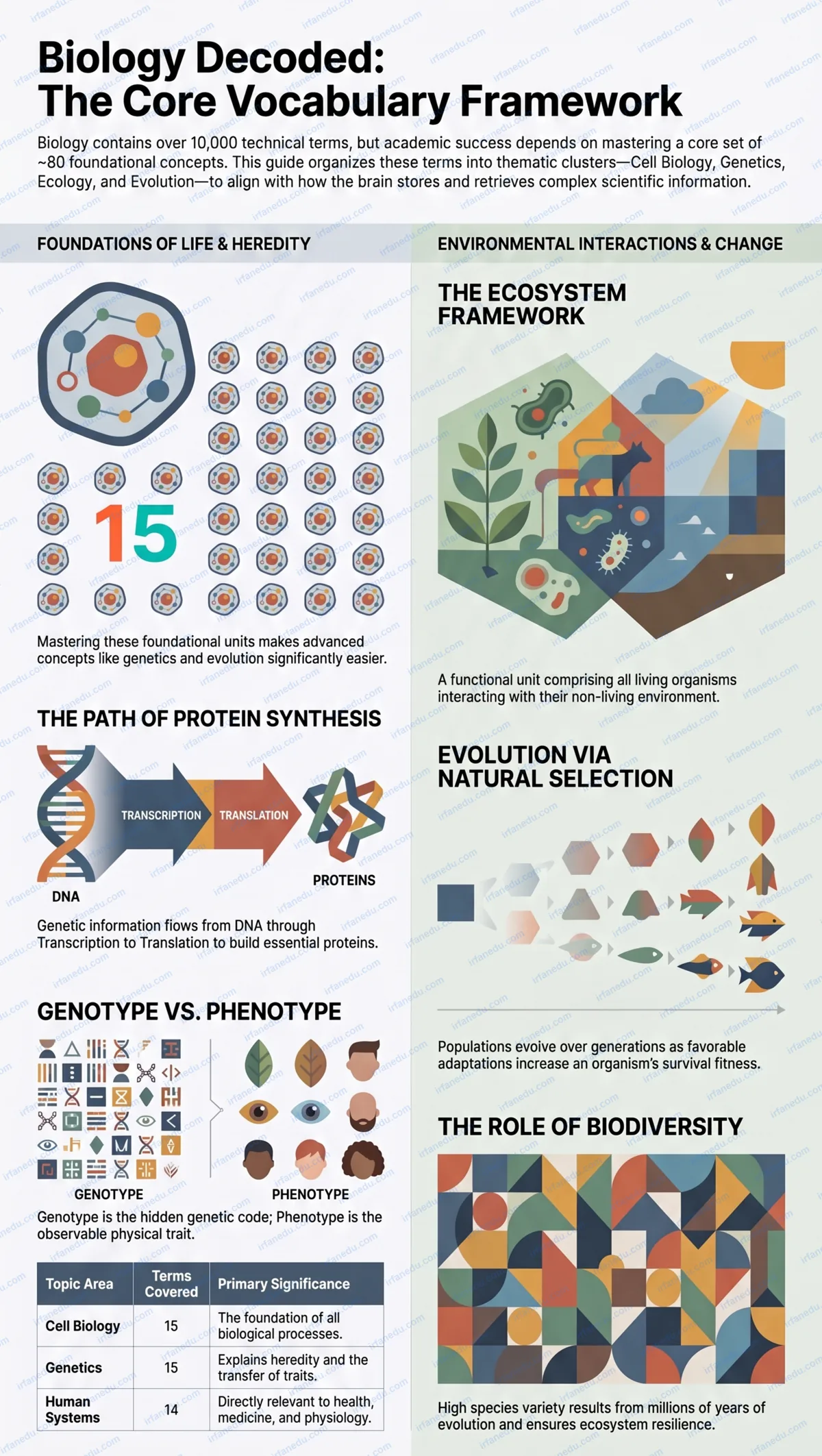
If you have ever stared at a biology textbook and felt like you were reading a foreign language, you are not alone. Biology has one of the largest technical vocabularies of any school subject — over 10,000 named terms by some estimates. The good news? You do not need to know all of them. You need a focused, well-organized biology vocabulary list that covers the terms that actually show up on tests, in textbooks, and in real scientific discussions.
A biology vocabulary list is a curated set of key scientific terms covering the major branches of biology — cell biology, genetics, ecology, evolution, and human physiology — along with their definitions and real-world examples. Mastering these core terms is the single fastest way to improve your biology grades and your ability to understand scientific reading.
In this guide, I have organized 80+ essential biology terms into topic-based checklists you can work through one section at a time. Each term comes with a plain-English definition and a quick example. By the end, you will have a complete reference you can return to throughout your course.
- ✅ Learn 80+ biology terms organized by topic
- ✅ Understand definitions with real-world examples
- ✅ Discover Greek/Latin roots to decode new words on your own
- ✅ Avoid the most common vocabulary mistakes students make
- ✅ Test yourself with a built-in quiz and practice problems
⚡ TL;DR – Quick Summary
- 🧬 This guide covers 80+ biology terms across 6 major topic areas.
- 📋 Each section is a checklist you can tick off as you learn each term.
- 🌱 Greek and Latin roots help you decode hundreds of unfamiliar words.
- ⚠️ Confusing mitosis/meiosis and gene/allele are the two most common student errors.
- 🧪 A 3-question quiz and reveal-on-click practice problems are included.
- 📚 Use spaced repetition and your own example sentences for long-term retention.
| Topic Area | Terms Covered | Why It Matters |
|---|---|---|
| Cell Biology | 15 terms | Foundation of all biology — everything starts at the cell |
| Genetics | 15 terms | Explains heredity, DNA, and how traits are passed on |
| Ecology | 14 terms | Describes how organisms interact with each other and their environment |
| Evolution | 12 terms | Explains the origin and diversity of life on Earth |
| Human Body Systems | 14 terms | Directly relevant to health, medicine, and physiology |
| Scientific Method | 10 terms | Essential for understanding experiments and research |
📋 Your Biology Vocabulary Master Checklist
Use this checklist as your study roadmap. Work through one section per study session. Each item links to its full definition in the section below.
🧫 Cell Biology (15 Terms)
- Cell
- Prokaryote
- Eukaryote
- Nucleus
- Cell membrane
- Organelle
- Mitochondria
- Chloroplast
- Ribosome
- Endoplasmic reticulum
- Golgi apparatus
- Mitosis
- Meiosis
- Osmosis
- Diffusion
🧬 Genetics (15 Terms)
- DNA
- Gene
- Allele
- Chromosome
- Genotype
- Phenotype
- Dominant
- Recessive
- Homozygous
- Heterozygous
- Mutation
- RNA
- Transcription
- Translation
- Protein synthesis
🌿 Ecology (14 Terms)
- Ecosystem
- Biome
- Population
- Community
- Food chain
- Food web
- Producer
- Consumer
- Decomposer
- Symbiosis
- Predation
- Carrying capacity
- Biodiversity
- Niche
🧫 Cell Biology Vocabulary: Definitions and Examples
Cell biology terms form the foundation of every other topic in biology. If you understand what happens inside a cell, every other concept — from genetics to evolution — becomes far easier to follow.
| Term | Definition | Quick Example |
|---|---|---|
| Cell | The smallest structural and functional unit of life | A red blood cell carries oxygen through your bloodstream |
| Prokaryote | A single-celled organism with no membrane-bound nucleus | Bacteria are prokaryotes |
| Eukaryote | An organism whose cells have a membrane-bound nucleus | All plants, animals, and fungi are eukaryotes |
| Nucleus | The membrane-bound organelle that contains the cell’s DNA | The nucleus controls which proteins a cell makes |
| Cell membrane | A flexible phospholipid bilayer that controls what enters and exits the cell | It acts like a security gate — letting some molecules through and blocking others |
| Organelle | A specialized structure within a cell that performs a specific function | Mitochondria and ribosomes are both organelles |
| Mitochondria | Organelles that produce ATP (energy) through cellular respiration | Muscle cells have many mitochondria because they need lots of energy |
| Chloroplast | An organelle in plant cells that captures sunlight and produces glucose via photosynthesis | Leaves are green because chloroplasts contain chlorophyll |
| Ribosome | A tiny organelle that assembles proteins from amino acids | Every cell that makes proteins needs ribosomes |
| Endoplasmic reticulum | A network of membranes that processes and transports proteins and lipids | Rough ER has ribosomes attached; smooth ER does not |
| Golgi apparatus | An organelle that packages and ships proteins to their destinations | Think of it as the cell’s post office |
| Mitosis | Cell division that produces two genetically identical daughter cells | Your skin cells replace themselves through mitosis |
| Meiosis | Cell division that produces four genetically unique sex cells (gametes), each with half the normal chromosome number | Sperm and egg cells are produced by meiosis |
| Osmosis | The movement of water across a semi-permeable membrane from an area of low solute concentration to high solute concentration | Cells shrivel in salty water because osmosis pulls water out |
| Diffusion | The movement of molecules from an area of high concentration to low concentration | Oxygen diffuses from the lungs into the bloodstream |
🔬 VISUAL: Cell Structure at a Glance
┌─────────────────────────────────────────────────────┐
│                   EUKARYOTIC CELL                   │
│                                                     │
│  ┌─────────┐   ┌──────────────┐   ┌─────────────┐  │
│  │ NUCLEUS │   │ MITOCHONDRIA │   │ CHLOROPLAST │  │
│  │  (DNA)  │   │   (Energy)   │   │ (Photosyn.) │  │
│  └─────────┘   └──────────────┘   └─────────────┘  │
│                                                     │
│  ┌──────────┐  ┌────────────┐  ┌──────────────┐    │
│  │RIBOSOME  │  │  GOLGI     │  │  ENDOPLASMIC │    │
│  │(Protein) │  │(Packaging) │  │  RETICULUM   │    │
│  └──────────┘  └────────────┘  └──────────────┘    │
│                                                     │
│  ←──────── CELL MEMBRANE (controls entry/exit) ───→ │
└─────────────────────────────────────────────────────┘
  PROKARYOTE: No nucleus, no membrane-bound organelles
  EUKARYOTE:  Has nucleus + membrane-bound organelles
In my experience tutoring students, the single biggest cell biology confusion is between mitosis and meiosis. Here is the shortcut I always share: Mitosis = More cells (same), Meiosis = Mix (different, half). Mitosis makes more of the same cells for growth. Meiosis makes sex cells that mix genetic material. Once that clicks, everything else about cell division falls into place.
🧬 Genetics Vocabulary: Definitions and Examples
Genetics vocabulary explains how traits are inherited and how DNA carries the instructions for building every living organism. These terms appear in nearly every biology course at every level.
| Term | Definition | Quick Example |
|---|---|---|
| DNA | Deoxyribonucleic acid — the double-helix molecule that carries genetic instructions for all living organisms | Your DNA is unique to you (except for identical twins) |
| Gene | A specific segment of DNA that codes for a particular protein or trait | The gene for blood type determines your A, B, AB, or O type |
| Allele | One of two or more versions of a gene | Brown eye allele vs. blue eye allele |
| Chromosome | A thread-like structure made of DNA and protein that carries genes | Humans have 46 chromosomes (23 pairs) |
| Genotype | The genetic makeup of an organism (the alleles it carries) | Bb is the genotype for a heterozygous brown-eyed person |
| Phenotype | The observable physical traits of an organism, produced by its genotype and environment | Brown eyes are a phenotype |
| Dominant | An allele that is expressed in the phenotype even when only one copy is present | Brown eye color is dominant over blue |
| Recessive | An allele that is only expressed in the phenotype when two copies are present | Blue eyes appear only when both alleles are recessive (bb) |
| Homozygous | Having two identical alleles for a gene (BB or bb) | A plant with two alleles for red flowers is homozygous dominant |
| Heterozygous | Having two different alleles for a gene (Bb) | A carrier of a recessive disease is often heterozygous |
| Mutation | A change in the DNA sequence of a gene | Some mutations cause disease; others have no effect |
| RNA | Ribonucleic acid — a single-stranded molecule that carries genetic messages from DNA to ribosomes | mRNA carries the instructions for making a specific protein |
| Transcription | The process of copying a DNA sequence into mRNA | Transcription happens in the nucleus |
| Translation | The process of reading mRNA to assemble a protein at a ribosome | Translation happens in the cytoplasm |
| Protein synthesis | The overall process of making a protein from a DNA template, involving both transcription and translation | Every enzyme in your body was made through protein synthesis |
Two plants both have brown flowers (same phenotype). But one has genotype BB (homozygous dominant) and the other has Bb (heterozygous). If you cross them, only the Bb plant can produce offspring with white flowers. Same phenotype, different genotype — this is why genotype matters.
🌿 Ecology Vocabulary: Definitions and Examples
Ecology vocabulary describes how living things interact with each other and with their physical environment. These terms are essential for understanding environmental science, conservation, and biodiversity.
| Term | Definition | Quick Example |
|---|---|---|
| Ecosystem | All the living organisms in an area plus the non-living physical environment they interact with | A coral reef is an ecosystem |
| Biome | A large geographic region with a characteristic climate and community of organisms | Tropical rainforest, desert, and tundra are biomes |
| Population | All the individuals of the same species living in the same area at the same time | All the wolves in Yellowstone National Park form a population |
| Community | All the different populations of species living in the same area | The wolves, elk, trees, and bacteria in a forest form a community |
| Food chain | A linear sequence showing how energy passes from one organism to the next through feeding | Grass → grasshopper → frog → snake → hawk |
| Food web | An interconnected network of food chains in an ecosystem | A food web shows that most animals eat more than one thing |
| Producer | An organism that makes its own food using sunlight or chemicals (autotroph) | Plants, algae, and some bacteria are producers |
| Consumer | An organism that obtains energy by eating other organisms (heterotroph) | Herbivores, carnivores, and omnivores are all consumers |
| Decomposer | An organism that breaks down dead organic matter and recycles nutrients back into the ecosystem | Fungi and bacteria are key decomposers |
| Symbiosis | A close, long-term interaction between two different species | Clownfish and sea anemones have a mutualistic symbiosis |
| Predation | An interaction where one organism (predator) hunts and eats another (prey) | A lion hunting a zebra is predation |
| Carrying capacity | The maximum population size that an environment can sustainably support | When deer exceed the forest’s carrying capacity, food runs short |
| Biodiversity | The variety of life in an area, including species, genetic, and ecosystem diversity | Tropical rainforests have the highest biodiversity on Earth |
| Niche | The role an organism plays in its ecosystem, including what it eats, where it lives, and how it interacts with others | The niche of a bee includes pollinating flowers and feeding on nectar |
🦕 Evolution Vocabulary: Definitions and Examples
Evolution vocabulary explains how species change over time and how the diversity of life on Earth came to be. These terms are central to modern biology and appear in standardized tests worldwide.
| Term | Definition | Quick Example |
|---|---|---|
| Evolution | The change in the inherited characteristics of a population over successive generations | The evolution of antibiotic resistance in bacteria |
| Natural selection | The process by which individuals with favorable traits survive and reproduce more successfully | Darker moths survived better on soot-covered trees during the Industrial Revolution |
| Adaptation | A heritable trait that increases an organism’s fitness in its environment | A polar bear’s thick fur is an adaptation to cold climates |
| Fitness | An organism’s ability to survive and reproduce in its environment relative to others | A faster cheetah has higher fitness than a slower one |
| Speciation | The formation of a new species from an existing one, usually through reproductive isolation | Darwin’s finches on the Galapagos Islands are a classic speciation example |
| Common ancestor | A species from which two or more descendant species evolved | Humans and chimpanzees share a common ancestor |
| Fossil | Preserved remains or traces of ancient organisms found in rock | Fossils provide direct evidence of past life forms |
| Genetic drift | Random changes in allele frequencies in a small population | A small island population may lose certain alleles by chance |
| Mutation | A source of new genetic variation that can be acted on by natural selection | A mutation that improves camouflage may spread through a population |
| Homologous structures | Body parts in different species that share the same evolutionary origin but may have different functions | A human arm, a whale flipper, and a bat wing are homologous |
| Vestigial structure | A body part that has lost its original function through evolution | The human appendix is a vestigial structure |
| Biodiversity | The variety of life that results from millions of years of evolution | Greater biodiversity means greater ecosystem resilience |
Students often confuse “adaptation” with “evolution.” Here is the key distinction I always emphasize: an individual organism does not evolve during its lifetime. Adaptations are traits that spread through a population over many generations because they improve survival. A single giraffe does not grow a longer neck because it needs one — giraffes with longer necks survived better and passed that trait on. That is evolution by natural selection.
🫀 Human Body Systems Vocabulary
Human body systems vocabulary covers the major organ systems and the processes that keep the body functioning. These terms are essential for health science, physiology, and medicine-related studies.
| Term | Definition | System |
|---|---|---|
| Homeostasis | The maintenance of a stable internal environment in the body | All systems |
| Organ | A group of tissues that work together to perform a specific function | All systems |
| Tissue | A group of similar cells that work together to perform a function | All systems |
| Neuron | A specialized cell that transmits electrical signals in the nervous system | Nervous |
| Synapse | The gap between two neurons where chemical signals (neurotransmitters) are passed | Nervous |
| Hormone | A chemical messenger produced by a gland and transported in the blood to regulate body functions | Endocrine |
| Enzyme | A protein that speeds up a chemical reaction in the body without being consumed | Digestive / All |
| Respiration (cellular) | The process by which cells break down glucose to release ATP energy | All cells |
| Photosynthesis | The process by which plants use sunlight, water, and CO₂ to produce glucose and oxygen | Plant cells |
| Immune system | The body’s defense network against pathogens, including white blood cells and antibodies | Immune |
| Antibody | A protein produced by the immune system that recognizes and neutralizes a specific pathogen | Immune |
| Pathogen | A microorganism (virus, bacterium, fungus, or parasite) that causes disease | Immune |
| Stimulus | A change in the environment that triggers a response from an organism | Nervous |
| Feedback loop | A regulatory mechanism where the output of a system influences its own input to maintain balance | Endocrine / All |
🔬 Scientific Method Vocabulary
Scientific method vocabulary is the language of research and experimentation. Every biology lab report and research paper uses these terms, so knowing them precisely is essential.
| Term | Definition |
|---|---|
| Hypothesis | A testable, falsifiable prediction about the relationship between variables, stated as an if-then statement |
| Variable | Any factor that can change in an experiment; includes independent, dependent, and controlled variables |
| Independent variable | The factor the experimenter deliberately changes to test its effect |
| Dependent variable | The factor that is measured or observed — it depends on the independent variable |
| Control group | The group in an experiment that does not receive the experimental treatment, used as a baseline for comparison |
| Data | Factual information collected during an experiment, which can be quantitative (numbers) or qualitative (descriptions) |
| Conclusion | A statement that interprets the results of an experiment and states whether the hypothesis was supported or refuted |
| Theory | A well-substantiated explanation of natural phenomena, supported by extensive evidence and repeated testing |
| Peer review | The process by which other scientists evaluate a study’s methods and conclusions before publication |
Sources & ReferencesReviewed by Dr. Irfan Mansuri. External links open in a new tab and are provided for further reading and verification. 1 thought on “Biology Vocabulary List: 80+ Must-Know Terms”Leave a Comment |
very goood Thank you