
Stoichiometry Practice Problems with Answers: Step-by-Step Guide
✓ Expert Reviewed by Dr. Irfan Mansuri | Last Updated: July 2026
| Fact | Detail |
|---|---|
| Core concept | Using balanced equations to calculate reactant/product quantities |
| Key unit | The mole (1 mol = 6.022 x 10²³ particles — Avogadro’s number) |
| Mole ratio source | Coefficients of a balanced chemical equation |
| Mass-to-moles formula | moles = mass (g) / molar mass (g/mol) |
| Limiting reagent | Reactant that runs out first; controls maximum product yield |
| Percent yield formula | (actual yield / theoretical yield) x 100% |
| Problem types covered | Mole-mole, mass-mass, limiting reagent, percent yield |
| Prerequisite skill | Balancing chemical equations |
Table of Contents
- What Is Stoichiometry?
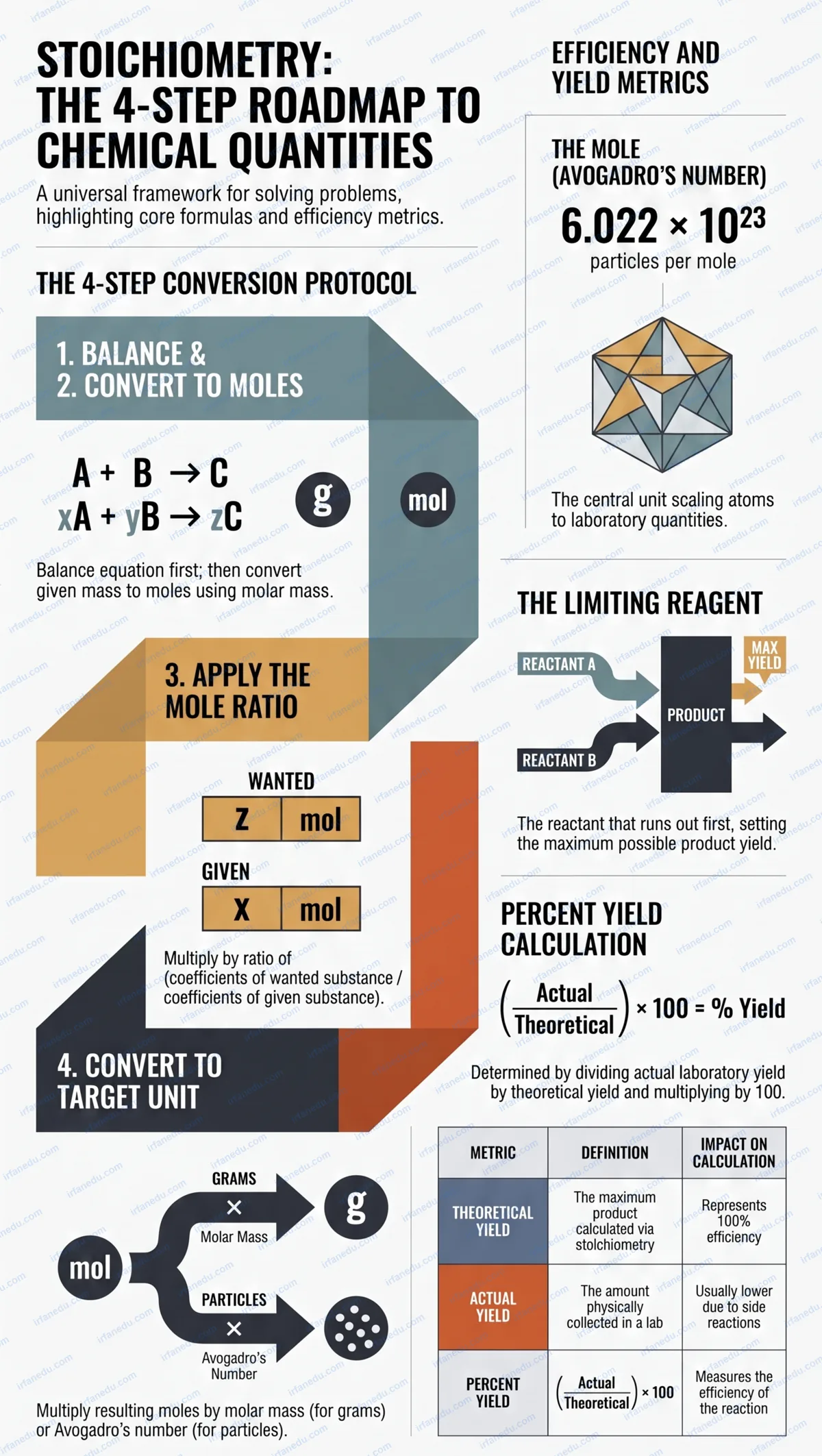
- The 4-Step Stoichiometry Method
- Mole-to-Mole Practice Problems
- Mass-to-Mass Practice Problems
- Limiting Reagent Problems
- Percent Yield Problems
- Common Mistakes and How to Avoid Them
- Real-World Applications of Stoichiometry
- Quick Knowledge Check
- Reveal-on-Click Practice Problems
- Frequently Asked Questions
- Key Takeaways
- Sources and References
Stoichiometry practice problems with answers help you convert between masses, moles, and particles in chemical reactions using balanced equations and mole ratios. The core method is always four steps: balance the equation, convert to moles, apply the mole ratio, then convert back to the unit you need.
If you have ever stared at a chemistry problem asking how many grams of water form when hydrogen burns in oxygen — and felt completely lost — you are in the right place. Stoichiometry is the mathematical backbone of chemistry, and once you see the pattern, every problem follows the same logical path.
In this guide, I walk you through every major problem type with fully worked examples, clear diagrams, and practice problems you can test yourself on. By the end, stoichiometry will feel less like guesswork and more like a reliable four-step recipe.
- Understand what stoichiometry is and why moles matter
- Apply the 4-step method to any stoichiometry problem
- Solve mole-mole, mass-mass, limiting reagent, and percent yield problems
- Avoid the most common calculation errors
- Connect stoichiometry to real-world chemistry
TL;DR – Quick Summary
- Stoichiometry uses balanced equations to calculate exact amounts of reactants and products.
- The 4-step method: balance equation, convert to moles, use mole ratio, convert back.
- Mole ratios come directly from the coefficients of the balanced equation.
- The limiting reagent runs out first and sets the maximum product amount.
- Percent yield = (actual / theoretical) x 100%; rarely reaches 100% in practice.
- Balancing the equation first is the single most important step — skip it and everything fails.
What Is Stoichiometry?
Stoichiometry is the quantitative study of chemical reactions. It tells you exactly how much of each substance reacts and how much product forms, based on the law of conservation of mass.
The word comes from the Greek stoicheion (element) and metron (measure). In practice, it means using the balanced chemical equation as a conversion tool between amounts of different substances.
The central unit is the mole. One mole of any substance contains 6.022 x 10²³ particles (Avogadro’s number). Because atoms react in fixed whole-number ratios, the mole lets us scale those ratios up to laboratory-sized quantities.
For example, the balanced equation for burning hydrogen is:
Foundational Equation
2H2 + O2 → 2H2O
This tells you: 2 moles of H2 react with exactly 1 mole of O2 to produce exactly 2 moles of H2O. The coefficients 2, 1, 2 are the mole ratios.
Those coefficients are everything. They are the conversion factors you will use in every single stoichiometry problem.
The 4-Step Stoichiometry Method
Every stoichiometry problem — from the simplest mole-mole conversion to a multi-step limiting reagent calculation — follows the same four-step path. Learn this once and you have a universal tool.
STOICHIOMETRY ROADMAP
=====================

  GIVEN (grams)
       |
       | Step 1: divide by molar mass (g/mol)
       v
  GIVEN (moles)
       |
       | Step 2: multiply by mole ratio
       |         (coeff. of WANT / coeff. of GIVEN)
       v
  WANTED (moles)
       |
       | Step 3: multiply by molar mass (g/mol)
       v
  WANTED (grams)

  KEY FORMULAS
  ------------
  moles = mass / molar mass
  mole ratio = coeff(want) / coeff(given)
  % yield = (actual / theoretical) x 100
Step-by-Step Breakdown
- Balance the equation. Atoms must be conserved. Never skip this.
- Convert given quantity to moles. Use: moles = mass (g) / molar mass (g/mol).
- Apply the mole ratio. Multiply moles of the given substance by (coefficient of wanted / coefficient of given).
- Convert moles to the desired unit. For grams: multiply by molar mass. For particles: multiply by 6.022 x 10²³.
In my experience tutoring hundreds of chemistry students, the single biggest source of wrong answers is not the math — it is using an unbalanced equation. Students rush to calculate and forget step one. I always tell my students: treat balancing the equation like putting on your seatbelt. You do it every single time before anything else moves.
Mole-to-Mole Practice Problems
Mole-to-mole problems are the purest form of stoichiometry. You are given moles of one substance and asked to find moles of another. No mass conversion needed — just the mole ratio.
Worked Example 1 — Mole-to-Mole
Problem: How many moles of O2 are needed to react completely with 4.0 mol of H2?
Balanced equation: 2H2 + O2 → 2H2O
Step 1: Equation is already balanced. Mole ratio: 2 mol H2 : 1 mol O2
Step 2: Apply ratio: 4.0 mol H2 x (1 mol O2 / 2 mol H2) = 2.0 mol O2
Worked Example 2 — Mole-to-Mole
Problem: In the reaction N2 + 3H2 → 2NH3, how many moles of NH3 form from 6.0 mol of H2?
Mole ratio: 3 mol H2 : 2 mol NH3
Calculation: 6.0 mol H2 x (2 mol NH3 / 3 mol H2) = 4.0 mol NH3
Mass-to-Mass Practice Problems
Mass-to-mass problems are the most common type on exams. You are given grams of one substance and must find grams of another. This requires the full 4-step chain.
Worked Example 3 — Mass-to-Mass
Problem: How many grams of water form when 4.0 g of H2 burns completely in oxygen?
Balanced equation: 2H2 + O2 → 2H2O
Molar masses: H2 = 2.02 g/mol; H2O = 18.02 g/mol
Step 1 — grams to moles of H2:
4.0 g / 2.02 g/mol = 1.98 mol H2
Step 2 — mole ratio (2H2 : 2H2O = 1:1):
1.98 mol H2 x (2 mol H2O / 2 mol H2) = 1.98 mol H2O
Step 3 — moles to grams of H2O:
1.98 mol x 18.02 g/mol = 35.7 g H2O
Worked Example 4 — Mass-to-Mass
Problem: How many grams of CO2 are produced when 12.0 g of carbon burns completely?
Balanced equation: C + O2 → CO2
Molar masses: C = 12.01 g/mol; CO2 = 44.01 g/mol
Step 1: 12.0 g C / 12.01 g/mol = 0.999 mol C (approx. 1.0 mol)
Step 2: Mole ratio C : CO2 = 1:1, so 1.0 mol CO2
Step 3: 1.0 mol x 44.01 g/mol = 44.0 g CO2
[IMAGE: Mass-to-mass stoichiometry conversion chain flowchart | ALT: mass to mass stoichiometry step by step conversion diagram]
Limiting Reagent Problems
The limiting reagent is the reactant that gets used up first, stopping the reaction. Identifying it correctly is essential because it determines the theoretical yield of product.
The method: calculate the moles of product each reactant could produce separately, then pick the smaller value. The reactant that gives the smaller product amount is the limiting reagent.
Worked Example 5 — Limiting Reagent
Problem: 5.0 g of H2 and 32.0 g of O2 are mixed. Which is the limiting reagent? How many grams of H2O form?
Balanced equation: 2H2 + O2 → 2H2O
Convert both to moles:
- H2: 5.0 g / 2.02 g/mol = 2.48 mol H2
- O2: 32.0 g / 32.00 g/mol = 1.00 mol O2
Find product moles from each reactant:
- From H2: 2.48 mol x (2 mol H2O / 2 mol H2) = 2.48 mol H2O
- From O2: 1.00 mol x (2 mol H2O / 1 mol O2) = 2.00 mol H2O
Smaller value = 2.00 mol H2O → O2 is the limiting reagent.
Mass of H2O: 2.00 mol x 18.02 g/mol = 36.0 g H2O
| Feature | Limiting Reagent | Excess Reagent |
|---|---|---|
| Definition | Runs out first in the reaction | Left over after reaction ends |
| Controls yield? | Yes — sets the maximum product | No |
| How to identify | Gives the smaller moles of product | Gives the larger moles of product |
| Analogy | Bread slices when making sandwiches | Cheese slices (extra left over) |
Percent Yield Problems
Percent yield measures how efficient a reaction is. The theoretical yield is the maximum amount of product calculated from stoichiometry. The actual yield is what you collect in the lab.
The formula is straightforward: % yield = (actual yield / theoretical yield) x 100%. A yield below 100% is normal — side reactions, incomplete reactions, and physical losses all reduce the actual yield.
Worked Example 6 — Percent Yield
Problem: A student reacts 10.0 g of iron (Fe) with excess sulfur to form iron(II) sulfide (FeS). The student collects 12.5 g of FeS. Calculate the percent yield.
Balanced equation: Fe + S → FeS
Molar masses: Fe = 55.85 g/mol; FeS = 87.91 g/mol
Step 1 — moles of Fe: 10.0 g / 55.85 g/mol = 0.179 mol Fe
Step 2 — mole ratio 1:1: 0.179 mol FeS (theoretical)
Step 3 — theoretical yield in grams: 0.179 mol x 87.91 g/mol = 15.7 g FeS
Step 4 — percent yield: (12.5 g / 15.7 g) x 100% = 79.6%
I have seen students panic when they get a percent yield above 100% in a lab report. In my experience, this almost always means the product was not fully dried before weighing — moisture adds mass. A yield slightly over 100% is a clue to check your lab technique, not your stoichiometry. Real reactions cannot violate conservation of mass.
Common Mistakes and How to Avoid Them
Most stoichiometry errors fall into a small number of repeating patterns. Knowing them in advance saves you from losing easy marks.
| Mistake | Wrong Approach | Correct Approach |
|---|---|---|
| Unbalanced equation | Using coefficients before balancing | Always balance first, then extract mole ratios |
| Wrong molar mass | Using atomic number instead of atomic mass | Use the periodic table atomic mass (e.g., O = 16.00, not 8) |
| Flipped mole ratio | Putting given substance on top of fraction | Put WANTED on top, GIVEN on bottom so units cancel |
| Ignoring limiting reagent | Using only one reactant’s data | Test both reactants; use the one giving smaller product |
| Rounding too early | Rounding intermediate mole values | Keep full precision until the final answer |
Real-World Applications of Stoichiometry
Stoichiometry is not just an exam topic. It is the calculation engine behind industries that affect daily life.
- Pharmaceutical manufacturing: Drug synthesis requires exact mole ratios to avoid toxic byproducts and maximize yield.
- Combustion engines: Engineers calculate the stoichiometric air-to-fuel ratio for complete combustion and minimal emissions.
- Fertilizer production: The Haber process (N2 + 3H2 → 2NH3) uses stoichiometry to optimize ammonia output at industrial scale.
- Baking: Leavening agents like baking soda react with acids in exact molar proportions to release CO2 and make bread rise.
- Environmental chemistry: Scientists use stoichiometry to model how pollutants like SO2 react in the atmosphere to form acid rain.
- Metallurgy: Smelting ore to extract pure metals requires precise stoichiometric calculations to determine how much reducing agent is needed.
[IMAGE: Industrial chemical plant showing stoichiometry in large-scale manufacturing | ALT: real world stoichiometry applications in industrial chemistry]
Quick Knowledge Check — Test Yourself
Select an answer. Green = correct. Red = try again.
Q1. In the equation 2H2 + O2 → 2H2O, what is the mole ratio of H2 to H2O?
Q2. Which formula correctly calculates percent yield?
Q3. The limiting reagent in a reaction is the one that:
Reveal-on-Click Practice Problems
Try each problem on your own first, then click to reveal the full worked answer.
Practice Problem 1: How many moles of NH3 form from 9.0 mol of H2? (N2 + 3H2 → 2NH3)
Mole ratio: 3 mol H2 : 2 mol NH3
Calculation: 9.0 mol H2 x (2 mol NH3 / 3 mol H2) = 6.0 mol NH3
Practice Problem 2: How many grams of CO2 form when 24.0 g of CH4 burns? (CH4 + 2O2 → CO2 + 2H2O)
Molar masses: CH4 = 16.05 g/mol; CO2 = 44.01 g/mol
Step 1: 24.0 g / 16.05 g/mol = 1.495 mol CH4
Step 2: Mole ratio CH4 : CO2 = 1:1, so 1.495 mol CO2
Step 3: 1.495 mol x 44.01 g/mol = 65.8 g CO2
Practice Problem 3: 8.0 g of H2 and 64.0 g of O2 react. Identify the limiting reagent. (2H2 + O2 → 2H2O)
Convert to moles: H2: 8.0/2.02 = 3.96 mol; O2: 64.0/32.00 = 2.00 mol
Product from H2: 3.96 x (2/2) = 3.96 mol H2O
Product from O2: 2.00 x (2/1) = 4.00 mol H2O
Smaller value = 3.96 mol → H2 is the limiting reagent.
Mass of H2O: 3.96 mol x 18.02 g/mol = 71.4 g H2O
Practice Problem 4: A reaction has a theoretical yield of 25.0 g and an actual yield of 19.5 g. What is the percent yield?
Formula: % yield = (actual / theoretical) x 100
Calculation: (19.5 / 25.0) x 100 = 78.0%
Frequently Asked Questions
What is stoichiometry in simple terms?
Stoichiometry is the branch of chemistry that uses balanced chemical equations to calculate the exact amounts of reactants and products involved in a reaction. It relies on mole ratios derived from the coefficients in a balanced equation to convert between masses, moles, and particles of different substances.
How do you find the mole ratio in stoichiometry?
The mole ratio comes directly from the coefficients of a balanced chemical equation. For example, in 2H2 + O2 → 2H2O, the mole ratio of H2 to O2 is 2:1, meaning 2 moles of hydrogen react with exactly 1 mole of oxygen. Always read the coefficients after balancing.
What is the limiting reagent and how do you find it?
The limiting reagent is the reactant that runs out first, stopping the reaction and setting the maximum product yield. To find it, convert all reactants to moles, calculate how many moles of product each could produce using the mole ratio, and identify the reactant that gives the smaller product amount.
How do you calculate percent yield?
Percent yield = (actual yield / theoretical yield) x 100. The theoretical yield is the maximum calculated from stoichiometry using the limiting reagent. The actual yield is what you physically collect in the lab. A value below 100% is normal due to side reactions, incomplete reactions, and physical losses during collection.
What is the 4-step stoichiometry method?
The 4-step method is: (1) Write and balance the equation, (2) convert the given mass to moles using molar mass, (3) use the mole ratio from the balanced equation to find moles of the target substance, (4) convert moles of the target back to grams by multiplying by its molar mass. This approach works for virtually every stoichiometry problem type.
Why is stoichiometry important in real life?
Stoichiometry is used in pharmaceutical manufacturing to calculate drug doses, in industrial chemistry to minimize waste, in environmental science to model pollution reactions, and in combustion engineering to optimize fuel efficiency. It is the foundation of quantitative chemistry and directly impacts product safety, cost, and environmental impact in virtually every chemical industry.
What is the most common mistake in stoichiometry problems?
The most common mistake is using an unbalanced equation. If the equation is not balanced, the mole ratios are wrong and every subsequent calculation fails. The second most common error is flipping the mole ratio fraction — always put the substance you want on top and the substance you have on the bottom so units cancel correctly.
Key Takeaways
- Stoichiometry converts between amounts of substances in a chemical reaction using balanced equations.
- The mole is the central unit — it bridges the atomic scale and the laboratory scale.
- Mole ratios come from the coefficients of the balanced equation, not from
Sources & References
Reviewed by Dr. Irfan Mansuri. External links open in a new tab and are provided for further reading and verification.