
Cellular Respiration Steps Simple: The Complete Student Guide
✓ Expert Reviewed by Dr. Irfan Mansuri [Last Updated: July 2026]
Every cell in your body is running a three-stage chemical factory right now, and it never stops. That factory is cellular respiration, and without it, you would have no energy to think, move, or breathe within seconds. The process is not mysterious once you see it broken into clear steps.
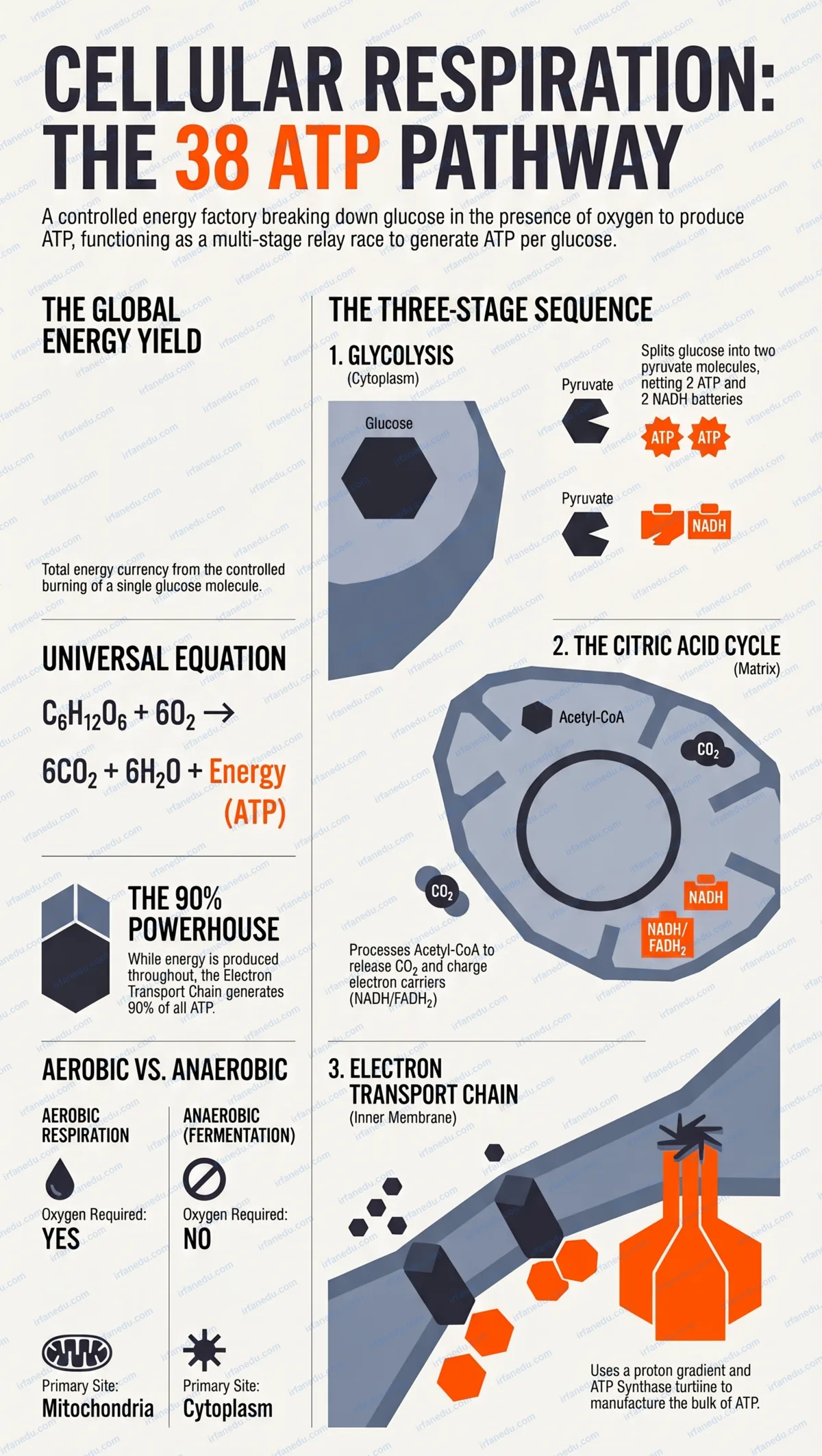
Cellular respiration is the process by which cells break down glucose (C6H12O6) in the presence of oxygen to produce ATP (adenosine triphosphate), carbon dioxide, and water. It occurs in three main stages: glycolysis in the cytoplasm, the Krebs cycle in the mitochondrial matrix, and the electron transport chain on the inner mitochondrial membrane, yielding approximately 36-38 ATP per glucose molecule.
In this guide, I walk you through each step with plain language, worked examples, and a visual overview. By the end, you will be able to explain the entire pathway from memory and answer any exam question on it with confidence.
- Understand what cellular respiration is and why it matters
- Follow each of the three main stages step by step
- Know the inputs, outputs, and location of every stage
- Distinguish aerobic from anaerobic respiration
- Avoid the most common exam mistakes on this topic
⚡ TL;DR – Quick Summary
- Cellular respiration converts one glucose molecule into 36-38 ATP molecules.
- Glycolysis (cytoplasm) splits glucose into 2 pyruvate, nets 2 ATP.
- Pyruvate oxidation converts pyruvate to acetyl-CoA, releasing CO2.
- Krebs cycle (mitochondrial matrix) extracts electrons, yields 2 ATP per glucose.
- Electron transport chain (inner mitochondrial membrane) produces 32-34 ATP using oxygen.
- Without oxygen, cells switch to fermentation and get only 2 ATP.
| Quick Fact | Detail |
|---|---|
| Overall equation | C6H12O6 + 6O2 → 6CO2 + 6H2O + ~38 ATP |
| Number of stages | 3 main stages (4 if pyruvate oxidation is counted separately) |
| Main site | Mitochondria (plus cytoplasm for glycolysis) |
| Net ATP from glycolysis | 2 ATP |
| Net ATP from Krebs cycle | 2 ATP |
| Net ATP from ETC | 32-34 ATP |
| Oxygen required? | Yes (aerobic); No for fermentation (anaerobic) |
| Key electron carriers | NADH, FADH2 |
| Final electron acceptor | Oxygen (O2) |
What Cellular Respiration Actually Is
Cellular respiration is the controlled burning of glucose to release energy in a form cells can use. The word “controlled” is critical. If you burned glucose in a test tube, you would get heat and light but no usable chemical energy. Cells do it in small, managed steps so they can capture that energy as ATP.
ATP (adenosine triphosphate) is the universal energy currency of life. Think of glucose as a large-denomination bill and ATP as the coins you actually spend. Cellular respiration is the process of making change.
The overall chemical equation is:
C6H12O6 + 6O2 → 6CO2 + 6H2O + ~36-38 ATP
This equation summarizes what happens across all three stages. The carbon atoms from glucose end up in carbon dioxide (which you exhale). The hydrogen atoms end up in water. The energy is captured as ATP.
The process happens inside and around the mitochondria, which is why mitochondria are called the “powerhouse of the cell.” That label is accurate, not just a textbook cliche.
The Three Steps at a Glance
The three stages of cellular respiration are glycolysis, the Krebs cycle, and the electron transport chain, and each one hands off products to the next. Understanding the handoff is the key to understanding the whole system.
GLUCOSE (C6H12O6)
     |
     v
+--------------------+
|   GLYCOLYSIS       |  Location: Cytoplasm
|   Glucose → 2 Pyruvate
|   Produces: 2 ATP, 2 NADH
+--------------------+
     |
     v
+--------------------+
| PYRUVATE OXIDATION |  Location: Mitochondrial Matrix
|   2 Pyruvate → 2 Acetyl-CoA
|   Produces: 2 NADH, releases 2 CO2
+--------------------+
     |
     v
+--------------------+
|   KREBS CYCLE      |  Location: Mitochondrial Matrix
|   2 Acetyl-CoA → 4 CO2
|   Produces: 2 ATP, 6 NADH, 2 FADH2
+--------------------+
     |
     v
+--------------------+
| ELECTRON TRANSPORT |  Location: Inner Mitochondrial Membrane
|   CHAIN (ETC)      |
|   10 NADH + 2 FADH2 → ~32-34 ATP
|   O2 + H+ + e- → H2O
+--------------------+
     |
     v
TOTAL: ~36-38 ATP + 6CO2 + 6H2O
Notice how each stage feeds the next. Glycolysis produces pyruvate, which feeds pyruvate oxidation. Pyruvate oxidation produces acetyl-CoA, which feeds the Krebs cycle. The Krebs cycle produces NADH and FADH2, which feed the electron transport chain. It is a relay race, not a single sprint.
Step 1: Glycolysis Breaks Glucose in Half
Glycolysis is the oldest energy-producing pathway in biology, and it proves that life found a way to make ATP long before oxygen existed on Earth. Every living organism, from bacteria to blue whales, performs glycolysis.
The word “glycolysis” comes from Greek: glykys (sweet) + lysis (splitting). It literally means “sugar splitting.” Here is what happens in plain terms:
Input: 1 Glucose + 2 ATP (investment)
Output: 2 Pyruvate + 4 ATP + 2 NADH
Net ATP gain: 2 ATP
Location: Cytoplasm (no mitochondria needed)
The 2 NADH produced here are important. They will travel to the electron transport chain later and help produce more ATP. Think of NADH as a rechargeable battery that gets charged during glycolysis and discharged at the ETC.
In my experience teaching this topic, the single biggest confusion students have about glycolysis is the ATP investment. They see “2 ATP produced” and think that is the net gain. It is not. The cell spends 2 ATP first, then earns 4 ATP, giving a net of 2. I always draw a simple bank account analogy on the board: you deposit 2 dollars, then withdraw 4, so your net gain is 2. That clicks immediately for most students.
Step 2: Pyruvate Oxidation Bridges the Gap
Pyruvate oxidation is the critical transition step that moves carbon from the cytoplasm into the mitochondria, and most textbooks underemphasize it. Without this step, the Krebs cycle cannot start.
Each pyruvate (3 carbons) crosses the outer mitochondrial membrane and enters the matrix. There, an enzyme complex called pyruvate dehydrogenase performs three actions at once:
- Removes one carbon as CO2 (this is the first CO2 you exhale from respiration)
- Oxidizes the remaining 2-carbon fragment
- Attaches it to coenzyme A (CoA) to form acetyl-CoA
Input: 1 Pyruvate + CoA + NAD+
Output: 1 Acetyl-CoA + 1 CO2 + 1 NADH
Since glucose makes 2 pyruvates: 2 Acetyl-CoA + 2 CO2 + 2 NADH total
Location: Mitochondrial matrix
The acetyl-CoA produced here is the entry molecule for the Krebs cycle. The 2 NADH produced here also head to the electron transport chain.
Step 3: The Krebs Cycle Extracts Electrons
The Krebs cycle does not produce much ATP directly, but it is the engine that charges the electron carriers that produce most of the ATP later. Understanding this distinction is what separates students who truly understand respiration from those who just memorize it.
The Krebs cycle (also called the citric acid cycle) is a loop of 8 chemical reactions. Each turn of the loop processes one acetyl-CoA. Because one glucose produces two acetyl-CoA molecules, the cycle runs twice per glucose.
One Turn of the Krebs Cycle
Input: 2 Acetyl-CoA
Output: 4 CO2 + 2 ATP + 6 NADH + 2 FADH2
Location: Mitochondrial matrix
[IMAGE: Krebs cycle diagram showing 8 steps in a circular pathway with CO2 release points and NADH/FADH2 production points labeled | ALT: Krebs cycle steps diagram showing citric acid cycle reactions producing NADH FADH2 and ATP]
The 6 NADH and 2 FADH2 from the Krebs cycle are the real prize. They carry high-energy electrons to the electron transport chain, where the bulk of ATP is made.
I think the Krebs cycle gets an unfair reputation for being complicated. When I strip it down to what matters for most students, it is simply this: two carbons go in, two carbons come out as CO2, and the energy is captured in NADH and FADH2. The 8 intermediate molecules are important for advanced biochemistry, but for a solid conceptual understanding, the inputs and outputs are what count. Focus there first.
Step 4: The Electron Transport Chain Makes Most of the ATP
The electron transport chain (ETC) is responsible for about 90% of the ATP produced in cellular respiration, and it works by converting electron energy into a proton gradient that drives a molecular turbine. That turbine is ATP synthase, and it is one of the most elegant machines in biology.
Here is how the ETC works, step by step:
Input: 10 NADH + 2 FADH2 + O2
Output: ~32-34 ATP + 6 H2O
Location: Inner mitochondrial membrane
Key mechanism: Chemiosmosis via ATP synthase
  INTERMEMBRANE SPACE (high H+ concentration)
  _______________________________________________
  |  Complex I  |  Complex III  |  Complex IV  |
  |    (NADH)   |   (Cyt c)     |   (+O2→H2O) |
  |   H+ pump   |   H+ pump     |   H+ pump    |
  |_____________|_______________|______________|
        |               |               |
        v               v               v
   H+ flows back through ATP Synthase
        |
        v
   ADP + Pi  -->  ATP  (x32-34 per glucose)
  _______________________________________________
  MITOCHONDRIAL MATRIX (low H+ concentration)
Each NADH contributes about 2.5 ATP and each FADH2 contributes about 1.5 ATP through this process. The exact numbers vary slightly depending on the cell type and conditions, which is why textbooks give a range of 36-38 ATP total.
Aerobic vs. Anaerobic Respiration
Aerobic and anaerobic respiration are not equally efficient, and the difference comes down to one molecule: oxygen. When oxygen is available, cells run the full three-stage process. When it is not, they take a shortcut that produces far less ATP.
| Feature | Aerobic Respiration | Anaerobic Respiration (Fermentation) |
|---|---|---|
| Oxygen required? | Yes | No |
| ATP yield per glucose | ~36-38 ATP | 2 ATP |
| Stages involved | Glycolysis + Krebs + ETC | Glycolysis only |
| End products | CO2 + H2O + ATP | Lactic acid OR ethanol + CO2 + ATP |
| Location | Cytoplasm + Mitochondria | Cytoplasm only |
| Examples in nature | Most animal and plant cells | Muscle cells (sprinting), yeast, bacteria |
Anaerobic respiration still starts with glycolysis. The difference is what happens to pyruvate afterward. In lactic acid fermentation (your muscle cells during intense exercise), pyruvate is converted to lactic acid. In alcoholic fermentation (yeast), pyruvate becomes ethanol and CO2. Both pathways regenerate NAD+ so glycolysis can keep running, but neither produces more ATP.
Common Mistakes Students Make
Most exam errors on cellular respiration come from a small set of predictable misconceptions, and knowing them in advance is a significant advantage. Here are the most common ones I see, paired with the correct understanding.
| Common Mistake (Wrong) | Correct Understanding (Right) |
|---|---|
| “Glycolysis produces 4 ATP net.” | Glycolysis produces 4 ATP gross but only 2 ATP net (2 are invested first). |
| “The Krebs cycle makes most of the ATP.” | The ETC makes most of the ATP (~32-34). The Krebs cycle makes only 2 ATP directly. |
| “Cellular respiration happens only in the mitochondria.” | Glycolysis happens in the cytoplasm. Only the Krebs cycle and ETC are in the mitochondria. |
| “CO2 is a waste product of the ETC.” | CO2 is released during pyruvate oxidation and the Krebs cycle, not the ETC. |
| “Fermentation is a type of cellular respiration.” | Fermentation is anaerobic and does not use the full respiration pathway. It is a separate process that follows glycolysis. |
| “Water is produced in the Krebs cycle.” | Water is produced in the ETC when electrons combine with oxygen and protons at Complex IV. |
Real-World Applications of Cellular Respiration
Cellular respiration is not a textbook abstraction. It directly explains phenomena you observe every day, from why you breathe harder during exercise to how bread rises. Connecting the biochemistry to real life makes it far easier to remember.
Exercise and Muscle Fatigue
When you sprint, your muscles demand ATP faster than aerobic respiration can supply it. Your cells switch to lactic acid fermentation. Lactic acid accumulates, lowering the pH in muscle tissue, which contributes to the burning sensation you feel. When you stop and breathe hard, you are supplying oxygen to clear the lactic acid and restore aerobic respiration.
Bread and Beer Production
Yeast cells perform alcoholic fermentation when oxygen is limited. They convert glucose into ethanol and CO2. The CO2 makes bread dough rise. The ethanol gives fermented beverages their alcohol content. Both are direct applications of glycolysis followed by fermentation.
Body Temperature
Not all the energy from glucose is captured as ATP. Some is released as heat. This is why cellular respiration keeps warm-blooded animals warm. Your body temperature of around 37°C is maintained partly by the continuous heat released during respiration in every cell.
Medical Relevance: Cancer Cells
Cancer cells often rely heavily on glycolysis even when oxygen is available. This phenomenon, called the Warburg effect, is why PET scans use radioactive glucose to detect tumors. Cancer cells consume glucose at a much higher rate than normal cells, so they light up on the scan.
[IMAGE: Diagram showing lactic acid fermentation in muscle cells during intense exercise with ATP production pathway | ALT: Lactic acid fermentation diagram showing anaerobic respiration in muscle cells producing lactic acid and 2 ATP]
Quick Knowledge Check
Select your answer. Correct answers are highlighted in green.
1. Where does glycolysis take place?
2. What is the net ATP yield from one glucose molecule in aerobic respiration?
3. What molecule acts as the final electron acceptor in the electron transport chain?
Practice Problems
Problem 1: How many CO2 molecules are released per glucose in aerobic respiration?
Breakdown: 2 CO2 are released during pyruvate oxidation (1 per pyruvate x 2 pyruvates). 4 CO2 are released during the Krebs cycle (2 per turn x 2 turns). The ETC releases no CO2. Total: 2 + 4 = 6 CO2. This matches the overall equation: C6H12O6 + 6O2 → 6CO2 + 6H2O + ATP.
Problem 2: A cell is deprived of oxygen. Which stages of cellular respiration can still occur?
Without oxygen, the electron transport chain stops because oxygen is the final electron acceptor. Without the ETC running, NADH cannot be oxidized back to NAD+. The Krebs cycle also slows to a halt because it needs NAD+ to accept electrons. Glycolysis can continue briefly, but only if fermentation regenerates NAD+ by converting pyruvate to lactic acid or ethanol.
Problem 3: Why does FADH2 produce fewer ATP than NADH in the ETC?
NADH donates electrons to Complex I, which pumps 4 protons per electron pair. FADH2 donates electrons to Complex II, which does not pump protons at all. As a result, FADH2 contributes to fewer protons being pumped across the membrane, meaning fewer protons flow through ATP synthase, and fewer ATP are produced. NADH yields ~2.5 ATP; FADH2 yields ~1.5 ATP.
Problem 4: A student says “the Krebs cycle produces the most ATP.” Correct this statement.
The Krebs cycle produces only 2 ATP directly (1 per turn x 2 turns). Its main contribution is producing 6 NADH and 2 FADH2, which carry electrons to the ETC. The ETC uses those electrons to generate ~32-34 ATP through chemiosmosis. The ETC accounts for roughly 90% of total ATP production in aerobic respiration.
Frequently Asked Questions
What are the 3 main steps of cellular respiration?
Where does glycolysis take place?
How many ATP does cellular respiration produce?
What is the role of oxygen in cellular respiration?
What is the difference between aerobic and anaerobic respiration?
What is NADH and why does it matter in cellular respiration?
Can cellular respiration happen without mitochondria?
Sources & References
Reviewed by Dr. Irfan Mansuri. External links open in a new tab and are provided for further reading and verification.