
Primary vs Secondary Sources Examples: The Complete Student Guide
The Short Answer: What Each Source Type Is
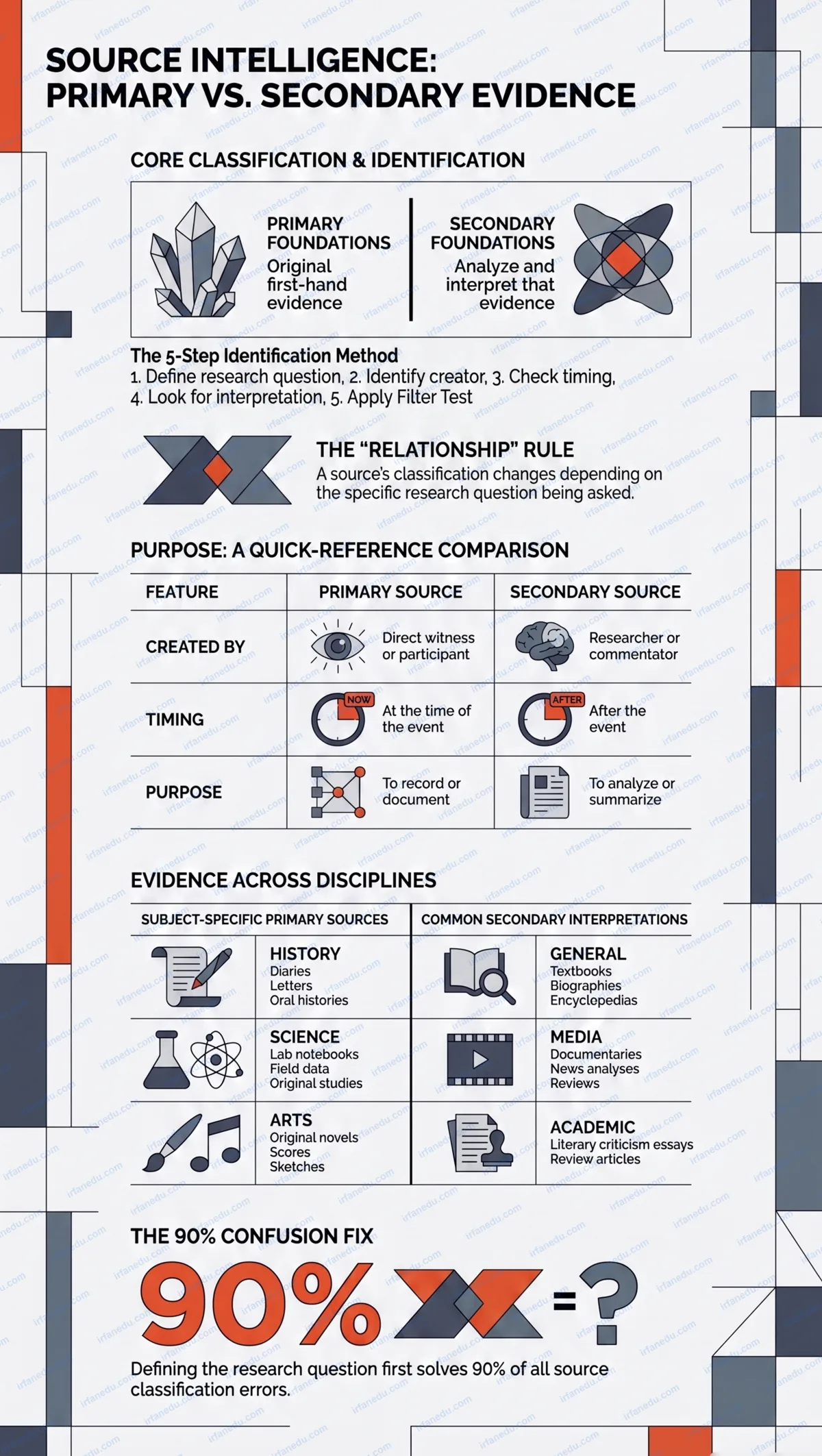
A primary source is original, first-hand evidence created at the time of an event or by someone who directly experienced it. A secondary source is any work that analyzes, interprets, or summarizes primary sources. A diary entry is primary. A biography written about the diary’s author is secondary.
That is the destination. Now let me reverse-engineer exactly how to get there every time, no matter what subject you are studying or what type of document you are holding.
I have taught research skills to students at every level for over 15 years. The single biggest mistake I see is students treating this as a fixed label on a document rather than a relationship between a document and a research question. Once you understand that shift, the whole concept clicks.
What You Will Know After Reading This
- The precise definition of primary and secondary sources with real examples
- How to classify any source in under 60 seconds using a 5-step method
- Why the same document can be both primary and secondary
- The most common classification mistakes and how to avoid them
- How to use both source types together for stronger research papers
⚡ TL;DR – Quick Summary
- Primary sources = first-hand, original evidence created at the time of the event
- Secondary sources = analysis or interpretation of primary sources by someone else
- Examples of primary: diaries, original research studies, speeches, photographs, artifacts
- Examples of secondary: textbooks, biographies, review articles, documentaries
- The same source can be primary or secondary depending on your research question
- Strong research uses both types together, not one or the other
Why the Distinction Actually Matters
Knowing the difference between primary and secondary sources is not just an academic exercise. It directly affects the quality and credibility of your argument.
When you cite a primary source, you give your reader direct access to the original evidence. When you cite a secondary source, you are borrowing someone else’s interpretation. Both are useful, but for different reasons.
| Feature | Primary Source | Secondary Source |
|---|---|---|
| Created by | Direct participant or witness | Researcher, analyst, or commentator |
| Created when | At the time of the event | After the event, often much later |
| Purpose | Record, document, express | Analyze, explain, summarize |
| Bias risk | Personal, emotional, one-sided | Interpretive, may misread original |
| Best used for | Direct evidence, original data | Context, background, expert analysis |
In a history paper, using only secondary sources means you are arguing through other people’s filters. In a science paper, citing only review articles instead of original studies weakens your evidence chain. Your teacher or professor can tell the difference immediately.
In my experience, students who struggle with source classification are usually asking the wrong question. They ask “What type of source is this?” when they should ask “What is my research question, and does this source give me first-hand evidence about it?” That one shift in thinking solves about 90% of the confusion I see in student papers.
Primary Source Examples Across Every Subject
Primary sources vary widely by subject area. What counts as first-hand evidence in history looks very different from what counts in science or literature.
History and Social Studies
- A soldier’s personal diary written during a war
- An official government treaty or declaration signed at the time
- A photograph taken at a historical event
- A newspaper article published on the day of a major event
- A speech transcript delivered by a political leader
- Census records and birth certificates from a specific era
- Letters exchanged between historical figures
Science and Medicine
- An original peer-reviewed research study reporting new experimental results
- A scientist’s lab notebook recording raw data
- Clinical trial data published for the first time
- A patent application describing a new invention
- Raw survey data collected directly from participants
Literature and the Arts
- The original novel, poem, or play you are analyzing
- An author’s personal letters or journals
- An original painting, sculpture, or musical score
- An interview with the author conducted in their lifetime
- A first-edition manuscript with the author’s handwritten notes
PRIMARY SOURCES
|
+-- DOCUMENTS
|     |-- Diaries / Journals
|     |-- Letters / Correspondence
|     |-- Government records / Laws
|     |-- Speeches / Transcripts
|     +-- Newspaper articles (day-of)
|
+-- DATA & RECORDS
|     |-- Original research studies
|     |-- Lab notebooks / Raw data
|     |-- Census / Survey data
|     +-- Patents
|
+-- ARTIFACTS & MEDIA
|     |-- Photographs (taken at the time)
|     |-- Audio / Video recordings
|     |-- Physical objects / Relics
|     +-- Original artworks
|
+-- CREATIVE WORKS
      |-- Novels / Poems / Plays (the text itself)
      |-- Musical scores
      +-- Films (as the subject of study)
Secondary Source Examples Across Every Subject
Secondary sources are created by people who were not present at the original event. They interpret, analyze, or summarize primary sources to help readers understand them.
History and Social Studies
- A history textbook chapter about a war written decades later
- A biography of a historical figure written by a modern author
- A documentary film analyzing a past political movement
- An encyclopedia article summarizing a historical period
- A scholarly journal article interpreting the causes of a revolution
Science and Medicine
- A literature review article summarizing 20 years of research on a topic
- A science textbook explaining a theory developed by others
- A meta-analysis combining results from multiple original studies
- A popular science magazine article explaining a new discovery
Literature and the Arts
- A literary criticism essay analyzing themes in a novel
- An art history book interpreting a painter’s style
- A film review published after a movie’s release
- A biography of a poet written by a literary scholar
How to Identify Any Source in 5 Steps
This method works for any document, article, or media item you encounter. Run through these five questions in order and you will have your answer in under a minute.
Step 1 is the one students always skip, and it causes most of the confusion. I have seen students argue for ten minutes about whether a newspaper article is primary or secondary, when the real problem is they never defined what they were researching. Nail down your research question first, and the classification almost always becomes obvious.
When the Same Source Is Both Primary and Secondary
This is the concept that trips up even advanced students. A source does not have a fixed classification. Its type depends entirely on how you use it.
Consider these real examples:
| Source | Research Question A (Primary) | Research Question B (Secondary) |
|---|---|---|
| A 1960s newspaper editorial | Studying public opinion in the 1960s | Studying the history of newspaper publishing |
| A biography of Einstein written in 1980 | Studying how Einstein was perceived in the 1980s | Studying Einstein’s scientific discoveries |
| A documentary about World War II | Studying how filmmakers portrayed WWII in the 1990s | Studying the actual events of WWII |
| A review article in a science journal | Studying trends in scientific publishing | Studying the original experiments it summarizes |
The key insight: the document does not change. Your research question changes, and that changes the classification. This is why your professor asks you to justify your source choices, not just list them.
Common Mistakes Students Make
After reviewing thousands of student research papers, I have identified the most frequent errors in source classification. Recognizing these patterns will save you marks.
| Wrong Assumption | Correct Understanding |
|---|---|
| “Old sources are primary, new ones are secondary.” | Age alone does not determine type. A textbook from 1920 is still secondary. A research study published last week is still primary. |
| “Wikipedia is a primary source because it has facts.” | Wikipedia summarizes and interprets other sources. It is always secondary, and usually not citable at all in academic work. |
| “A photograph is always primary.” | A photograph taken at the event is primary for that event. A photo of a historical painting in a modern art book is secondary for studying that painting. |
| “I only need secondary sources for a good paper.” | Secondary sources provide context, but primary sources provide the actual evidence your argument rests on. Most strong academic papers use both. |
| “A news article is always a primary source.” | A news article published on the day of an event is primary for that event. An analysis piece published a year later is secondary. |
Side-by-Side Comparison Table
Use this table as a quick reference when you are classifying sources for any assignment. It covers the most common source types you will encounter.
| Source Type | Primary? | Secondary? | Notes |
|---|---|---|---|
| Personal diary or journal | Yes | No | First-hand account by the writer |
| Original research study | Yes | No | Reports new data and findings |
| Textbook | No | Yes | Summarizes existing knowledge |
| Biography | No | Yes | Interprets another person’s life |
| Autobiography | Yes | No | First-hand account by the subject |
| Encyclopedia entry | No | Yes | Summary of established knowledge |
| Speech transcript | Yes | No | Original words of the speaker |
| Literary criticism essay | No | Yes | Analysis of another work |
| Original novel or poem | Yes | No | The creative work itself |
| Documentary film | No | Yes | Usually interprets events |
| Interview (conducted by you) | Yes | No | You gathered the data directly |
| Meta-analysis | No | Yes | Combines results of other studies |
| Government census data | Yes | No | Raw collected data |
| Review article | No | Yes | Synthesizes existing research |
| Photograph (taken at the event) | Yes | No | Direct visual evidence |
Real-World Research Applications
Understanding source types is not just for school. Professionals in every field use this distinction every day to make decisions based on reliable evidence.
In Academic Research Papers
A student writing about climate change would use original climate data sets and peer-reviewed studies as primary sources, and use review articles and textbooks as secondary sources to provide context and background.
In Journalism
A journalist investigating a story seeks primary sources first: eyewitness interviews, official documents, and direct statements. Secondary sources like previous news coverage help them understand the background, but they cannot substitute for original reporting.
In Legal and Medical Fields
Lawyers cite original case law (primary) and legal commentary (secondary). Doctors rely on original clinical trial data (primary) and clinical guidelines that synthesize that data (secondary). In both fields, the distinction between original evidence and interpreted guidance is critical.
In Everyday Fact-Checking
When you read a news story that cites “a new study,” the study itself is the primary source. The news article is secondary. Going back to the original study lets you verify whether the news article represented it accurately. This habit is one of the most valuable critical-thinking skills you can build.
[IMAGE: A student at a desk with a laptop showing a research database, surrounded by open books and printed journal articles | ALT: student using primary and secondary sources for academic research paper]
Quick Knowledge Check
Test Your Understanding (3 Questions)
1. A scientist publishes the results of her own experiment in a journal. What type of source is this article?
2. You are writing a paper about how people felt during a major earthquake. Which source would be most useful as a primary source?
3. A literary critic writes an essay analyzing the symbolism in a famous novel. What type of source is the essay?
Practice Problems: Classify These Sources
Try to classify each source before revealing the answer. Think about your research question first.
Practice 1: A letter written by Abraham Lincoln to a general during the Civil War. Primary or secondary?
Lincoln wrote this letter himself during the Civil War. It is a direct, first-hand document created by a participant in the events. For any research question about Lincoln’s thinking, the Civil War, or 19th-century political communication, this is primary evidence.
Practice 2: A book published in 2010 titled “The Life and Legacy of Marie Curie.” Primary or secondary?
This book was written by someone who did not know Curie personally and is interpreting her life using other sources. It is secondary for studying Curie’s life and work. However, if you were studying how scientists are remembered in popular culture in the 2010s, this book could serve as a primary source for that specific question.
Practice 3: Raw survey data you collected by interviewing 50 students about their study habits. Primary or secondary?
You gathered this data directly. No one has filtered or interpreted it yet. Raw data you collect yourself is always a primary source, regardless of the topic. The moment you write a report analyzing that data, the report becomes secondary.
Practice 4: A Wikipedia article about the French Revolution. Primary or secondary?
Wikipedia summarizes and interprets information from other sources. It is always secondary. It can be useful for getting an overview of a topic and finding links to real primary and secondary sources, but it should not be cited directly in academic papers because its content can be edited by anyone and lacks peer review.
Practice 5: The original audio recording of Martin Luther King Jr.’s “I Have a Dream” speech. Primary or secondary?
This is the original speech delivered by King himself. It is direct, first-hand evidence of his words, his delivery, and his rhetoric. For any research question about King, the Civil Rights Movement, or public speaking, this recording is a primary source.
Frequently Asked Questions
What is the simplest way to tell a primary source from a secondary source?
Can a source be both primary and secondary at the same time?
Are textbooks primary or secondary sources?
Is a photograph a primary or secondary source?
Which type of source is more reliable: primary or secondary?
Do I always need primary sources in my essay or research paper?
Is an interview a primary or secondary source?
Key Takeaways
What to Remember
- Primary sources are original, first-hand evidence created at the time of the event or by a direct participant.
- Secondary sources analyze, interpret, or summarize primary sources. They are one step removed from the original event.
- Classification is always relative to your research question. The same document can be primary for one question and secondary for another.
- Use the 5-step identification method: define your question, identify the creator, check the date, look for interpretation, and apply the filter test.
- Common traps include assuming age determines type, thinking Wikipedia is primary, and believing only primary sources matter.
- The strongest research papers use both types together: primary sources for direct evidence,
Sources & References
Reviewed by Dr. Irfan Mansuri. External links open in a new tab and are provided for further reading and verification.