
How to Study for the PSAT: Proven Strategies That Actually Work 🎯
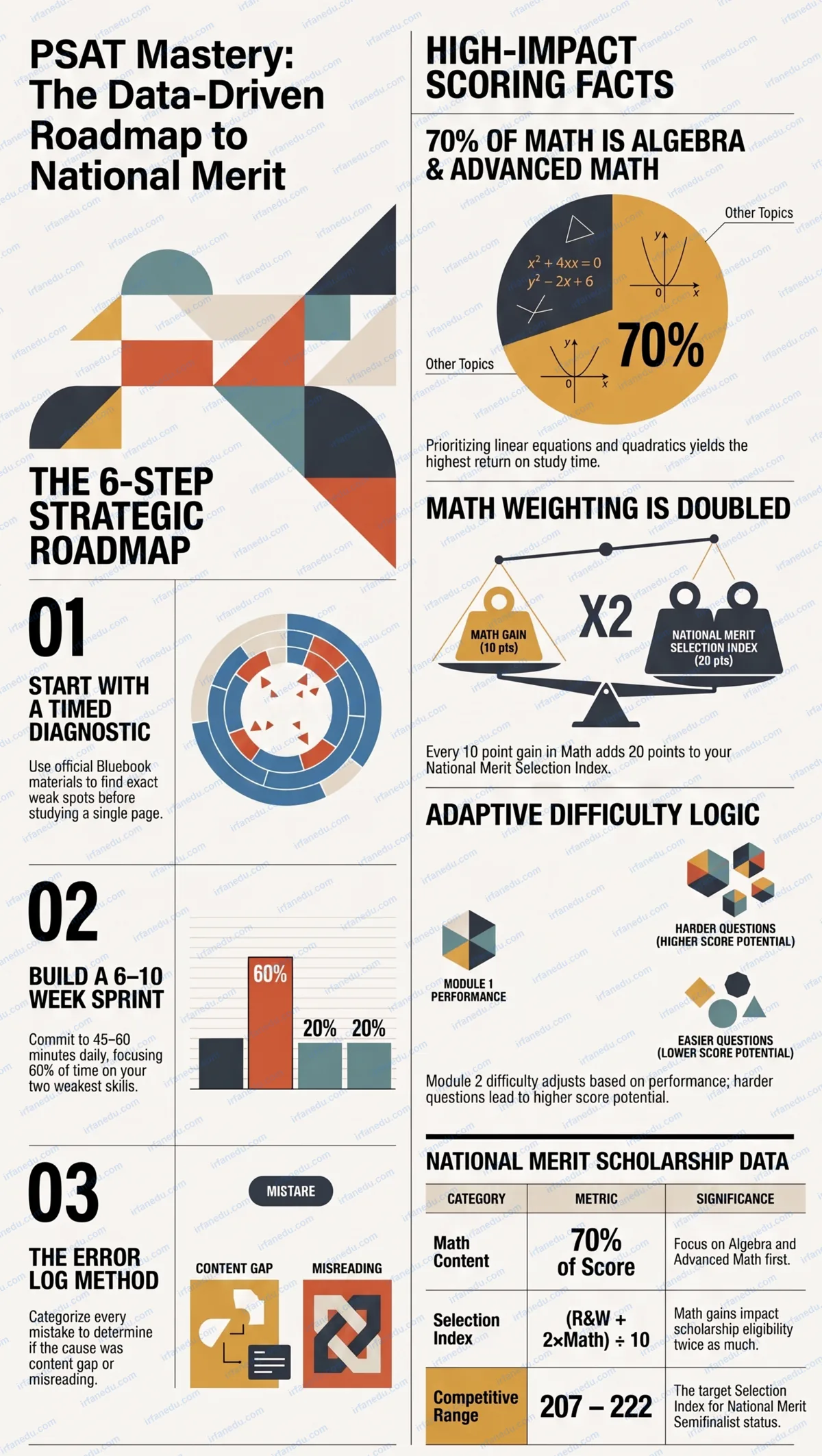
To study for the PSAT effectively, take a timed diagnostic test first to find your weak spots, build a 6–10 week schedule focused on those areas, review every error with a written log, and simulate real test conditions with at least one full-length practice exam before test day.
Most students approach PSAT prep backwards. They buy a prep book, flip to chapter one, and start reading from the beginning — regardless of what they actually need to work on. I have seen this pattern hundreds of times, and it almost always leads to wasted hours and disappointing scores.
The students who improve the most do something different. They start with data, not content. They find out exactly where their points are leaking, then plug those specific holes. This guide shows you that process from start to finish, with contrast-driven examples so you can see the difference between what works and what doesn’t.
- How to diagnose your real weak spots before you study a single page
- A week-by-week study schedule that fits a busy school life
- The single most effective math and reading strategy for the PSAT
- Why error review beats extra practice tests every time
- How to aim for National Merit without burning out
⚡ TL;DR – Quick Summary
- 📊 Start with a full diagnostic test to find your exact weak areas
- 📅 Build a 6–10 week schedule: 45–60 minutes per day, skill-focused
- 🔴 Error review after every practice session beats doing more tests
- 📐 PSAT math is 70% algebra and advanced math — prioritize those first
- 📖 Reading: answer from evidence only, never from memory or opinion
- 🏆 National Merit cutoffs vary by state — know your target score early
| Feature | Details |
|---|---|
| Full name | PSAT/NMSQT (Preliminary SAT / National Merit Scholarship Qualifying Test) |
| Format | Digital (Bluebook app), adaptive |
| Sections | Reading & Writing (2 modules) + Math (2 modules) |
| Total time | ~2 hours 14 minutes |
| Score range | 320–1520 |
| Who takes it | Typically 10th and 11th graders |
| When offered | October (school-administered) |
| Calculator | Built-in Desmos allowed for all math |
🔴 Good vs. Bad PSAT Prep: See the Difference Immediately
Before anything else, I want to show you the contrast that defines this entire guide. Below is what ineffective prep looks like versus what actually moves scores. This contrast will frame every section that follows.
❌ Bad PSAT Prep
- Opens prep book at page 1, reads linearly
- Does practice questions but never reviews wrong answers
- Studies 3 hours the night before the test
- Focuses on topics they already know well
- Guesses randomly and leaves blanks
- Ignores the digital format until test day
- Sets a vague goal: “I want to do well”
✅ Good PSAT Prep
- Takes a diagnostic test first, then studies gaps
- Writes an error log for every single wrong answer
- Studies 45–60 min/day for 6–10 weeks consistently
- Focuses 60% of time on two weakest skill areas
- Always answers every question (no penalty for guessing)
- Practices in Bluebook app to match real conditions
- Sets a specific score target tied to National Merit data
Keep this contrast in mind as you read. Every strategy in this guide is designed to move you from the left column to the right one.
📌 What Is the PSAT and Why Does It Matter?
The PSAT/NMSQT is a standardized test administered by the College Board, typically taken in 10th or 11th grade. It serves two major purposes: it gives you a preview of the SAT, and it qualifies you for the National Merit Scholarship Program.
The test is now fully digital and section-adaptive, meaning the difficulty of your second module in each section adjusts based on how well you do in the first. This matters for your prep strategy — I will explain exactly why in the math and reading sections below.
The score range is 320–1520, split between Reading & Writing (160–760) and Math (160–760). For National Merit consideration, the College Board calculates a Selection Index from your section scores. The cutoff varies by state and year, but historically competitive scores sit between 207 and 222 out of 228.
In my experience teaching test prep, students consistently underestimate the PSAT because it “doesn’t count” for college admissions. That mindset is a mistake. The PSAT is the only path to National Merit recognition, which can mean tens of thousands of dollars in scholarships. Treat it with the same seriousness as the SAT and you will be glad you did — especially when your peers who didn’t prep are scrambling to explain a low score to scholarship committees.
🔬 Step 1 — Take a Diagnostic Test First (Not Last)
The single most important thing you can do before opening any prep book is take a full-length, timed practice test. This is your diagnostic — your data. Without it, you are studying blind.
The College Board provides free official PSAT practice materials through the Bluebook app and Khan Academy. Use those, not third-party tests, for your diagnostic. The official materials match the real test’s adaptive format and question style most accurately.
Suppose your diagnostic gives you: Reading & Writing 580, Math 520. Total: 1100.
What this tells you: Math is your bigger gap. Within math, check which sub-scores are lowest. If your “Advanced Math” sub-score is 14/22 but your “Algebra” sub-score is 18/22, you know to prioritize advanced math (quadratics, functions) over algebra in your study plan. You now have a roadmap — not a guess.
After the diagnostic, calculate your Selection Index if you are aiming for National Merit: add your Reading & Writing score and double your Math score, then divide by 10. This gives you a rough proxy. Compare it to your state’s historical cutoff to know how many points you need to gain.
┌─────────────────────────────────────────────────────────┐
│                  PSAT TOTAL SCORE (320–1520)             │
├──────────────────────────┬──────────────────────────────┤
│  READING & WRITING       │  MATH                        │
│  (160–760)               │  (160–760)                   │
│                          │                              │
│  Module 1 (27 questions) │  Module 1 (22 questions)     │
│       ↓ adaptive         │       ↓ adaptive             │
│  Module 2 (27 questions) │  Module 2 (22 questions)     │
│                          │                              │
│  Sub-scores:             │  Sub-scores:                 │
│  • Information & Ideas   │  • Algebra (13–15 qs)        │
│  • Craft & Structure     │  • Advanced Math (13–15 qs)  │
│  • Expression of Ideas   │  • Problem-Solving & Data    │
│  • Standard English      │  • Geometry & Trig (5–7 qs)  │
└──────────────────────────┴──────────────────────────────┘
  Selection Index ≈ (R&W + 2×Math) ÷ 10   [rough proxy]
  National Merit competitive range: ~207–222 / 228
📅 Step 2 — Build a Realistic Study Schedule
A good PSAT study schedule is specific, sustainable, and skill-targeted. Most students have 6 to 10 weeks between when they decide to prep and test day. Here is how to structure that time.
| Week | Focus | Daily Time | Key Activity |
|---|---|---|---|
| 1 | Diagnostic + Analysis | 60 min | Full practice test + error categorization |
| 2–3 | Weakest skill area | 45 min | Targeted drills on your #1 gap topic |
| 4–5 | Second weakest area | 45 min | Targeted drills + mixed practice |
| 6–7 | Reading & Writing strategy | 45 min | Evidence-based reading, grammar rules |
| 8 | Full practice test #2 | 60 min | Timed full test + detailed error review |
| 9 | Targeted review of new errors | 40 min | Drill only the question types you missed in test #2 |
| 10 | Light review + logistics | 20 min | No new material; review notes, confirm test location |
❌ Bad Schedule
- Studies 4 hours on Saturday, nothing all week
- Reads prep book chapters in order
- No specific daily goal — just “study PSAT”
✅ Good Schedule
- 45–60 min daily, same time each day
- Each session has one specific skill target
- Tracks progress with a simple log or spreadsheet
Use a simple spreadsheet with three columns: Date, Topic Studied, and Errors Made. Reviewing this log weekly shows you which topics keep coming back — those are your real weak spots, not the ones you think you have.
📐 Step 3 — Master PSAT Math the Right Way
PSAT math is not about memorizing formulas. It is about recognizing problem types and applying the right approach quickly. Algebra and Advanced Math together account for roughly 70% of the math score — start there.
The digital PSAT gives you access to a built-in Desmos graphing calculator for the entire math section. Most students underuse it. In my experience, students who practice graphing equations in Desmos during prep save 30–60 seconds per complex question on test day — time that adds up significantly.
Question type: “Which of the following is a solution to $$2x^2 – 5x – 3 = 0$$?”
Bad approach: Attempt to factor under time pressure, make an arithmetic error.
Good approach: Type $$y = 2x^2 – 5x – 3$$ into Desmos. Read the x-intercepts directly from the graph. The solutions are $$x = 3$$ and $$x = -0.5$$. Done in 20 seconds.
This is not cheating — it is using the tools the test gives you. Practice this approach during prep so it becomes automatic.
| Math Topic | % of Math Score | Priority | Key Skills |
|---|---|---|---|
| Algebra | ~35% | 🔴 High | Linear equations, systems, inequalities |
| Advanced Math | ~35% | 🔴 High | Quadratics, functions, polynomials |
| Problem-Solving & Data | ~20% | 🟡 Medium | Ratios, percentages, statistics, probability |
| Geometry & Trig | ~10% | 🟢 Lower | Area, volume, basic trig ratios |
📖 Step 4 — Crack Reading and Writing
The Reading & Writing section trips up students who rely on their gut feeling about answers. The PSAT is not testing your opinions — it is testing whether you can find evidence in the passage and apply grammar rules consistently.
Every correct answer in the Reading portion is directly supported by words in the passage. If you find yourself thinking “I think the author means…” without pointing to a specific sentence, you are guessing. That is the contrast that separates high scorers from average ones.
❌ Bad Reading Approach
- Reads the whole passage, then answers questions
- Picks answers based on what “sounds right”
- Spends 4+ minutes on a single hard question
- Ignores the “most strongly supported” qualifier
✅ Good Reading Approach
- Reads the question first, then finds the evidence
- Every answer choice is tested against the passage text
- Skips and flags hard questions; returns with time left
- Treats “most strongly supported” as the literal standard
For the Writing (Standard English Conventions) questions, the rules tested are finite and learnable. Focus on: subject-verb agreement, pronoun reference, punctuation (especially commas and semicolons), and transition words. These four areas cover the majority of grammar questions on the PSAT.
The PSAT’s adaptive format means a strong Module 1 performance routes you to a harder Module 2. This is good — harder questions are worth more to your score. Do not panic if Module 2 feels more difficult. That difficulty means you are on track for a higher score.
🔍 Step 5 — The Error Log Method (Most Students Skip This)
This is the highest-leverage activity in all of PSAT prep, and almost no student does it properly. After every practice session, do not just check how many you got right. Write down, for every single wrong answer, exactly why you got it wrong.
There are only four reasons you miss a question: you did not know the concept, you knew it but applied it wrong, you misread the question, or you ran out of time. Each reason requires a different fix. Without categorizing your errors, you cannot fix the right thing.
I worked with a student who was stuck at a 1180 PSAT score after three practice tests. She was doing more and more practice questions but not improving. When I had her start an error log, we discovered that 60% of her math errors were “misread the question” errors — she was solving for x when the question asked for 2x, or finding the area when it asked for the perimeter.
The fix was not more math practice. It was a 10-second habit: circle the exact quantity the question asks for before starting to solve. Her score jumped 80 points in the next practice test. The problem was never her math ability — it was her reading of the question.
In my experience, the error log is the single biggest differentiator between students who plateau and students who keep improving. It feels slow and tedious compared to just doing more questions. But it is the difference between practicing your mistakes and correcting them. I tell every student I work with: 30 minutes of error review is worth more than 2 hours of new practice questions.
🏆 Step 6 — Targeting National Merit
If National Merit recognition is your goal, you need a specific score target, not just a general desire to “do well.” The Selection Index cutoff varies significantly by state. A score that earns Commended Scholar status nationally may fall short of Semifinalist status in a high-competition state.
The College Board publishes Selection Index cutoffs for each state after each year’s results. Look up your state’s cutoff from the most recent year as your benchmark. Then work backwards: if you need a Selection Index of 215 and your diagnostic gives you 195, you need to gain 20 index points across your sections.
In the Selection Index formula, Math is weighted double compared to Reading & Writing. A 10-point gain in your Math score adds 20 points to your Selection Index. A 10-point gain in Reading & Writing adds 10. If you are close to the cutoff, prioritize math gains for maximum index impact.
| National Merit Level | Approximate Selection Index | What It Means |
|---|---|---|
| Commended Scholar | ~207–209 | Top ~50,000 students nationally; recognition letter |
| Semifinalist | ~210–222 (state-dependent) | Top ~16,000; eligible for finalist status and scholarships |
| Finalist | Semifinalist + application | ~15,000 students; eligible for National Merit Scholarships |
❌ Common PSAT Prep Mistakes (Wrong vs. Right)
These are the most common errors I see students make during PSAT prep. Each one has a direct fix.
❌ Wrong: Studying without a target score
- “I’ll just study and see what happens”
- No way to know if prep is working
- No motivation to push through hard topics
✅ Right: Set a specific score goal
- Look up your state’s National Merit cutoff
- Calculate the gap from your diagnostic
- Track progress toward that specific number
❌ Wrong: Using only third-party prep books
- Question style often differs from real PSAT
- Adaptive format not replicated
- May over-prepare for topics not heavily tested
✅ Right: Use official College Board materials first
- Official Bluebook practice tests match real format
- Khan Academy PSAT prep is free and College Board-aligned
- Supplement with third-party books only for concept review
❌ Wrong: Skipping the Writing section
- “I’m good at English, I don’t need to prep this”
- Grammar rules on the PSAT are specific and testable
- Leaves easy points on the table
✅ Right: Learn the 10 most-tested grammar rules
- Subject-verb agreement, pronoun reference, punctuation
- These rules repeat across nearly every test form
- 30 minutes of focused grammar review can add 20+ points
Most guides tell you to “take as many practice tests as possible.” This advice is incomplete and can actually hurt your score.
Here is the non-obvious truth: the PSAT is section-adaptive. Your Module 2 difficulty is determined by your Module 1 performance. Students who practice on non-adaptive materials (static PDFs, old SAT tests) train themselves to pace for a flat difficulty curve. On the real test, they hit a harder Module 2 and panic — not because the questions are impossible, but because the difficulty jump feels unexpected.
The fix: always practice in the Bluebook app for full tests so you experience the adaptive difficulty shift. For concept drills, static materials are fine. But your two full-length practice tests must be in Bluebook. This one change in practice format is something almost no prep guide mentions, and in my experience it is one of the biggest reasons students underperform relative to their practice scores.
🧠 Quick Knowledge Check — Test Yourself
1. What percentage of the PSAT math score comes from Algebra and Advanced Math combined?
Show Answer
2. In the PSAT’s adaptive format, what happens if you perform well on Math Module 1?
Show Answer
3. In the Selection Index formula, which section is weighted more heavily?
Show Answer
✏️ Practice Problems — Click to Reveal Solutions
Problem 1 (Algebra): If $$3x + 7 = 22$$, what is the value of $$6x – 4$$?
Step 1: Solve for x. $$3x = 15$$, so $$x = 5$$.
Step 2: Substitute into the target expression. $$6(5) – 4 = 30 – 4 = 26$$.
Answer: 26. Notice the question asks for $$6x – 4$$, not x. This is a classic “misread the question” trap — exactly the type of error the error log method catches.
Problem 2 (Advanced Math): What are the solutions to $$x^2 – 4x – 12 = 0$$?
Method 1 (Factoring): Find two numbers that multiply to -12 and add to -4. Those are -6 and +2.
$$(x – 6)(x + 2) = 0$$, so $$x = 6$$ or $$x = -2$$.
Method 2 (Desmos): Graph $$y = x^2 – 4x – 12$$ and read the x-intercepts: 6 and -2. Same answer, faster execution under pressure.
Problem 3 (Data Analysis): A survey of 200 students found that 45% prefer online learning. How many students prefer online learning?
Calculation: $$200 \times 0.45 = 90$$ students.
Sources & References
Reviewed by Dr. Irfan Mansuri. External links open in a new tab and are provided for further reading and verification.