
Is the PSAT Really Necessary? (Honest Answer Inside)
Every year, millions of high school students sit down for the PSAT without fully understanding why. Some treat it as a throwaway test. Others panic over it as if college admission hangs in the balance. Both reactions miss the point entirely.
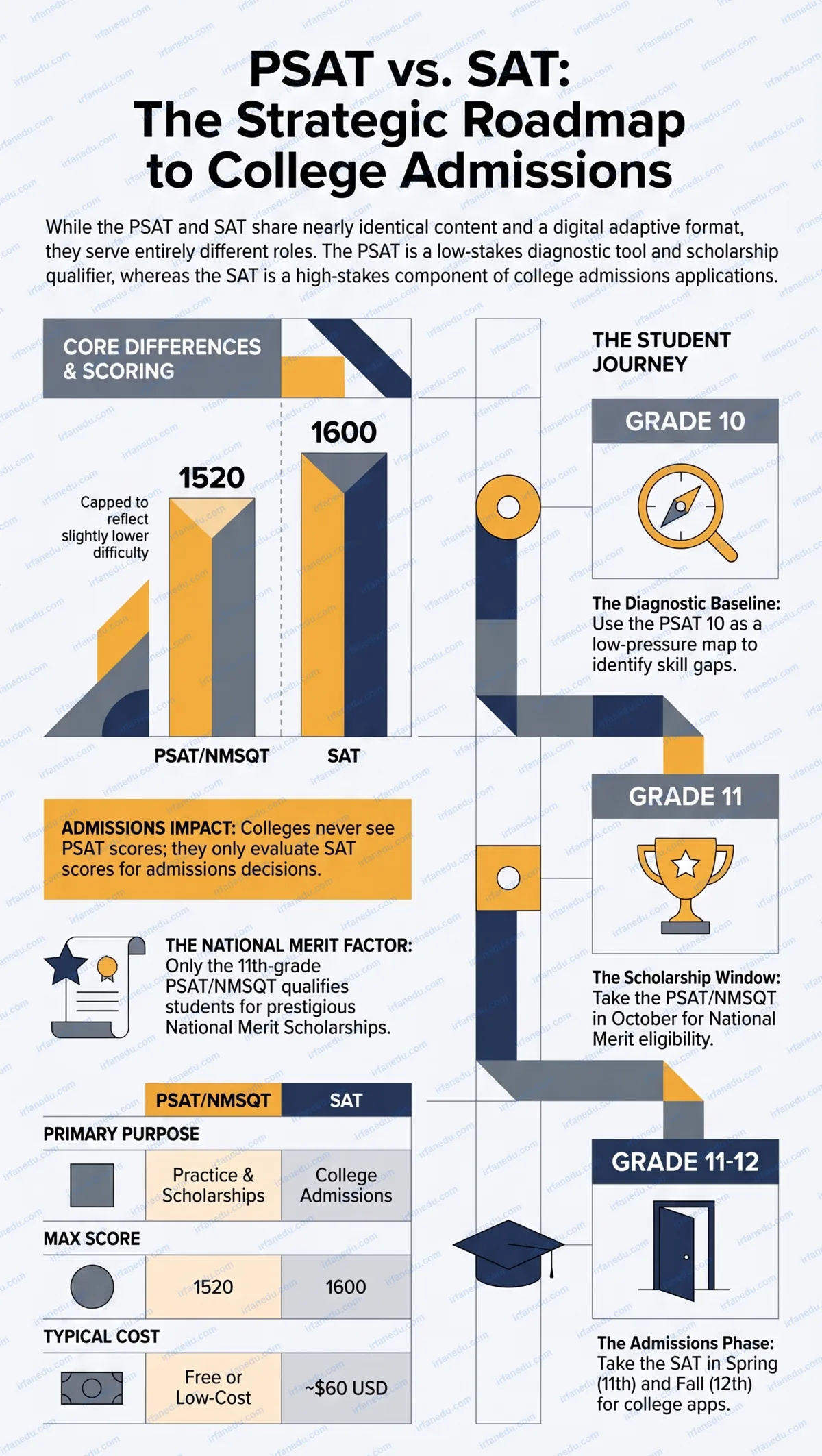
The PSAT vs SAT difference comes down to purpose and stakes: the PSAT (scored 320-1520) is a shorter practice test taken in grades 9-11 that qualifies 11th graders for National Merit Scholarships, while the SAT (scored 400-1600) is the full college admissions test that universities actually evaluate. Your PSAT score never appears on a college application.
In my experience working with students across skill levels, the confusion between these two tests costs real preparation time. Students either over-prepare for the PSAT or completely ignore it, both of which are strategic errors. This guide cuts through the noise and tells you exactly what each test is, how they differ, and what you should do about it.
- You will understand the structural and scoring differences between PSAT and SAT.
- You will know when each test matters and for whom.
- You will learn how the National Merit Scholarship changes the PSAT’s importance.
- You will walk away with a clear, actionable test timeline.
⚡ TL;DR – Quick Summary
- PSAT max score is 1520; SAT max score is 1600.
- PSAT scores do NOT go to colleges; SAT scores do.
- 11th-grade PSAT qualifies you for National Merit Scholarships.
- SAT is slightly harder and longer than the PSAT.
- Both tests now use a digital adaptive format via College Board.
- You can skip the PSAT, but doing so removes a free diagnostic opportunity.
| Feature | PSAT/NMSQT | SAT |
|---|---|---|
| Score Range | 320 – 1520 | 400 – 1600 |
| Test Length | ~2 hours 14 min | ~2 hours 14 min (digital) |
| Cost | Free or low-cost at school | ~$60 USD (fee waivers available) |
| Who Takes It | Grades 9, 10, 11 | Grades 11, 12 (and older) |
| Counts for College | No | Yes |
| National Merit | Yes (11th grade only) | No |
| Format (2024+) | Digital, adaptive | Digital, adaptive |
| Administered by | College Board | College Board |
Is the PSAT Actually Necessary?
Honestly? It depends on your situation. The PSAT is not required for college admission anywhere in the world. No university asks for it. No application has a PSAT score field.
But “not required” does not mean “not valuable.” The PSAT serves two distinct purposes that can genuinely benefit you. First, it is the best low-stakes diagnostic tool available before the SAT. The format, question style, and content are nearly identical to the SAT, so your PSAT score report tells you exactly where your preparation gaps are. Second, if you are in 11th grade and score in the top 1% for your state, you become a National Merit Semifinalist, which opens doors to significant scholarship money.
If neither of those two things matters to you, then no, the PSAT is not necessary. But for most students, at least one of them does matter.
I tell every student I work with to take the PSAT in 10th grade at minimum, even if they have zero interest in National Merit. The score report alone is worth the two hours. You get a detailed breakdown of every skill area, and that data shapes a smarter SAT prep plan. Skipping it is like driving to a new city without checking the map first.
What Is the PSAT? A Clear Definition
PSAT stands for Preliminary SAT. The College Board offers three versions: the PSAT 8/9 (for 8th and 9th graders), the PSAT 10 (for 10th graders), and the PSAT/NMSQT (for 11th graders). The NMSQT part stands for National Merit Scholarship Qualifying Test.
All three versions test the same two broad areas: Evidence-Based Reading and Writing (now called “Reading and Writing” in the digital format) and Math. The questions are multiple-choice and student-produced response, delivered on a digital adaptive platform since 2023.
The PSAT is administered at schools in October each year. Most students take it during a regular school day. Your school registers you, and in many cases, the fee is covered by the school or district.
What Is the SAT and Who Needs It?
The SAT is a standardized college admissions test used by thousands of universities, primarily in the United States but also accepted by institutions in Canada, the United Kingdom, and many other countries. It measures the same skill areas as the PSAT but at a higher difficulty ceiling and with a score range of 400-1600.
Since 2023, the SAT has been fully digital and adaptive, administered through the College Board’s Bluebook app. Students register independently through the College Board website and can take the test on multiple dates throughout the year at authorized testing centers or, in some regions, at their own school.
The SAT is scored on a 400-1600 scale, with two section scores of 200-800 each. There is no penalty for wrong answers, so guessing is always worth doing.
PSAT vs SAT: The Key Differences Side by Side
The two tests share the same DNA, but they are not identical. Here are the differences that actually matter for your preparation strategy.
GRADE 9          GRADE 10         GRADE 11              GRADE 12
   |                |                |                      |
[PSAT 8/9]     [PSAT 10]     [PSAT/NMSQT]           [SAT Retake?]
Optional       Optional       IMPORTANT                  Optional
Diagnostic     Diagnostic     National Merit             Final Score
Score 240-1440 Score 320-1520 Score 320-1520          Score 400-1600
                                    |
                              [First SAT]
                              Spring of 11th
                              Score 400-1600
                              Counts for College

KEY:  [PSAT] = Practice + Scholarship Qualifier
      [SAT]  = College Admissions + Scholarship Eligibility
| Difference | PSAT | SAT |
|---|---|---|
| Max Score | 1520 | 1600 |
| Math Difficulty | Up to Algebra II / Pre-Calc basics | Includes more advanced data analysis and problem-solving |
| Reading Passages | Slightly shorter, lower complexity | Longer, more complex texts |
| Stakes | Low (no college impact) | High (college admissions) |
| Registration | Through your school | Self-register at collegeboard.org |
| Test Dates | Once per year (October) | Multiple dates per year |
| Score Report | Detailed diagnostic breakdown | Score + percentile + subscores |
| Scholarship Link | National Merit (11th grade) | Many university merit awards |
Scoring Explained: 1520 vs 1600
The 80-point gap between the PSAT ceiling (1520) and the SAT ceiling (1600) is not a typo. It is intentional. The PSAT is designed to be slightly easier, so its scoring scale stops at 1520 to reflect that lower difficulty ceiling.
Both tests produce two section scores. On the PSAT, each section scores 160-760. On the SAT, each section scores 200-800. Add the two sections together to get the composite.
A student scores 730 Reading/Writing + 740 Math on the PSAT = 1470 composite.
That same student, after a few months of prep, scores 760 Reading/Writing + 780 Math on the SAT = 1540 composite.
The PSAT score predicted strong SAT performance and highlighted the math section as the area to push hardest.
The PSAT also produces a “Selection Index” score used specifically for National Merit purposes. This is calculated by doubling your Reading/Writing score and adding your Math score (all converted to subscores). The Selection Index ranges from 48 to 228.
The National Merit Factor
This is the one scenario where the PSAT becomes genuinely high-stakes. The National Merit Scholarship Program uses your 11th-grade PSAT/NMSQT score as its qualifying criterion. There is no other way to enter the program.
Each year, roughly 1.5 million students take the PSAT/NMSQT. About 50,000 of the highest scorers receive recognition. Around 16,000 become Semifinalists, and approximately 7,500 become Finalists who compete for scholarships worth up to $2,500 from the National Merit Corporation, plus additional corporate and college-sponsored awards that can reach full tuition at some institutions.
National Merit is genuinely worth pursuing if you are already a strong student. The scholarship money is real, and the Finalist designation carries weight on applications. But I caution students against warping their entire 10th-grade year around PSAT prep at the expense of coursework and extracurriculars. A balanced approach, using the PSAT as a diagnostic and doing targeted prep in the six months before 11th grade, is far more sustainable.
The cutoff score (called the “Selection Index”) varies by state and by year. Competitive states typically require a Selection Index of 220 or higher. Less competitive states may have cutoffs around 209-214. The College Board publishes these cutoffs after each test cycle.
Which Test Should You Take and When?
The answer depends on your grade level and your goals. Here is a straightforward decision framework.
| Your Situation | What to Do |
|---|---|
| 9th grader, curious about your level | Take PSAT 8/9 if your school offers it. Low pressure, good baseline. |
| 10th grader, planning ahead | Take PSAT 10 for a diagnostic. Start light SAT prep after results. |
| 11th grader, targeting National Merit | PSAT/NMSQT in October is mandatory. Prepare seriously from summer. |
| 11th grader, focused on college apps | Take PSAT for practice, then SAT in spring. Retake in fall of 12th grade if needed. |
| 12th grader, applying to colleges | Skip PSAT. Focus entirely on SAT. You have limited time; use it wisely. |
| Strong student, both goals | PSAT in 11th grade for National Merit, then SAT in spring of 11th grade. |
Boost your scores with expert resources at IrfanEdu
Common Mistakes Students Make
After working with hundreds of test-prep students, I see the same errors repeated. Knowing them in advance puts you ahead.
| Wrong Approach | Right Approach |
|---|---|
| Ignoring the PSAT score report | Study the detailed skill breakdown; it maps directly to SAT prep needs |
| Treating PSAT like a high-stakes test in 9th/10th grade | Use it as a low-pressure diagnostic; save serious prep for 11th grade |
| Assuming a high PSAT score means SAT prep is unnecessary | The SAT is harder; a 1400 PSAT does not guarantee a 1400 SAT |
| Registering for SAT without reviewing PSAT results first | Use PSAT data to build a targeted SAT study plan |
| Taking the SAT only once | Plan for at least two attempts; most students improve on the second try |
| Confusing PSAT percentiles with SAT percentiles | Always check percentiles within the same test’s population |
How to Prepare for Both Tests Efficiently
The good news is that preparing for the PSAT and SAT is essentially the same process. The content overlap is around 95%. The difference is in the ceiling of difficulty you need to reach.
Step 1: Take a Diagnostic First
Before buying any prep book or signing up for a course, take a full-length official practice test. The College Board offers free digital practice tests through Khan Academy and the Bluebook app. Your baseline score tells you how much work you need to do and in which areas.
Step 2: Focus on Your Weakest Skill Areas
The PSAT and SAT both test Reading and Writing (grammar, vocabulary in context, evidence analysis) and Math (algebra, advanced math, problem-solving, data analysis). Your score report breaks down performance by skill category. Spend 60-70% of your prep time on your two or three weakest categories.
Step 3: Practice with Official Materials
Third-party prep books vary in quality. The most reliable materials come directly from the College Board and from Khan Academy’s free SAT prep program, which is built in partnership with the College Board. The practice questions there are as close to real test questions as you will find outside an actual test.
Step 4: Simulate Test Conditions
Sit down with a timer, no phone, and complete full practice sections in one sitting. Stamina matters. Students who only practice individual questions often struggle with the pacing of a full test.
Step 5: Review Every Wrong Answer
Getting a question wrong and moving on is wasted time. For every incorrect answer, identify whether the error was a knowledge gap, a careless mistake, or a time-management issue. Each type requires a different fix.
June-August (before 11th grade): 2-3 hours per week, focus on weak areas identified from 10th-grade PSAT.
September-October: Simulate PSAT conditions twice. Light review only in final week.
November-March: Full SAT prep, 4-6 hours per week. Two full practice tests per month.
April-May: First SAT attempt.
August-October (12th grade): Review results, targeted prep, retake if needed.
Quick Knowledge Check: PSAT vs SAT
Select an answer to see instant feedback.
1. What is the maximum score on the PSAT/NMSQT?
2. Which grade’s PSAT score qualifies students for National Merit Scholarships?
3. Do colleges see your PSAT score on your application?
Practice Problems: Apply What You Know
Work through these scenario-based questions, then click to reveal the answer.
Problem 1: Maya is in 10th grade and just got her PSAT score: 1180. She wants to know if she should start SAT prep now. What should she do?
Problem 2: James scored 1460 on the PSAT/NMSQT in 11th grade. His state’s National Merit cutoff is typically around 1420 (Selection Index ~218). Is he likely a Semifinalist?
Problem 3: Sofia is in 12th grade and has not taken the SAT yet. She has two months before her early decision application deadline. Should she take the PSAT first for practice?
Frequently Asked Questions
What is the main difference between the PSAT and SAT?
Does the PSAT score affect college admissions?
Is the PSAT harder than the SAT?
When should I take the PSAT?
What is a good PSAT score?
Can I skip the PSAT and go straight to the SAT?
How many times can I take the SAT?
Key Takeaways
- The PSAT and SAT test the same content but at different difficulty levels and for different purposes.
- PSAT max score is 1520; SAT max score is 1600. Neither test penalizes wrong answers.
- Colleges never see your PSAT score. It has zero direct impact on admissions.
- The 11th-grade PSAT/NMSQT is the only path into the National Merit Scholarship Program.
- Use your PSAT score report as a diagnostic blueprint for SAT preparation.
- Both tests are now digital and adaptive, delivered through the College Board’s Bluebook platform.
- A smart timeline: PSAT in 10th and 11th grade, first SAT in spring of 11th grade, retake in fall of 12th grade if needed.