
How to Cite a Play: MLA, APA & Chicago (With Examples) 📖
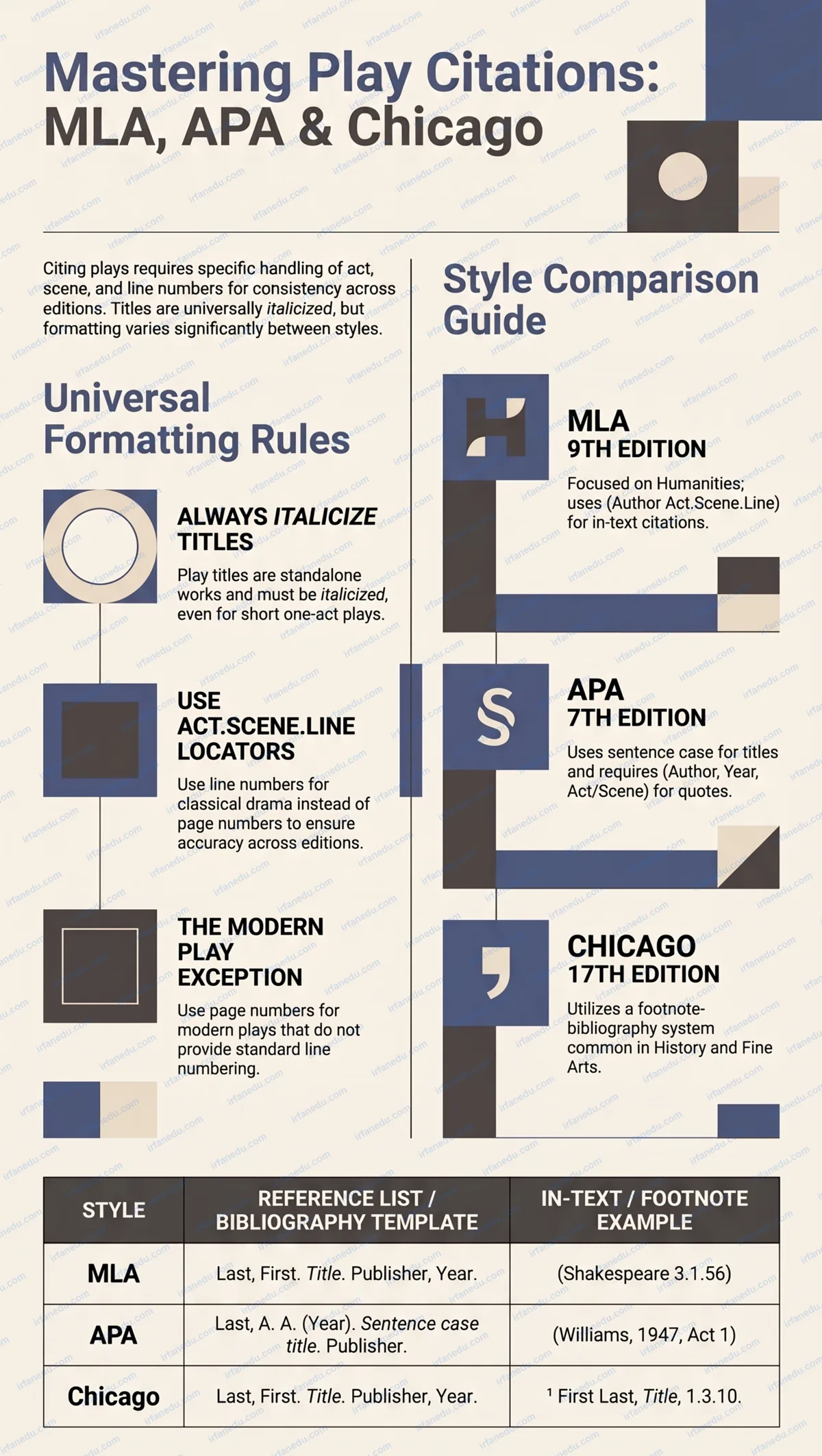
If I could teach you one thing about academic writing, it would be this: citation confidence changes everything. I have watched students lose marks not because their analysis was weak, but because they formatted a play citation wrong — or skipped it entirely out of confusion. That stops today.
Citing a play is slightly different from citing a novel or a journal article, and most guides gloss over the tricky parts: what to do with act and scene numbers, how to handle Shakespeare specifically, and what changes when you saw the play performed live rather than read it on the page. I will walk you through all of it.
- Exact MLA, APA, and Chicago citation formats for plays
- How to cite Shakespeare and other classic dramatists
- How to cite a play from an anthology or a live performance
- The most common mistakes students make — and how to fix them
- Ready-to-copy worked examples for each format
📋 Table of Contents
- Why Citing a Play Is Different
- How to Cite a Play in MLA Format
- How to Cite a Play in APA Format
- How to Cite a Play in Chicago Style
- How to Cite Shakespeare Specifically
- Anthology & Live Performance Citations
- Common Mistakes (Wrong vs. Right)
- 💡 Unique Insight: The Act/Scene Shortcut Most Guides Miss
- Quick Quiz
- Practice Problems
- FAQ
- Sources & References
⚡ TL;DR – Quick Summary
- 📌 MLA: Playwright Last, First. Title. Editor (if any), Publisher, Year.
- 📌 APA: Playwright, A. A. (Year). Title of play. Publisher.
- 📌 Chicago: Playwright First Last, Title of Play (Publisher, Year).
- 📌 Always italicize play titles — even one-act plays.
- 📌 For in-text, use act.scene.line numbers (not page numbers) when quoting lines.
- 📌 Live performances and anthology plays have their own citation rules — see below.
| Format | Edition Used | Play Title Style | In-Text Uses | Act/Scene/Line? |
|---|---|---|---|---|
| MLA | 9th (2021) | Italics | Author + Act.Scene.Line | ✅ Yes |
| APA | 7th (2020) | Italics | Author + Year | Recommended for quotes |
| Chicago | 17th (2017) | Italics | Footnote number | ✅ Yes (in footnote) |
🎭 Why Citing a Play Is Different From Citing a Book
Plays have a structural feature that novels do not: acts, scenes, and line numbers. These replace page numbers in academic citations because different editions of the same play paginate differently. A reader using a Penguin edition of Hamlet will find Act 3, Scene 1 on a different page than someone using the Arden edition — but the line numbers stay consistent across scholarly editions.
This is why your professor asks for act.scene.line citations rather than page numbers. It is not arbitrary — it is the only way to make your citations reproducible across editions.
📝 How to Cite a Play in MLA Format (9th Edition)
MLA 9th edition is the most commonly required format for literature and humanities courses. The Works Cited entry for a play follows the standard book format, with one key addition: if you are quoting lines, your in-text citation uses act, scene, and line numbers instead of page numbers.
MLA Works Cited Entry — Template
Playwright Last, First. Title of Play. Edited by Editor First Last,
Publisher, Year of Publication.

─────────────────────────────────────────────────────────
ELEMENTS IN ORDER:
  1. Playwright's last name, first name.
  2. Title of play (italicized).
  3. "Edited by" + editor's name (only if edition has an editor).
  4. Publisher name.
  5. Year.
─────────────────────────────────────────────────────────
Shakespeare, William. Hamlet. Edited by Harold Jenkins, Methuen, 1982.
In-text citation (quoting lines):
“To be, or not to be, that is the question” (Shakespeare 3.1.56).
In-text citation (general reference, no specific lines):
Shakespeare explores the theme of indecision throughout the play (Shakespeare).
Miller, Arthur. Death of a Salesman. Penguin Books, 1998.
In-text: Willy Loman’s delusions drive the central conflict (Miller 45). (Page number used here because this edition does not use act/scene/line numbering in the standard way.)
- Write the playwright’s last name, comma, first name, period.
- Italicize the full play title, followed by a period.
- If the edition has an editor, write: Edited by First Last, (with a comma after the name).
- Write the publisher name, comma, year, period.
- For in-text quotes, use (Last Name Act.Scene.Line) — e.g. (Shakespeare 3.1.56).
📝 How to Cite a Play in APA Format (7th Edition)
APA 7th edition treats a play exactly like a book. The reference list entry uses the author-date format, and the in-text citation uses the author’s last name and publication year. APA does not have a dedicated “play” citation type — you apply the book template.
APA Reference List Entry — Template
Playwright, A. A. (Year). Title of play: Subtitle if any. Publisher.

─────────────────────────────────────────────────────────
ELEMENTS IN ORDER:
  1. Playwright's last name, initials. (Year).
  2. Title of play in italics (sentence case — only first word
     and proper nouns capitalised).
  3. Publisher.
─────────────────────────────────────────────────────────
Williams, T. (1947). A streetcar named desire. New Directions.
In-text (general reference):
Blanche’s psychological fragility is central to the narrative (Williams, 1947).
In-text (quoting specific lines):
“I have always depended on the kindness of strangers” (Williams, 1947, Act 11, Scene 1).
📝 How to Cite a Play in Chicago Style (17th Edition)
Chicago style is used in history, fine arts, and many humanities disciplines. It has two systems: Notes-Bibliography (NB) — used most often in literature and arts — and Author-Date. For plays, Notes-Bibliography is standard. You place a footnote number in your text and a full citation in the footnote, then a shortened version in the bibliography.
Chicago Notes-Bibliography — Templates
FOOTNOTE (first citation):
  ¹ Playwright First Last, Title of Play (Publisher, Year), Act.Scene.Line.

FOOTNOTE (subsequent citations — shortened):
  ² Last, Title Short Form, Act.Scene.Line.

BIBLIOGRAPHY ENTRY:
  Last, First. Title of Play. Publisher, Year.

─────────────────────────────────────────────────────────
EXAMPLE — Macbeth:
  Footnote:  ¹ William Shakespeare, Macbeth (Arden Shakespeare, 1997), 1.3.48.
  Bibliography: Shakespeare, William. Macbeth. Arden Shakespeare, 1997.
─────────────────────────────────────────────────────────
Footnote: ¹ Samuel Beckett, Waiting for Godot (Grove Press, 1954), Act 1.
Bibliography: Beckett, Samuel. Waiting for Godot. Grove Press, 1954.
🖊️ How to Cite Shakespeare Specifically
Shakespeare citations deserve their own section because they come up so often and have a few quirks. The core rule is simple: always cite the edition you actually used. Different scholarly editions (Arden, Folger, Oxford, Penguin) have different editorial notes and sometimes different line numbering, so your reader needs to know which one you worked from.
| Format | Works Cited / Reference / Bibliography Entry | In-Text Example |
|---|---|---|
| MLA | Shakespeare, William. Hamlet. Edited by Harold Jenkins, Methuen, 1982. | (Shakespeare 3.1.56) |
| APA | Shakespeare, W. (1982). Hamlet. (H. Jenkins, Ed.). Methuen. (Original work published 1603) | (Shakespeare, 1603/1982, Act 3, Scene 1, Line 56) |
| Chicago NB | Shakespeare, William. Hamlet. Edited by Harold Jenkins. Methuen, 1982. | Footnote: ¹ Shakespeare, Hamlet, 3.1.56. |
📚 Citing a Play from an Anthology or a Live Performance
Play from an Anthology (MLA)
When a play appears inside a larger anthology or collection, you cite it like a chapter in an edited book. The play title goes in italics (it is still a standalone work), and the anthology title also goes in italics.
Ibsen, Henrik. A Doll’s House. The Norton Anthology of Drama, edited by J. Ellen Gainor et al., W. W. Norton, 2009, pp. 340–395.
Live Performance Citation (MLA)
If you attended a live theatre performance and want to cite it, the format shifts significantly. You lead with the play title (not the playwright), then list the playwright, director, performers, venue, and date.
Hamilton. Written by Lin-Manuel Miranda, directed by Thomas Kail, performances by Leslie Odom Jr. and Phillipa Soo, Richard Rodgers Theatre, New York, 6 Aug. 2015.
❌ Common Mistakes When Citing a Play (Wrong vs. Right)
These are the errors I see most often when reviewing student papers. Each one is easy to fix once you know what to look for.
“Hamlet” (quotation marks for the title)
Hamlet (italics — plays are standalone works)
(Shakespeare p. 45) — using page numbers for line citations
(Shakespeare 3.1.56) — act.scene.line format
Williams, T. (1947). A Streetcar Named Desire. — title case in APA reference list
Williams, T. (1947). A streetcar named desire. — sentence case
Omitting the editor’s name for a scholarly edition of Shakespeare
Always include “Edited by [Name]” for scholarly editions — it identifies which version you used
(Shakespeare, 1982) — only the edition year
(Shakespeare, 1603/1982) — original year / edition year
💡 Unique Insight: The Act/Scene Shortcut Most Citation Guides Get Wrong
Almost every citation guide tells you to use act.scene.line numbers — but very few explain what to do when your edition does not number lines. Many popular student editions of modern plays (Arthur Miller, Tennessee Williams, Samuel Beckett) do not print line numbers at all. In that case, MLA recommends using page numbers from your specific edition, not act/scene labels, because those labels are not standardised in modern drama the way they are in Renaissance plays.
Here is the non-obvious part: for modern plays, act and scene labels in in-text citations are actually less precise than page numbers, because a “scene” in a modern play can run 30 pages. A page number pins the reader to an exact location. I have seen students use (Miller, Act 2, Scene 1) thinking it is more scholarly — it is actually less useful than (Miller 67). Use page numbers for modern plays without line numbering. Reserve act.scene.line for Renaissance and classical drama where line numbers are printed.
🧠 Quick Quiz: Can You Cite a Play Correctly?
Test Your Citation Knowledge
1. In MLA format, how should you format the title of a play in your Works Cited entry?
See Answer
2. You are writing an APA paper and quoting from Tennessee Williams’ A Streetcar Named Desire (1947). Which in-text citation is correct?
See Answer
3. In MLA format, when citing Shakespeare’s Hamlet and quoting from Act 2, Scene 2, Line 250, what is the correct in-text citation?
See Answer
✏️ Practice Problems — Reveal the Answer
Practice 1: Format this MLA Works Cited entry for Othello — Playwright: William Shakespeare, Editor: E. A. J. Honigmann, Publisher: Arden Shakespeare, Year: 1997.
Shakespeare, William. Othello. Edited by E. A. J. Honigmann, Arden Shakespeare, 1997.
Key points: Last name first, play title italicized, “Edited by” (not “Ed.”), publisher, year. No location needed in MLA 9th edition.
Practice 2: Write the APA 7th edition reference for Arthur Miller’s The Crucible, published by Penguin Books in 2003.
Miller, A. (2003). The crucible. Penguin Books.
Key points: Initials only for first name in APA. Title in sentence case (only “The” capitalised as the first word; “crucible” is lowercase). No editor needed since this is a standard edition.
Practice 3: You saw a live performance of A Midsummer Night’s Dream directed by Emma Rice at the Globe Theatre, London, on 15 July 2024. Write the MLA citation.
A Midsummer Night’s Dream. Written by William Shakespeare, directed by Emma Rice, Globe Theatre, London, 15 July 2024.
Key points: For a live performance, lead with the play title (not the playwright). Include playwright, director, venue, city, and date. No publisher or page numbers — this is a performance, not a text.
Practice 4: Write a Chicago Notes-Bibliography footnote for quoting from Act 1, Scene 3, Line 10 of Macbeth — Edition: Arden Shakespeare, Editor: Kenneth Muir, Publisher: Methuen, Year: 1984.
¹ William Shakespeare, Macbeth, ed. Kenneth Muir (Methuen, 1984), 1.3.10.
Bibliography entry: Shakespeare, William. Macbeth. Edited by Kenneth Muir. Methuen, 1984.
Key points: Chicago footnotes use first name first (unlike bibliography which uses last name first). “ed.” is the abbreviation for “edited by” in footnotes. Act.scene.line goes at the end after the closing parenthesis.
❓ Frequently Asked Questions
How do you cite a play in MLA format?
How do you cite a play in APA format?
How do you cite Shakespeare in MLA?
Do you italicize a play title?
How do you cite a play you saw performed live?
How do you cite a play from an anthology?
What is the difference between citing a play and citing a novel in MLA?
Do I need to include the act and scene in APA in-text citations for plays?
✅ Key Takeaways
- 🎭 Always italicize play titles — in MLA, APA, and Chicago, without exception.
- 📍 Use act.scene.line for in-text citations of Renaissance/classical plays; use page numbers for modern plays without line numbering.
- 📖 MLA: Playwright Last, First. Title. Edited by Name, Publisher, Year.
- 📖 APA: Playwright, A. A. (Year). Title in sentence case. Publisher.
- 📖 Chicago NB: Footnote with first name first; bibliography with last name first.
- 🏛️ For Shakespeare in APA, include both original and edition year: (Shakespeare, 1603/1982).
- 🎪 Live performances lead with the play title, not the playwright.
- 📚 Anthology plays follow the edited book chapter format, with page range included.
📎 Related Articles
Dr
Sources & References
Reviewed by Dr. Irfan Mansuri. External links open in a new tab and are provided for further reading and verification.