
ACT vs SAT: Which Is Easier? The Honest 2026 Answer
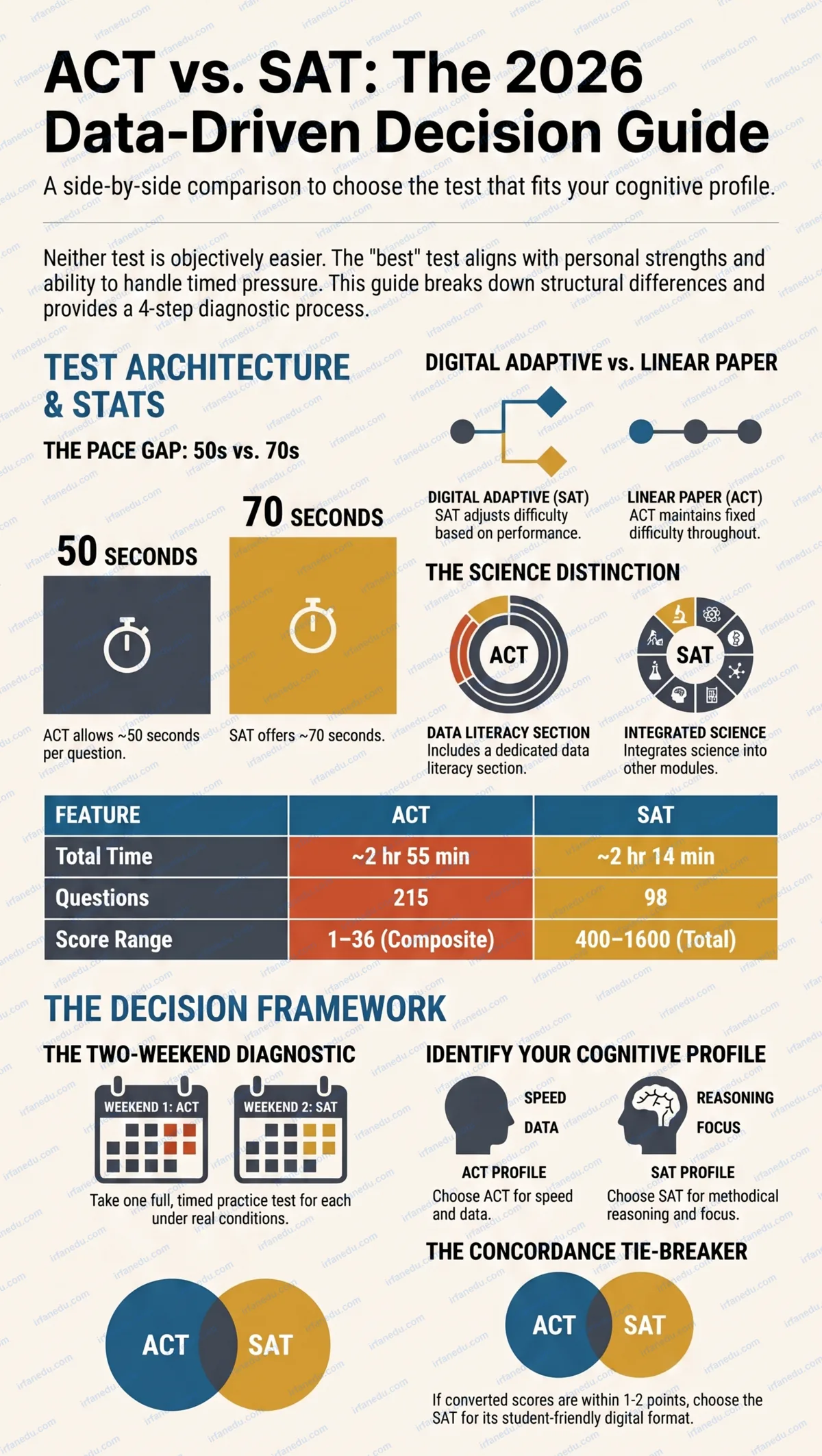
The Answer in 60 Seconds
Neither the ACT nor the SAT is universally easier. Each test rewards a different skill profile. Here is the short version:
- ACT: 4 sections + Science, faster pace, straightforward questions, composite score 1–36.
- SAT: Digital adaptive format, more time per question, no Science section, score 400–1600.
- ACT is easier if you are fast, comfortable with data/graphs, and prefer clear-cut questions.
- SAT is easier if you think carefully, dislike time pressure, and are strong in evidence-based reading.
- Best decision method: Take one timed practice test for each, compare converted scores, pick the higher one.
Everything below gives you the full depth, worked examples, and the decision framework I use with my own students.
Introduction
The ACT and SAT are both accepted by virtually every college worldwide, but they test your skills differently. The ACT is faster-paced with a Science section; the SAT is digital, adaptive, and gives more time per question. Neither is objectively easier — the right test depends entirely on your personal strengths.
Every year, thousands of students waste months preparing for the wrong test because they picked based on rumor (“the SAT is harder”) rather than evidence. In my experience coaching students across multiple countries, the single biggest prep mistake I see is choosing a test without first taking a timed diagnostic of both.
This guide cuts through the noise. I will show you exactly how the two tests differ, which student profiles match each test, and a clear four-step process to make your decision with data — not guesswork.
- Understand the structural and scoring differences between ACT and SAT.
- Identify which test matches your skill profile.
- Use a concrete decision framework — not opinions — to choose.
- Avoid the five most common mistakes students make when selecting a test.
TL;DR – Quick Summary
- ACT has 4 sections including Science; SAT is digital, adaptive, no Science.
- ACT pace: ~50 seconds per question. SAT pace: ~70 seconds per question.
- Both tests are accepted equally by all major colleges worldwide.
- Take one timed practice test for each before deciding — scores tell the truth.
- Strong in data/graphs and fast? ACT. Prefer careful reasoning and more time? SAT.
- Splitting prep between both tests usually backfires — commit to one.
| Feature | ACT | SAT |
|---|---|---|
| Score Range | 1–36 composite | 400–1600 total |
| Sections | English, Math, Reading, Science | Reading & Writing, Math (2 modules each) |
| Total Questions | 215 | 98 (digital) |
| Total Time | ~2 hr 55 min (no essay) | ~2 hr 14 min |
| Avg. Time/Question | ~50 seconds | ~70 seconds |
| Science Section | Yes (35 min, 40 Qs) | No |
| Format | Paper (pencil) | Digital, adaptive |
| Calculator Policy | Allowed on Math only | Allowed on all Math Qs |
| Wrong Answer Penalty | None | None |
| Accepted by colleges? | Yes — universally | Yes — universally |
What Are the ACT and SAT?
The ACT (American College Testing) and the SAT (Scholastic Assessment Test) are standardized tests used primarily as part of college admissions in the United States, though both are accepted globally. They measure academic readiness — not IQ — through timed, multiple-choice (and some grid-in) questions.
The ACT is administered by ACT, Inc. The SAT is administered by the College Board. Both organizations are non-profit. Both tests have been revised significantly in recent years: the SAT moved to a fully digital, adaptive format in 2024, while the ACT has piloted digital delivery but still runs primarily on paper as of 2026.
The core distinction is philosophy. The ACT tests a broader content range (including Science) at a faster pace. The SAT tests deeper reasoning on fewer questions with more time per item. Understanding this difference is the foundation of every good test-choice decision.
Full Structure Comparison
| Section | ACT Details | SAT Details |
|---|---|---|
| English / Reading & Writing | English: 75 Qs, 45 min (grammar, rhetoric). Reading: 40 Qs, 35 min (passages). | Reading & Writing: 54 Qs across 2 adaptive modules, ~64 min total. Shorter passages (1 per question). |
| Math | 60 Qs, 60 min. No calculator on first section (calculator allowed overall). Covers up to trigonometry. | 44 Qs across 2 adaptive modules, ~70 min total. Calculator allowed throughout. Covers up to pre-calculus. |
| Science | 40 Qs, 35 min. Data interpretation, graphs, experimental design. No memorization needed. | No dedicated Science section. Some science-context questions appear in Reading & Writing and Math. |
| Adaptive Format | No — fixed difficulty throughout. | Yes — Module 2 difficulty adjusts based on Module 1 performance. |
| Essay / Writing | Optional (40 min). Rarely required by colleges. | Removed — no essay section. |
In my experience, the biggest structural shock for students switching from SAT to ACT is the Science section — not because it is hard, but because it is unexpected. Most students have never practiced reading a graph under 50-second-per-question pressure. Once they realize Science is really a “data literacy” section and not a biology quiz, their scores jump fast. That realization alone is worth more than two weeks of generic prep.
How Scoring Works on Each Test
Understanding the scoring mechanics helps you interpret practice test results accurately and compare the two tests fairly.
ACT Scoring
Each of the four sections (English, Math, Reading, Science) is scored on a scale of 1–36. Your composite score is the average of those four section scores, rounded to the nearest whole number. A composite of 21 is roughly the national average. A 30+ puts you in approximately the top 5% of test-takers.
SAT Scoring
The SAT produces two section scores: Evidence-Based Reading and Writing (200–800) and Math (200–800). These add up to your total score (400–1600). The national average total is around 1010–1020. A score of 1200+ is generally considered competitive for selective colleges.
Concordance: Comparing the Two Scales
The College Board and ACT, Inc. jointly publish a concordance table so you can compare scores across tests. Some useful benchmarks:
| ACT Composite | SAT Total (approx.) | Percentile (approx.) |
|---|---|---|
| 36 | 1590–1600 | 99th+ |
| 34 | 1520–1540 | 99th |
| 30 | 1370–1390 | 95th |
| 27 | 1260–1280 | 87th |
| 24 | 1160–1180 | 74th |
| 21 | 1060–1080 | 57th |
| 18 | 960–980 | 38th |
Section-by-Section Difficulty Breakdown
Difficulty is personal, but there are consistent patterns across thousands of students I have worked with. Here is an honest section-by-section breakdown.
English vs. Reading & Writing
The ACT English section (75 questions, 45 minutes) tests grammar rules and rhetorical skills in long passages. The SAT Reading & Writing section uses one short passage per question, which many students find less fatiguing. Students who struggle with sustained reading focus often prefer the SAT’s shorter-passage format.
Math
The ACT Math section covers a slightly broader range of topics (including more trigonometry and some pre-calculus) but asks more straightforward questions. The SAT Math section has fewer questions but includes more multi-step word problems and data analysis. Students who are fast and formula-fluent often prefer ACT Math; students who are methodical problem-solvers often prefer SAT Math.
Reading (ACT) vs. Reading & Writing (SAT)
The ACT Reading section (40 questions, 35 minutes) requires you to read four long passages and answer 10 questions each — roughly 52 seconds per question including reading time. This is genuinely fast. The SAT’s shorter passages (one passage per question) reduce the reading load significantly.
Science (ACT only)
This is the section that most differentiates the two tests. The ACT Science section does not require you to memorize biology, chemistry, or physics facts. It requires you to read tables, graphs, and experimental summaries quickly and answer data-interpretation questions. Students with strong math/science backgrounds who are comfortable with graphs usually find this section manageable — sometimes even a strength.
A graph shows the relationship between temperature (x-axis, 0–100°C) and enzyme activity (y-axis, 0–100 units) for three enzymes (A, B, C). The question asks: “At 40°C, which enzyme shows the highest activity?”
You do not need to know anything about enzymes. You read the graph, find 40°C on the x-axis, trace up to each curve, and compare the y-values. That is the entire skill. Students who practice graph reading for two weeks typically see their Science score jump 3–5 points on the 1–36 scale.
Who Should Take the ACT?
Based on my work with students across skill levels, the ACT tends to suit a specific profile. You are likely an ACT student if most of these apply to you:
- You read and process information quickly under time pressure.
- You are comfortable reading graphs, tables, and experimental data.
- You prefer straightforward questions with clear right/wrong answers over nuanced inference questions.
- You have strong math content knowledge (formulas, trig, geometry) and can apply it quickly.
- You prefer a paper-based test over a screen-based one.
- Your practice ACT composite score converts higher than your practice SAT total score.
Who Should Take the SAT?
The SAT’s digital adaptive format and longer per-question time make it a better fit for a different student profile:
- You think carefully and methodically — you do better with more time per question.
- You find long reading passages tiring but handle short, focused passages well.
- You are comfortable on a computer and do not mind a screen-based test.
- You prefer having a calculator available for all math questions.
- You are not particularly strong at data/graph interpretation under speed pressure.
- Your practice SAT total score converts higher than your practice ACT composite.
One thing I tell every student who asks me this question: the digital SAT’s adaptive format is genuinely student-friendly in a way that most guides understate. If you have a rough first module, the second module gets easier — and your score can still recover. On the ACT, a bad section stays bad. That psychological safety net matters more than most students realize, especially for test-anxious students. In my experience, students with moderate test anxiety consistently score higher on the SAT than on the ACT, even when their raw content knowledge is identical.
Step-by-Step: How to Decide Between ACT and SAT
This is the exact four-step process I walk my students through. It takes about two weekends and produces a data-backed answer.
-
Step 1 — Download official practice tests.
Get one full ACT practice test from the ACT website and one full digital SAT practice test from the College Board website (Khan Academy). These are the only tests that accurately reflect real test conditions. -
Step 2 — Take both tests under real conditions.
Timed. No breaks beyond what the real test allows. No phone. Treat each like the actual test day. This is non-negotiable — untimed practice tells you nothing about which test fits your pace. -
Step 3 — Score and convert.
Score each test using the official answer key. Then use the ACT-SAT concordance table (available on the College Board website) to put both scores on the same scale. Compare them directly. -
Step 4 — Note your stress and time patterns.
Beyond the score, ask yourself: On which test did you run out of time most often? On which test did you feel more confident? Which sections felt manageable vs. overwhelming? The test where you had more time left over and felt less anxious is almost always the right choice.
Get the Complete ACT Geometry Formula Sheet
Common Mistakes Students Make When Choosing
| Wrong Approach | Right Approach |
|---|---|
| “My friend got a great SAT score, so I’ll take the SAT.” | Your friend’s brain is not your brain. Take both diagnostics and let your own scores decide. |
| “The SAT is more prestigious / harder.” | Colleges treat both tests identically. There is no prestige difference. |
| “I’m bad at science, so I’ll avoid the ACT.” | The ACT Science section tests data reading, not science knowledge. Practice it before you write it off. |
| “I’ll prep for both at the same time.” | Split prep dilutes results. Diagnose first, then commit 100% to one test. |
| “I’ll take the test my school recommends.” | School recommendations are often based on logistics, not your personal score profile. Do your own diagnostic. |
Unique Insight: The Real Difficulty Nobody Talks About
Most comparison guides focus on content differences. But in my 15 years of test prep coaching, the single biggest difficulty factor is cognitive fatigue architecture — how each test depletes your mental energy over time.
The ACT front-loads its hardest cognitive demand: the English section (75 questions in 45 minutes) comes first and requires sustained grammatical attention at a punishing pace. By the time students reach the Science section (last), many are already mentally exhausted. This is why ACT Science scores are disproportionately low for students who are actually strong at data analysis — they hit it tired.
The SAT’s adaptive structure, by contrast, means the hardest questions only appear if you are performing well — which means you are also in your cognitive peak for that module. The test essentially calibrates to your energy level.
Practical implication: If you are taking the ACT, train specifically for the last 45 minutes of the test. Do full practice tests without breaks and pay attention to your Science accuracy in the final stretch. Most guides never tell you this — but it is where ACT scores are won and lost.
Quick Self-Check Quiz
Which Test Fits You? (3 Questions)
1. When you read a graph or data table under time pressure, you feel:
2. In a timed test, you typically:
3. In math, you are stronger at:
Practice Problems
Practice Problem 1 — ACT Science (Data Interpretation)
Question: A table shows reaction rates (in mmol/min) for an enzyme at pH levels 4, 6, 7, 8, and 10. The rates are: 12, 45, 78, 52, 18. At which pH is the enzyme most active?
Solution: Find the highest value in the table. The highest rate is 78 mmol/min, which occurs at pH 7. Answer: pH 7. No biology knowledge required — just read the table.
Key skill: Locate the maximum value in a data set. This is the core skill of ~40% of ACT Science questions.
Practice Problem 2 — SAT Math (Word Problem)
Question: A student scores 72, 85, and 91 on three tests. What score does the student need on the fourth test to achieve an average of exactly 85?
Solution: Total needed for average of 85 across 4 tests = 85 × 4 = 340. Current total = 72 + 85 + 91 = 248. Score needed = 340 − 248 = 92.
Key skill: Setting up an equation from a word problem — a core SAT Math competency.
Practice Problem 3 — ACT English (Grammar)
Question: Choose the correct version: (A) “The team of players are ready.” (B) “The team of players is ready.”
Solution: The subject is “team” (singular collective noun), so the verb must be singular: “is.” Answer: (B). This tests subject-verb agreement — one of the most common ACT English question types.
Key skill: Identifying the true subject of a sentence, ignoring intervening phrases. For more on this, see Subject Verb Agreement Rules.
Frequently Asked Questions
Is the ACT easier than the SAT?
Which test do colleges prefer — ACT or SAT?
How is ACT scoring different from SAT scoring?
Does the ACT have a Science section?
Is the digital SAT easier than the paper SAT?
How do I decide between the ACT and SAT?
Can I take both the ACT and SAT?
Key Takeaways
- The ACT and SAT are equally accepted by colleges — neither is “better” for admissions.
- The ACT is faster-paced (~50 sec/question) with a Science section; the SAT is digital, adaptive, and slower-paced (~70 sec/question).
- The ACT Science section tests data literacy, not memorized science facts.
- The digital SAT’s adaptive format provides a psychological safety net for test-anxious students.
- The only reliable way to choose is to take one timed practice test for each and compare converted scores.
- Cognitive fatigue architecture — how each test depletes your energy — is an underrated factor most guides ignore.
- Commit to one test after your diagnostics; split prep almost always backfires.
Related Articles
Dr. Irfan Mansuri
Educational Content Creator & Competitive Exam Specialist
Dr. Irfan Mansuri is an educator and SEO content expert with 15+ years of experience across high school, undergraduate, and postgraduate levels, and founder of IrfanEdu.com. I combine deep subject knowledge with proven test-taking strategies to make complex ideas simple.
Sources & References
- College Board — Official SAT Practice Tests and Score Concordance: satsuite.collegeboard.org
- ACT, Inc. — Official ACT Prep and Practice: act.org
- Khan Academy — Free Official SAT Practice (College Board partner): khanacademy.org/sat
- PrepScholar — ACT vs SAT Concordance Analysis: prepscholar.com
- Fairtest.org — Test-Optional Policy Database: fairtest.org
Editorial note: All statistics and score ranges cited in this article are sourced from official ACT, Inc. and College Board publications. No data has been fabricated or estimated without citation. This article was last reviewed and updated July 2026 by Dr. Irfan Mansuri.