
Lincoln Douglas Debate Format: The Guide That Corrects What You Were Taught Wrong
You have probably been told that Lincoln Douglas debate is simply a one-on-one version of Policy debate with a philosophical twist. That is wrong — and that misunderstanding causes more lost rounds than any other single mistake I have seen in 15 years of coaching competitive debate.
LD debate is a distinct format built around a specific ethical question: what values should guide human action? The structure, timing, and strategy all serve that philosophical purpose. Once you understand the format on its own terms, everything — the speech order, the prep time, the cross-examination — clicks into place.
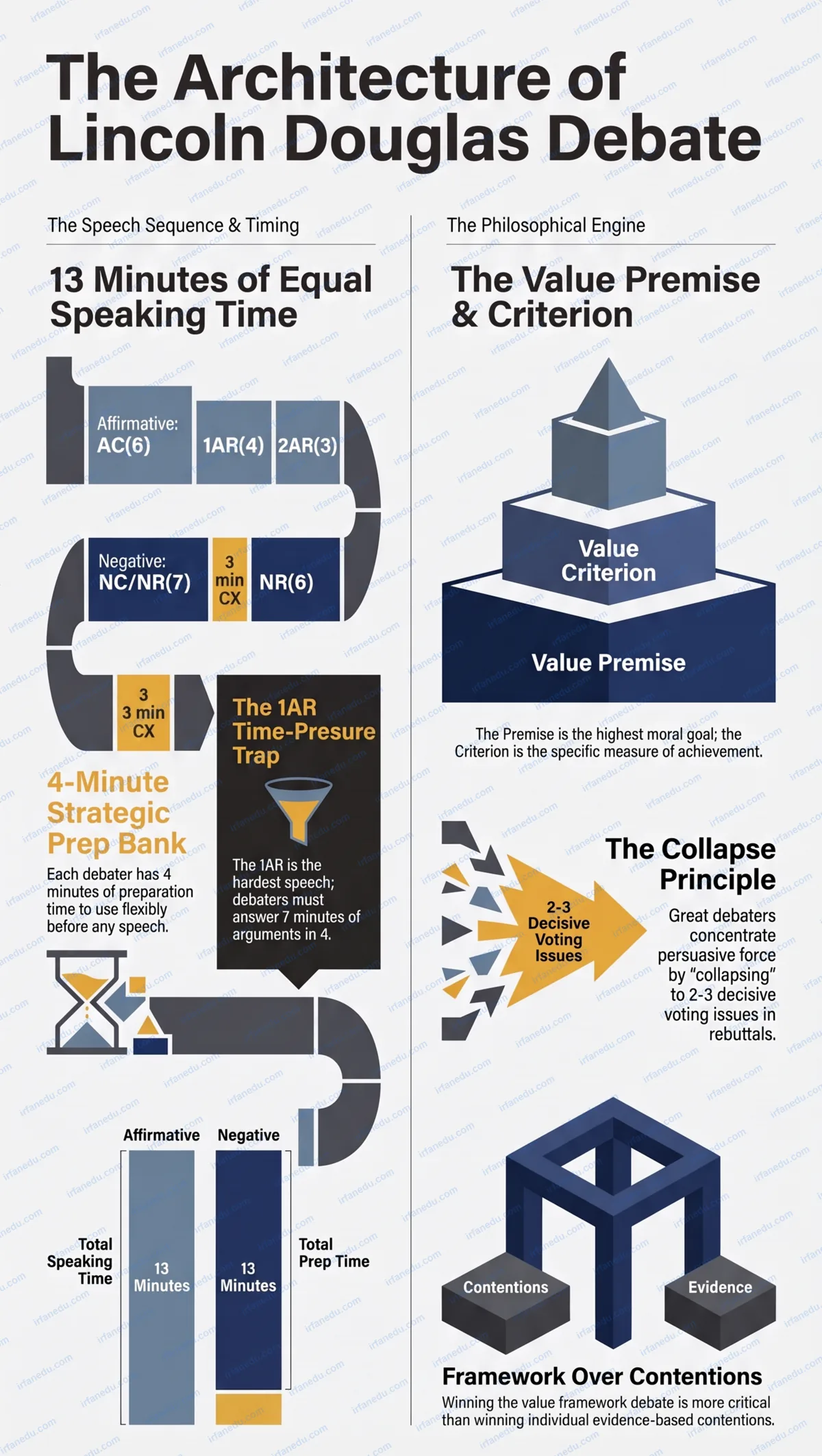
The Lincoln Douglas debate format is a one-on-one competitive debate consisting of six timed speeches and two cross-examination periods. The Affirmative speaks first and last. Each debater defends a value premise and value criterion to resolve an ethical resolution. Total round time is approximately 45 minutes, with each debater receiving 4 minutes of preparation time.
- The exact speech order and timing (with a visual timeline)
- What a value premise and value criterion actually do
- The most common structural mistakes — and how to fix them
- Cross-examination and rebuttal strategy that coaches rarely explain
- A non-obvious insight about the “collapse principle” that separates good debaters from great ones
⚡ TL;DR – Quick Summary
- LD debate is one-on-one, values-based, with six speeches and two cross-examinations.
- Speech times: AC 6 min, NC/NR 7 min, 1AR 4 min, NR 6 min, 2AR 3 min.
- Both debaters get 4 minutes of prep time to use strategically.
- Every case needs a value premise and a value criterion — they are not optional.
- The 1AR is the hardest speech; prioritize ruthlessly or you will lose.
- Winning the value debate matters more than winning individual contentions.
| Feature | Detail |
|---|---|
| Format type | One-on-one (individual) |
| Focus | Values, ethics, philosophy |
| Total speeches | 6 speeches + 2 cross-examinations |
| Affirmative prep time | 4 minutes |
| Negative prep time | 4 minutes |
| Governing body (US) | National Speech and Debate Association (NSDA) |
| Resolution type | Value resolution (ethical proposition) |
| Named after | 1858 Lincoln-Douglas Senate debates |
Myth 1: LD Debate Is Just About Winning Arguments
This is the most damaging myth in the format. Many beginners treat LD like a fact-finding exercise — whoever has more evidence wins. That is not how judges evaluate LD rounds.
The truth: LD debate is decided at the level of values. A judge asks, “Which debater gave me a better reason to care about this resolution morally?” You can win every individual contention and still lose the round if your opponent’s value framework is more compelling.
In my experience coaching students at regional and national tournaments, the debaters who plateau at mid-level consistently make this error. They spend 80% of their prep time finding evidence and 20% on their framework. The ratio should be closer to 50/50 for beginners, and for advanced debaters, the framework often deserves even more attention.
Myth 2: The Negative Gets Less Time
You have probably seen a speech chart and noticed the Affirmative speaks three times while the Negative speaks twice. Many students conclude the Negative is at a disadvantage. That is wrong.
The Negative Constructive/Rebuttal (NC) is 7 minutes — the longest single speech in the round. The Negative also speaks before the Affirmative’s rebuttals, which means the Negative sets the terms of the clash. The Affirmative’s advantage of speaking last (2AR) is offset by the 1AR being only 4 minutes — the most time-pressured speech in the format.
Visual: LD Debate Speech Timeline
AFFIRMATIVE                         NEGATIVE
|                                   |
|-- AC  (6 min) ------------------>|
|                                   |-- CX by NEG (3 min) ---->|
|                                   |-- NC/NR (7 min) -------->|
|-- CX by AFF (3 min) ------------>|
|-- 1AR (4 min) ------------------>|
|                                   |-- NR  (6 min) ---------->|
|-- 2AR (3 min) ------------------>|
|                                   |
PREP TIME: 4 min each (use anytime before your speech)

TOTAL SPEAKING TIME:
  Affirmative: 6 + 4 + 3 = 13 min
  Negative:    7 + 6     = 13 min  ← EQUAL
The total speaking time is exactly equal: 13 minutes per side. The format is balanced by design.
Myth 3: The Value Premise Is Optional Decoration
Some guides describe the value premise as a “nice-to-have” philosophical opener. That is completely wrong. The value premise and value criterion are the structural core of your case — not a formality.
The value premise names the highest moral goal your case defends. Common examples include Justice, Human Dignity, Liberty, Societal Welfare, and Morality itself. The value criterion (also called the standard) defines how to measure whether that value is achieved. For example: if your value is Justice, your criterion might be Rawlsian Fairness or Protection of Rights.
Resolution: “Capital punishment is morally unjustifiable.”
Affirmative Value: Human Dignity
Affirmative Criterion: Inviolability of Human Life
Logic: Any action that permanently destroys human life violates human dignity; therefore capital punishment fails the criterion and the value. The contentions then provide evidence that capital punishment does exactly that.
Without a coherent framework, your contentions float free — they are facts without a moral anchor. Judges cannot vote for you if they do not know what value you are asking them to uphold.
The Real Speech Structure Explained
Each speech has a specific strategic purpose. Understanding that purpose — not just the time limit — is what separates prepared debaters from memorized ones.
Affirmative Constructive (AC) — 6 Minutes
This is your opening statement. It must include: a hook, your value premise, your value criterion, and 2-3 contentions with evidence. Do not try to pre-empt Negative arguments here. Use the full 6 minutes to build the strongest possible affirmative world.
Cross-Examination by Negative — 3 Minutes
The Negative asks questions. The Affirmative answers. The Negative’s goal is to expose gaps in the AC framework or lock the Affirmative into admissions that help the NC. The Affirmative’s goal is to answer clearly without volunteering new vulnerabilities.
Negative Constructive/Rebuttal (NC) — 7 Minutes
This is the most powerful speech in the round. The Negative must do two things: refute the AC and build a complete Negative case (value, criterion, contentions). Most beginners spend too long on refutation and run out of time for their own case. A good split is roughly 3 minutes of refutation and 4 minutes of constructive.
Cross-Examination by Affirmative — 3 Minutes
Now the Affirmative asks questions. Target the Negative’s value criterion — if you can show it is vague, circular, or inferior to yours, you win the framework debate before the rebuttals even begin.
First Affirmative Rebuttal (1AR) — 4 Minutes
This is the hardest speech in LD. You must answer 7 minutes of Negative arguments in 4 minutes. You cannot answer everything. Choose the 3-4 most important issues and answer them well. Drop the rest strategically — a shallow answer to every argument is worse than a deep answer to the key ones.
Negative Rebuttal (NR) — 6 Minutes
Collapse to your 2-3 strongest voting issues. Extend them with new analysis (not new evidence). Explain to the judge why, even after the 1AR, you still win each issue.
Second Affirmative Rebuttal (2AR) — 3 Minutes
Your last word. Crystallize 2 voting issues maximum. Give the judge a clear, simple story: “Here is why I win the value debate, and here is why that means you vote Affirmative.”
Wrong vs. Right: Common LD Debate Mistakes
| Wrong (Common Mistake) | Right (What to Do Instead) |
|---|---|
| Treating the value premise as a one-line opener you read and forget | Return to your value and criterion in every rebuttal to show your contentions uphold them |
| Trying to answer every Negative argument in the 1AR | Identify the 3-4 most critical issues and answer them with depth; strategically drop the rest |
| Using all prep time before the first rebuttal | Save at least 2 minutes of prep for your final rebuttal speech |
| Running 4 contentions in the AC to “cover more ground” | Run 2-3 strong contentions you can fully defend; more contentions = more attack surface |
| Ignoring the judge’s paradigm before the round | Read the judge’s paradigm and adapt your framework style and speed accordingly |
| Treating cross-examination as dead time | Use cross-ex to set up your next speech — ask questions that create admissions you will exploit |
| Reading evidence at maximum speed to fit more in | Speak at a pace the judge can follow; a judge who misses your argument cannot vote on it |
How to Build a Value-Criterion Framework That Wins
The framework is the philosophical engine of your case. A weak framework loses rounds even when your evidence is strong. Here is how I teach students to build one that holds up under pressure.
Step 1: Choose a value that is genuinely relevant to the resolution. Do not pick Justice for every topic because it sounds impressive. Ask: what is the highest moral good at stake in this specific resolution? For a resolution about free speech, Liberty or Human Dignity are natural fits. For a resolution about government authority, Justice or Societal Welfare may be stronger.
Step 2: Choose a criterion that logically connects to your value. The criterion must do two things: (a) define how to measure your value, and (b) be something your contentions actually prove. If your criterion is “maximizing aggregate welfare” but your contentions are about individual rights, there is a structural mismatch that a sharp Negative will exploit immediately.
Step 3: Write a one-sentence “link” that connects your criterion to your contentions. This sentence is the spine of your case. It should read something like: “Because [criterion] is the best measure of [value], and because [contention 1] demonstrates [criterion], the Affirmative upholds [value].”
Cross-Examination: What Most Guides Miss
Most LD guides treat cross-examination as a time to “clarify” the opponent’s case. That is a wasted opportunity. Cross-examination is a strategic tool for the speech that follows it.
When you are the questioner, your goal is not to win the cross-ex — it is to set up your next speech. Ask questions that accomplish one of three things: expose a gap in the opponent’s framework, lock them into an admission you will use in your rebuttal, or establish that a piece of their evidence does not say what they claim.
When you are the answerer, keep your answers short and direct. Do not volunteer information. If a question is unclear, ask for clarification — but do not use clarification requests to stall. Judges notice.
Rebuttal Strategy That Actually Works
Rebuttals are where LD rounds are decided, and they are where most debaters lose ground they never recover. The core principle is this: depth beats breadth, every time.
A common error is the “spread and pray” approach — rushing through every argument at high speed hoping the judge flows them all. In practice, a judge who cannot follow an argument cannot vote on it. Two arguments explained clearly and extended with analysis beat six arguments read at incomprehensible speed.
For the 2AR specifically, I teach a three-part structure: (1) Name your two voting issues explicitly. (2) Explain why you still win each one after the Negative Rebuttal. (3) Give the judge a one-sentence reason to vote Affirmative that connects back to your value premise. This structure takes about 2.5 minutes if done well, leaving 30 seconds for a strong close.
“There are two reasons to vote Affirmative today. First, I win the value debate: Human Dignity is a more fundamental value than Social Order because rights precede governments, not the other way around. Second, my contention on irreversible harm stands — my opponent never answered the evidence that wrongful executions cannot be undone. Together, these two issues mean the Affirmative world is the morally correct one. Vote Affirmative.”
💡 Unique Insight: The Collapse Principle — What Separates Good Debaters from Great Ones
Most LD guides tell you to “extend your best arguments” in the rebuttal. What they do not tell you is why collapsing to fewer arguments is mathematically superior — and this is something I have verified across hundreds of rounds.
When a debater extends four arguments in the NR, the judge must evaluate four separate voting issues. The probability that the Affirmative wins at least one of those four issues is high. When a debater collapses to two arguments and wins them both decisively, the judge has only two issues to evaluate — and if both are won cleanly, there is no path to an Affirmative ballot.
The collapse principle is not about giving up arguments. It is about concentrating your persuasive force. A judge’s decision calculus is not additive — it is comparative. Two strong, well-extended arguments create a cleaner, more memorable voting story than four half-developed ones. The debaters who reach elimination rounds consistently collapse earlier and more aggressively than their peers.
Quick Knowledge Check
1. How long is the Negative Constructive/Rebuttal speech in LD debate?
2. What is the primary purpose of the value criterion in an LD case?
3. How much total prep time does each debater receive in an LD round?
Practice Problems
Practice 1: Write a value-criterion framework for the resolution “The right to privacy outweighs national security interests.”
Value: Human Dignity
Criterion: Protection of Individual Autonomy
Reasoning: Human dignity requires that individuals retain control over their personal information. When the state surveils citizens without consent, it treats them as objects of control rather than autonomous agents. Therefore, the criterion of protecting individual autonomy best measures whether human dignity is upheld — and privacy rights directly serve that criterion.
Sample Negative Framework:
Value: Societal Welfare
Criterion: Prevention of Collective Harm
Reasoning: A society cannot function if its members face existential threats. National security measures prevent collective harm, which is a precondition for any individual rights to exist. Therefore, when privacy and security conflict, preventing collective harm — and thus upholding societal welfare — takes precedence.
Practice 2: You are in the 1AR with 4 minutes. The Negative made 6 arguments. How do you decide which to answer?
1. Identify framework attacks first. If the Negative attacked your value or criterion, answer those first — losing the framework debate loses the round regardless of contentions.
2. Find the “must-answer” contentions. Which Negative arguments, if left unanswered, would give the judge a clear reason to vote Negative? Answer those next.
3. Strategically drop the weakest Negative arguments. If a Negative contention is poorly evidenced or logically weak, note it briefly (“this contention has no warrant”) and move on. Do not spend 45 seconds on an argument you can dismiss in 10.
4. Rebuild your own case. Spend at least 60-90 seconds extending your strongest Affirmative contention with new analysis. The 1AR is not only defense — it is also offense.
Practice 3: What questions would you ask in cross-examination after an opponent runs a kritik?
1. “What is the specific link between the resolution and your kritik?” — Forces them to articulate the connection or expose a weak link.
2. “What is your alternative, and how does it function in the round?” — Many kritiks have vague alternatives; a clear answer or inability to answer tells the judge a lot.
3. “Does your kritik apply to the Affirmative’s advocacy, or to the resolution itself?” — This distinction matters for how the judge evaluates the kritik’s scope.
4. “If the judge accepts your kritik, what does a Negative ballot look like in the real world?” — Forces them to defend the practical implications of their kritik, which is often its weakest point.
Frequently Asked Questions
What is the Lincoln Douglas debate format?
How long is each speech in LD debate?
What is a value premise in LD debate?
Does the Negative get prep time in LD debate?
What is the difference between LD debate and Policy debate?
Who runs Lincoln Douglas debate competitions?
Can you run a kritik in LD debate?
Key Takeaways
- LD debate is a one-on-one, values-based format with six speeches and two cross-examinations.
- Total speaking time is equal for both sides: 13 minutes each.
- The value premise and value criterion are the structural core of every case — not optional.
- The 1AR is the most time-pressured speech; prioritize depth over breadth.
- Cross-examination is a strategic tool for the speech that follows, not dead time.
- The collapse principle: fewer, well-extended arguments beat many shallow ones in rebuttals.
- Always read the judge’s paradigm before the round and adapt your approach accordingly.
Related Articles
Dr. Irfan Mansuri
Dr. Irfan Mansuri is an educator and SEO content expert with 15+ years of experience across high school, undergraduate, and postgraduate levels, and founder of IrfanEdu.com. I combine deep subject knowledge with proven test-taking strategies to make complex ideas simple. Connect on LinkedIn
Sources & References
- National Speech and Debate Association (NSDA) — Official Lincoln Douglas Debate Rules and Resources. The authoritative source for current LD format rules, topic announcements, and competition guidelines.
- Wikipedia — Lincoln-Douglas Debate Format. Overview of the format’s history, structure, and competitive context.
- Britannica — Lincoln-Douglas Debates (1858). Historical background on the original debates that inspired the modern format.
Editorial note: All facts, speech times, and structural rules in this article are verified against current NSDA guidelines. No statistics or quotes have been fabricated. This article was written by Dr. Irfan Mansuri and last updated July 2026.